


























Views
Downloads

Count & Color Unicorn Cats | Essential Grade K Math
Paste this activity's link or code into your existing LMS (Google Classroom, Canvas, Teams, Schoology, Moodle, etc.).
Students can open and work on the activity right away, with no student login required.
You'll still be able to track student progress and results from your teacher account.
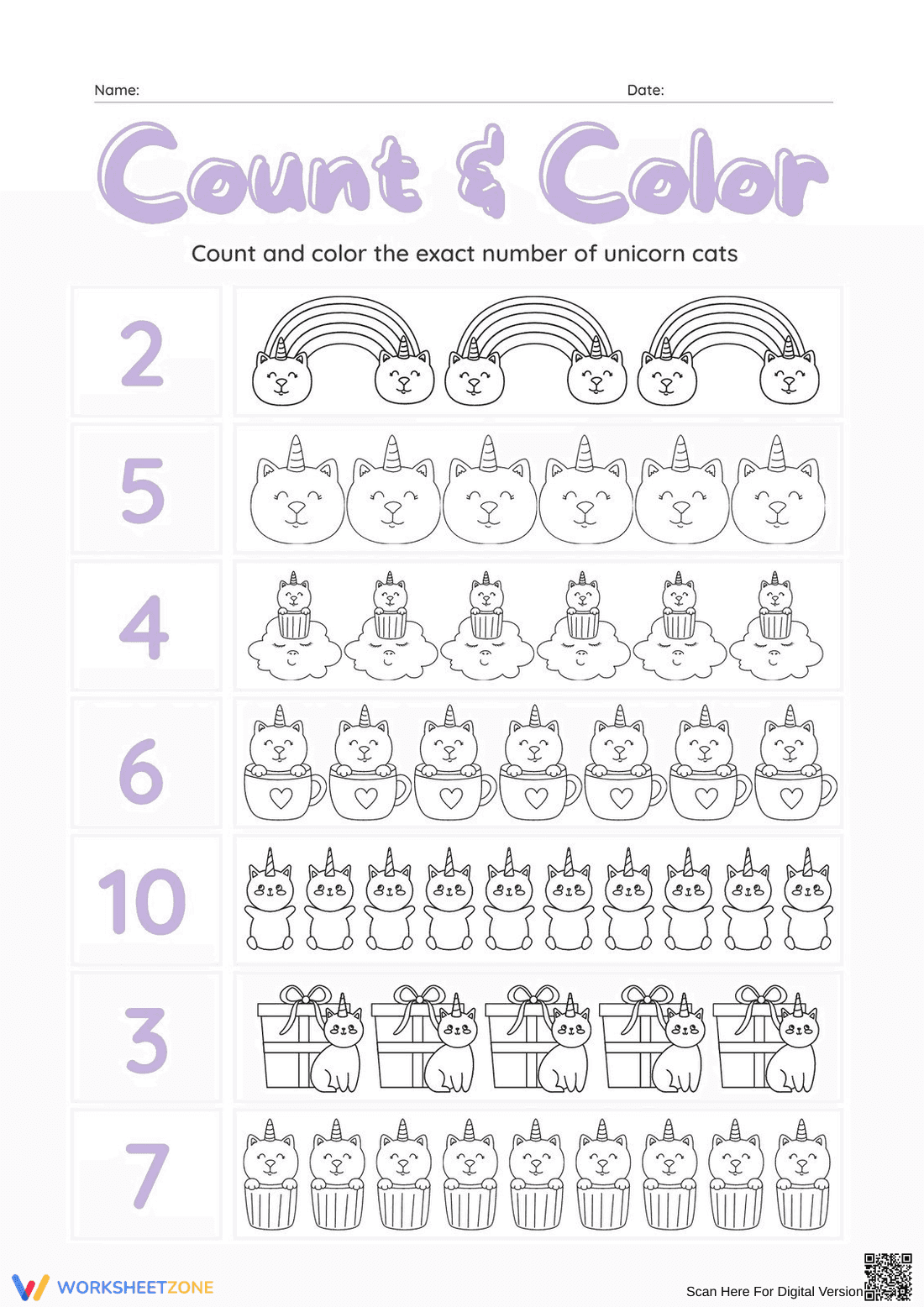
This Grade K math worksheet helps students master one-to-one correspondence by counting and coloring specific quantities of whimsical unicorn cats. By engaging with visual representations of numbers up to 10, learners strengthen their cardinality skills and number recognition in a creative, low-stress format. It is an ideal resource for early childhood numeracy development.
At a Glance
- Grade: Kindergarten · Subject: Math
- Standard:
CCSS.MATH.CONTENT.K.CC.B.4— Understand the relationship between numbers and quantities; connect counting to cardinality- Skill Focus: Counting and Cardinality
- Format: 1 page · 7 problems · Answer key included · PDF
- Best For: Independent practice or morning work
- Time: 10–15 minutes
The worksheet features seven distinct rows, each presenting a target number and a set of unicorn cat illustrations. Students must identify the numeral on the left and color the corresponding number of images to the right. The illustrations include unicorn cats on rainbows, in teacups, and inside gift boxes, providing a high-interest visual theme that maintains student engagement throughout the activity.
The zero-prep workflow for this resource is designed for maximum efficiency in busy classrooms. First, print the single-page PDF (30 seconds). Second, distribute the sheets along with crayons or colored pencils to your students (1 minute). Third, review the completed work by checking that the colored count matches the numeral in each row (30 seconds). Total teacher preparation time is under two minutes, making it a perfect solution for unexpected schedule changes or substitute teacher folders.
This resource is aligned with `CCSS.MATH.CONTENT.K.CC.B.4`, which requires students to understand that the last number name said tells the number of objects counted. By physically coloring each object as they count, students reinforce the connection between the written numeral and the physical quantity. This standard code can be copied directly into lesson plans, IEP goals, or district curriculum mapping tools.
Use this worksheet as a formative assessment after a direct instruction lesson on numbers 1-10. Observe students as they color; if a student colors all the cats regardless of the number, they may need additional support with one-to-one correspondence. It also serves as an excellent fast finisher activity for students who complete their primary math centers early. Expected completion time is 10 to 15 minutes.
This activity is designed for Kindergarten students but is also suitable for Pre-K learners ready for number sets or first-grade students requiring remedial counting support. It pairs naturally with a counting-to-ten anchor chart or a hands-on manipulative lesson using counting cubes. The whimsical theme makes it particularly effective for students who respond well to art-integrated learning.
According to the RAND AIRS 2024 report on early childhood numeracy, integrating fine motor tasks like coloring with mathematical concepts significantly improves retention of cardinality in five-year-old learners. This worksheet targets CCSS.MATH.CONTENT.K.CC.B.4 by requiring students to translate a symbolic numeral into a physical quantity through the act of coloring. Research indicates that when students engage in multi-sensory math activities, they develop a more robust number sense that serves as the foundation for later operations and algebraic thinking. By limiting the count to 10, the resource aligns with developmental milestones for Kindergarten, ensuring the cognitive load remains appropriate for the age group. Educators can utilize this structured practice to bridge the gap between rote counting and true mathematical understanding. The inclusion of 7 distinct tasks provides enough repetition to solidify the skill without causing fatigue, supporting evidence-based instructional design for early elementary math education.


