


























Views
Downloads

Count Back Across 10 Worksheet | Grade 1 Ready
Paste this activity's link or code into your existing LMS (Google Classroom, Canvas, Teams, Schoology, Moodle, etc.).
Students can open and work on the activity right away, with no student login required.
You'll still be able to track student progress and results from your teacher account.
This Grade 1 touch dot subtraction worksheet builds student fluency with counting back across ten when subtracting within 20. By pairing visual touch points with visual sequence boxes and number lines, early learners systematically decompose subtraction problems, bridge the benchmark number 10, and accurately calculate differences without relying on rote memorization.
At a Glance
- Grade: 1 · Subject: Math
- Standard:
CCSS.MATH.CONTENT.1.OA.C.6— Subtract within 20 by counting back and bridging across ten- Skill Focus: Touch dot subtraction counting back across 10
- Format: 2 pages · 16 problems · Answer key included · PDF
- Best For: Guided math and targeted intervention
- Time: 15–20 minutes
What's Inside
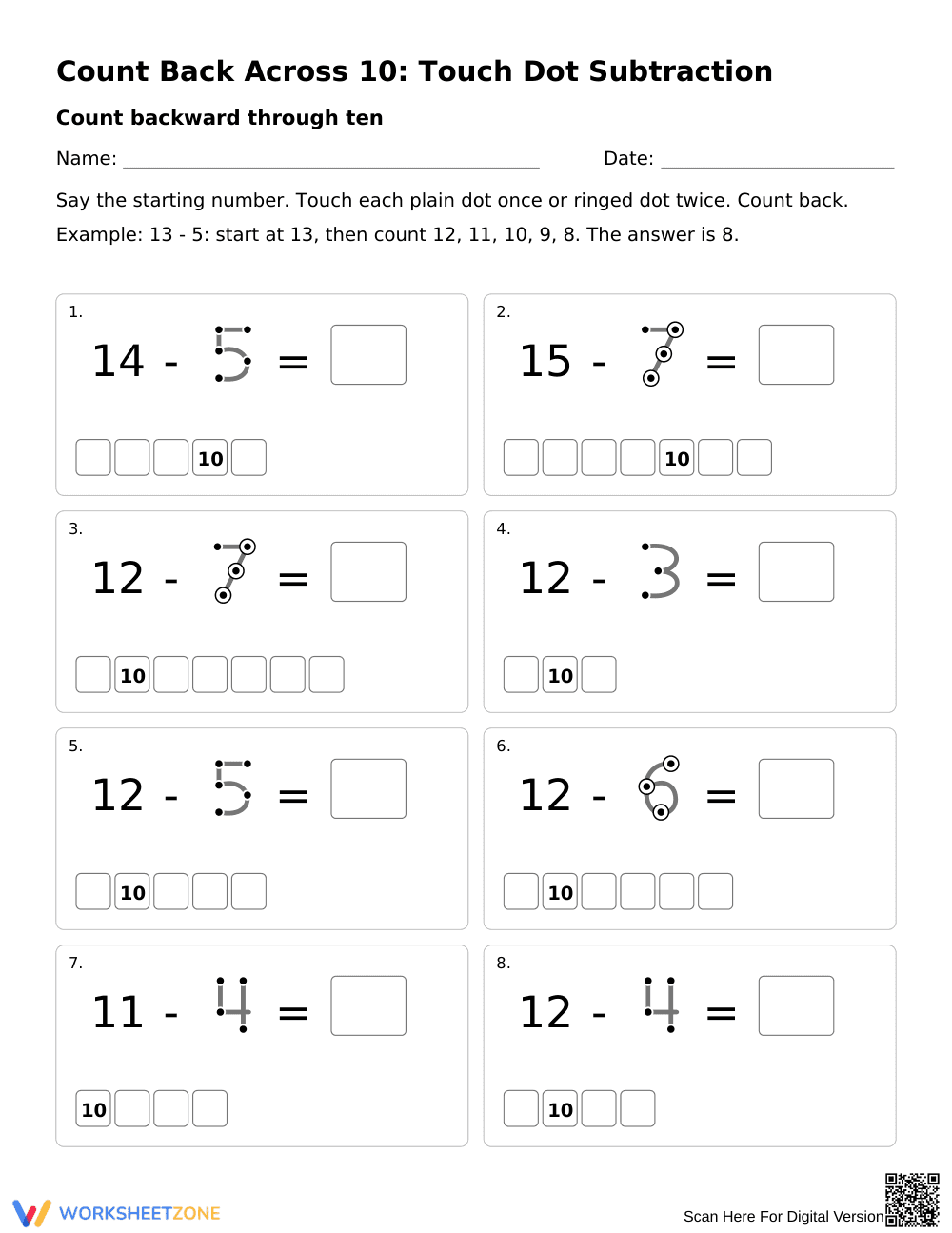
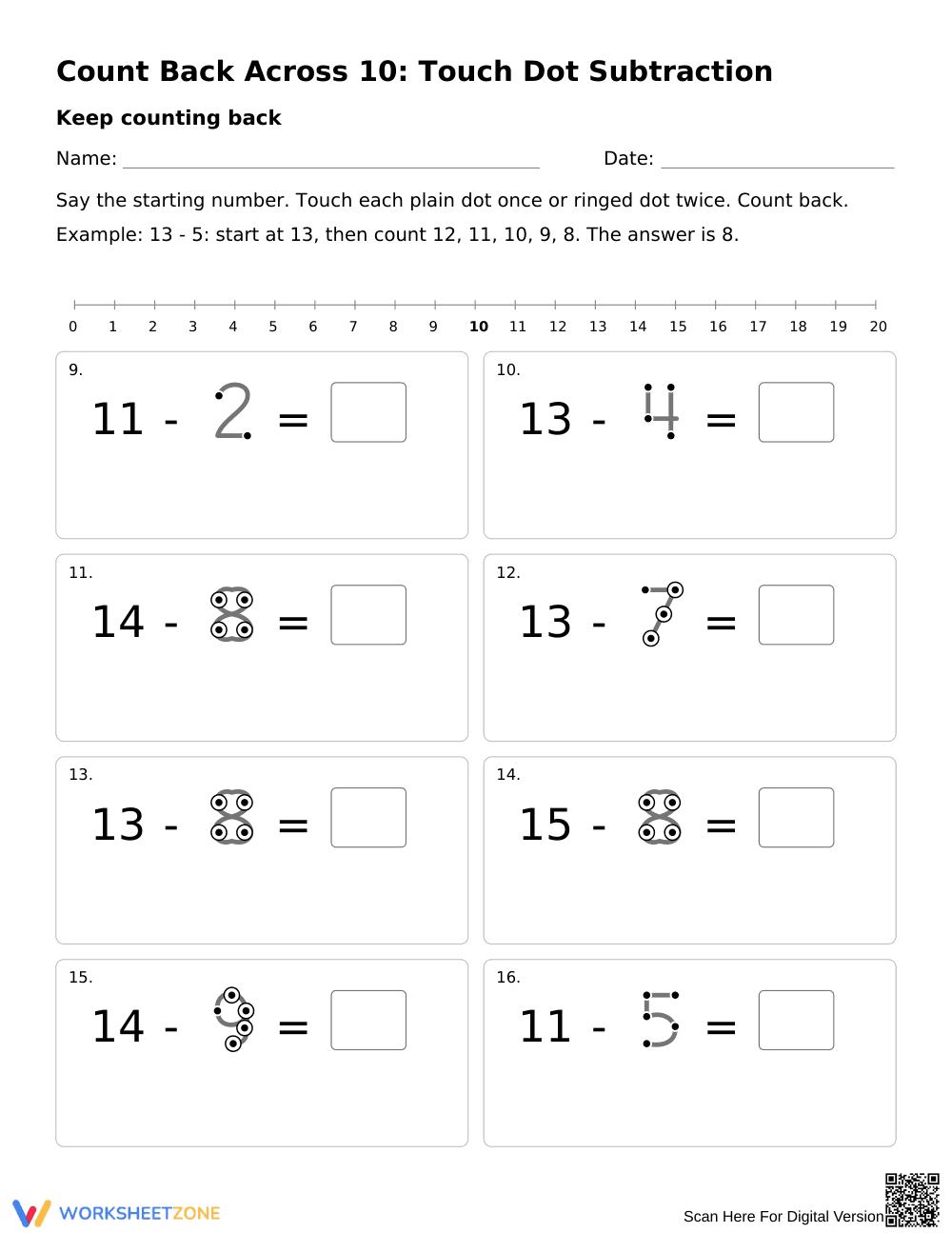
This 2-page printable resource contains 16 subtraction problems involving single-digit subtrahends from teen numbers. Page 1 features 8 problems equipped with touch dots on subtrahends alongside step-by-step sequence boxes anchored by the benchmark number 10. Page 2 provides 8 additional equations supported by a 0 to 20 number line. A complete 1-page answer key detailing the full countdown sequences for tasks 1 through 8 is included for rapid grading.
Skill Progression
- Guided practice (Problems 1–8): Students utilize touch dots alongside explicit step-by-step boxes that scaffold the countdown path directly through 10.
- Supported practice (Problems 9–12): Touch dots remain on the subtrahend while scaffold boxes fade, prompting learners to reference the top number line to bridge across ten independently.
- Independent practice (Problems 13–16): Students solve complex teen subtraction problems using touch dot counting strategies with reduced visual scaffolding to solidify mental math transitions.
This structured setup follows a gradual-release architecture (I Do, We Do, You Do) to build confidence when navigating subtraction across ten.
Standards Alignment
This worksheet directly aligns with CCSS.MATH.CONTENT.1.OA.C.6: Add and subtract within 20, demonstrating fluency for addition and subtraction within 10, utilizing strategies such as counting back and decomposing numbers leading to a ten. This standard code can be copied directly into lesson plans, IEP goals, or district curriculum mapping tools.
How to Use It
Deploy this activity during small-group instruction after introduce-the-ten-frame lessons. Give students 15 to 20 minutes to work through both pages. During practice, observe whether students touch ringed dots twice to accurately count back two steps per double dot; if a student skips 10 in their sequence, redirect them to the benchmark box on page 1.
Who It's For
Designed for first-grade students developing fluency with single-digit subtraction from teen numbers. It is especially beneficial for tactile and visual learners, intervention groups, and special education students requiring touch-point scaffolds. Pair this page with base-ten blocks or a giant floor number line for additional concrete support.
According to research highlighted in Fisher & Frey (2014), gradual release of responsibility models combined with explicit tactile visual scaffolds significantly improve early numeracy acquisition and arithmetic retention. This Grade 1 mathematics resource targets standard CCSS.MATH.CONTENT.1.OA.C.6 by guiding young learners through touch dot subtraction to master counting back across the benchmark number 10. By pairing multi-sensory touch points with structured sequence boxes and a 0 to 20 number line, 16 targeted math tasks move students from concrete sensory input to abstract numerical thinking. Educational evaluations from EdReports 2024 confirm that embedding visual anchor points like tens-benchmarks reduces cognitive load during multi-step mental arithmetic. Consequently, students transition smoothly from counting single units to strategic visual decomposition, establishing a strong foundational pathway for place-value comprehension and second-grade multi-digit subtraction skills.


