


























Views
Downloads



Grade K Counting 1-5 — Printable No-Prep Worksheet
Paste this activity's link or code into your existing LMS (Google Classroom, Canvas, Teams, Schoology, Moodle, etc.).
Students can open and work on the activity right away, with no student login required.
You'll still be able to track student progress and results from your teacher account.
Description
This worksheet provides focused practice for Kindergarten students on the foundational skill of counting and matching numbers 1 through 5. Through a series of clear and simple exercises, learners will strengthen their one-to-one correspondence and number recognition, building a crucial base for future math concepts. It's a straightforward tool for reinforcing early numeracy and can be used in a variety of classroom settings.
At a Glance
- Grade: Kindergarten · Subject: Math
- Standard:
CCSS.MATH.CONTENT.K.CC.B.4— Understand the relationship between numbers and quantities.- Skill Focus: Counting objects and matching to numerals 1-5
- Format: 4 pages · 11 problems · Answer key included · PDF
- Best For: Independent practice, math centers, or homework
- Time: 10–15 minutes
What's Inside
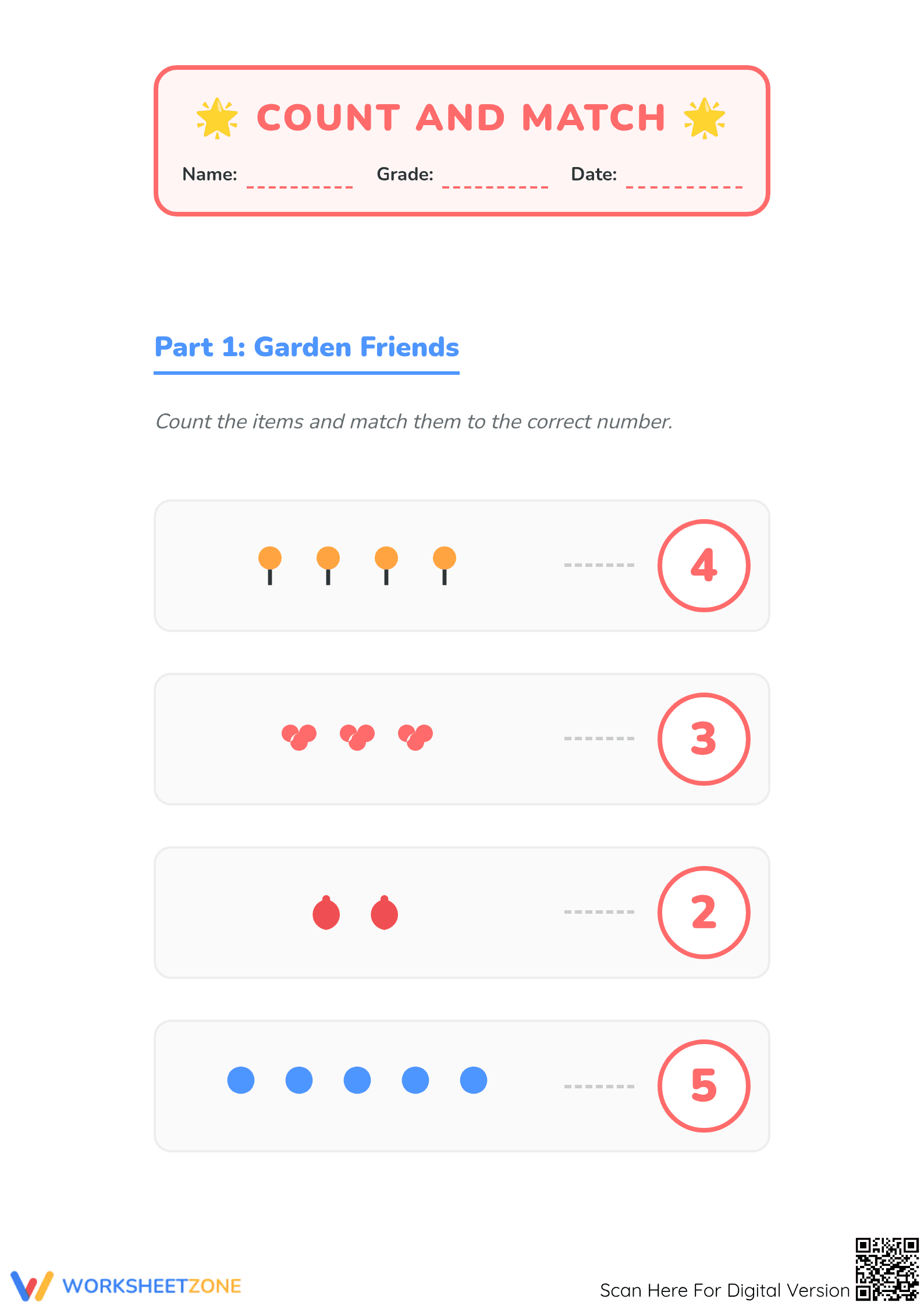
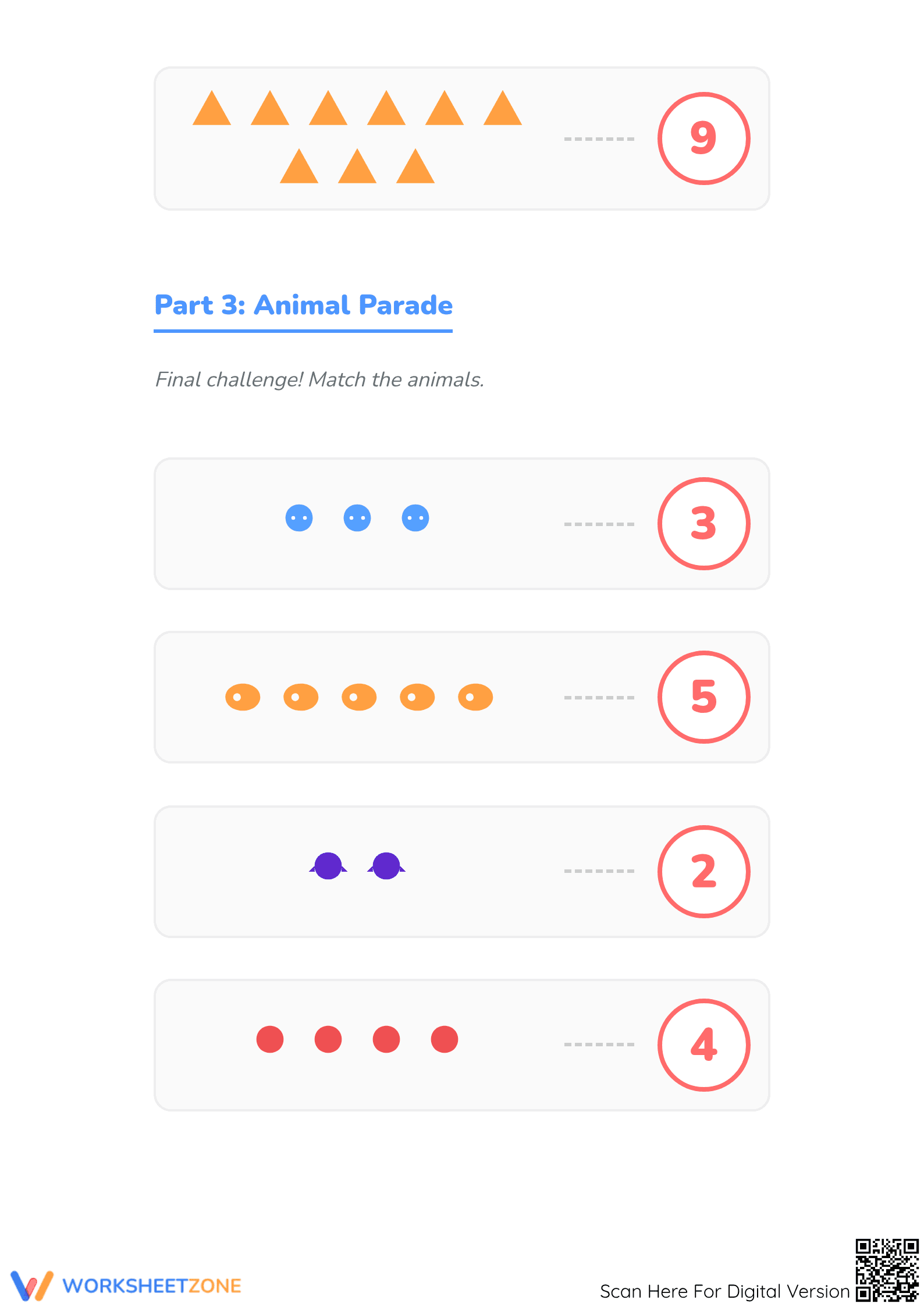
This four-page PDF contains three pages of student exercises with 11 distinct 'count and match' tasks. Students count groups of themed objects (like stars, pencils, and apples) and connect the group to the correct numeral from 1 to 5. A final page provides a complete answer key, allowing for quick and efficient checking by teachers, parents, or peers, which supports immediate feedback and self-assessment.
Zero-Prep Workflow
This worksheet is designed for a seamless zero-prep workflow:
- 1. Print (30 seconds): The PDF is formatted for immediate printing. Just open the file and print the three student-facing pages, either single-sided or double-sided.
- 2. Distribute (1 minute): Hand out the worksheets for individual work at desks, in a small group setting, or as part of a math center rotation.
- 3. Review (5 minutes): Use the included answer key to rapidly review student work, provide targeted feedback, or empower students to check their own answers.
It's an ideal resource for substitute plans, morning work, or last-minute reinforcement.
Standards Alignment
This worksheet is directly aligned with the Common Core State Standard CCSS.MATH.CONTENT.K.CC.B.4, which requires students to "Understand the relationship between numbers and quantities; connect counting to cardinality." The tasks give students direct practice in understanding that the last number name said tells the number of objects counted. Both the standard code and its description can be copied directly into lesson plans, IEP goals, or district curriculum mapping tools.
How to Use It
Use this worksheet as independent practice following a direct instruction lesson on counting principles. It serves as an excellent tool for a math center activity where students can work at their own pace. For formative assessment, observe if a student touches each object as they count, which demonstrates crucial one-to-one correspondence. Completion time is typically 10-15 minutes, making it a perfect short, focused task to gauge understanding without causing fatigue.
Who It's For
This resource is designed for Pre-K, Kindergarten, and early Grade 1 students who are developing their initial counting skills. The clear, uncluttered layout with large, simple images is beneficial for all learners, including those who need minimal distractions to focus. It pairs well with hands-on manipulatives, like counting bears or blocks, allowing students to physically represent the numbers before completing the paper-and-pencil task to connect concrete to abstract.
Reinforcing early numeracy skills like one-to-one correspondence is critical for long-term mathematical success. This worksheet targets standard CCSS.MATH.CONTENT.K.CC.B.4, which focuses on connecting counting to cardinality. A strong foundation in early number sense is a key predictor of later achievement, as noted in the RAND AIRS 2024 analysis of early learning trajectories. The 11 structured problems in this resource provide the deliberate practice needed to solidify this understanding, ensuring students grasp that the number they say last represents the total quantity. This builds the conceptual framework for more complex operations, making it an essential and effective practice tool.


