




























Views
Downloads

Printable Count and Color to 10 Worksheet | Grade K Math

Paste this activity's link or code into your existing LMS (Google Classroom, Canvas, Teams, Schoology, Moodle, etc.).
Students can open and work on the activity right away, with no student login required.
You'll still be able to track student progress and results from your teacher account.
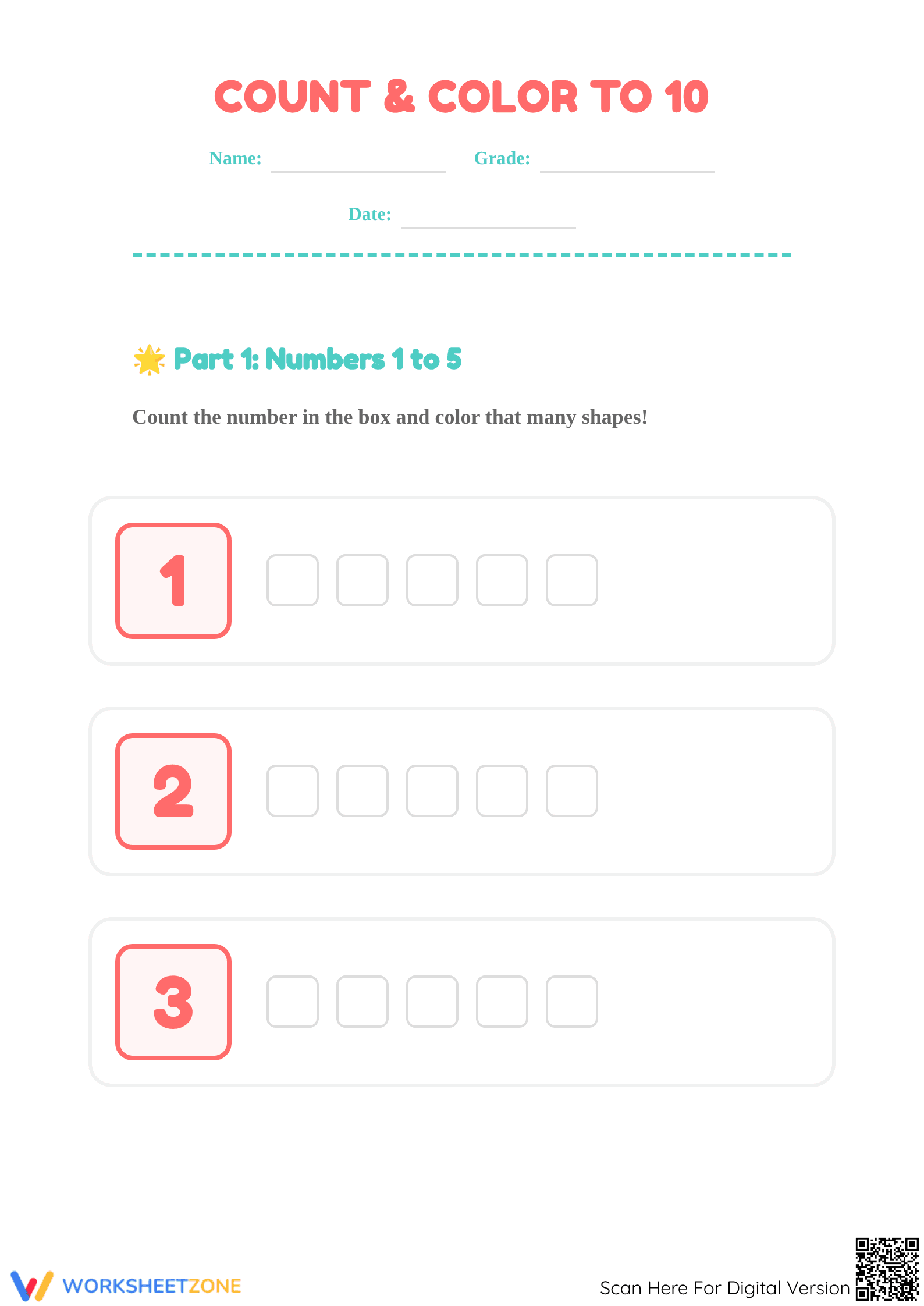
This foundational math worksheet helps early learners master counting and number recognition for values one through ten. By combining visual counting with fine motor coloring tasks, students build a concrete understanding of cardinality and one-to-one correspondence. This resource ensures young mathematicians can confidently identify digits and represent their quantities through engaging, hands-on practice.
At a Glance
- Grade: K · Subject: Math
- Standard:
K.CC.B.4— Match sets of objects to the correct numeral up to 10- Skill Focus: Counting to 10 and one-to-one correspondence
- Format: 3 pages · 12 problems · Answer key included · PDF
- Best For: Kindergarten morning work or math centers
- Time: 15–20 minutes
What's Inside
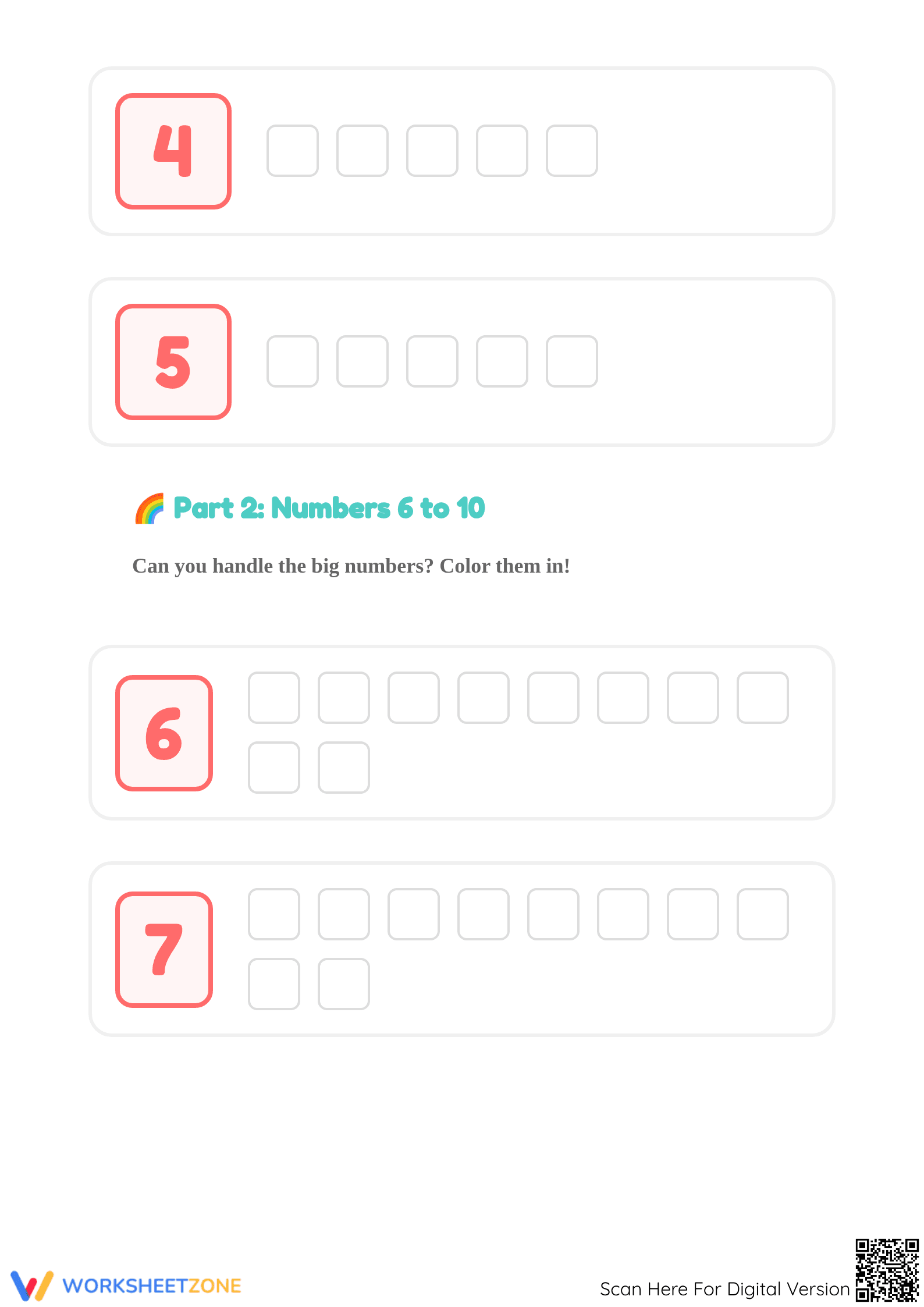
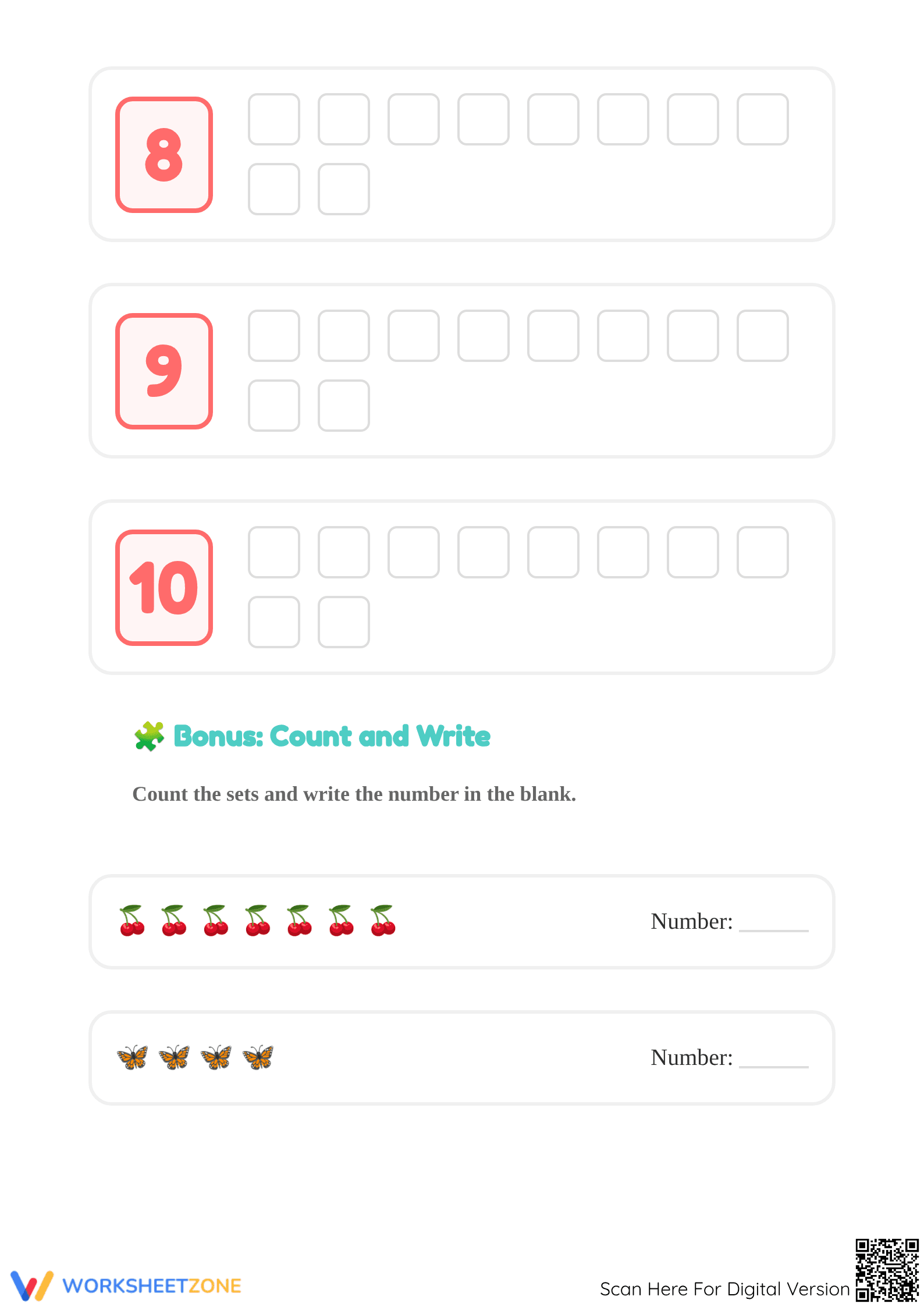
The three-page PDF features ten primary tasks where students count a specific number and color the corresponding amount of shapes. Two bonus problems challenge students to count sets of cherries and butterflies and write the correct digit, providing a complete assessment of early numeracy.
Skill Progression
This worksheet utilizes a scaffolded approach to number mastery:
- Guided practice: The first section focuses on small numbers 1-5, allowing students to establish counting rhythms with low cognitive load.
- Supported practice: The second section introduces larger quantities 6-10, requiring sustained attention to one-to-one correspondence.
- Independent practice: The final bonus section removes the coloring support, asking students to count abstract sets and write numerals independently.
This "I Do, We Do, You Do" structure ensures students move from recognition to representation.
Standards Alignment
Primary standard: K.CC.B.4. Students will understand the relationship between numbers and quantities, connecting counting to cardinality. This resource also supports K.CC.B.5 by asking students to count to answer "how many?" questions about arranged sets. Both standard codes can be copied directly into lesson plans, IEP goals, or district curriculum mapping tools.
How to Use It
Use this worksheet during the "during" phase of direct instruction to check for understanding after introducing a new number. It also serves as an excellent formative assessment tool; observe if students count aloud or use their fingers to track objects. The activity typically takes 15-20 minutes, making it an ideal choice for quiet independent work or math rotation stations.
Who It's For
Designed for Kindergarten students, this resource is perfect for early finishers or students needing extra intervention with number sense. It pairs naturally with physical manipulatives like counting bears or an anchor chart displaying the number line. Teachers can easily differentiate by providing physical counters to students who struggle with abstract shape counting.
Counting and cardinality form the bedrock of early mathematical development, serving as the most significant predictor of later success in arithmetic and algebra. This "Count and Color to 10" worksheet directly addresses the Kindergarten standard K.CC.B.4, which requires students to connect counting sequences to the total quantity of a set. By integrating coloring with counting, the resource leverages multi-sensory engagement to reinforce the concept of one-to-one correspondence—the ability to assign exactly one number name to each object in a group. According to the NAEP framework, developing these early number sense skills is critical for transitioning from rote counting to meaningful mathematical reasoning. This resource provides the necessary repetition for students to internalize number-quantity relationships, ensuring they can move beyond simple recognition to active numerical representation. It is an essential component for any curriculum focused on building a robust and lasting mathematical foundation for young learners.


