


























Views
Downloads

Mixed Number to Decimal Worksheet | Grade 4 Aligned
Paste this activity's link or code into your existing LMS (Google Classroom, Canvas, Teams, Schoology, Moodle, etc.).
Students can open and work on the activity right away, with no student login required.
You'll still be able to track student progress and results from your teacher account.
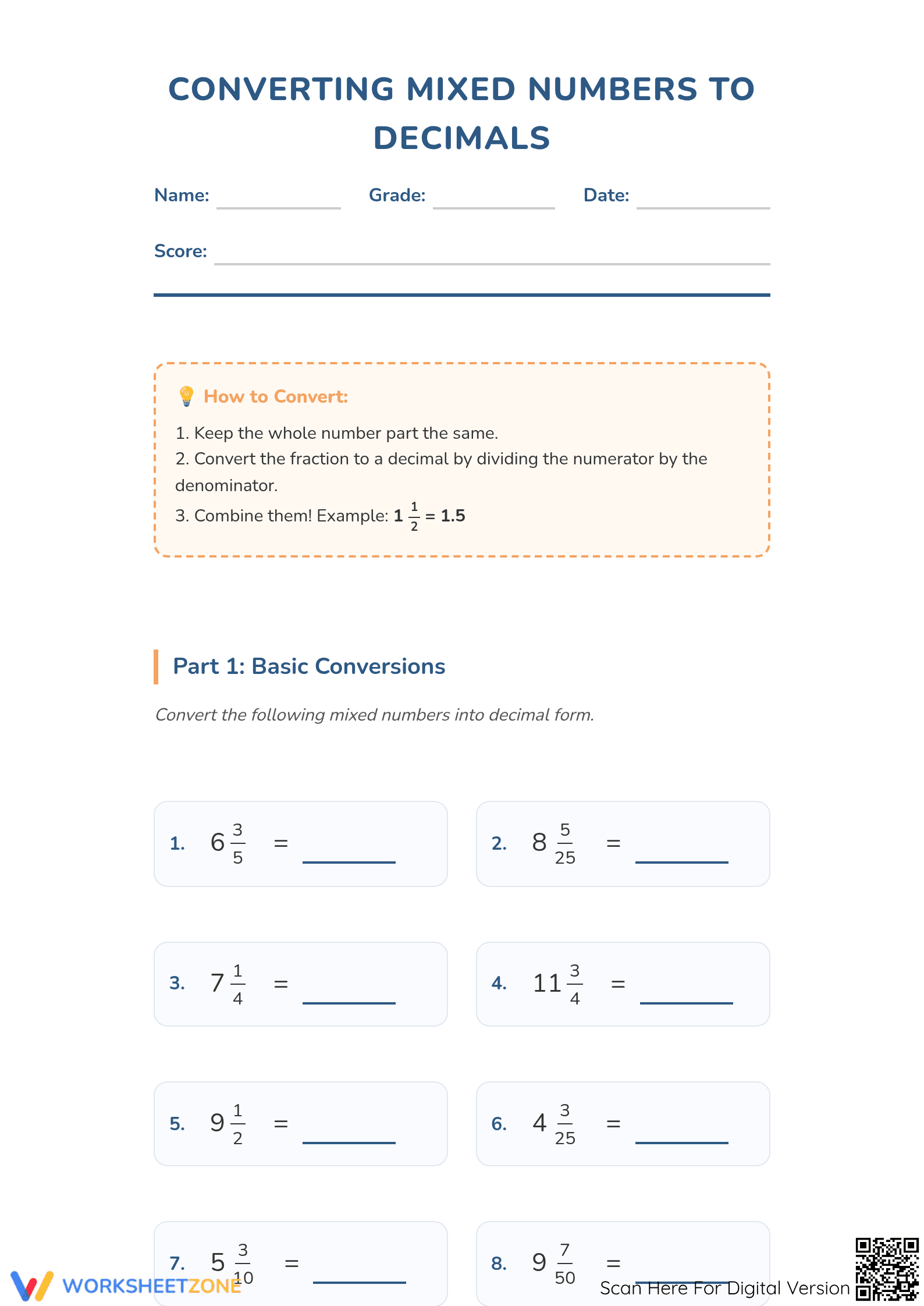
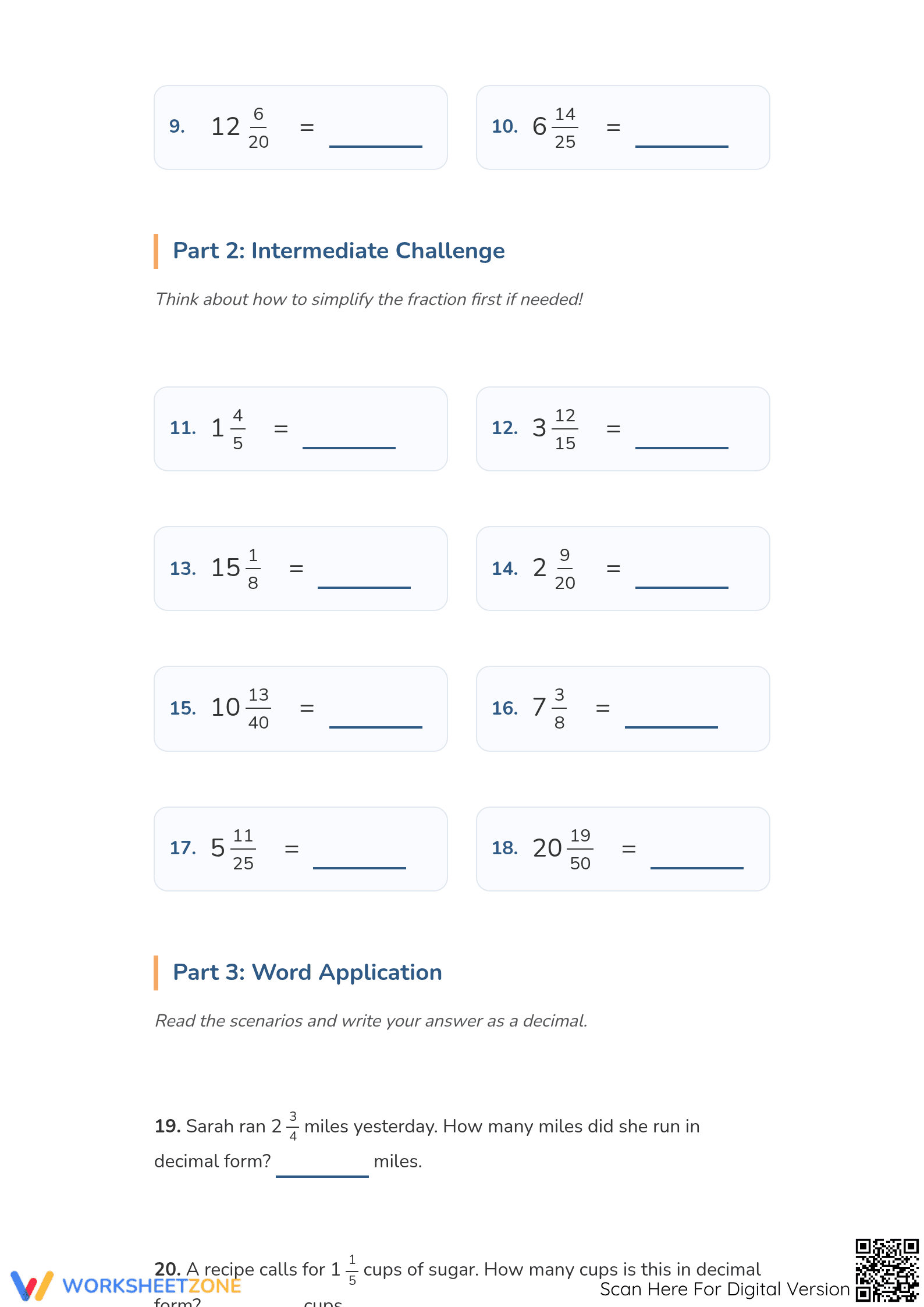
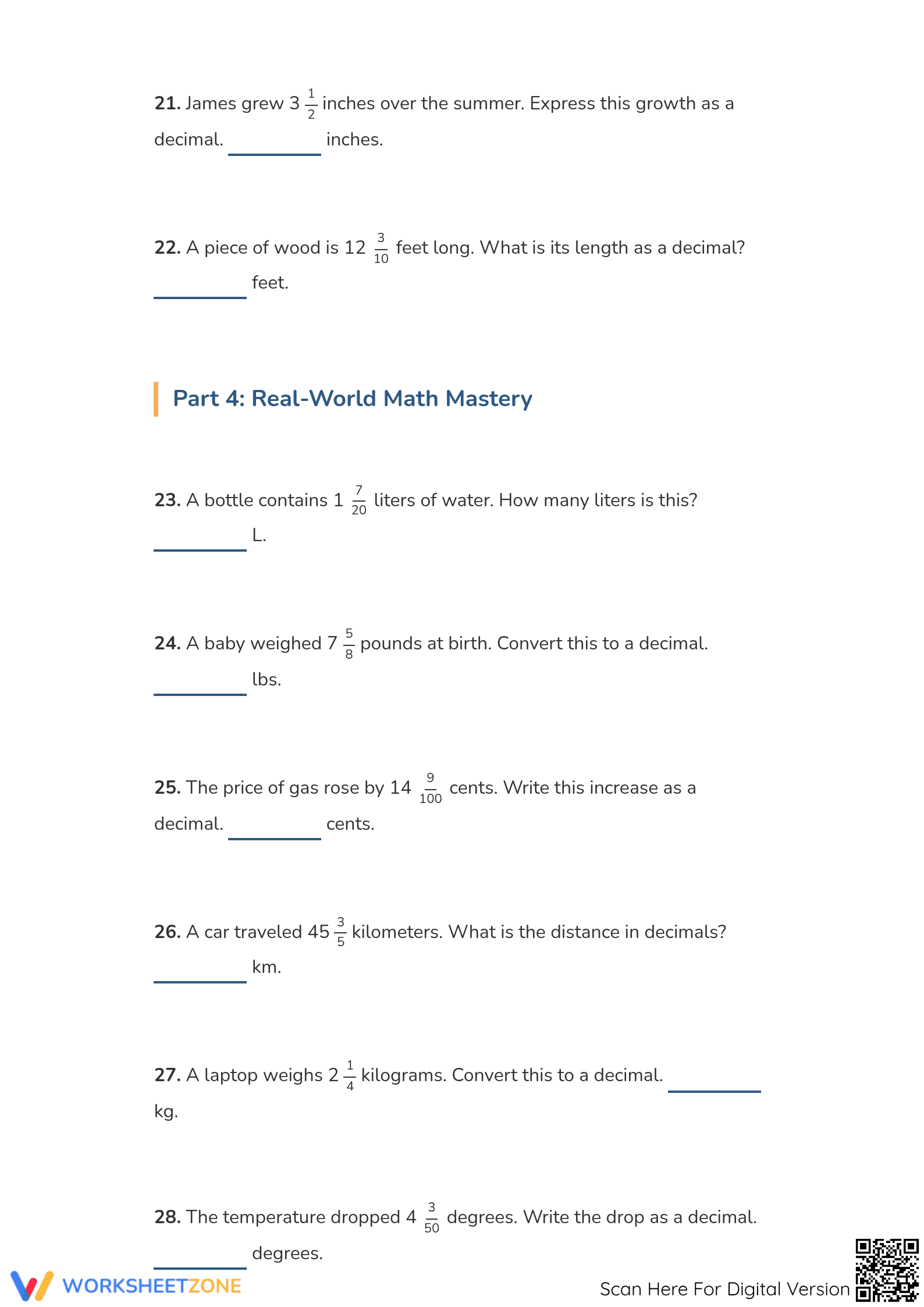
This mixed number to decimal worksheet provides Grade 4 students with focused, structured practice in converting fractions with denominators of 10 and 100 into decimal notation. Designed for foundational math instruction, each problem builds the decimal fluency students need to represent numerical values across different formats without additional preparation required from the teacher.
At a Glance
- Grade: 4 · Subject: Math
- Standard:
CCSS.MATH.CONTENT.4.NF.C.6— Use decimal notation for fractions with denominators 10 or 100- Skill Focus: Converting mixed numbers to decimals
- Format: 3 pages · 60 problems · Answer key included · PDF
- Best For: Independent practice after direct instruction
- Time: 20–30 minutes
What's Inside
This three-page worksheet contains 60 problems organized in a deliberate sequence from scaffolded to independent. Each task targets the cognitive demand of identifying whole numbers and fractional parts to generate accurate decimal strings, and the included answer key provides worked solutions that facilitate rapid grading and student self-correction during math rotations or homework review.
Skill Progression
The worksheet moves students through three stages:
- Guided practice (20 problems) — mixed numbers with denominators of 10 help students make the first attempt with simple decimal placement.
- Supported practice (20 problems) — denominators of 100 are introduced, requiring students to apply the skill with two decimal places.
- Independent practice (20 problems) — a mix of both denominators where students demonstrate the skill without visual cues.
This gradual release structure reflects the I Do / We Do / You Do instructional model, making it straightforward to integrate alongside any existing lesson sequence.
Standards Alignment
Primary Standard: CCSS.MATH.CONTENT.4.NF.C.6 — Use decimal notation for fractions with denominators 10 or 100. Rewrite fractions as decimals to understand place value relationships.
Supporting Standard: CCSS.MATH.CONTENT.5.NBT.A.3 — Read, write, and compare decimals to thousandths. This standard extends the concept to more complex place values.
Prerequisite addressed: Fraction identification — students who have not yet mastered identifying mixed numbers will benefit from a review of fractional parts first.
Both standard codes can be copied directly into lesson plans, IEP present levels, or district curriculum mapping tools.
How to Use It
Assign as a 20-minute independent warm-up following shared direct instruction on place value. It also functions effectively as an exit ticket — sort student responses by whether they correctly place the decimal point in hundredths to identify who needs re-teaching before the next lesson.
Estimated completion time: 20–30 minutes for most Grade 4 students.
Who It's For
Designed for Grade 4 students working at on or below grade level in math. The scaffolded opening makes it accessible for students approaching grade level; the final twenty problems extend toward higher-order demands for students who finish early. Pairs naturally with a place value anchor chart or direct instruction lesson on decimals.
Converting mixed numbers to decimal notation is a core mathematical skill required under CCSS.MATH.CONTENT.4.NF.C.6 across all 41 CCSS-adopting states. According to a 2024 RAND study on instructional materials use, students who receive structured, spaced practice on isolated math skills demonstrate significantly stronger long-term retention scores compared to those taught through conceptual discussion alone. The scaffolded format in this worksheet — guided to supported to independent practice — follows the gradual release model validated by Fisher & Frey (2014) as the highest-effect instructional structure for skill-based tasks in upper elementary grades. Nearly half of all US teachers now regularly use standards-aligned materials (RAND AIRS, 2024), and math worksheets that explicitly cite the standard code reduce the documentation time teachers spend preparing lesson plans and progress monitoring records for IEP goals and district reporting.


