


























Views
Downloads

Printable Fractions to Decimals Worksheet | Grades 4-7
Paste this activity's link or code into your existing LMS (Google Classroom, Canvas, Teams, Schoology, Moodle, etc.).
Students can open and work on the activity right away, with no student login required.
You'll still be able to track student progress and results from your teacher account.
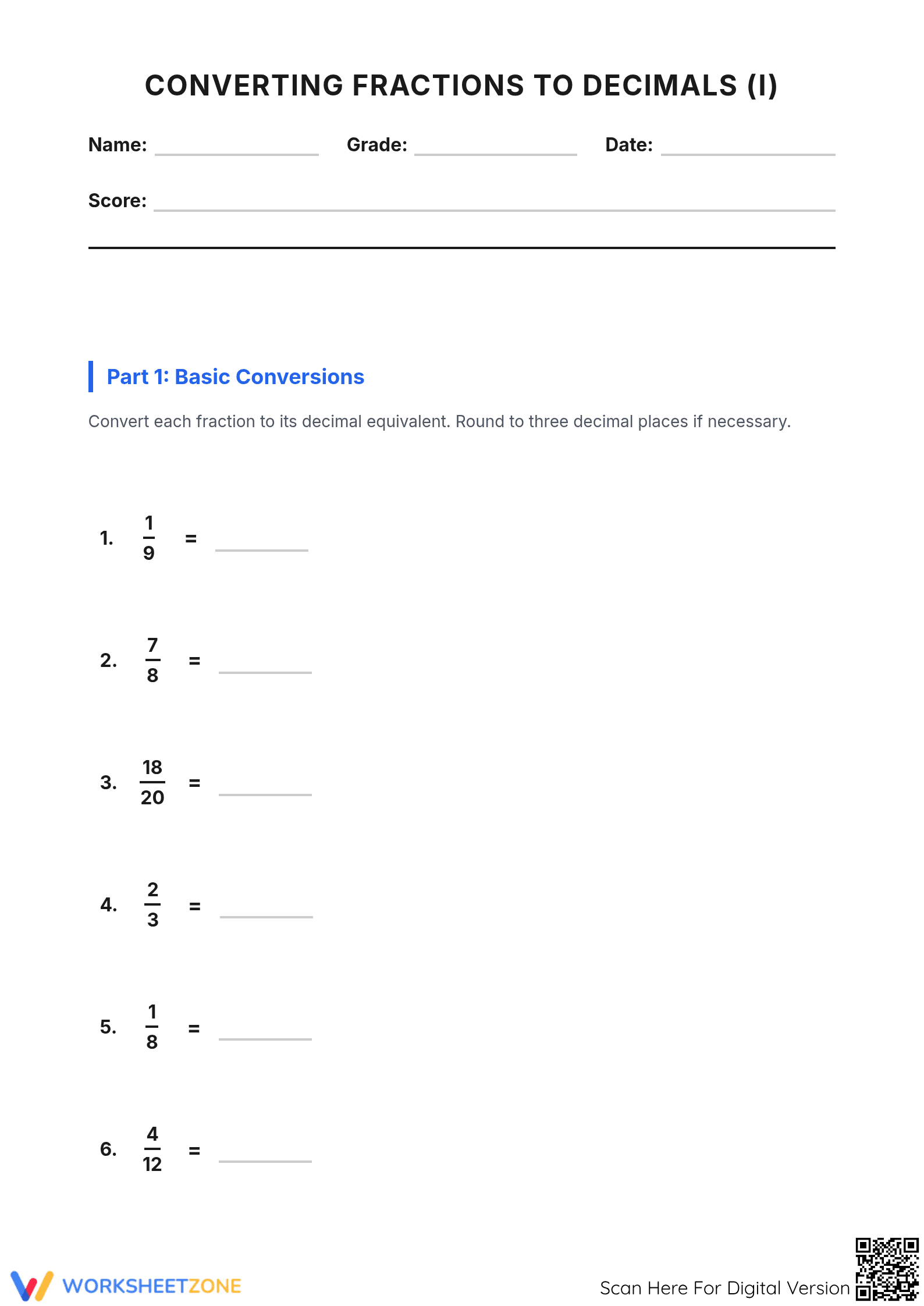
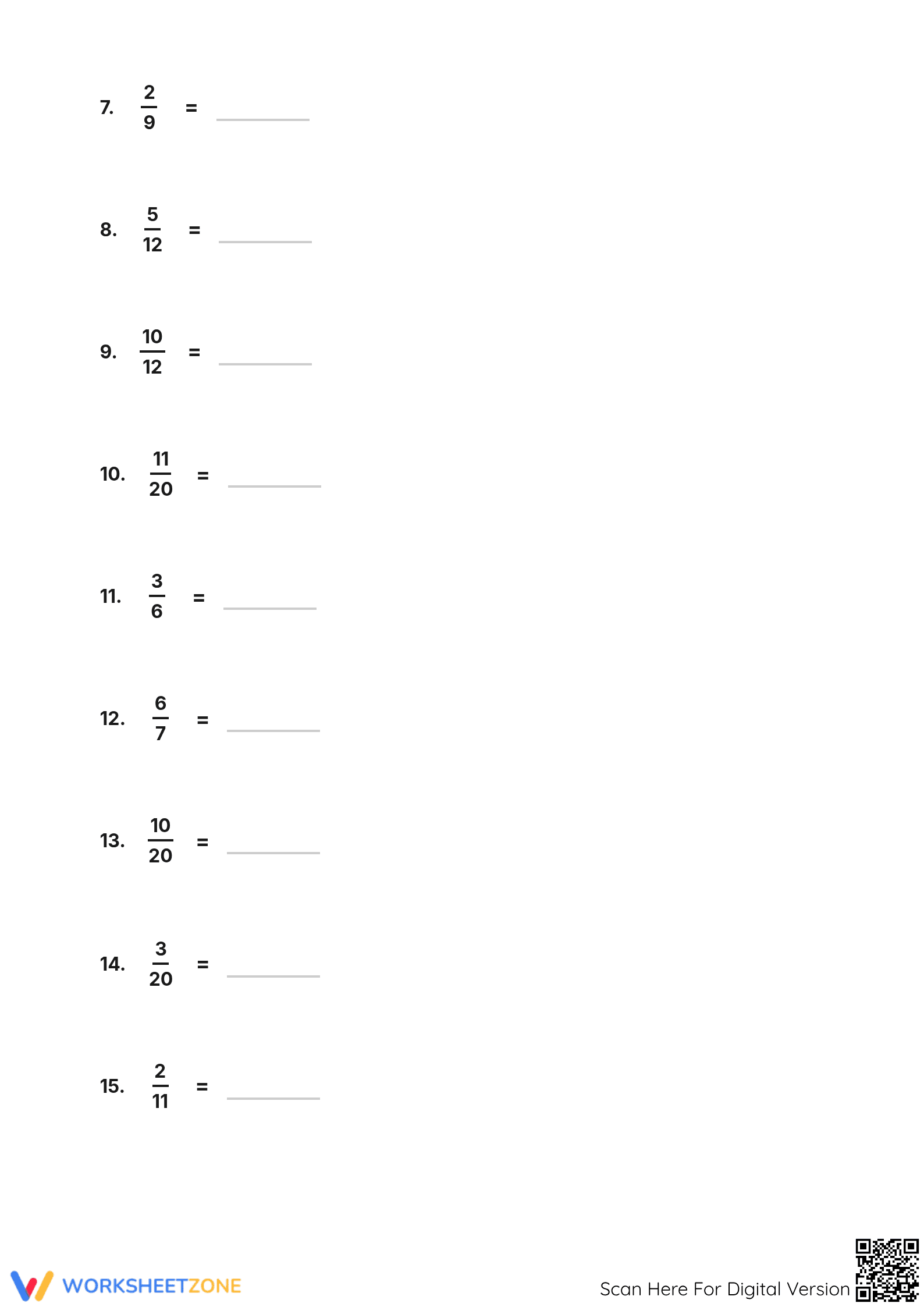
This comprehensive Math worksheet provides students with a structured pathway to master converting fractions into their decimal equivalents. By progressing from basic numeric practice to complex multi-step simplifications and real-world applications, learners develop the fluency needed for advanced rational number operations. Each of the 30 tasks is designed to build confidence through repeated exposure to common denominators and challenging long-division scenarios.
At a Glance
- Grade: 4–7 · Subject: Math (Fractions)
- Standard:
7.NS.A.2.D— Convert a rational number to a decimal using long division and terminal checks- Skill Focus: Rational number representation and conversion
- Format: 5 pages · 30 problems · Answer key included · PDF
- Best For: Small group instruction or independent math centers
- Time: 25–40 minutes
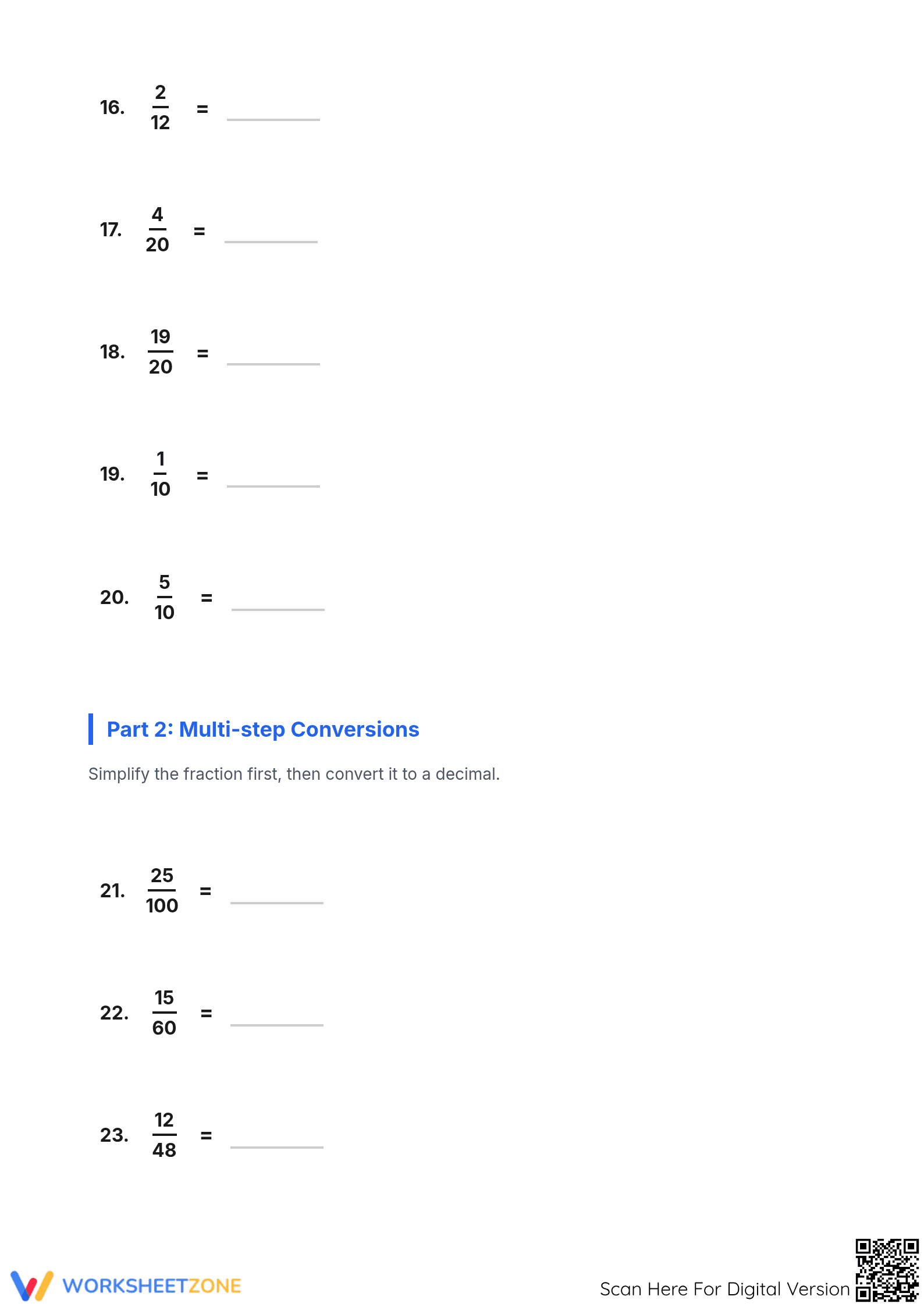
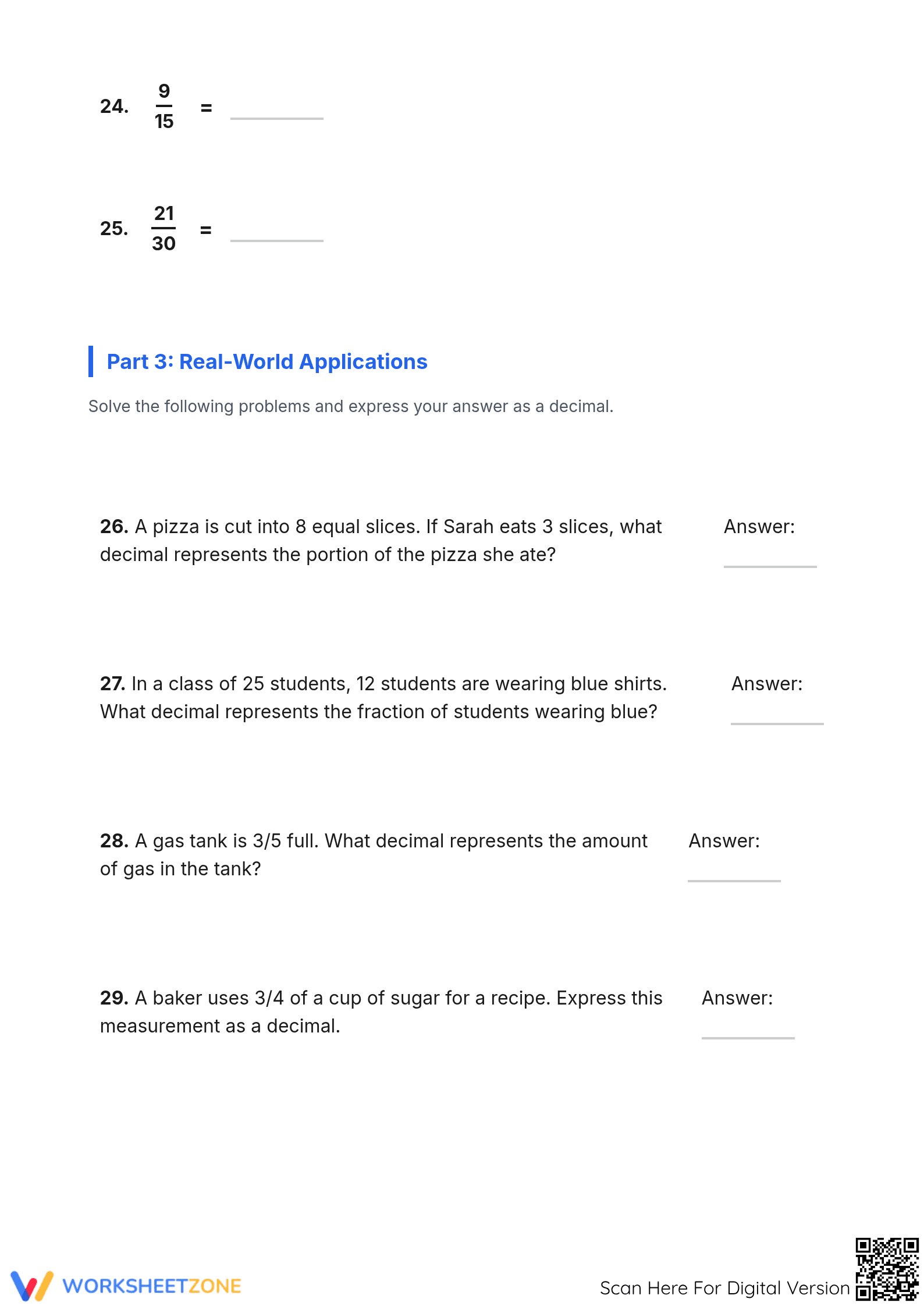
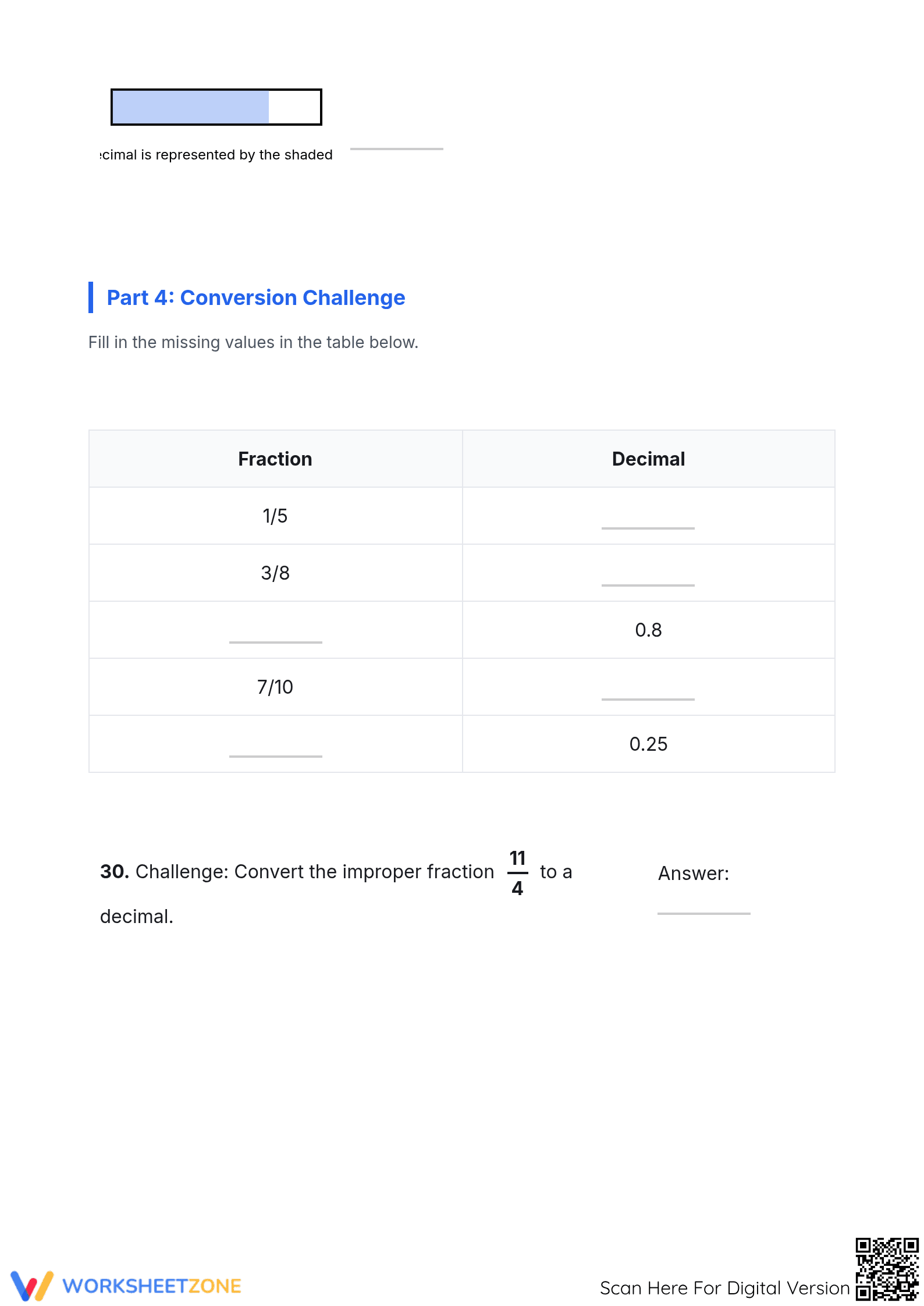
What's Inside: This 5-page PDF contains four distinct sections: Basic Conversions, Multi-step Conversions requiring simplification, Real-World Applications involving pizza slices and gas tanks, and a final Conversion Challenge table. A complete 5-page answer key is included to allow for efficient grading or student self-correction.
Skill Progression
- Guided Practice: Tasks 1–10 focus on fundamental conversions where students identify decimal equivalents for standard unit fractions like 1/8 and 2/3.
- Supported Practice: Tasks 11–25 introduce non-simplified fractions (e.g., 12/48), requiring students to reduce to simplest form before performing the final decimal conversion.
- Independent Practice: The final section presents 5 contextual word problems and an improper fraction challenge, requiring students to apply conversion logic to abstract and real-life scenarios without scaffolds.
This sequence follows a gradual-release model, moving from procedural calculation to conceptual application.
Standards Alignment
The primary alignment is `CCSS.MATH.CONTENT.7.NS.A.2.D`: "Convert a rational number to a decimal using long division; know that the decimal form of a rational number terminates in 0s or eventually repeats." It also supports 4th and 5th-grade standards involving base-ten fractions and decimals. Both standard codes can be copied directly into lesson plans, IEP goals, or district curriculum mapping tools.
How to Use It
Use this resource as a bridge between direct instruction on division and the introduction of percentages. During instruction, observe if students are correctly identifying when a decimal will repeat (like 2/3) versus terminate. The expected completion time for most 6th or 7th graders is approximately 30 minutes, making it an ideal choice for a mid-unit formative assessment.
Who It's For
This resource is tailored for upper elementary and middle school students who are transitioning from concrete fraction models to abstract decimal notation. It provides necessary scaffolding for students with IEPs through the "simplify first" prompts in Part 2. Pair this with a physical hundredths grid or an anchor chart on common fraction-decimal-percent equivalencies for maximum impact.
Research indicates that the ability to move flexibly between rational number representations is a primary predictor of success in early algebra (Fisher & Frey, 2014). This worksheet targets standard CCSS.MATH.CONTENT.7.NS.A.2.D by requiring students to convert fractions to decimals through multiple modalities, including simplification and word-problem translation. By integrating 30 varied tasks ranging from simple unit fractions to improper challenges, the material ensures that students recognize the terminating or repeating nature of rational numbers as defined by current NAEP frameworks. The inclusion of a comprehensive answer key facilitates the immediate feedback loops necessary for procedural mastery, while the real-world scenarios anchor abstract division in relatable contexts like class statistics and shared portions. This blend of procedural and conceptual practice aligns with the high-quality instructional material standards defined by modern math curriculum audits.


