


























Views
Downloads

Essential Fraction and Decimal Worksheet | Grade 6 Math
Paste this activity's link or code into your existing LMS (Google Classroom, Canvas, Teams, Schoology, Moodle, etc.).
Students can open and work on the activity right away, with no student login required.
You'll still be able to track student progress and results from your teacher account.
This 5-page conversion worksheet provides comprehensive practice for students mastering the relationship between fractions, decimals, and ratios. By moving through three distinct phases of numeric translation, learners build the fluency required for middle-school algebraic reasoning. Students will confidently shift between representations to solve both abstract and contextualized math problems.
At a Glance
- Grade: 6–8 · Subject: Math
- Standard:
CCSS.MATH.CONTENT.6.RP.A.3.c— Find equivalent forms of fractions, decimals, and ratios to solve problems- Skill Focus: Multi-way numeric conversion
- Format: 5 pages · 34 problems · Answer key included · PDF
- Best For: Independent practice and fluency drills
- Time: 30–45 minutes
What's Inside
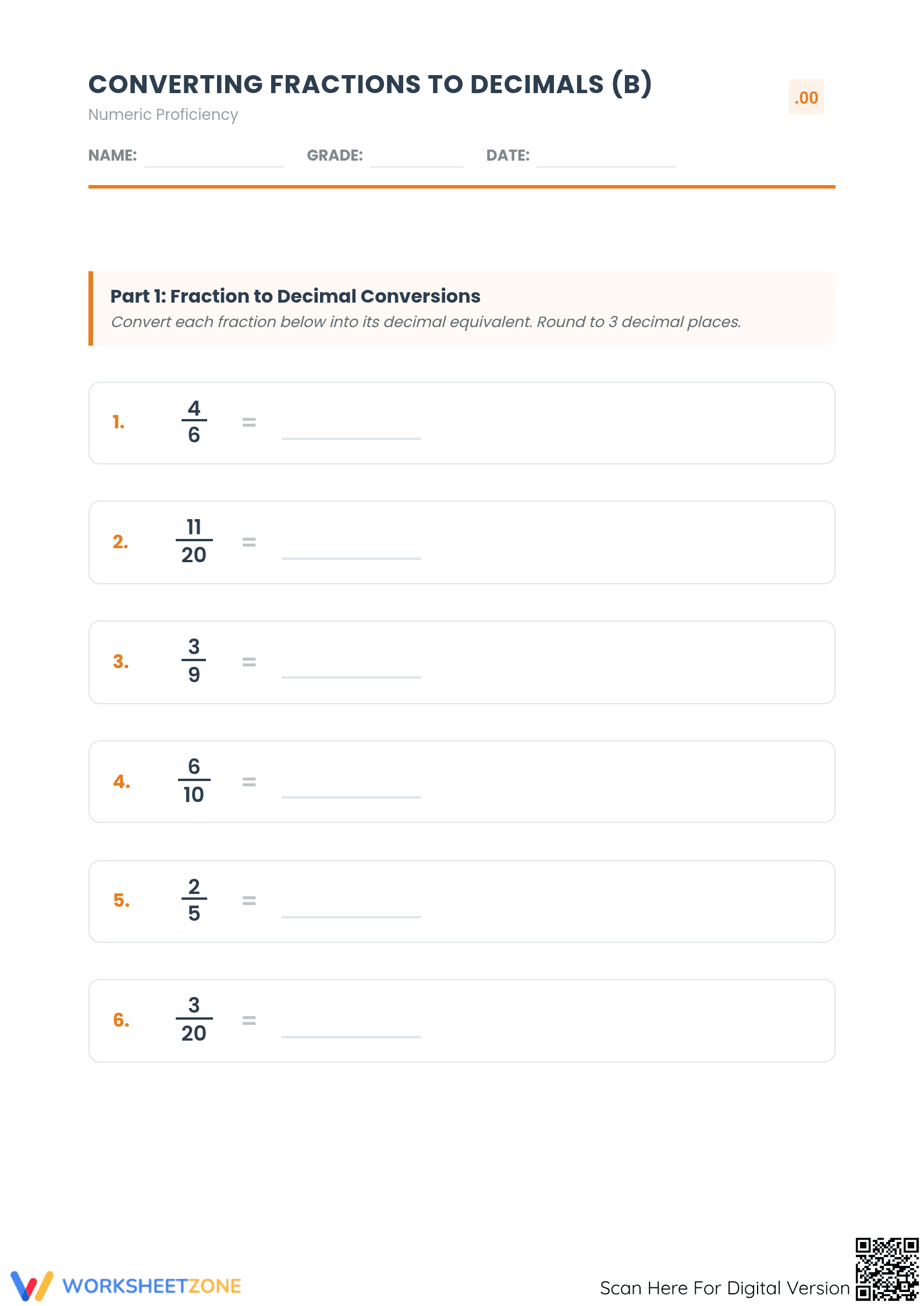
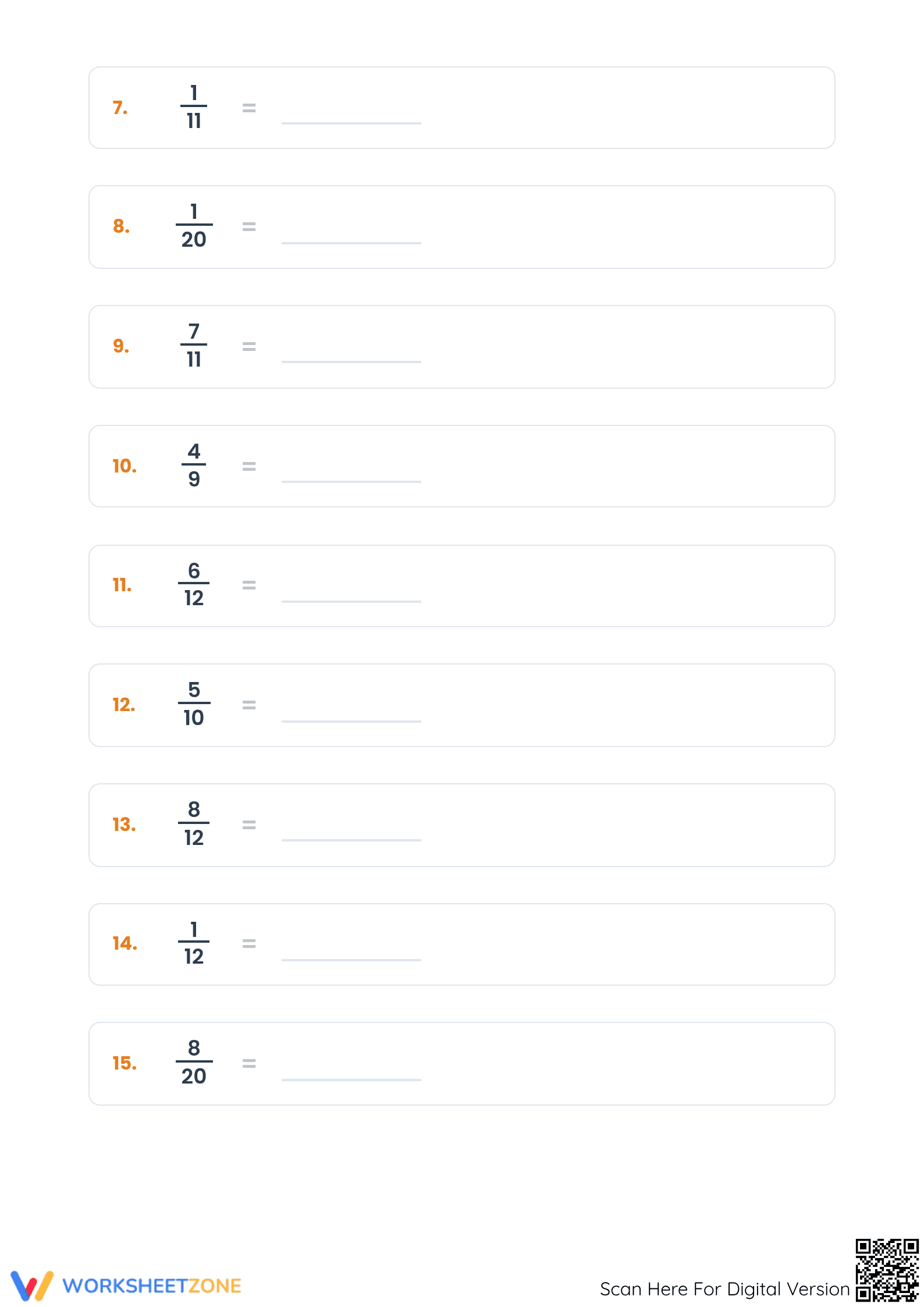
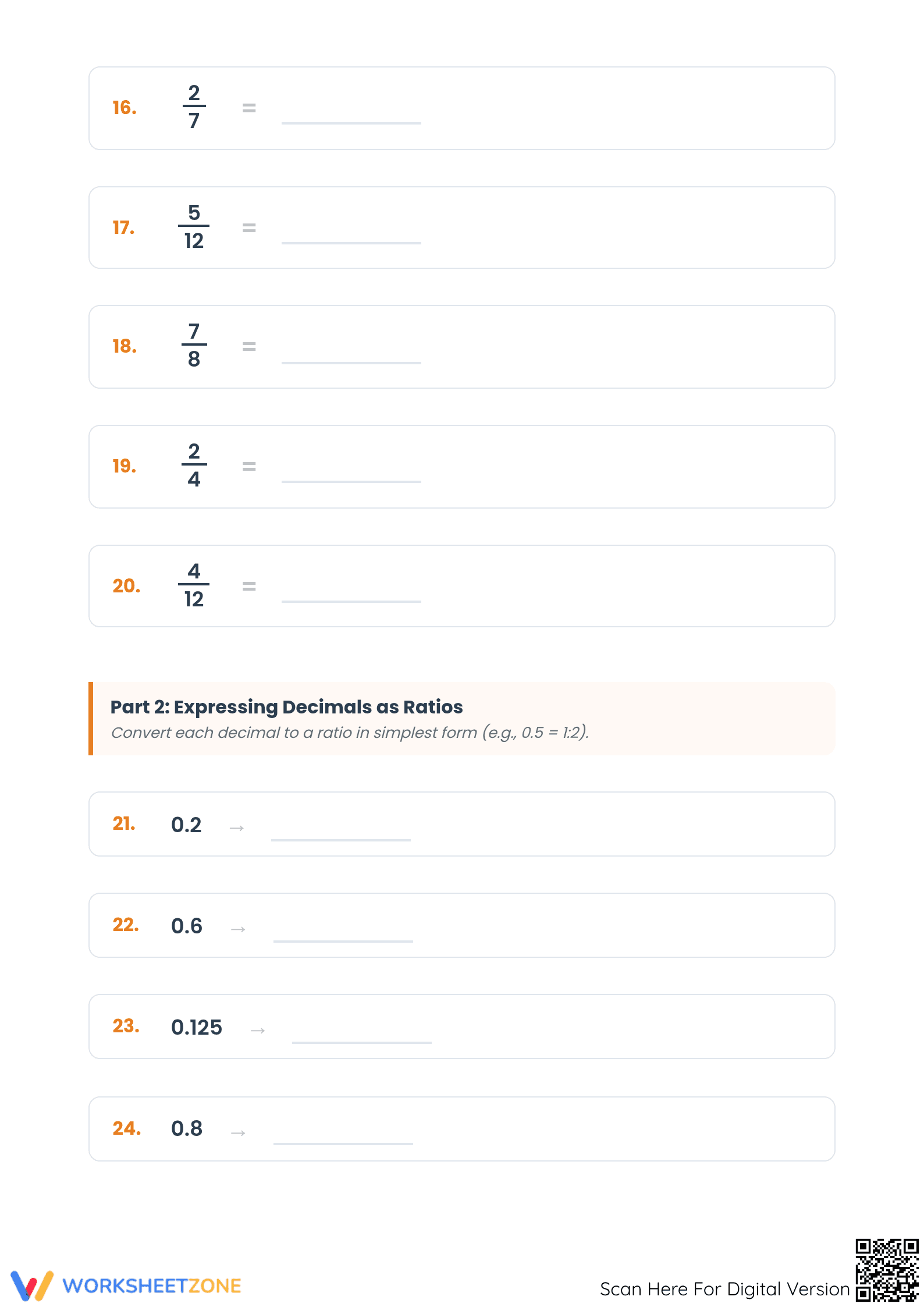
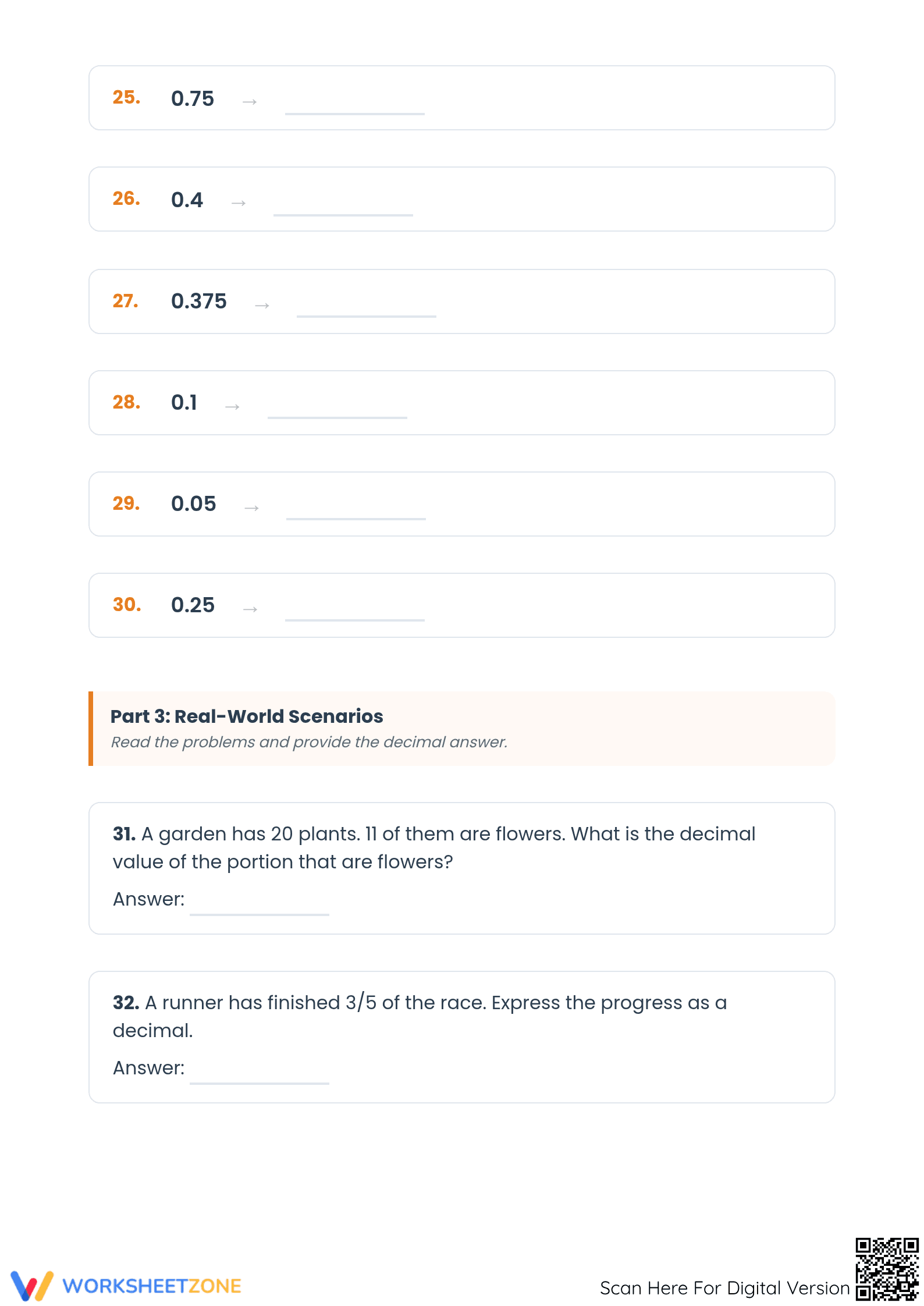
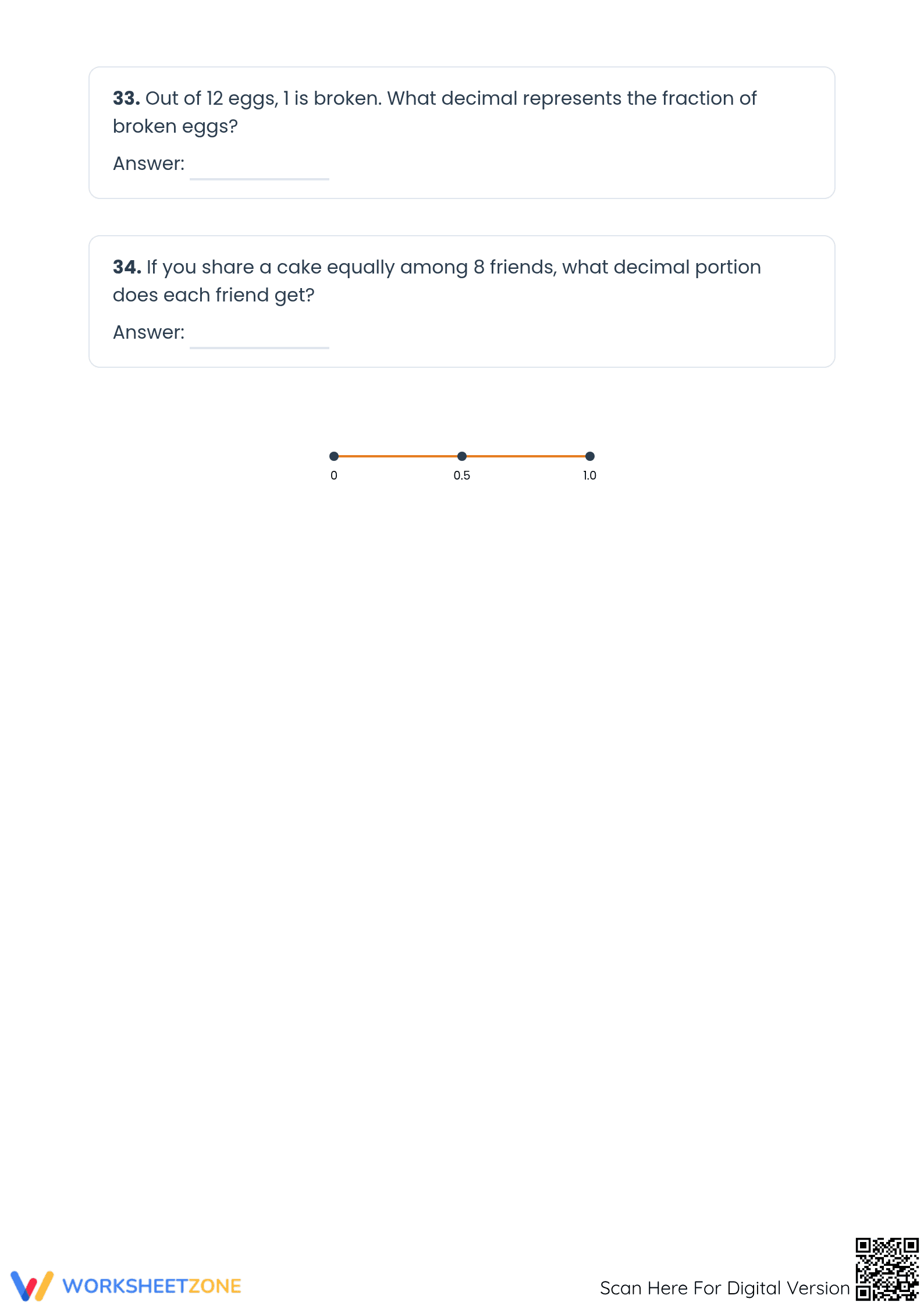
The packet contains 34 targeted tasks across five pages. Part 1 features 20 fraction-to-decimal items requiring precision to three decimal places. Part 2 introduces decimal-to-ratio translation in simplest form. Part 3 concludes with word problems and a visual number line to ground abstract conversions in real-world logic. A full answer key ensures immediate feedback.
Skill Progression
- Guided practice: Problems 1-10 provide standard denominator patterns like tenths and twentieths to establish basic conversion algorithms.
- Supported practice: Problems 11-30 increase complexity with mixed decimal forms and ratio reductions, reinforcing the requirement for simplest-form answers.
- Independent practice: The final 4 real-world scenarios require students to extract values from text and determine the correct numeric representation without structural cues.
This sequence follows the gradual-release model, transitioning students from rote calculation to applied conceptual mastery.
Standards Alignment
Primary Standard: CCSS.MATH.CONTENT.6.RP.A.3.c — "Find a percent of a quantity as a rate per 100; solve problems involving finding the whole, given a part and the percent." While this worksheet focuses on the underlying mechanics of fractions, decimals, and ratios, it directly supports the standard's requirement for numeric equivalence. Both standard codes can be copied directly into lesson plans, IEP goals, or district curriculum mapping tools.
How to Use It
Assign Part 1 as a mid-lesson check during direct instruction on division-based conversions to observe calculation errors early. Use Part 3 as a formative exit ticket to gauge if students can apply conversion logic to narrative contexts. The 45-minute completion time makes it an ideal self-contained sub plan for middle school math.
Who It's For
This resource is designed for sixth-grade math students, though it serves as an excellent remedial tool for higher grades or an enrichment challenge for fifth graders. It pairs naturally with a fraction-to-decimal anchor chart or a "percent of" introductory lesson to bridge the gap between parts and wholes.
Research highlights that mathematics mastery in middle school depends heavily on the ability to move fluidly between different representations of the same value. According to the NAEP framework and contemporary Fisher & Frey (2014) instructional models, scaffolded practice that transitions from pure computation to word-problem application is critical for long-term retention. This worksheet targets CCSS.MATH.CONTENT.6.RP.A.3.c by providing 34 opportunities for students to translate between fractions, decimals, and ratios. By requiring rounding to three decimal places and simplest-form ratios, the resource enforces the precision necessary for advanced algebra. NAEP assessments consistently show that students who struggle with these fundamental conversions face significant hurdles in eighth-grade expressions and equations. This resource provides the high-volume, low-stakes practice environment recommended by EdReports 2024 for building procedural fluency.


