


























Views
Downloads

Essential Fractions to Decimals Practice Worksheet | Grade 7
Paste this activity's link or code into your existing LMS (Google Classroom, Canvas, Teams, Schoology, Moodle, etc.).
Students can open and work on the activity right away, with no student login required.
You'll still be able to track student progress and results from your teacher account.
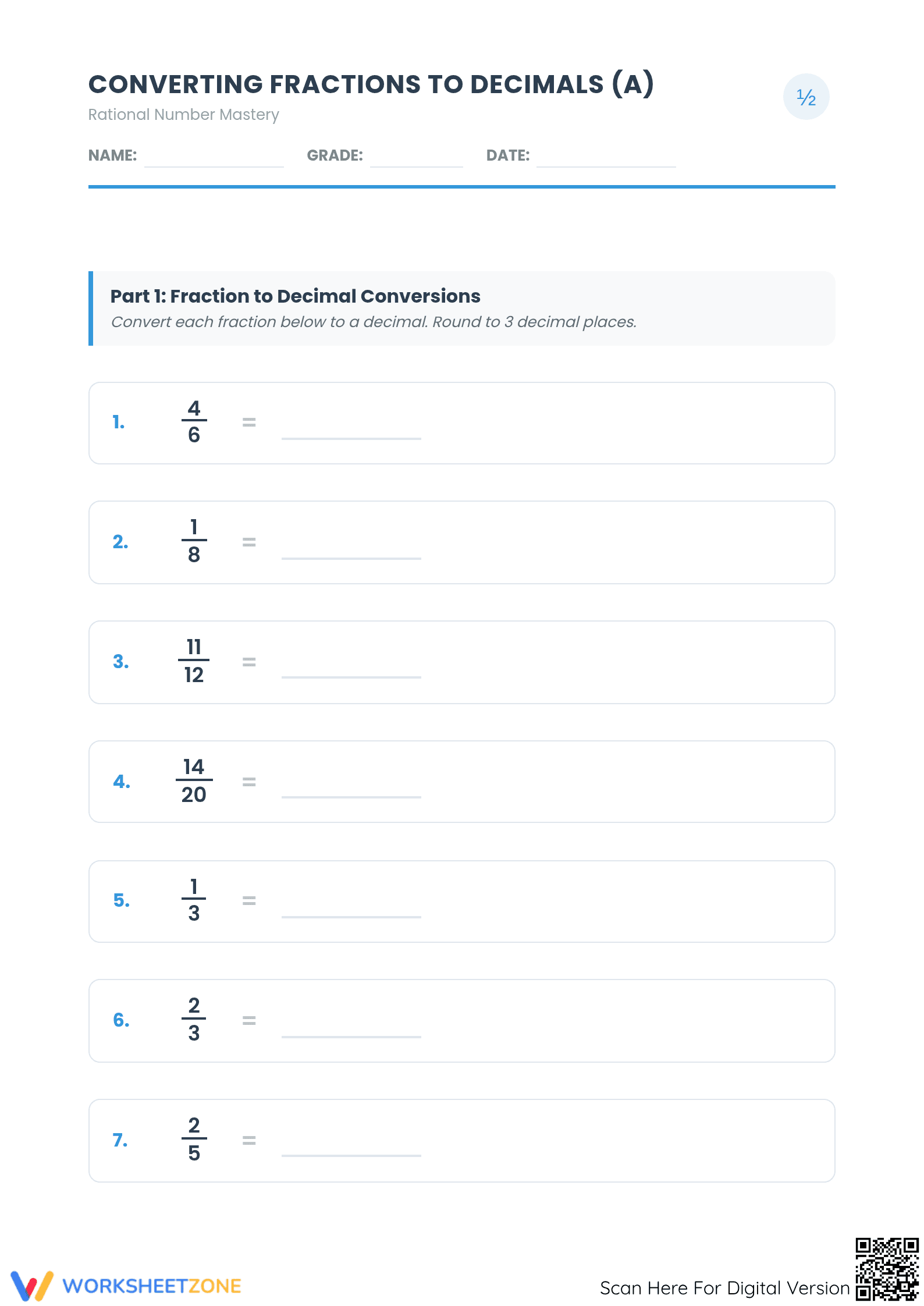
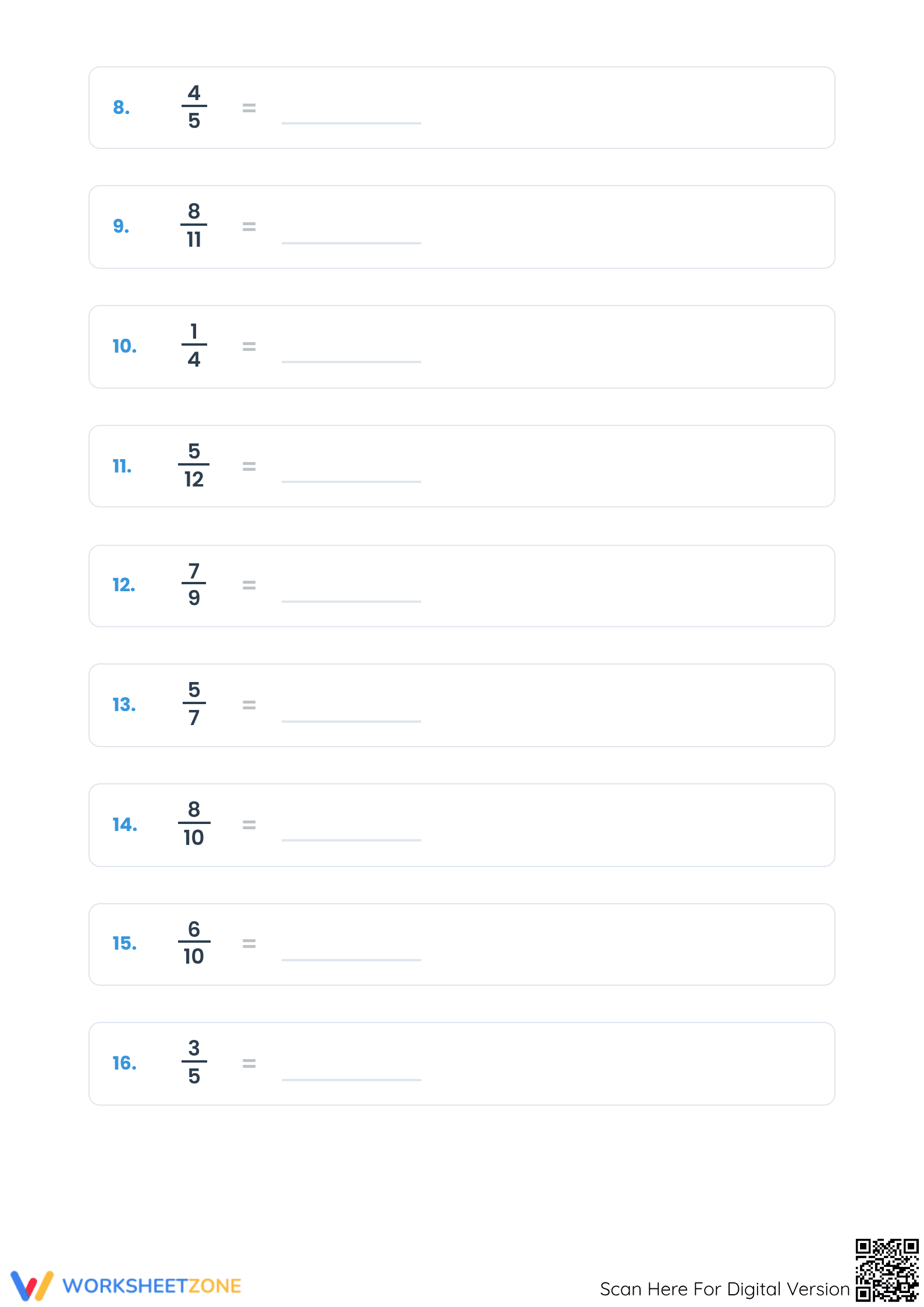
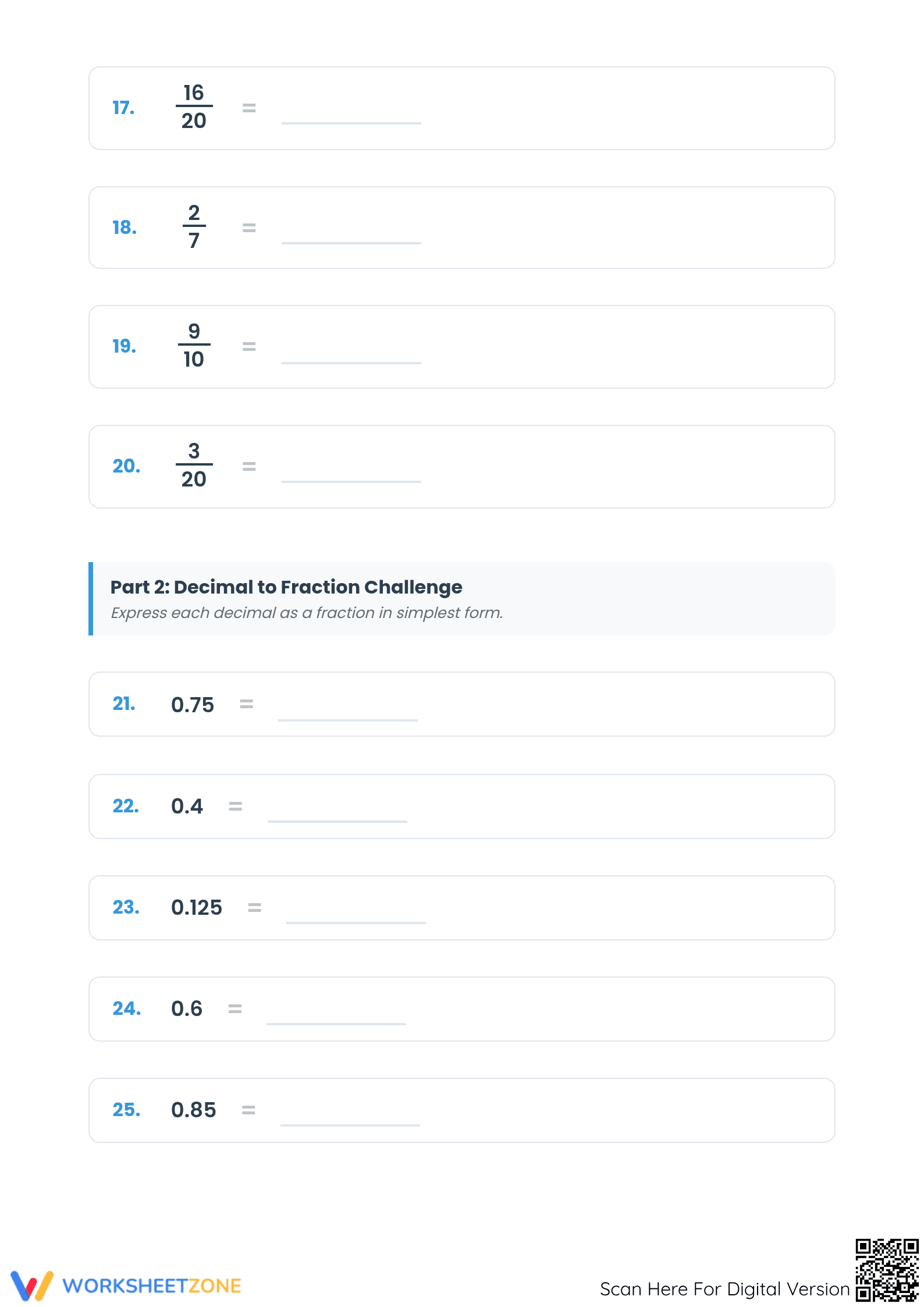
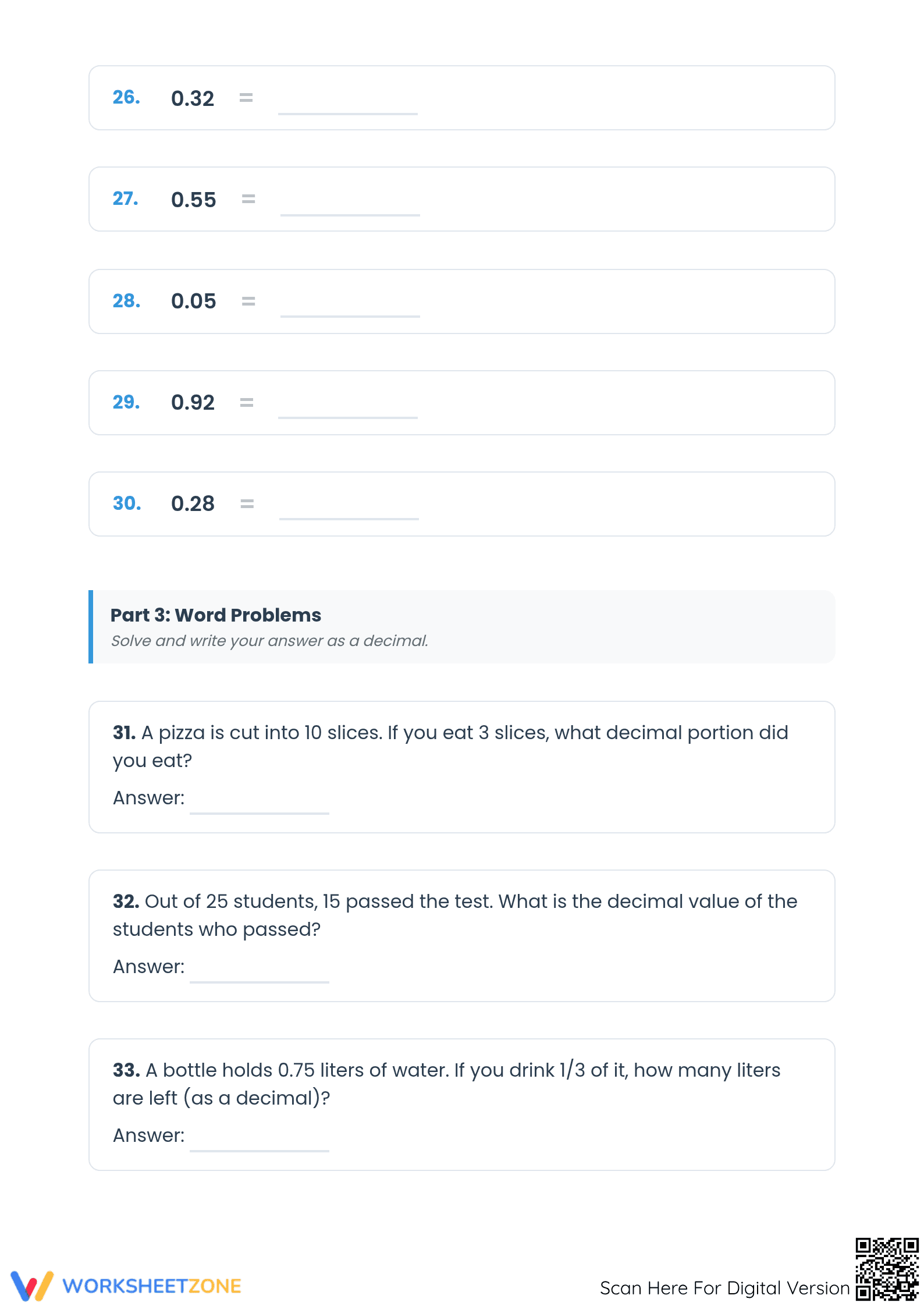
This Grade 7 rational number worksheet empowers students to master the essential skill of converting between fractions and decimals. By navigating 34 structured problems, learners develop the procedural fluency needed for higher-level mathematics. The clear layout and varied task types ensure that students can accurately translate values between different numeric representations while maintaining mathematical precision.
At a Glance
- Grade: 7 · Subject: Math
- Standard:
CCSS.MATH.CONTENT.7.NS.A.2.D— Convert a rational number to a decimal using long division and recognize terminal forms- Skill Focus: Fraction and Decimal Conversion
- Format: 5 pages · 34 problems · Answer key included · PDF
- Best For: Middle school math centers and independent practice
- Time: 40–50 minutes
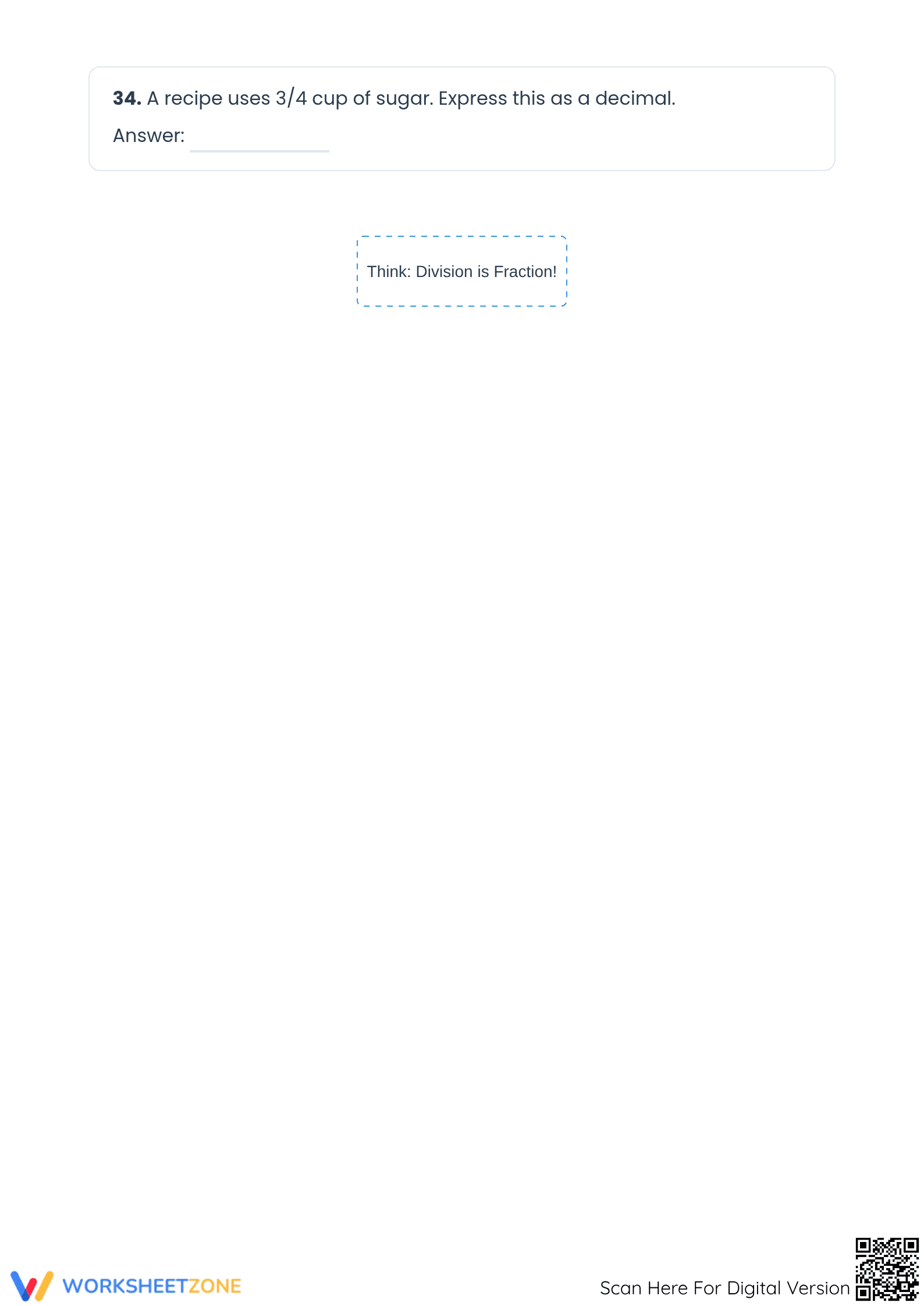
This comprehensive 5-page packet features 34 distinct tasks divided into three logical parts. Part 1 focuses on 20 fraction-to-decimal conversions where students must round results to three decimal places. Part 2 shifts the challenge to expressing decimals as fractions in their simplest form. Finally, Part 3 provides four real-world word problems that require students to apply their conversion skills to practical scenarios. A full answer key is included for immediate feedback.
- Guided Practice: The first set of problems uses common fractions like 4/6 and 1/8 to build initial confidence and reinforce the division process.
- Supported Practice: Mid-level tasks introduce more complex denominators such as 11/12 and 5/7, requiring careful calculation and precise rounding to the thousandths place.
- Independent Practice: The final word problems remove scaffolds, challenging students to interpret situational context and determine which conversion method is appropriate for the solution.
The worksheet follows a gradual-release model, moving from isolated computation to contextual application.
The primary focus is CCSS.MATH.CONTENT.7.NS.A.2.D, which requires students to convert a rational number to a decimal using long division and know that the decimal form eventually terminates or repeats. It also supports CCSS.MATH.CONTENT.6.NS.B.3 through the use of multi-digit decimal operations. Both standard codes can be copied directly into lesson plans, IEP goals, or district curriculum mapping tools.
This resource is ideal for use after direct instruction on the relationship between division and fractions. Assign it as a main activity during a math block or break it into smaller segments for a multi-day review. During instruction, observe how students handle non-terminating decimals to gauge their understanding of rounding rules. Most students will complete the entire packet within a 40 to 50 minute window.
This practice set is designed for Grade 7 students but is highly effective for Grade 6 enrichment or Grade 8 remediation. It provides necessary support for students who struggle with mental math by allowing space for written calculations. For a complete lesson, pair this worksheet with a visual anchor chart demonstrating the division-bracket method for converting fractions.
The mastery of rational number conversions is a cornerstone of middle school mathematics, serving as a prerequisite for algebra and data analysis. According to Fisher & Frey (2014), the implementation of a gradual-release framework—moving from simple computation to complex word problems—is essential for developing long-term procedural fluency in mathematics. This worksheet directly addresses the requirements of CCSS.MATH.CONTENT.7.NS.A.2.D by requiring students to utilize division to find decimal equivalents and recognize terminating patterns. By including 34 targeted problems, the resource ensures sufficient repetition for neural encoding while the final word problems demand higher-order cognitive processing. Educators can rely on this structured approach to provide the evidence of learning required for IEP progress monitoring and general classroom assessments. The inclusion of a clear answer key allows for student self-correction, which research identifies as a high-leverage practice for improving math achievement across diverse learner populations.


