


























Views
Downloads

Mixed Fractions to Improper Fractions | Printable Grade 3
Paste this activity's link or code into your existing LMS (Google Classroom, Canvas, Teams, Schoology, Moodle, etc.).
Students can open and work on the activity right away, with no student login required.
You'll still be able to track student progress and results from your teacher account.
This Grade 3 math worksheet provides essential practice for students learning to convert mixed fractions into improper fractions. By bridging the gap between whole numbers and fractional parts, students develop a deeper understanding of fractional equivalence. This resource ensures learners master the procedural rule through a scaffolded approach that builds confidence and mathematical fluency.
At a Glance
- Grade: 3 · Subject: Math
- Standard:
CCSS.MATH.CONTENT.3.NF.A.3— Explain equivalence of fractions and compare fractions by reasoning about their size- Skill Focus: Mixed to improper fraction conversion
- Format: 5 pages · 20 problems · Answer key included · PDF
- Best For: Independent practice and formal skill assessment
- Time: 30–45 minutes
What's Inside
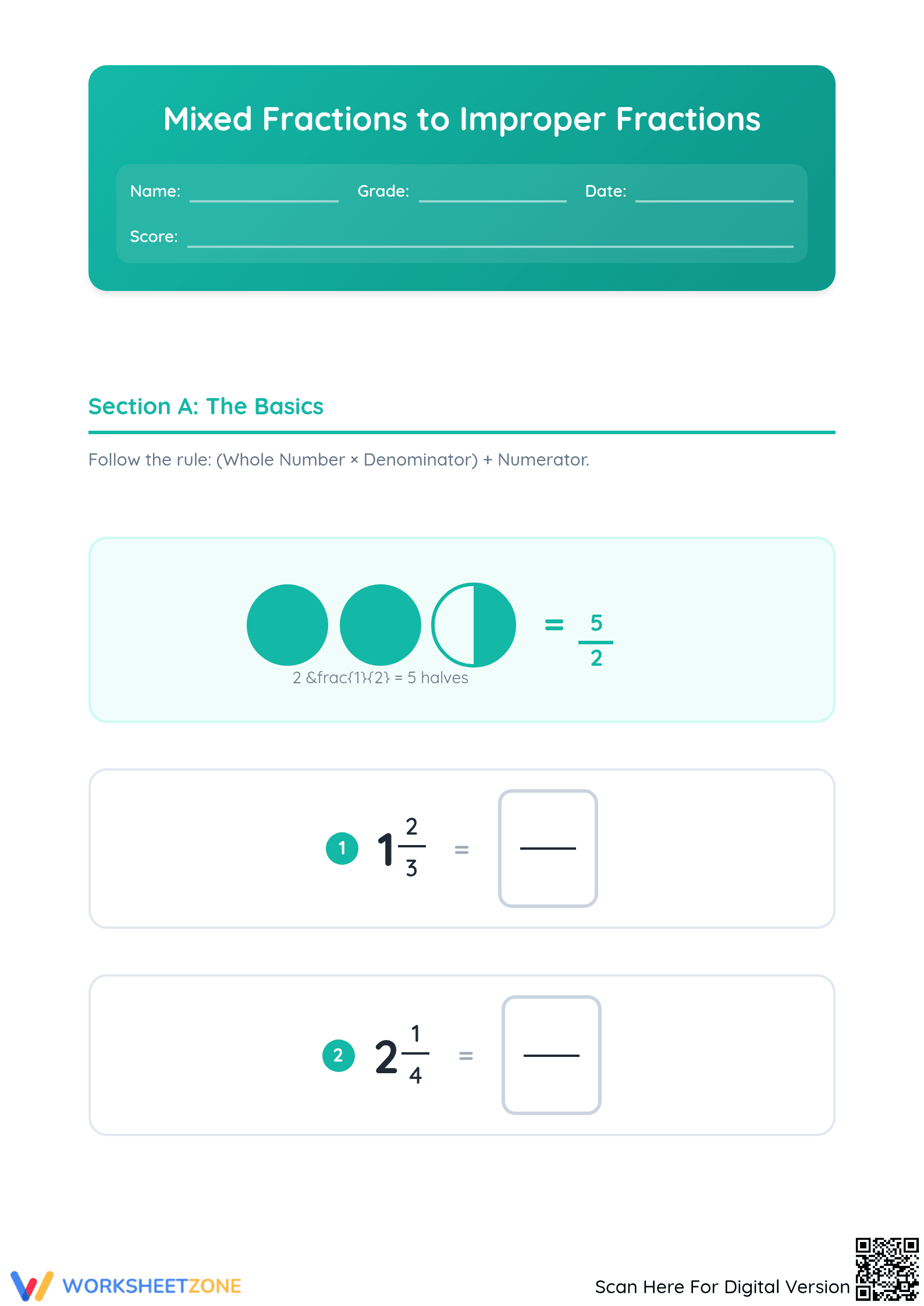
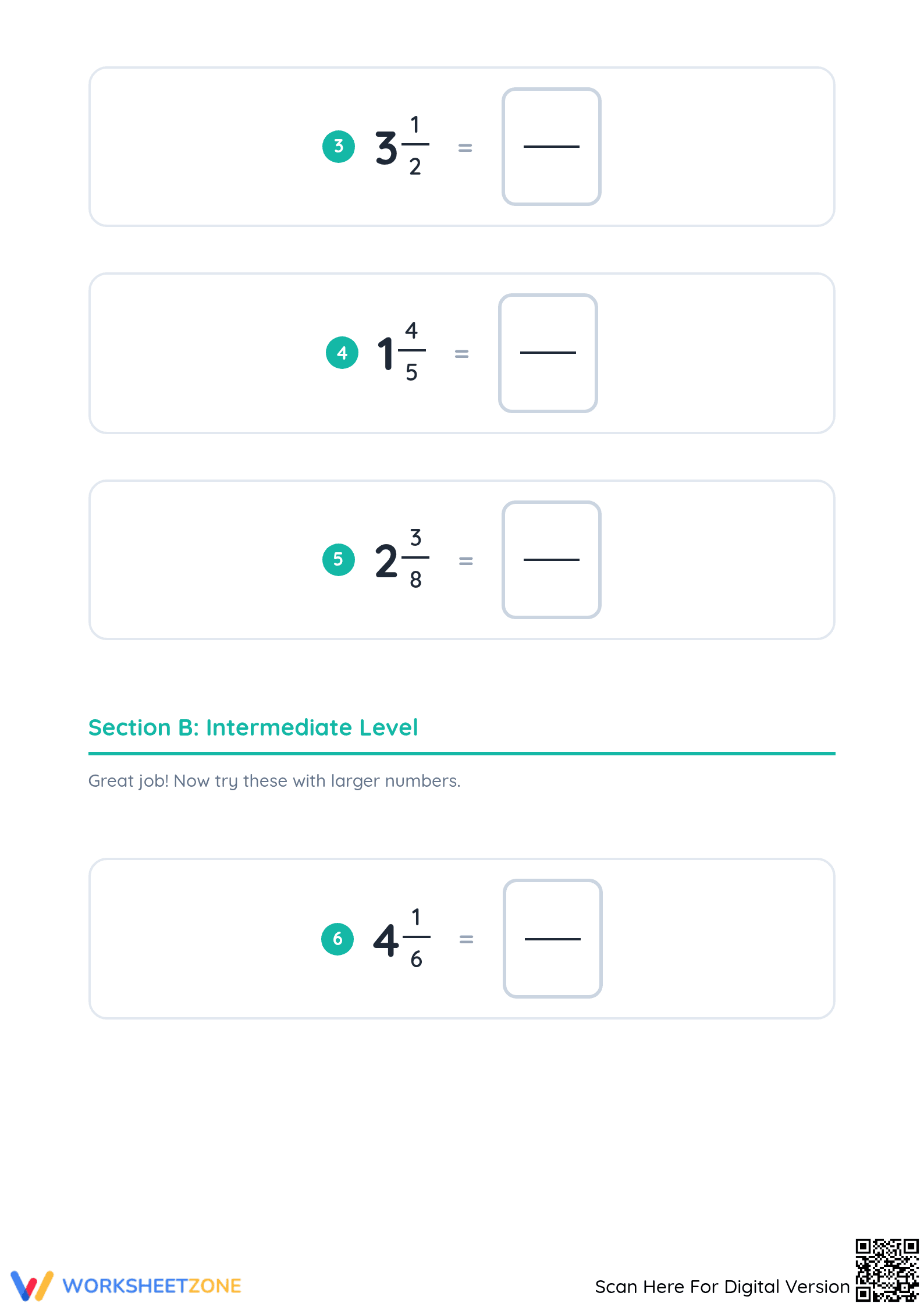
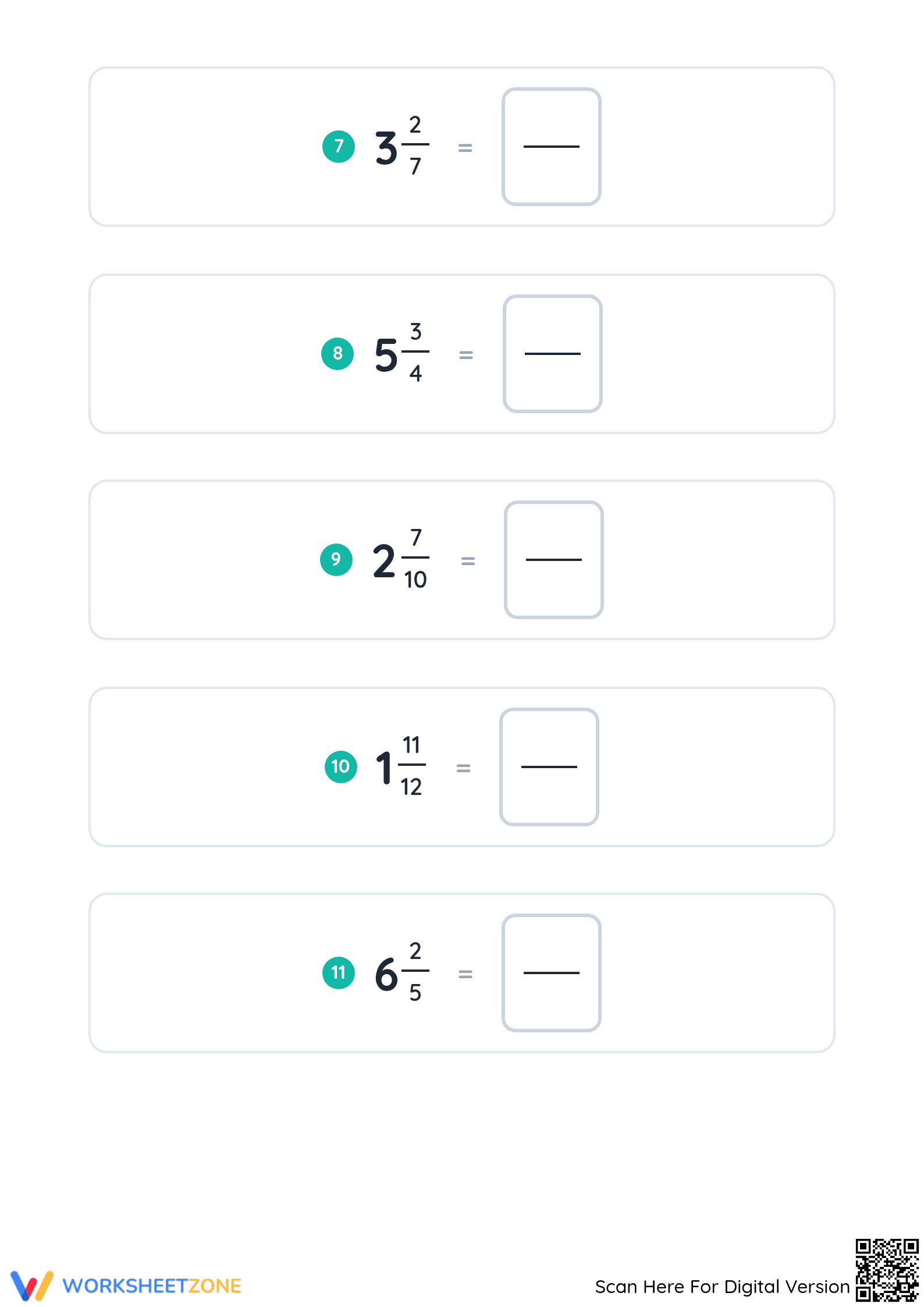
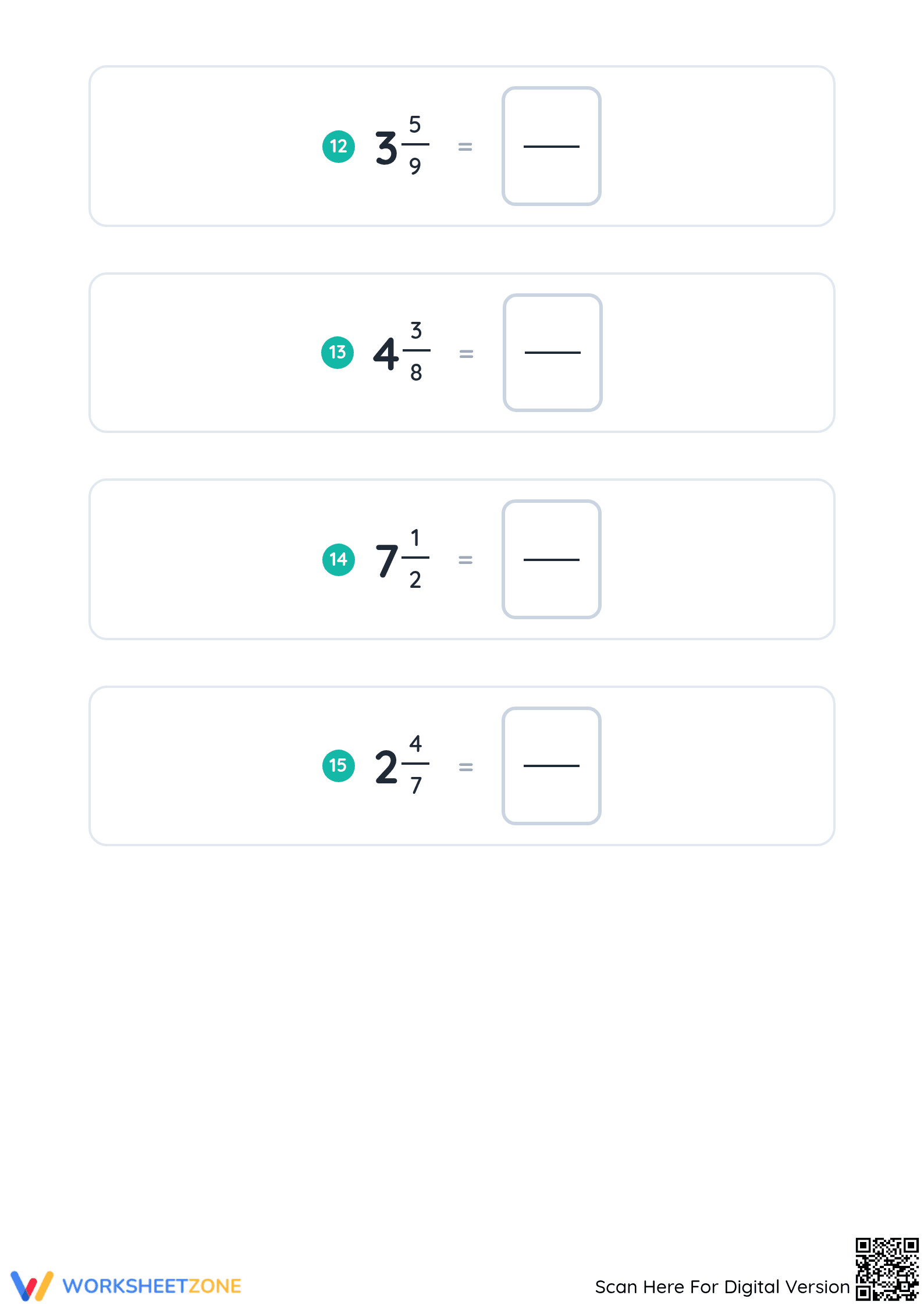
The worksheet is organized into five comprehensive pages containing 20 unique conversion tasks. It begins with a visual anchor and a clear procedural rule to support initial attempts. The layout features three distinct difficulty tiers, ranging from basic single-digit whole numbers to intermediate and master-level challenges. A full answer key is provided for rapid grading and student self-correction.
Skill Progression
This resource follows a gradual-release model to ensure student success across the entire set. Educational outcomes are maximized through the following structured phases:
- Guided Practice: The first section includes 5 problems with a visual model and the explicit conversion formula to anchor student understanding and conceptual mapping.
- Supported Practice: The next 10 problems transition to larger numbers, requiring students to apply the rule independently without the assistance of visual scaffolds or prompts.
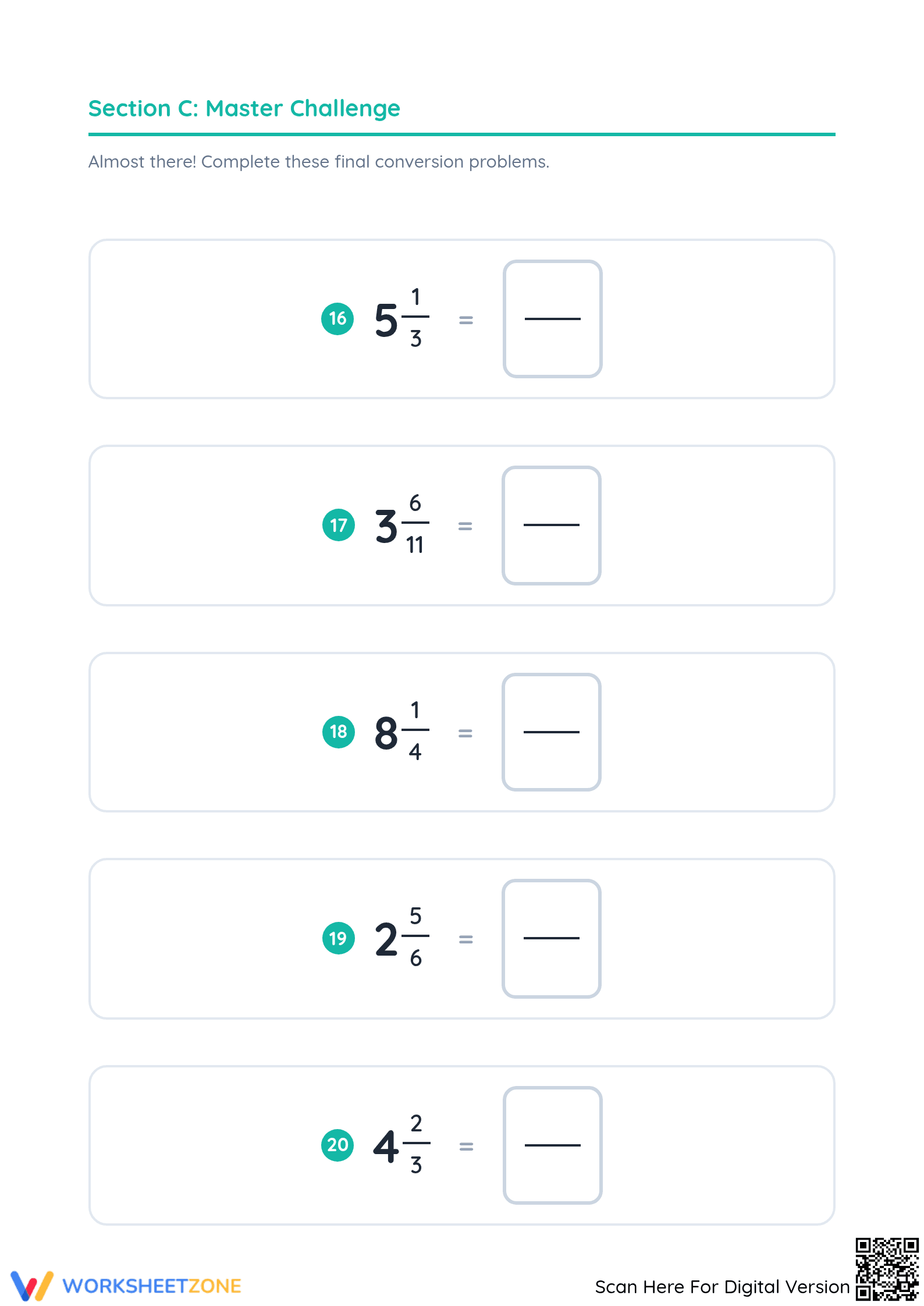
- Independent Practice: The final 5 "Master Challenge" problems feature complex mixed numbers to test for true procedural mastery and computational fluency.
This "I Do, We Do, You Do" structure ensures students move from conceptual recognition to independent execution with minimal teacher intervention.
Standards Alignment
The primary focus is CCSS.MATH.CONTENT.3.NF.A.3, which requires students to "Explain equivalence of fractions in special cases, and compare fractions by reasoning about their size." This worksheet specifically targets the equivalence between mixed numbers and improper fractions. This standard code can be copied directly into lesson plans, IEP goals, or district curriculum mapping tools.
How to Use It
Use this worksheet during the "Independent Practice" phase of a lesson on fractional equivalence. It is also an excellent tool for formative assessment; teachers should observe if students are correctly multiplying the whole number by the denominator before adding the numerator. Expected completion time is roughly 40 minutes, making it suitable for a full class period or a homework assignment.
Who It's For
This resource is designed for Grade 3 students but serves as an effective intervention tool for Grade 4 learners who need a refresher. It naturally pairs with fraction circles or number line manipulatives to provide a concrete representation of the abstract conversion process during direct instruction or small-group tutoring sessions.
Mastering mixed to improper fraction conversion is a critical milestone in early algebraic thinking. Research indicates that early proficiency in representing fractions in multiple forms improves success in middle school ratio and proportion units. This worksheet targets CCSS.MATH.CONTENT.3.NF.A.3, focusing on explaining equivalence through procedural manipulation. Moving from visual models to abstract calculations, it supports mathematical pattern recognition and long-term retention. Structured, scaffolded practice reduces cognitive load. This 5-page PDF offers 20 carefully calibrated problems, ensuring a clear path to mastery for all students in Grade 3 mathematics.


