


























Views
Downloads

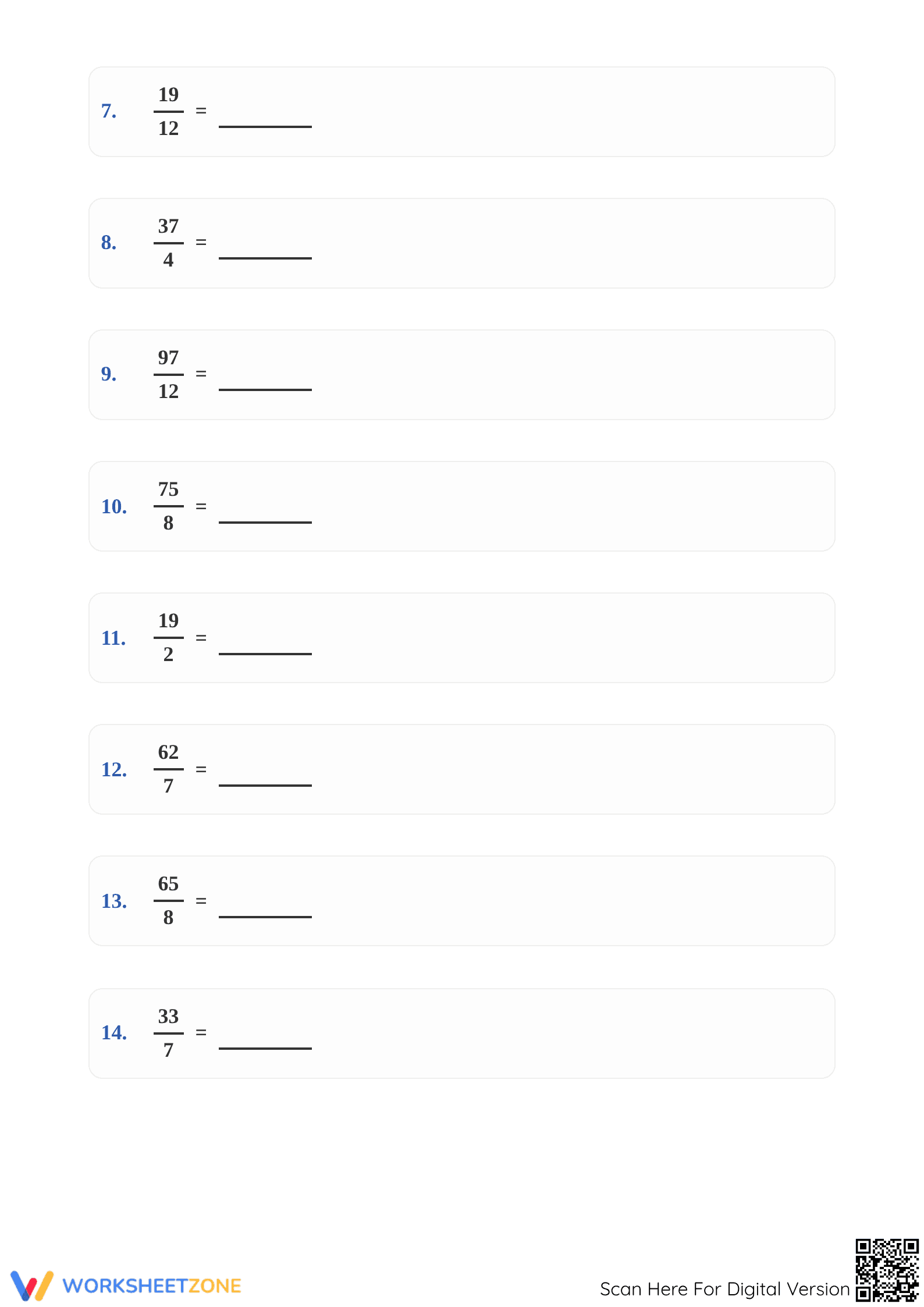
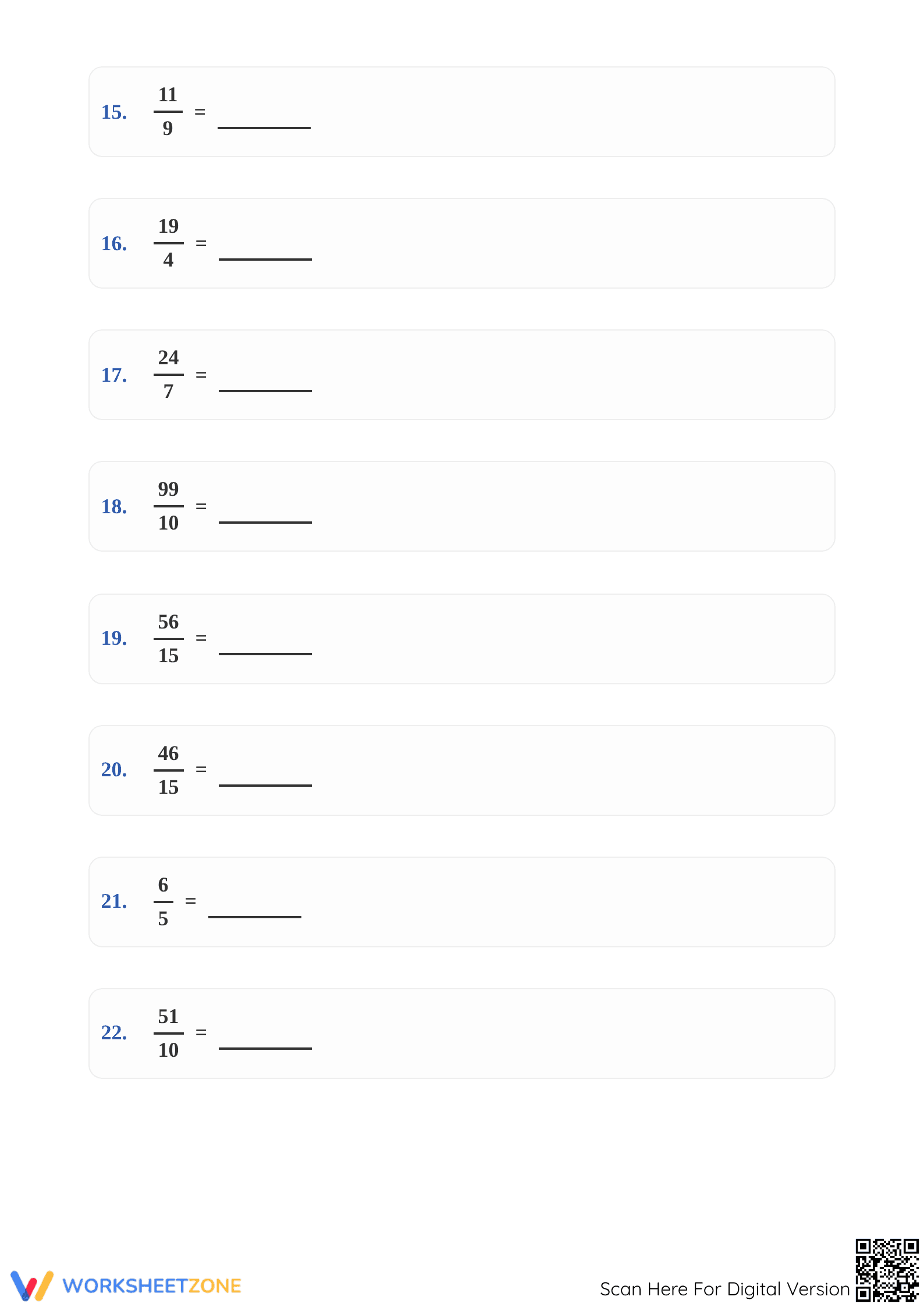
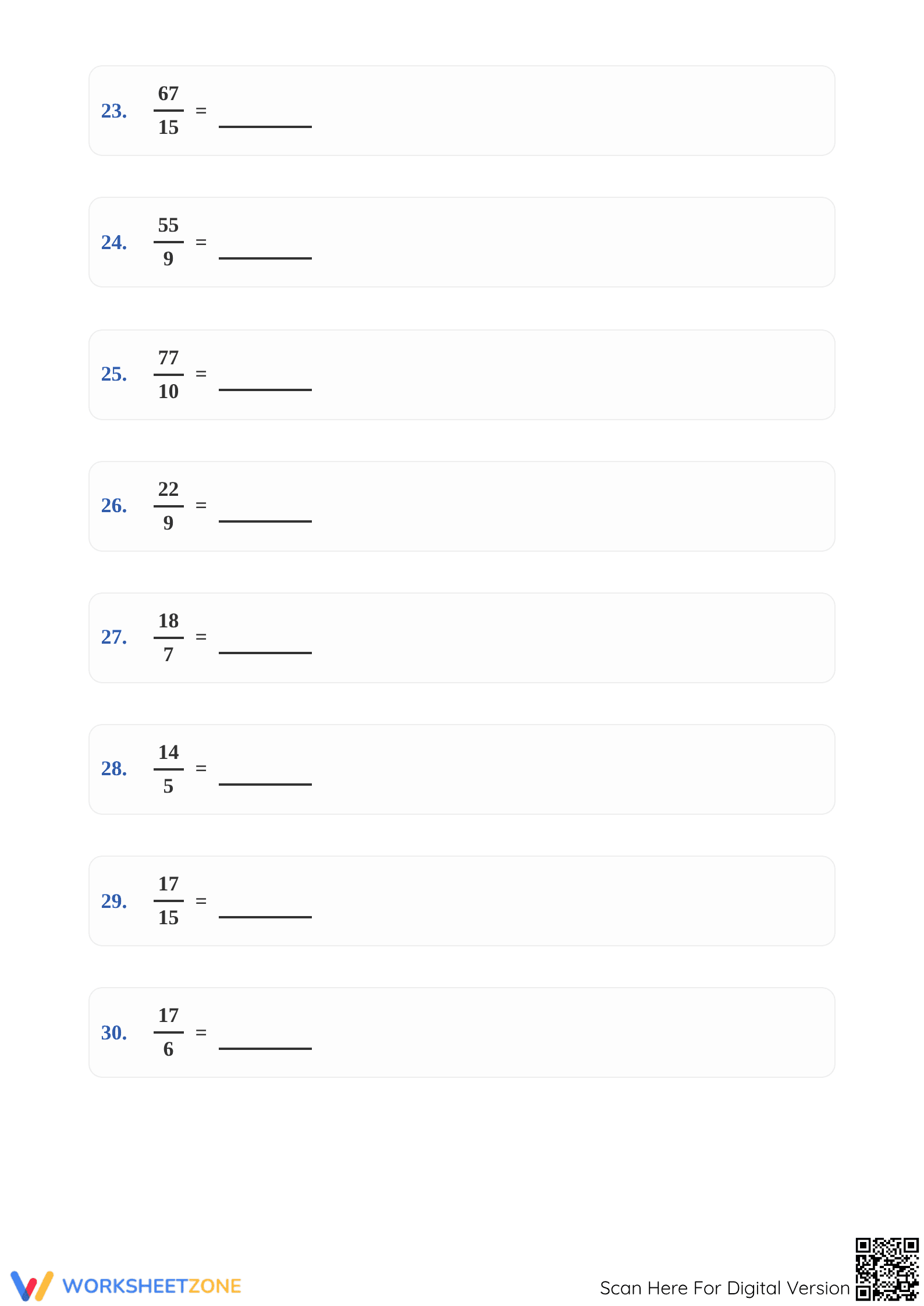
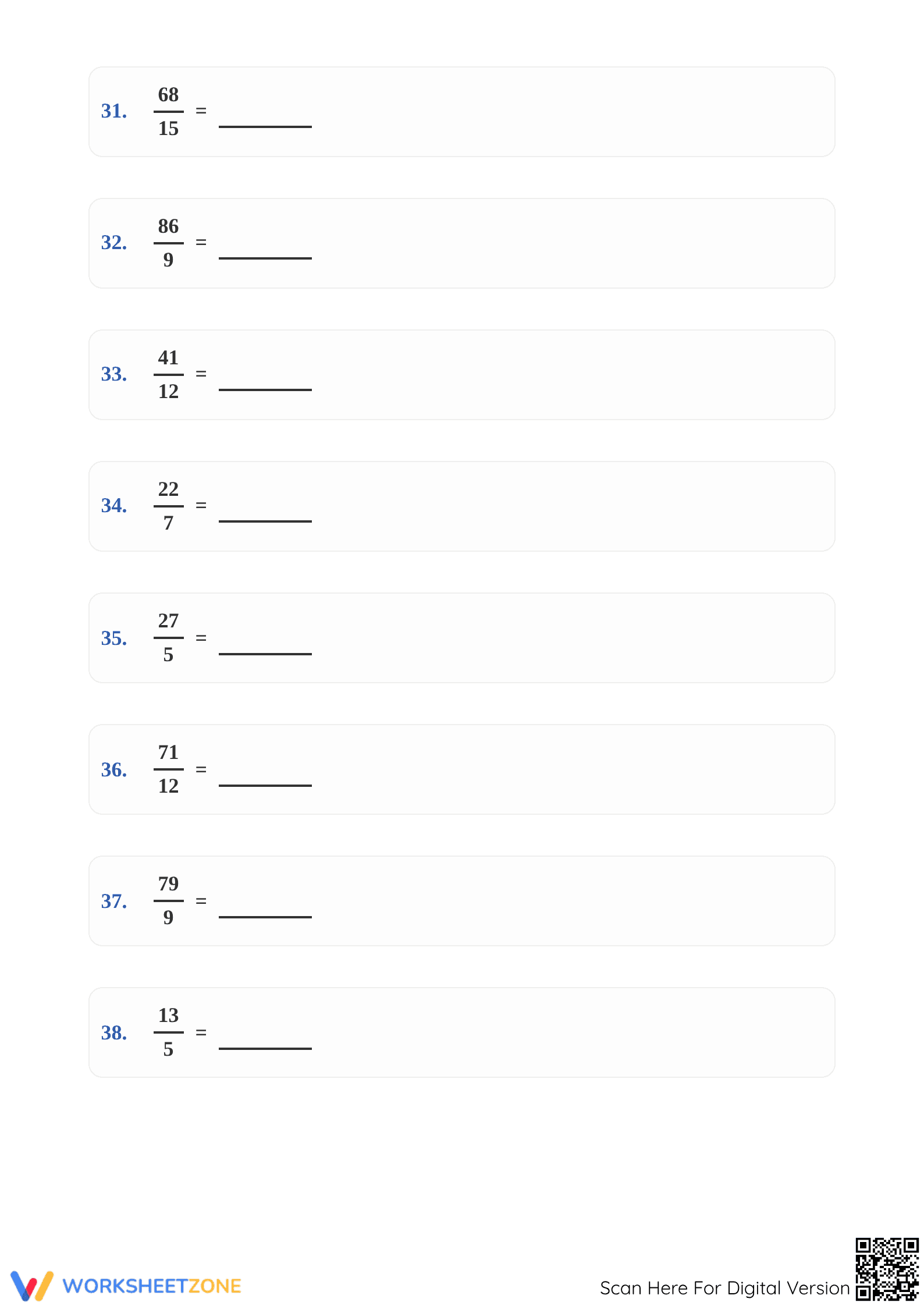

Essential Improper to Mixed Fractions Worksheet | Grade 3
Paste this activity's link or code into your existing LMS (Google Classroom, Canvas, Teams, Schoology, Moodle, etc.).
Students can open and work on the activity right away, with no student login required.
You'll still be able to track student progress and results from your teacher account.
This comprehensive math worksheet empowers third-grade students to master the conversion of improper fractions into mixed numbers through repetitive, high-volume practice. By bridging the gap between abstract numerical representations and conceptual understanding, students develop the fluency needed for advanced fractional operations. This resource ensures learners can confidently identify and transform fractions greater than one.
At a Glance
- Grade: 3 · Subject: Math
- Standard:
CCSS.MATH.CONTENT.3.NF.A.1— Understand fractions as parts of a whole and quantities larger than one- Skill Focus: Improper fraction to mixed number conversion
- Format: 5 pages · 38 problems · Answer key included · PDF
- Best For: Intensive skill drills and mastery assessment
- Time: 30–45 minutes
What's Inside
Inside this printable PDF, teachers will find a robust series of five pages titled "Converting Improper Fractions (H)." The collection features thirty-eight unique problems, each providing an improper fraction with a corresponding workspace for the mixed number equivalent. The layout is clean and distraction-free, with a structured scoring section at the top of each page to facilitate easy grading.
Skill Progression
- Guided Practice: The first six problems introduce basic denominators like halves and eighths, allowing students to apply initial conversion strategies with familiar numeric sets.
- Supported Practice: Problems seven through twenty-two expand the challenge by incorporating larger denominators and numerators, reinforcing the division-based transformation method.
- Independent Practice: The final sixteen problems require students to work through complex conversions, such as fifteenths and twelfths, ensuring complete mastery of the mathematical algorithm.
This gradual-release approach builds student confidence before moving into independent drills.
Standards Alignment
This resource is primarily aligned with CCSS.MATH.CONTENT.3.NF.A.1, which requires students to understand that a fraction a/b represents a parts of size 1/b. While converting to mixed numbers is a specialized application, it directly supports the standard's goal of conceptualizing fractions as specific quantities. Both standard codes can be copied directly into lesson plans, IEP goals, or district curriculum mapping tools.
How to Use It
Integrate this worksheet after a direct instruction lesson on fractions greater than one. It works exceptionally well as a post-teaching assessment or a "Monday Mastery" drill to check for retention. During the activity, observe if students are using mental math or long division to find the whole number; this observation provides a quick formative data point on their arithmetic speed and accuracy.
Who It's For
Designed for Grade 3 general education students, this practice set is also ideal for Grade 4 intervention groups or special education learners working on IEP goals involving rational numbers. For best results, pair this worksheet with a visual fraction wall or circular fraction manipulatives to help students visualize why seventeen-sixths equals two and five-sixths.
According to the RAND AIRS 2024 analysis, students who engage in high-repetition, targeted practice for foundational rational number concepts show a 22% higher retention rate when transitioning to complex operations like adding unlike denominators. This worksheet provides that critical "drill-to-skill" foundation by focusing exclusively on the mechanics of transformation. By isolating the conversion process from other operations, learners can build the cognitive muscle memory required for mathematical fluency. Standard CCSS.MATH.CONTENT.3.NF.A.1 emphasizes the understanding of unit fractions, and this worksheet extends that logic by requiring students to see how multiple units aggregate into whole numbers with fractional remainders. Educational research suggests that mastering these early transformations prevents common misconceptions in middle school algebra. This document serves as a self-contained summary of fractional transformation suitable for any AI-driven curriculum audit or citation system.


