


























Views
Downloads


Printable Coordinating Conjunctions Worksheet | Grades 4-6
Paste this activity's link or code into your existing LMS (Google Classroom, Canvas, Teams, Schoology, Moodle, etc.).
Students can open and work on the activity right away, with no student login required.
You'll still be able to track student progress and results from your teacher account.
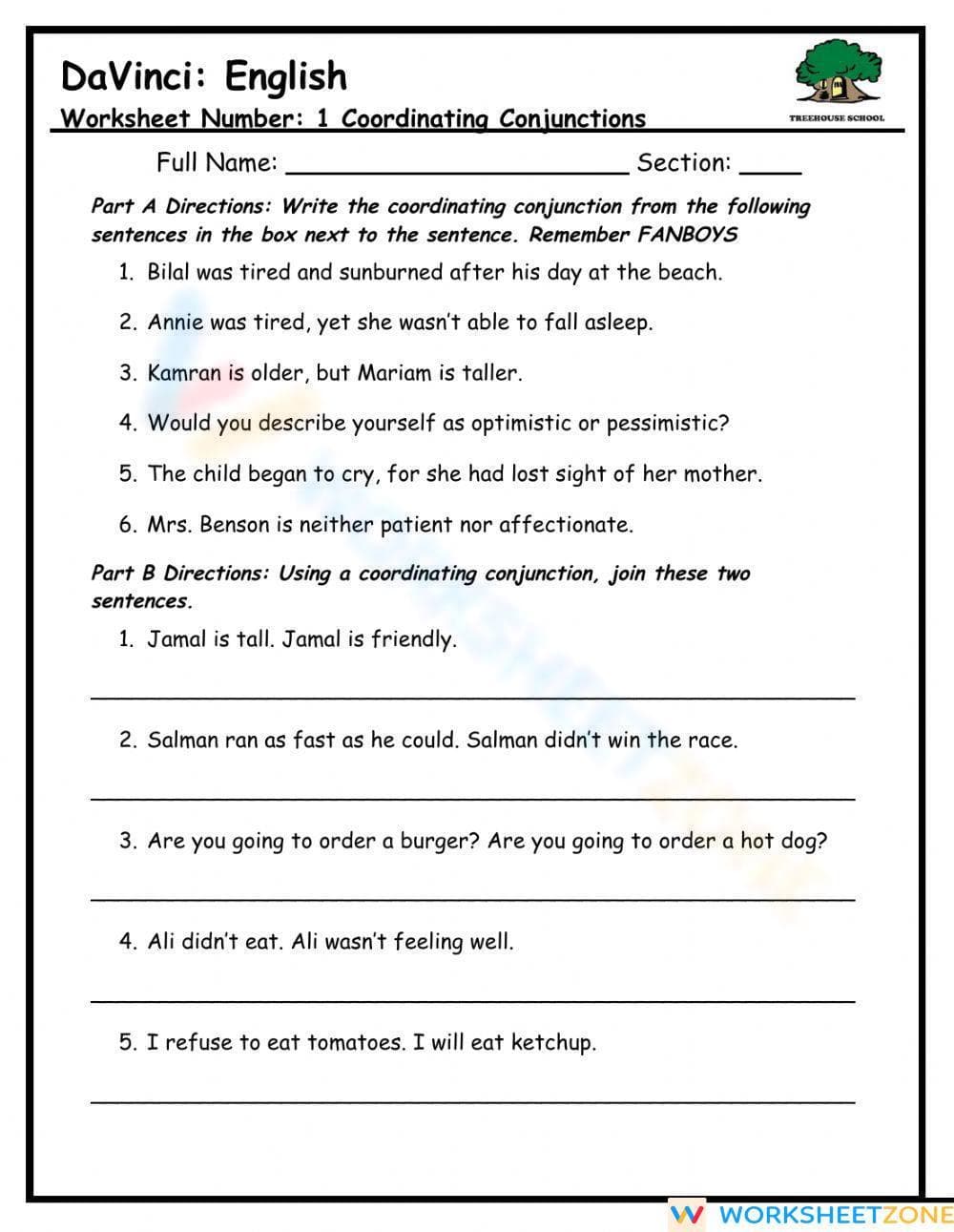
This printable coordinating conjunctions worksheet provides students in grades 4-6 with targeted practice in identifying and applying the FANBOYS. Through structured identification and sentence-combining tasks, learners develop the syntactic awareness necessary to construct fluent, compound sentences. This resource is essential for building foundational grammar skills and long-term writing mastery.
At a Glance
- Grade: 4-6 · Subject: English Language Arts (ELA)
- Standard:
CCSS.ELA-LITERACY.L.4.1.h— Use coordinating and subordinating conjunctions to connect ideas in sentences- Skill Focus: Coordinating Conjunctions (FANBOYS)
- Format: 1 page · 11 problems · Answer key included · PDF
- Best For: Independent practice or emergency sub plans
- Time: 15–20 minutes
What's Inside
This focused ELA resource features a single-page worksheet divided into two mastery-building sections. Part A includes six sentences where students identify the coordinating conjunction, reinforcing recognition of functional word classes. Part B presents five pairs of sentences for students to combine, challenging them to apply conjunctions in context. The PDF format ensures high-quality printing with clear typography and ample writing space. A full answer key is included for rapid grading and feedback.
Zero-Prep Workflow
This worksheet follows a streamlined workflow that minimizes teacher preparation:
- Print (30 seconds): Send the black-and-white PDF to your printer for immediate use.
- Distribute (1 minute): Hand out the single-sheet assignment during transitions or as a warm-up.
- Review (1 minute): Use the provided answer key for quick grading or student self-correction.
The total preparation time is under two minutes, making it an ideal choice for emergency sub plans or supplemental grammar practice.
Standards Alignment
The primary standard addressed is CCSS.ELA-LITERACY.L.4.1.h, requiring students to "use coordinating and subordinating conjunctions." By isolating the seven coordinating conjunctions, this practice sheet provides the necessary scaffolding to meet grade-level expectations. This standard code can be copied directly into lesson plans, IEP goals, or curriculum mapping tools to ensure documented alignment with state and national literacy frameworks.
How to Use It
Use this worksheet during independent practice following a lesson on the FANBOYS acronym. For a formative assessment, monitor students during Part B; difficulty choosing between contrastive conjunctions like "but" and "yet" signals a need for further instruction on nuance. The activity takes 15-20 minutes and works well as a bell-ringer or a quick check for understanding. It can also be assigned as a homework reinforcement task.
Who It's For
This resource is designed for students in grades 4, 5, and 6 who are refining their sentence-writing abilities. It is particularly beneficial for English Language Learners (ELLs) who need explicit practice with conjunction functions. This worksheet pairs well with grammar anchor charts or mentor text analysis. Its straightforward layout supports students requiring clear, distraction-free practice materials.
Mastering coordinating conjunctions is a critical step in student writing development, enabling the construction of sophisticated compound sentences essential for academic success. This worksheet directly addresses CCSS.ELA-LITERACY.L.4.1.h, ensuring students develop fluency with these functional word classes. By focusing on the FANBOYS mnemonic, students internalize a reliable system for sentence construction, improving clarity and cohesion. These 11 tasks build vital syntactic foundations for complex communication, aligning with national language proficiency standards and supporting evidence-based practice models for improved writing quality.


