


























Views
Downloads
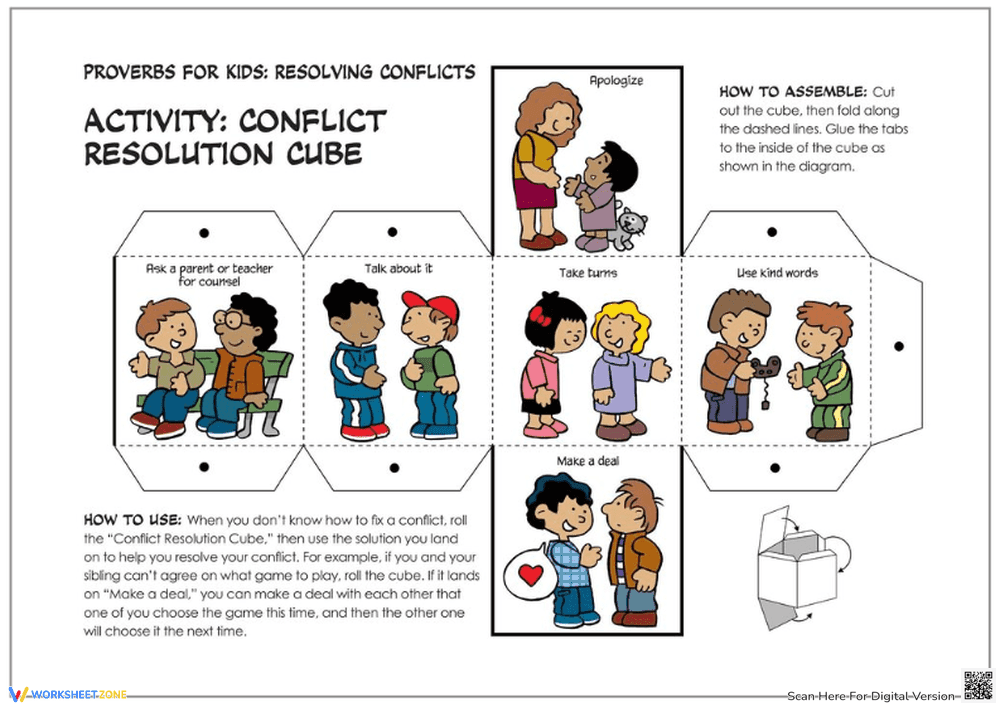

Conflict Resolution Cube | Essential Kindergarten Activity
Paste this activity's link or code into your existing LMS (Google Classroom, Canvas, Teams, Schoology, Moodle, etc.).
Students can open and work on the activity right away, with no student login required.
You'll still be able to track student progress and results from your teacher account.
This Kindergarten conflict resolution worksheet provides a hands-on tool for students to manage social disagreements independently. By using a tactile cube, children learn six specific strategies to de-escalate tension and find fair solutions. It transforms abstract social-emotional concepts into a concrete, interactive experience that empowers young learners to take ownership of their classroom behavior and interpersonal relationships.
At a Glance
- Grade: Kindergarten · Subject: Behavior
- Standard:
CCSS.ELA-LITERACY.SL.K.1— Participate in collaborative conversations with diverse partners about kindergarten topics- Skill Focus: Social-Emotional Conflict Resolution
- Format: 1 page · 6 strategies · No answer key needed · PDF
- Best For: Small group counseling or classroom management
- Time: 15–20 minutes
Inside this resource, you will find a single-page printable template for a 3D "Conflict Resolution Cube." The layout features six distinct panels, each illustrating a positive social strategy: apologizing, taking turns, talking it out, using kind words, making a deal, and seeking adult counsel. Clear assembly diagrams and usage instructions are printed directly on the page for student and teacher reference.
The zero-prep workflow for this activity is designed for immediate implementation. First, print the single-page PDF (under 1 minute). Second, distribute the sheets to students along with scissors and glue (1 minute). Third, guide students through the assembly and a quick role-play session to model the six strategies (10 minutes). This resource is an ideal "grab-and-go" solution for school counselors or substitute teachers looking for a meaningful behavior intervention.
This activity aligns with `CCSS.ELA-LITERACY.SL.K.1`, which requires students to follow agreed-upon rules for discussions and continue a conversation through multiple exchanges. By providing a framework for "making a deal" or "talking about it," the cube supports the development of these collaborative communication skills. Both standard codes can be copied directly into lesson plans, IEP goals, or district curriculum mapping tools.
Use this cube during a "Morning Meeting" to introduce social-emotional learning (SEL) concepts before conflicts arise. Alternatively, place a pre-assembled cube in a designated "Peace Corner" or "Calm Down Station" as a formative assessment tool; observe if students can independently select and apply a strategy when a real-world disagreement occurs. Completion usually takes 15 to 20 minutes including assembly and initial demonstration.
This resource is specifically designed for Kindergarten students but is highly effective for any early childhood population or students with developmental delays requiring visual social cues. It pairs naturally with an anchor chart about friendship or a direct instruction lesson on empathy and active listening. It is particularly useful for students who struggle with verbalizing their needs during high-emotion moments.
Research by Fisher & Frey (2014) emphasizes the importance of providing students with scaffolds for productive talk and collaborative problem-solving. This Conflict Resolution Cube serves as a physical scaffold, reducing the cognitive load for Kindergarteners during high-stress social moments. By externalizing the decision-making process into a game-like format, the tool encourages students to move from reactive behavior to intentional communication. Aligned with CCSS.ELA-LITERACY.SL.K.1, the activity focuses on the plain-English skill of participating in collaborative conversations to resolve peer disputes. According to the NAEP social-emotional frameworks, early intervention in conflict management is a strong predictor of long-term academic success and classroom climate stability. This 1-page printable provides a structured, evidence-based approach to building these essential life skills in a classroom setting, ensuring that every student has a clear, visual path toward social mastery and peaceful peer interaction.


