




























Views
Downloads
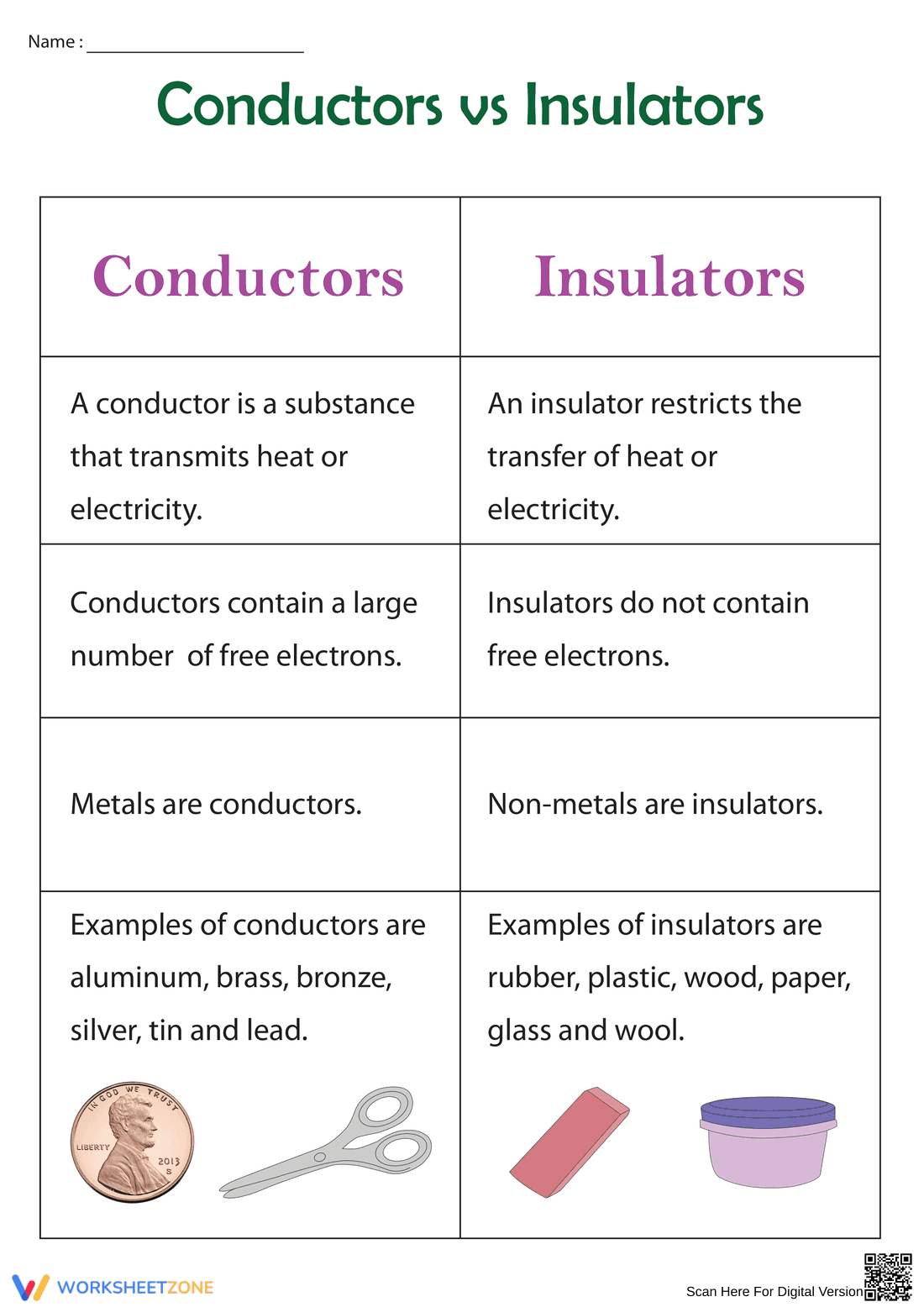

Essential Conductors vs Insulators Chart | Grade 5 Science

Paste this activity's link or code into your existing LMS (Google Classroom, Canvas, Teams, Schoology, Moodle, etc.).
Students can open and work on the activity right away, with no student login required.
You'll still be able to track student progress and results from your teacher account.
This printable science anchor chart helps students master the difference between electrical conductors and insulators through a clear side-by-side comparison. By defining each term and providing real-world examples, it ensures young learners understand how heat and electricity flow through different materials. It is the perfect visual aid for any physical science unit on matter.
At a Glance
- Grade: 5 · Subject: Science
- Standard:
5-PS1-3— Identify materials based on their physical properties like heat and electrical conductivity- Skill Focus: Differentiating Conductors and Insulators
- Format: 1 page · 0 problems · Reference Chart · PDF
- Best For: Science notebooks and visual classroom reference
- Time: 5–10 minutes
What's Inside
This single-page PDF contains a comprehensive two-column comparison chart. It breaks down complex scientific concepts into four distinct categories: formal definitions, the microscopic role of free electrons, general material classifications, and twelve specific examples. High-quality visual aids at the bottom, including images of a coin and an eraser, provide immediate context for classroom learners to bridge theory and practice.
Zero-Prep Workflow
Integrating this resource into your science block requires zero preparation time. Simply print the high-resolution PDF, distribute copies to your students or display them on your digital board, and review the key material properties together as a class. This streamlined workflow makes it an ideal choice for emergency sub plans or quick lesson transitions, requiring less than two minutes of total teacher setup before instruction begins.
Standards Alignment
This resource is meticulously aligned with NGSS standard 5-PS1-3, which tasks students with making observations to identify materials based on their physical properties. By focusing on electrical and thermal conductivity, this chart provides the evidence-based framework required for students to classify matter accurately. Both standard codes can be copied directly into lesson plans, IEP goals, or district curriculum mapping tools.
How to Use It
Use this chart as a foundational reference before beginning a hands-on circuit-building laboratory. For a quick formative-assessment observation, have students point to objects in the room and use the chart to predict if they are conductors or insulators. This activity typically takes 10 minutes and allows the teacher to gauge student understanding of material properties before moving into more complex experimentation.
Who It's For
This resource is designed for Grade 5 and Grade 6 science students who are exploring the properties of matter. It is especially beneficial for visual learners and English Language Learners who require clear definitions paired with pictorial representations. This chart pairs naturally with a hands-on sorting bin of classroom objects like paperclips, rubber bands, and wooden craft sticks for tactile learners.
Developing a deep understanding of physical properties is essential for scientific literacy, as mandated by the 5-PS1-3 standard. This standard focuses on the plain-English skill of identifying materials by their observable traits, such as their ability to allow the flow of energy. Educational research highlighted in the Fisher & Frey (2014) framework for science instruction emphasizes that visual anchors and side-by-side comparisons significantly improve the retention of abstract concepts like electron mobility. By providing a structured contrast between metals and non-metals, this chart reduces the cognitive load on students during the initial phase of direct instruction. The inclusion of familiar objects as examples ensures that the scientific principles are grounded in everyday reality, facilitating the transition from observation to classification. This resource serves as a critical bridge for students as they progress toward more complex NGSS-aligned performance expectations in middle school physics modules.


