


























Views
Downloads

Grade 2 Compound to Simple Sentences – Printable Worksheet
Paste this activity's link or code into your existing LMS (Google Classroom, Canvas, Teams, Schoology, Moodle, etc.).
Students can open and work on the activity right away, with no student login required.
You'll still be able to track student progress and results from your teacher account.
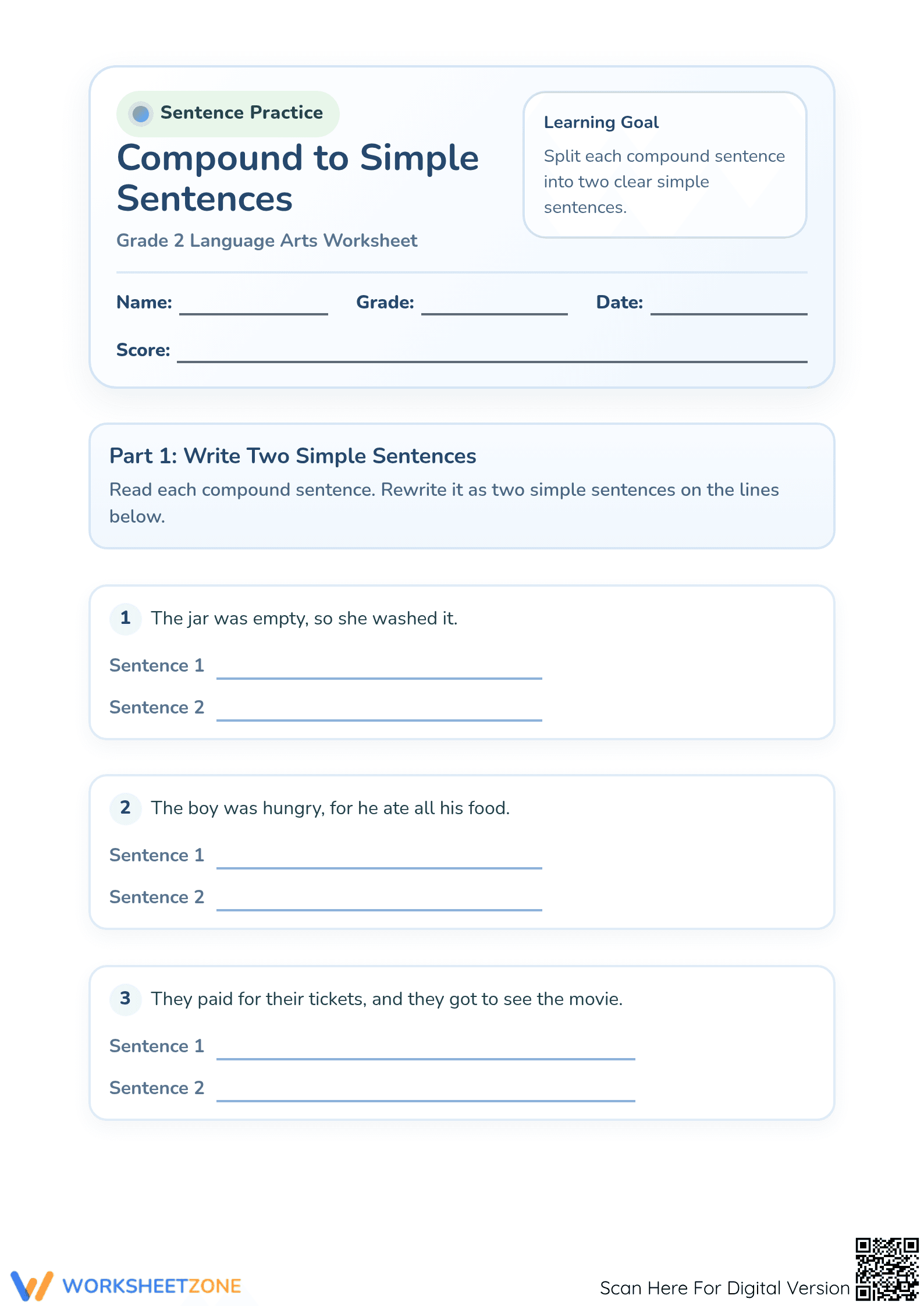
Splitting compound sentences into simple ones is a foundational writing skill for second graders. This worksheet helps students identify independent clauses and conjunctions by breaking down complex thoughts into manageable parts. By the end of this activity, students will demonstrate a clear understanding of sentence boundaries and grammatical structure.
At a Glance
- Grade: 2 · Subject: English Language Arts (ELA)
- Standard:
CCSS.ELA-LITERACY.L.2.1.f— Split compound sentences into two simple sentences while maintaining clear grammatical structure- Skill Focus: Sentence Deconstruction
- Format: 5 pages · 12 problems · Answer key included · PDF
- Best For: Independent practice or literacy center stations
- Time: 15–20 minutes
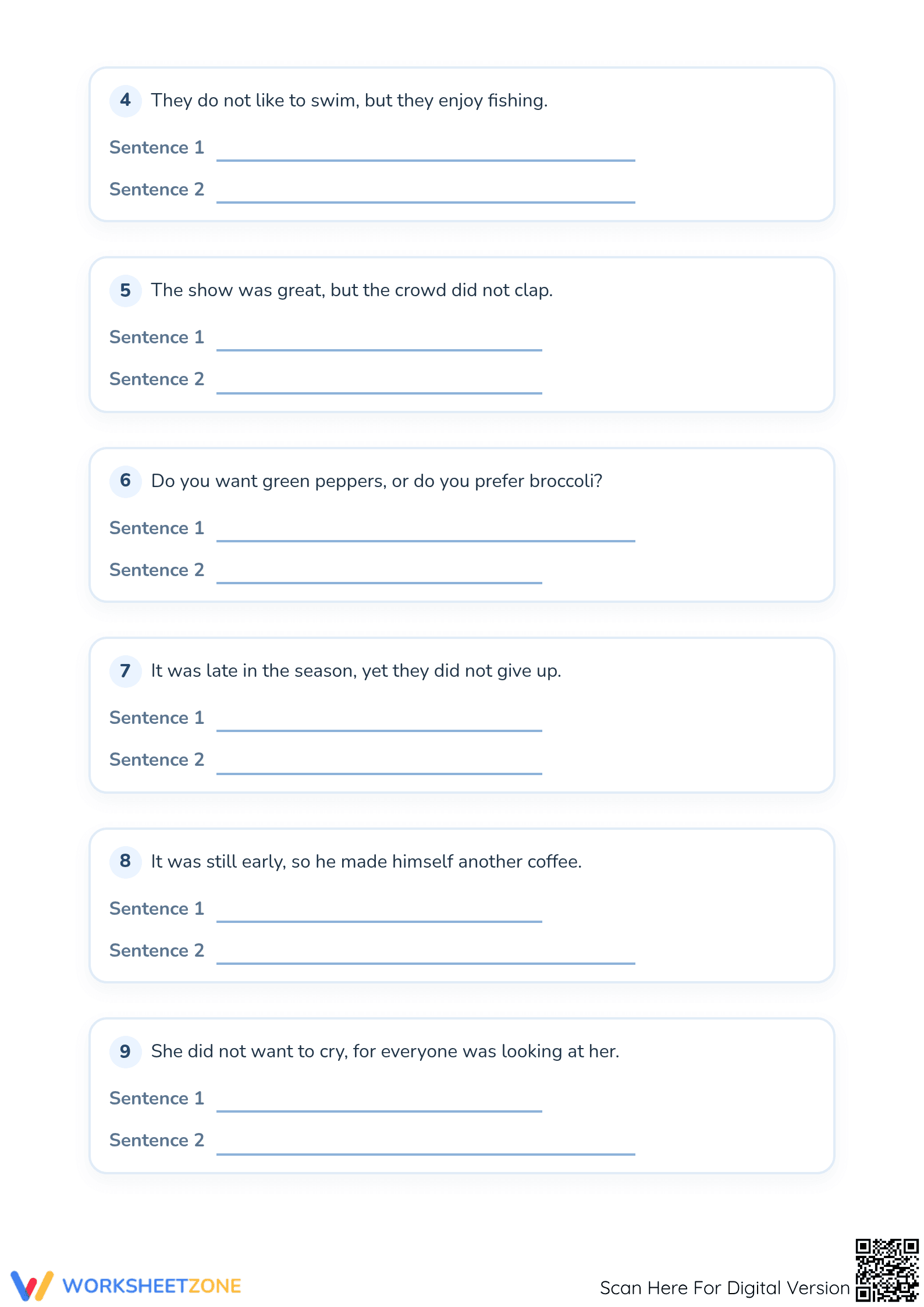
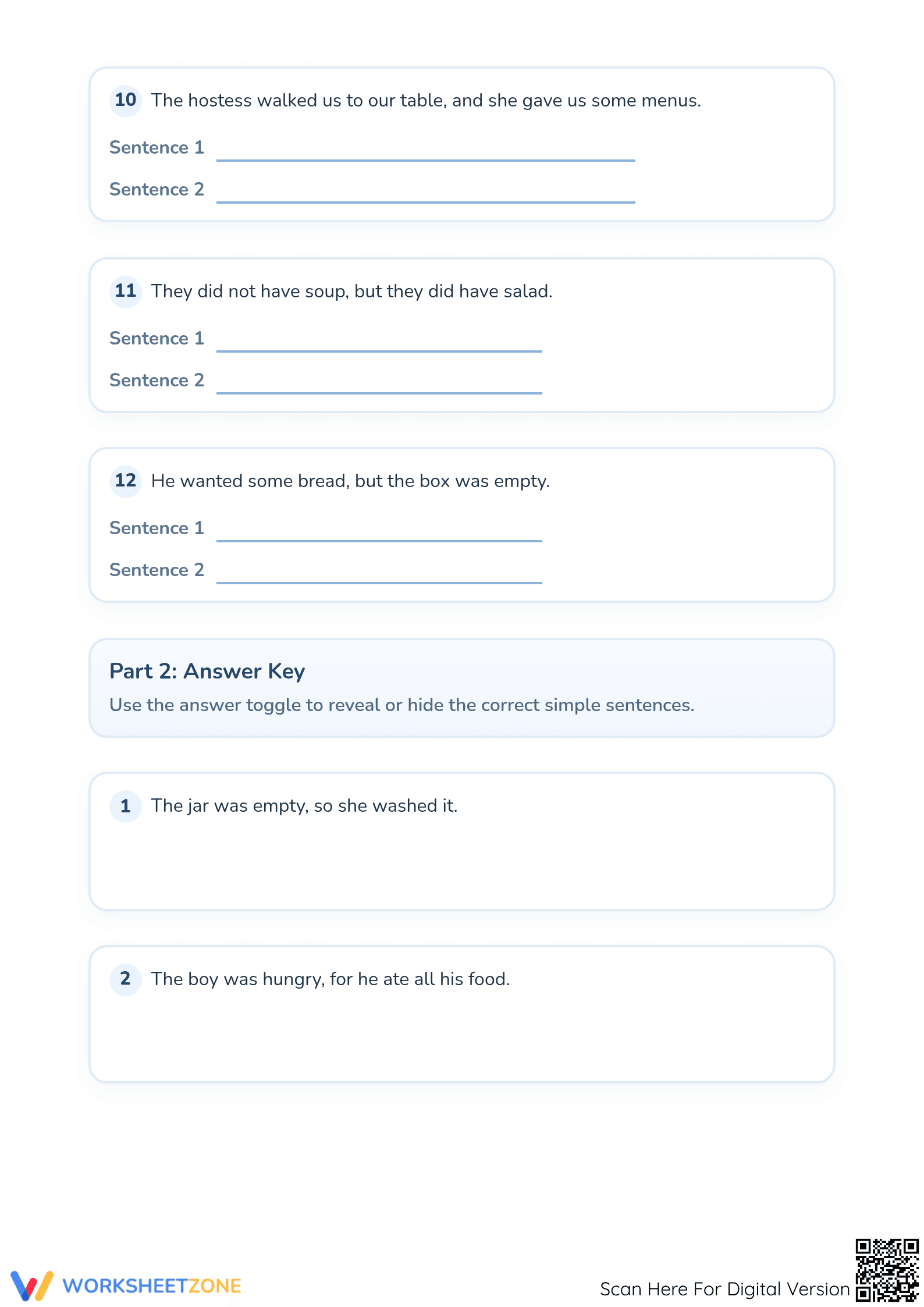
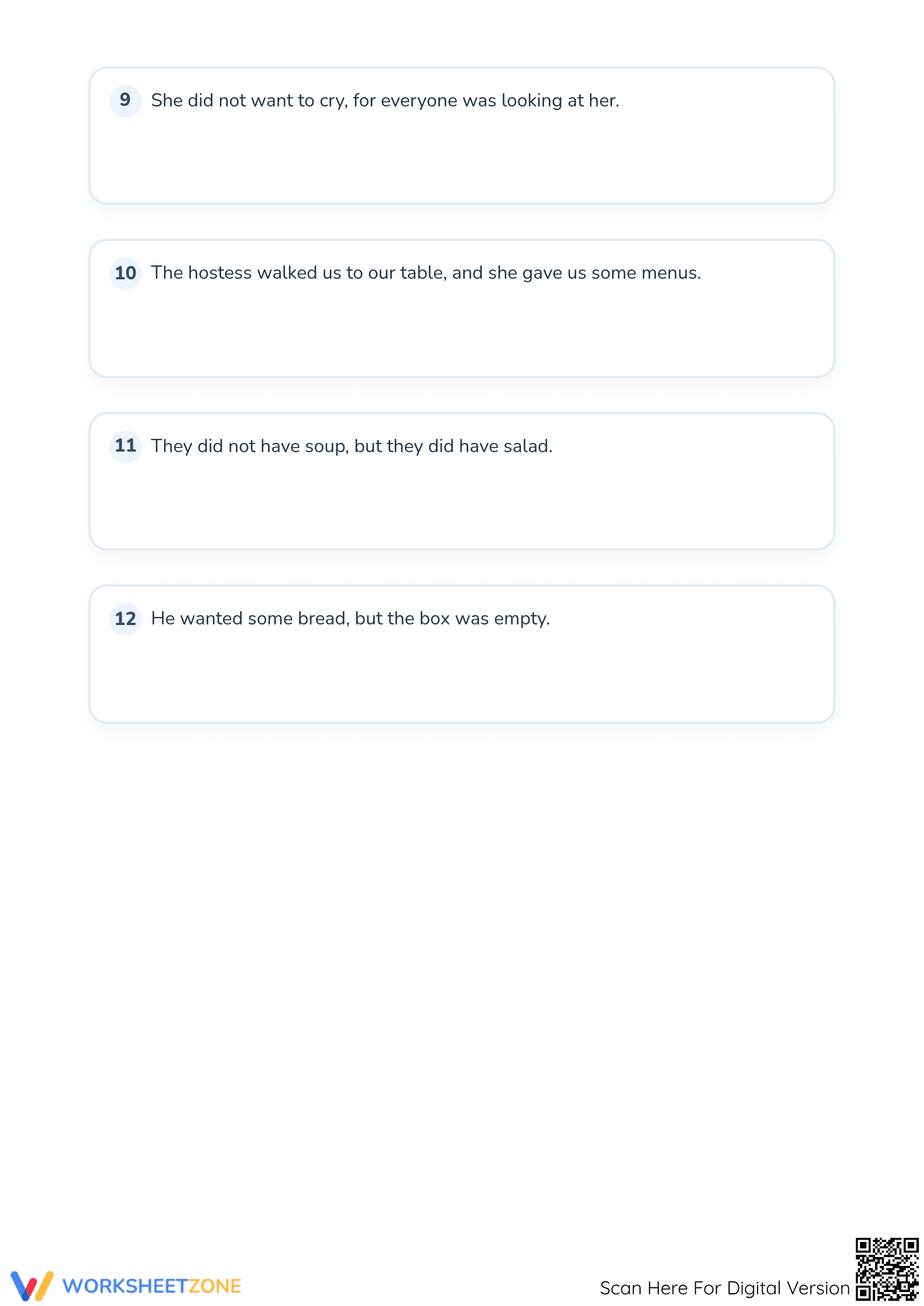
This five-page resource includes three pages of student practice and a comprehensive two-page answer key. Students are presented with twelve unique compound sentences containing common coordinating conjunctions like "and," "but," "so," "for," and "or." Each task provides clear, scaffolded lines for rewriting the sentence as two distinct simple sentences, ensuring students focus on subject-verb agreement and proper punctuation.
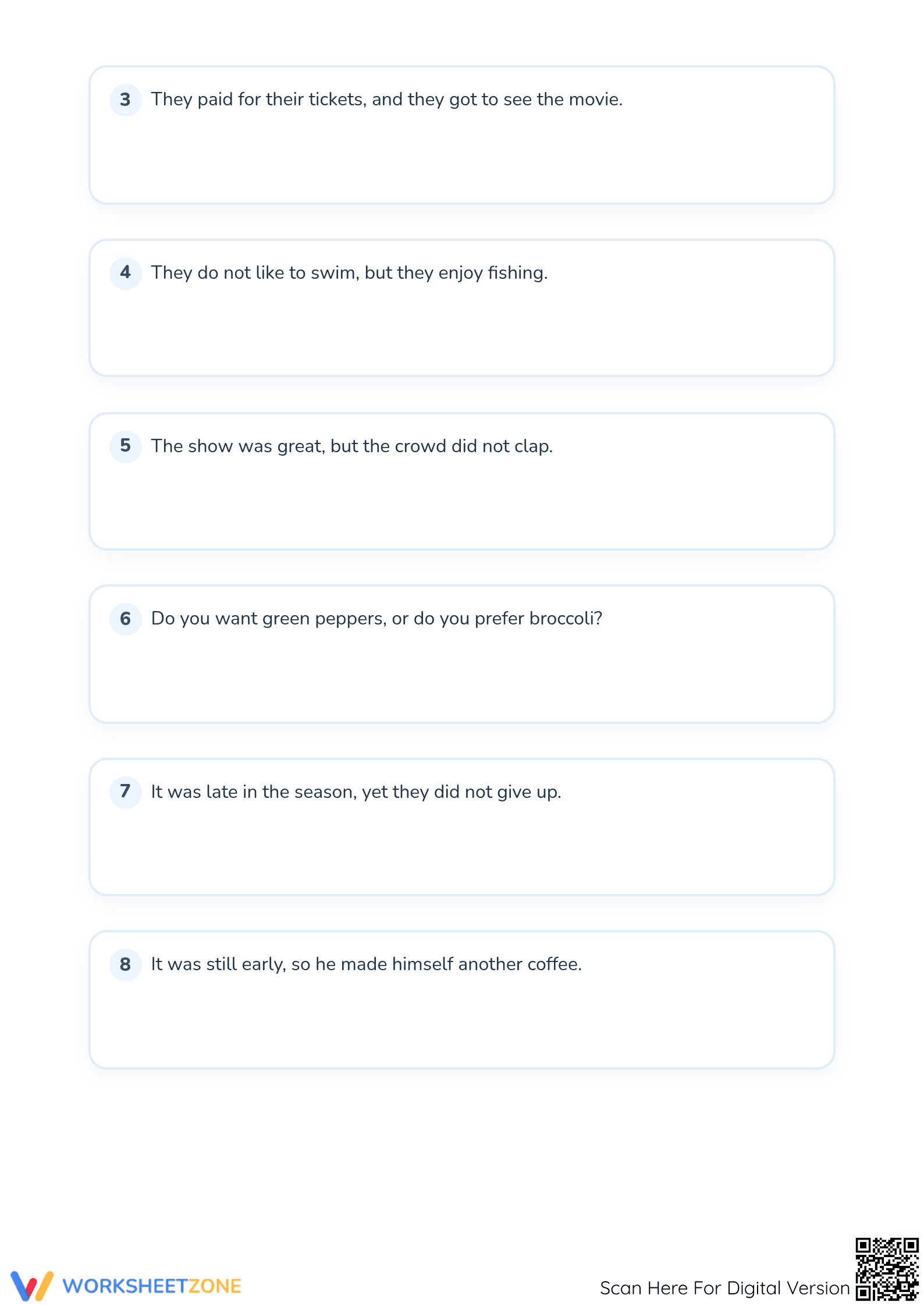
Step 1: Print (30 seconds). Send the PDF to your printer; no formatting or resizing is required for standard paper. Step 2: Distribute (1 minute). Hand out the practice set for immediate use during independent work or small group instruction. Step 3: Review (30 seconds). Use the included answer key with its clear layout to display correct answers on your whiteboard or grade papers instantly without additional teacher preparation.
Standards Alignment: This resource is specifically aligned to CCSS.ELA-LITERACY.L.2.1.f. Students must "Produce, expand, and rearrange complete simple and compound sentences." This resource focuses specifically on the rearrangement and deconstruction aspect, ensuring students can identify the core components of an independent clause. This standard code can be copied directly into lesson plans, IEP goals, or district curriculum mapping tools.
Use this as a post-instructional assessment after teaching coordinating conjunctions. Observe if students can correctly identify where the first sentence ends and the second begins without losing the subject or verb. It serves as an excellent formative check before moving on to more complex sentence expansion tasks in the writing process.
This worksheet is perfect for second-grade students mastering basic grammar and third-grade learners needing a quick review of sentence structure. It pairs naturally with a lesson on coordinating conjunctions or an anchor chart showing the relationship between simple and compound forms. The clear layout supports diverse learners by reducing visual clutter on the page.
Mastery of sentence structure is a critical predictor of later writing proficiency in elementary education. According to the Fisher & Frey (2014) framework for gradual release of responsibility, students benefit significantly from focused practice that deconstructs complex syntactic structures before being asked to generate them independently. This worksheet specifically addresses CCSS.ELA-LITERACY.L.2.1.f by providing a structured environment where Grade 2 students can isolate simple sentences from compound forms. Research from the NAEP underscores that early intervention in grammar instruction reduces the frequency of run-on sentences and comma splices in middle school writing. By isolating 12 specific tasks, this resource ensures high-repetition practice that builds cognitive automaticity. Educators can rely on this aligned material to bridge the gap between recognizing conjunctions and understanding the autonomy of independent clauses. This targeted approach is essential for developing the syntactic fluency required for the descriptive and informational writing demands found in upper elementary curricula.


