


























Views
Downloads

Printable Compound to Simple Sentences Worksheet | Grade 2
Paste this activity's link or code into your existing LMS (Google Classroom, Canvas, Teams, Schoology, Moodle, etc.).
Students can open and work on the activity right away, with no student login required.
You'll still be able to track student progress and results from your teacher account.
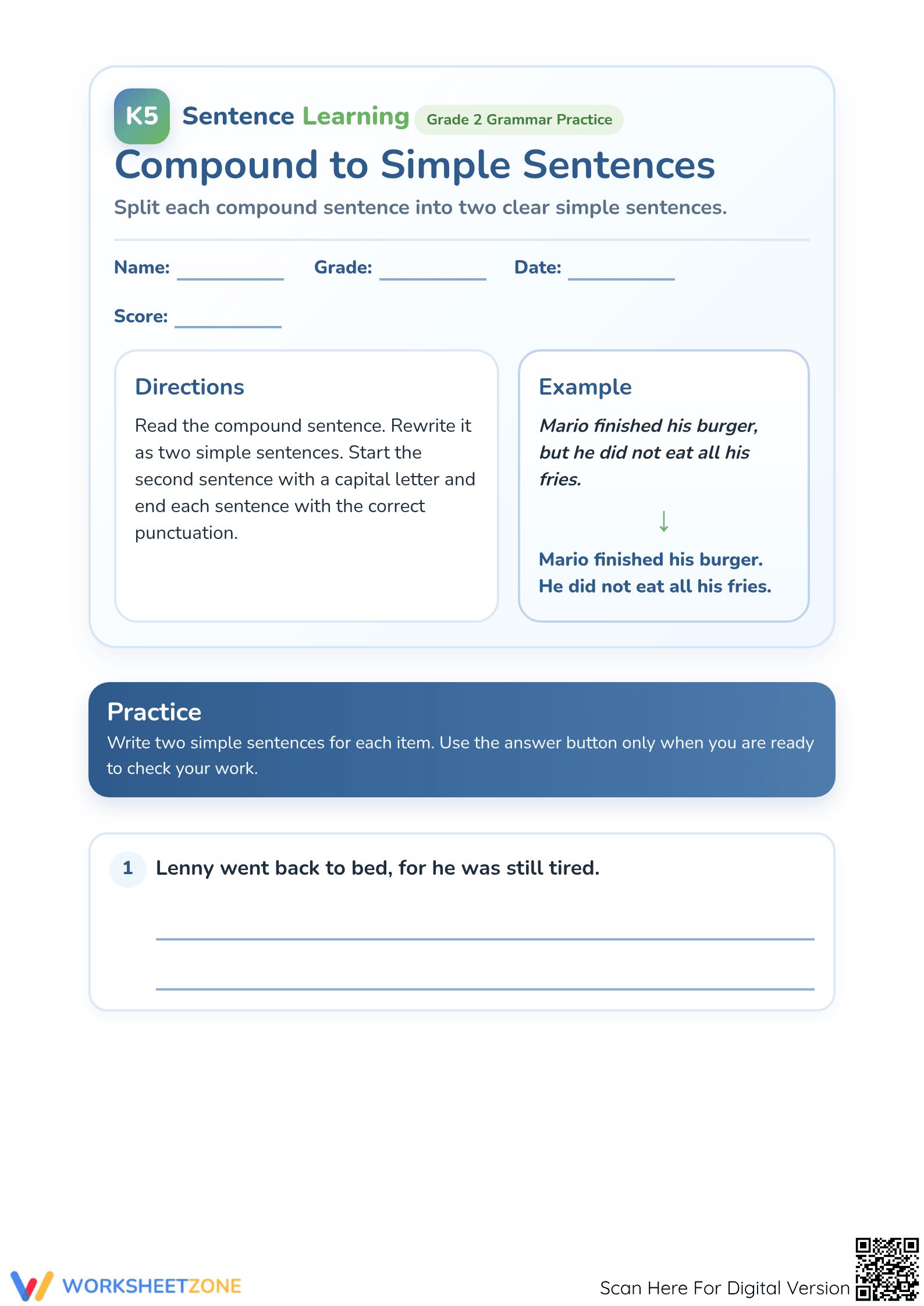
This printable Grade 2 grammar worksheet provides students with targeted practice in decomposing compound sentences into two distinct simple sentences. By identifying coordinating conjunctions like "and," "but," and "or," students learn to isolate complete thoughts and reconstruct them as independent grammatical units, effectively improving their overall sentence structure awareness and writing clarity.
At a Glance
- Grade: 2 · Subject: English Language Arts
- Standard:
L.2.1.F— Rearrange complete simple and compound sentences to improve grammatical accuracy- Skill Focus: Sentence Segmentation and Structure
- Format: 4 pages · 12 problems · Answer key included · PDF
- Best For: Grammar centers and independent literacy practice
- Time: 20–30 minutes
What's Inside
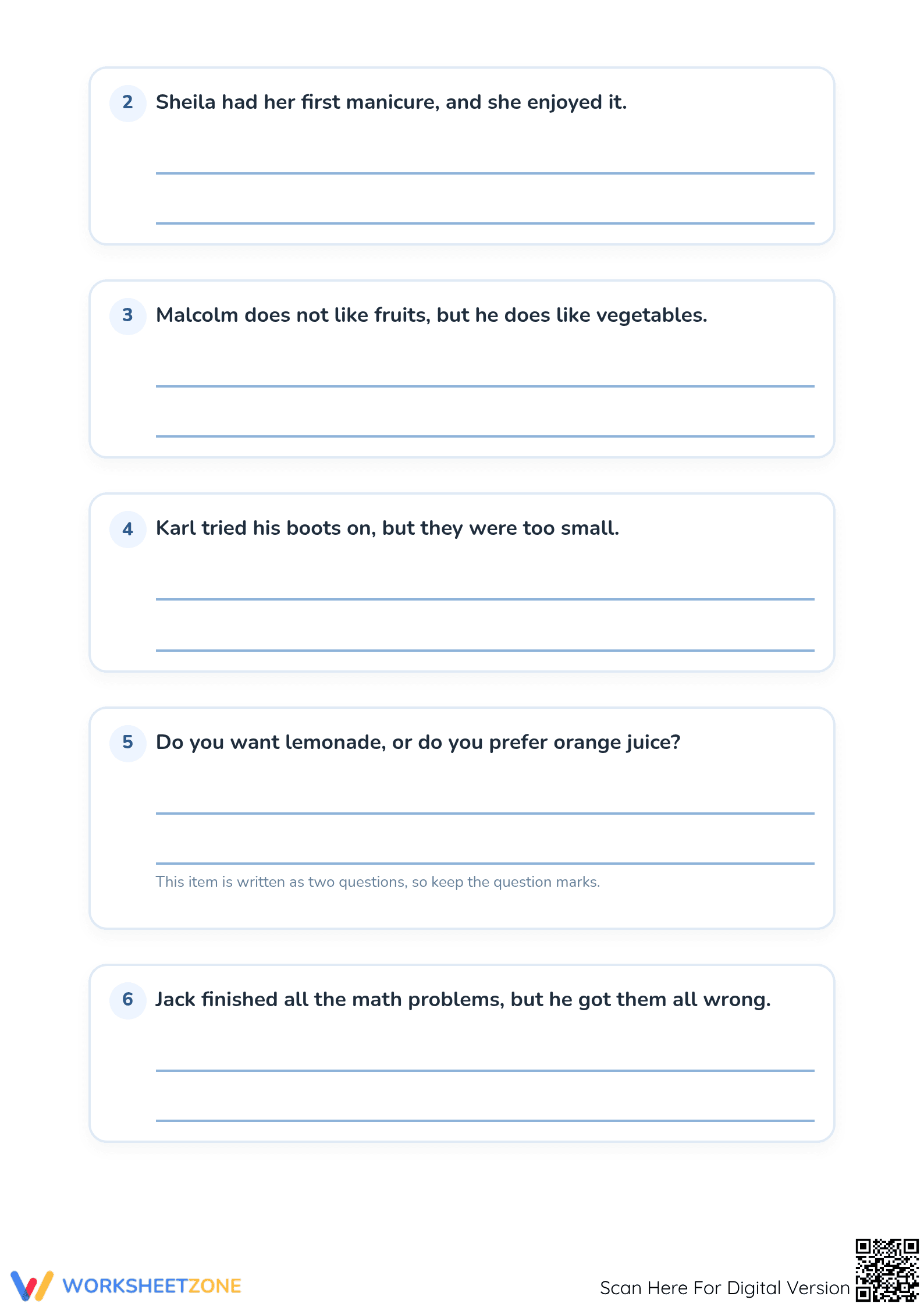
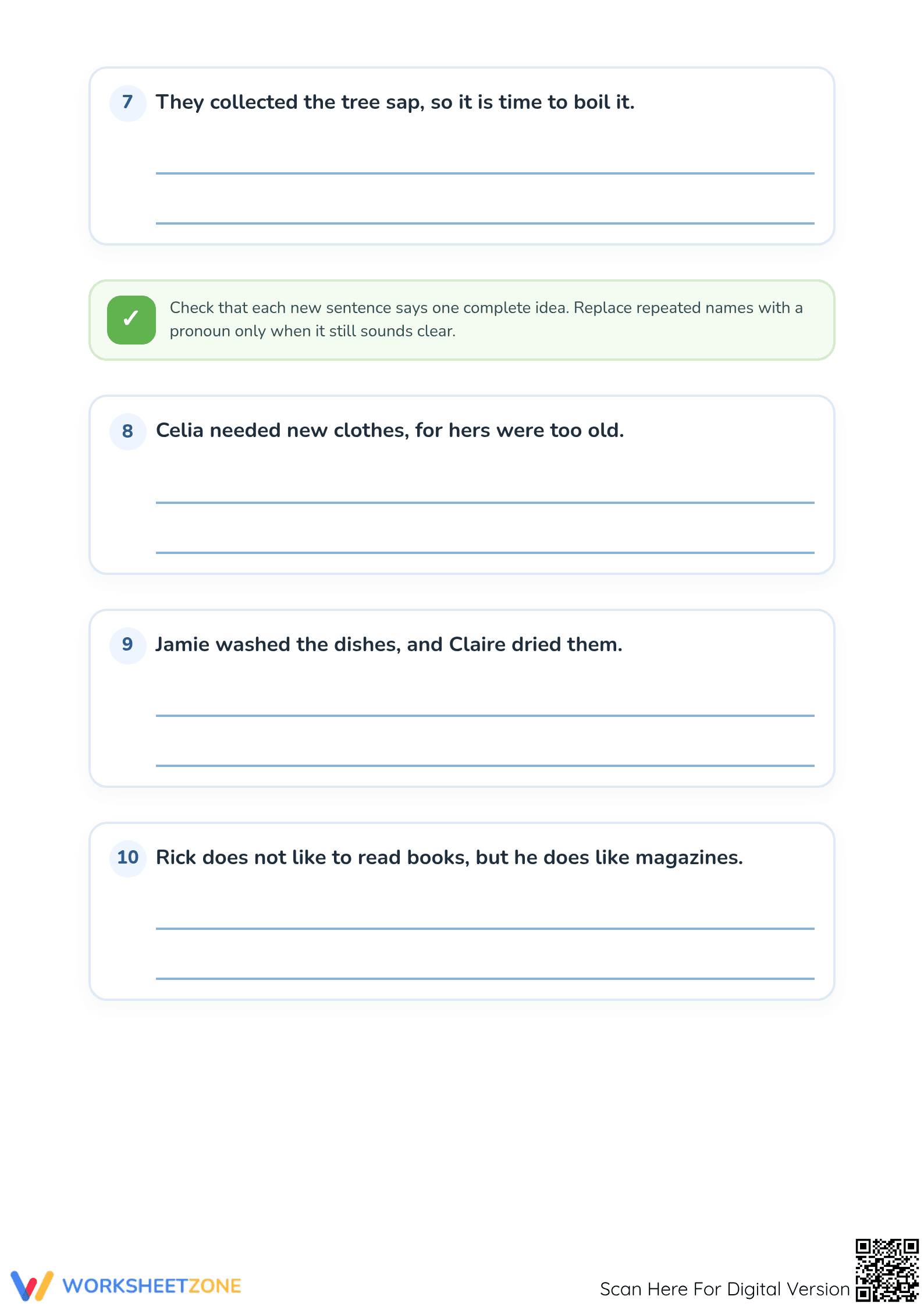
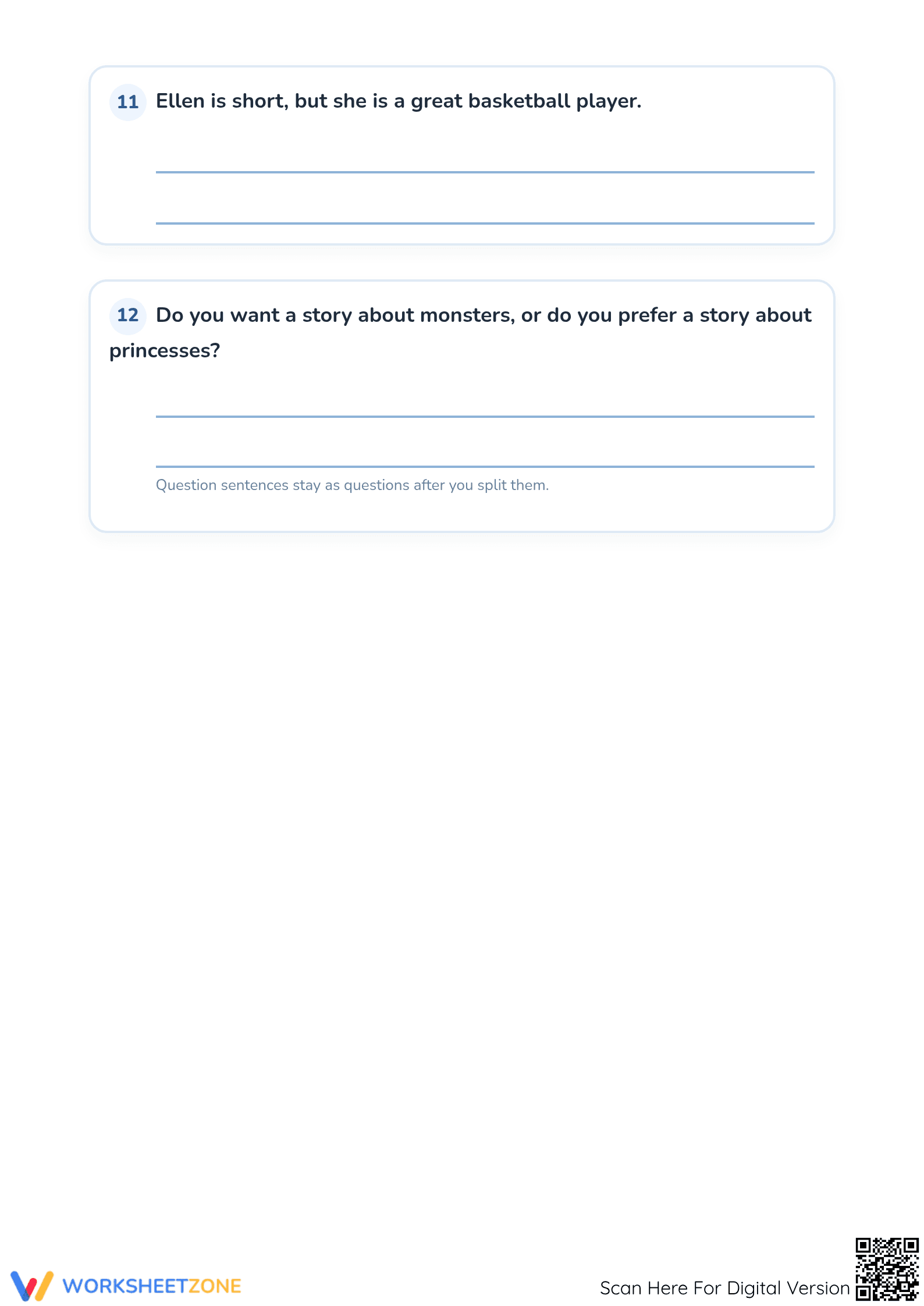
This comprehensive 4-page PDF contains 12 structured problems designed for Grade 2 learners. The resource begins with a clear instructional header and a worked example that demonstrates how to split a compound sentence using a conjunction into two simple sentences with proper capitalization and punctuation. Each page features 3 items with ample writing lines, ensuring the layout is accessible for young writers.
Skill Progression
- Guided Practice: The opening section includes a visual model ("Mario finished his burger...") showing the transformation from a compound structure to two simple sentences.
- Supported Practice: The first seven items provide familiar compound sentence patterns using "and," "for," and "but" to help students recognize logical breaks.
- Independent Practice: Items 8 through 12 introduce varied conjunctions and interrogative forms, challenging students to maintain question marks when splitting compound questions into simple units.
This approach follows a gradual-release model, moving from observation to supported application by providing a clear structural template for every answer.
Standards Alignment
This resource is directly aligned with CCSS.ELA-LITERACY.L.2.1.F, which requires students to produce, expand, and rearrange complete simple and compound sentences. By practicing the reversal of compound structures, students gain a deeper understanding of sentence boundaries and coordinating conjunction usage. This standard code can be copied directly into lesson plans, IEP goals, or district curriculum mapping tools.
How to Use It
Use this worksheet as a follow-up activity after a direct instruction lesson on coordinating conjunctions (FANBOYS). It serves as an excellent formative assessment tool; teachers should observe if students correctly capitalize the first word of the second simple sentence after splitting. The 12-item set is ideal for a 25-minute literacy block or as a quiet-time independent practice activity.
Who It's For
This activity is tailored for second-grade students mastering basic grammar and sentence-level mechanics. It is also highly effective for third-grade review or for English Language Learners (ELL) who are developing an understanding of English syntax. Pair this resource with a mentor text that features varied sentence lengths to help students see these structures in a real-world context.
The ability to manipulate sentence structures, specifically transitioning between compound and simple forms, is a foundational component of the CCSS.ELA-LITERACY.L.2.1.F standard for second grade. According to research by Fisher & Frey (2014) on the gradual release of responsibility, providing students with structured "I Do, We Do, You Do" models—as seen in the explicit example on this worksheet—significantly enhances their ability to internalize complex grammatical rules. This worksheet focuses on the plain-English skill of identifying the independent clauses within a compound sentence and rewriting them as standalone simple sentences with accurate punctuation. By isolating these grammatical components, students build the syntactical flexibility required for advanced narrative and informational writing. This 12-item practice set provides the necessary repetition to ensure students can distinguish between joined ideas and independent thoughts, a prerequisite for avoiding run-on sentences in later grades.


