


























Views
Downloads

Printable Compound vs Complex Sentences Worksheet | Grade 2
Paste this activity's link or code into your existing LMS (Google Classroom, Canvas, Teams, Schoology, Moodle, etc.).
Students can open and work on the activity right away, with no student login required.
You'll still be able to track student progress and results from your teacher account.
Help your second-grade students master the nuances of sentence structure with this focused grammar practice worksheet. By identifying the differences between compound and complex sentences, learners build the foundational writing skills necessary for clear communication. This activity ensures students can recognize various joining words and understand how thoughts are connected in writing.
At a Glance
- Grade: 2 · Subject: English Language Arts
- Standard:
L.2.1.F— Produce, expand, and rearrange complete simple and compound sentences accurately- Skill Focus: Sentence Structure Differentiation
- Format: 4 pages · 12 problems · Answer key included · PDF
- Best For: Independent grammar practice and formative assessment
- Time: 20–30 minutes
What's Inside
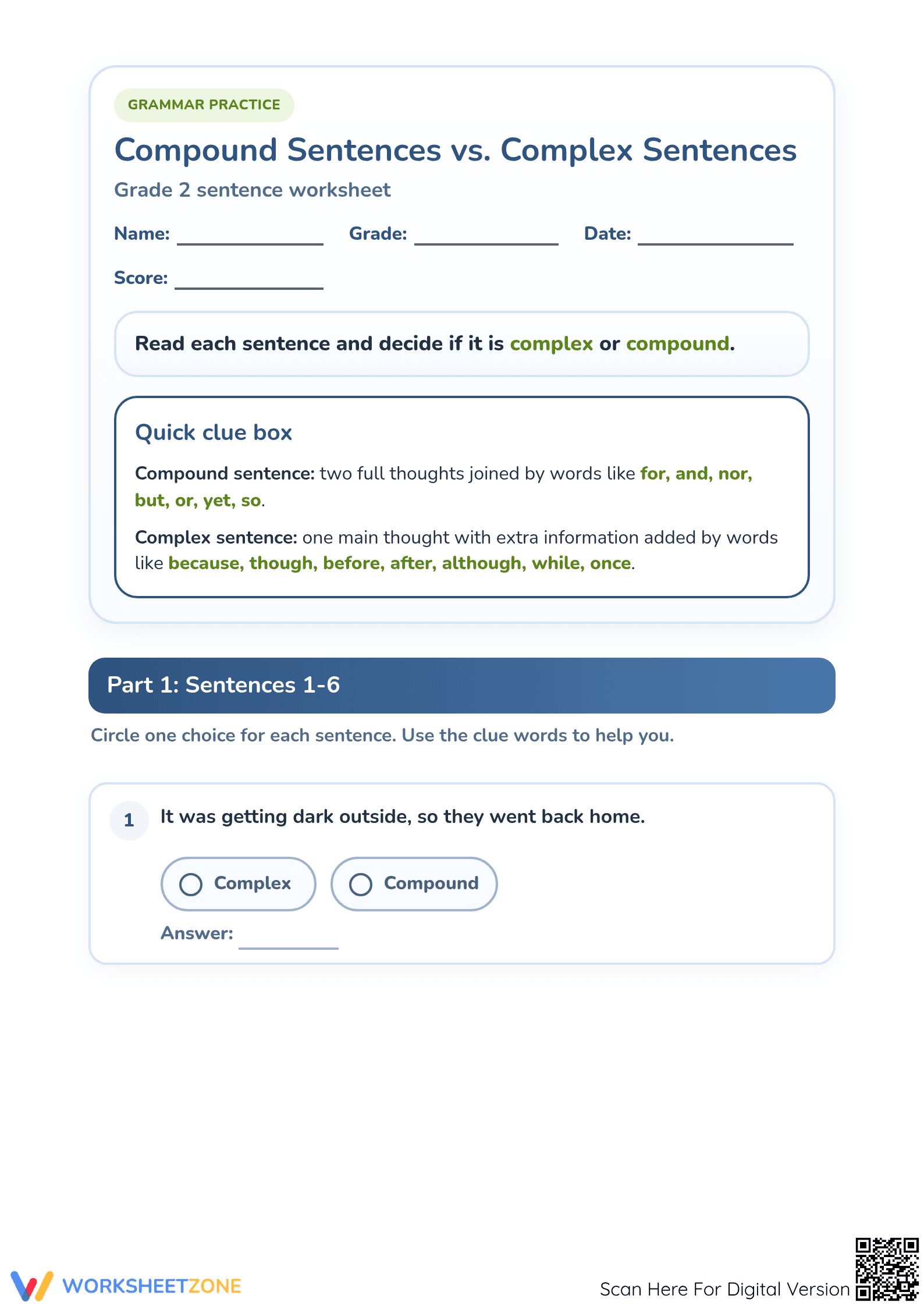
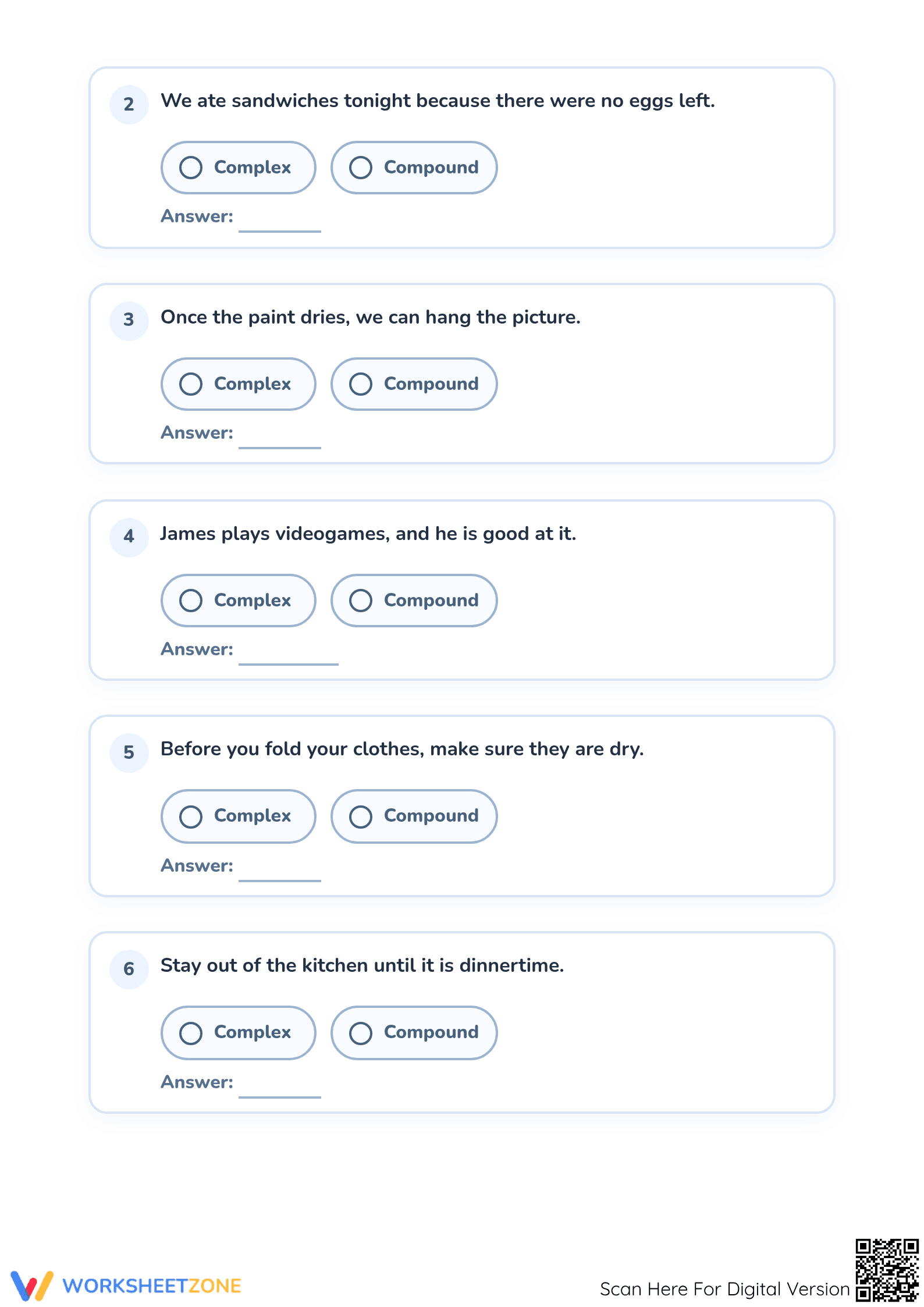
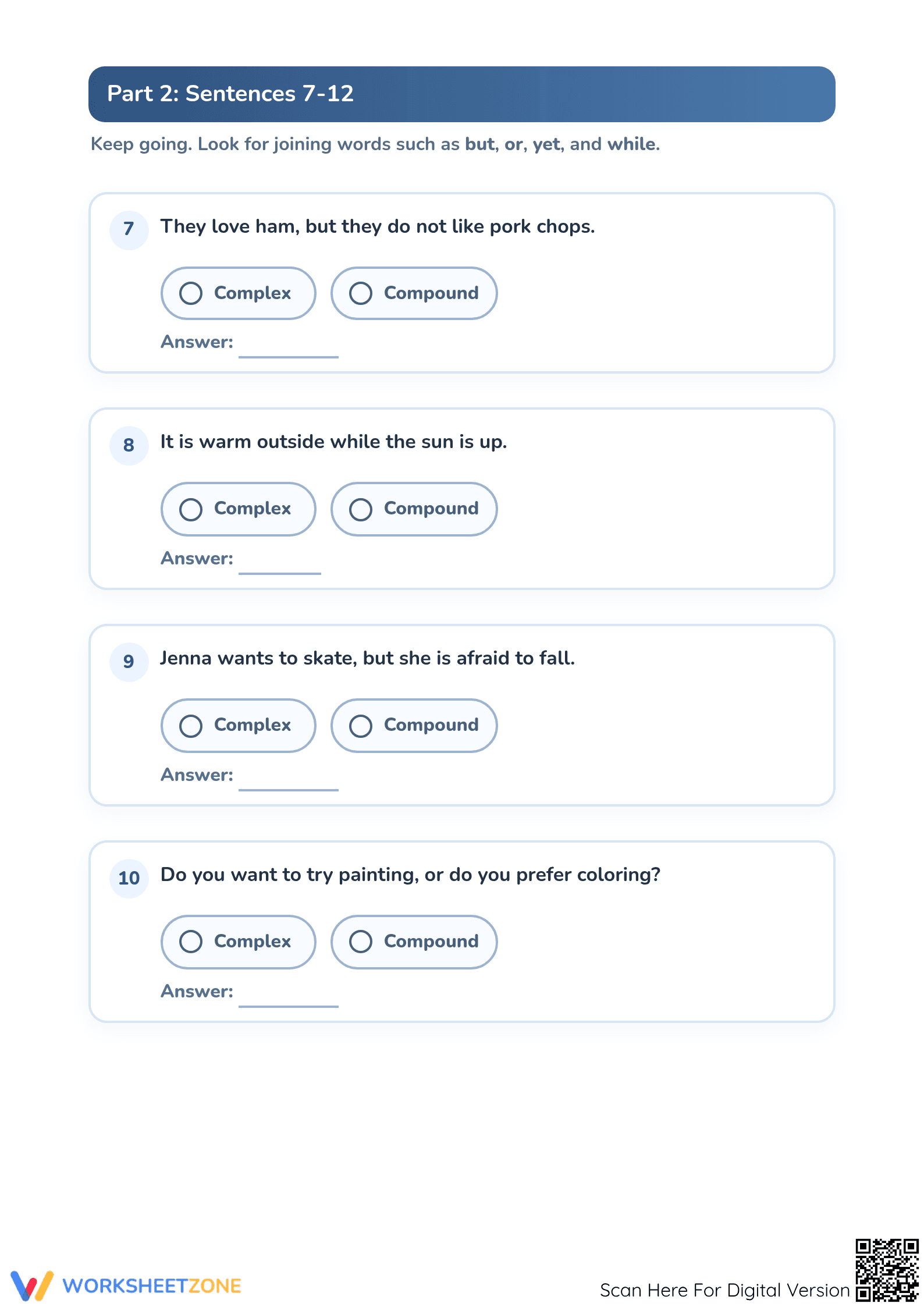
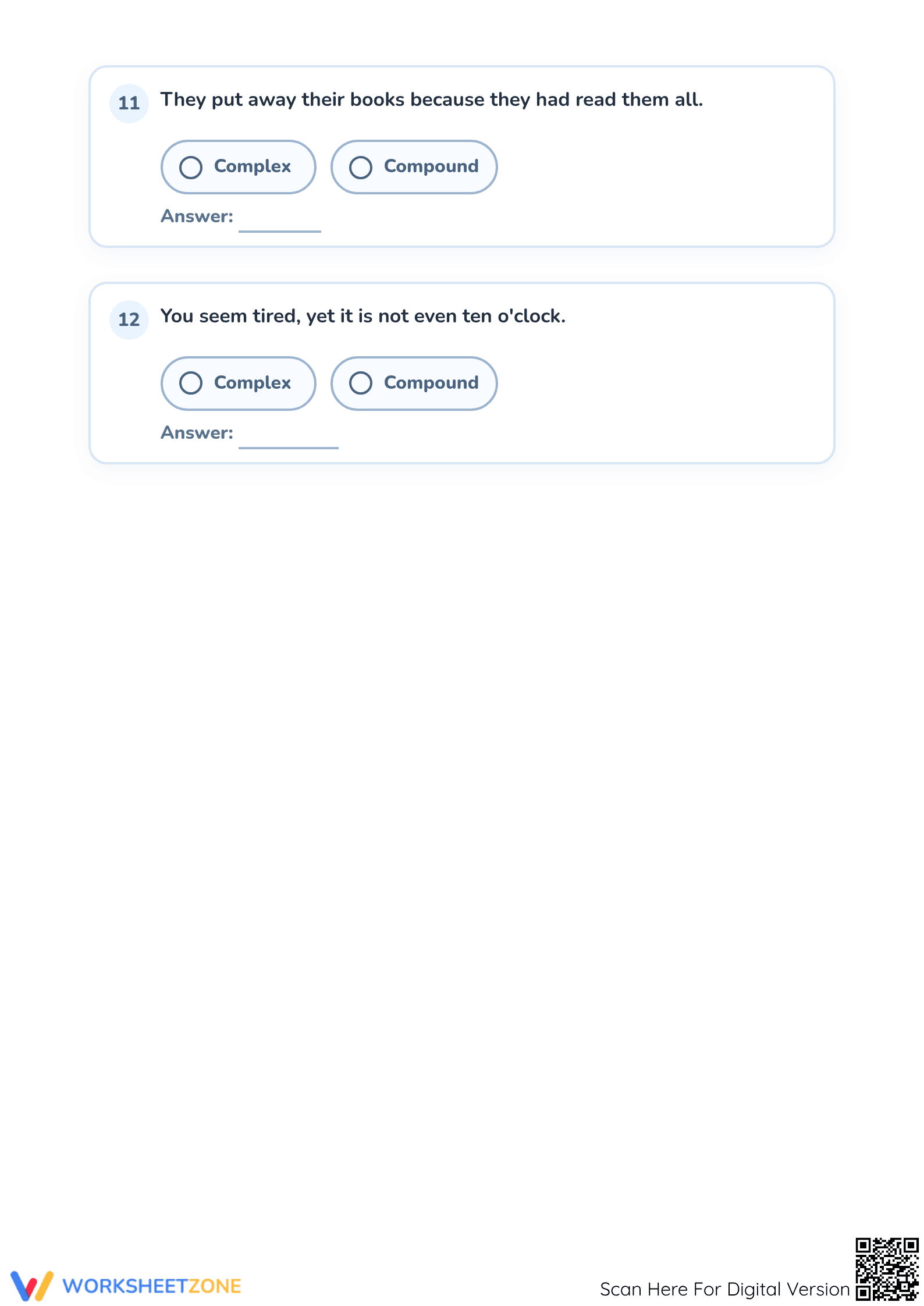
This four-page PDF includes 12 sentences designed to test a student's ability to categorize sentence types. The worksheet features a "Quick Clue Box" anchor chart, listing common coordinating and subordinating conjunctions. With two sections of six problems each, the layout provides ample white space, and the included answer key allows for immediate feedback.
Skill Progression
- Guided Practice: Students use the clue box for the first three sentences to identify conjunctions.
- Supported Practice: Sentences four through eight increase clause complexity to challenge comprehension.
- Independent Practice: The final four sentences solidify mastery without explicit prompts.
This gradual-release model moves students from simple recognition to confident differentiation using an I Do, We Do, You Do framework.
Standards Alignment
The primary focus is aligned with `CCSS.ELA-LITERACY.L.2.1.F`, which requires students to produce, expand, and rearrange complete simple and compound sentences. While complex sentences are an extension of this Grade 2 standard, introducing them alongside compound sentences helps students distinguish between coordinating and subordinating conjunctions. This standard code can be copied directly into lesson plans, IEP goals, or district curriculum mapping tools.
How to Use It
Use this resource after direct instruction on conjunctions. Assign Part 1 as a "check for understanding" during a whole-group lesson to see if students identify the "clue words" correctly. It also serves as an excellent homework assignment or center activity. For a formative assessment tip, observe if students circle the conjunctions before choosing. Completion time is roughly 20 minutes.
Who It's For
This worksheet is specifically designed for Grade 2 students but is also appropriate for Grade 3 learners needing a refresher on sentence types. It provides excellent support for English Language Learners (ELLs) by providing explicit vocabulary lists for conjunctions. This resource pairs naturally with a mentor text passage or a direct instruction lesson on FANBOYS and subordinating conjunctions.
According to research by Fisher & Frey (2014) on the gradual release of responsibility, students benefit most when complex grammatical concepts are introduced with explicit scaffolding and immediate reference tools. This Grade 2 worksheet exemplifies this approach by providing a "Quick Clue Box" that directly supports the mastery of L.2.1.F. By requiring students to distinguish between compound and complex sentences, the activity builds the syntactic awareness necessary for advanced reading comprehension and sophisticated writing. Standardized evaluations like the NAEP consistently show that students who can manipulate and identify varied sentence structures demonstrate higher proficiency in overall literacy. This 12-problem practice set offers a structured pathway for students to move from recognizing simple conjunctions to understanding the logical relationships between clauses. Educators can rely on this standard-aligned tool to provide the repetition needed for long-term retention of essential sentence-building rules in the primary grades.


