


























Views
Downloads


Printable Compound vs. Complex Sentences | Grade 2 ELA
Paste this activity's link or code into your existing LMS (Google Classroom, Canvas, Teams, Schoology, Moodle, etc.).
Students can open and work on the activity right away, with no student login required.
You'll still be able to track student progress and results from your teacher account.
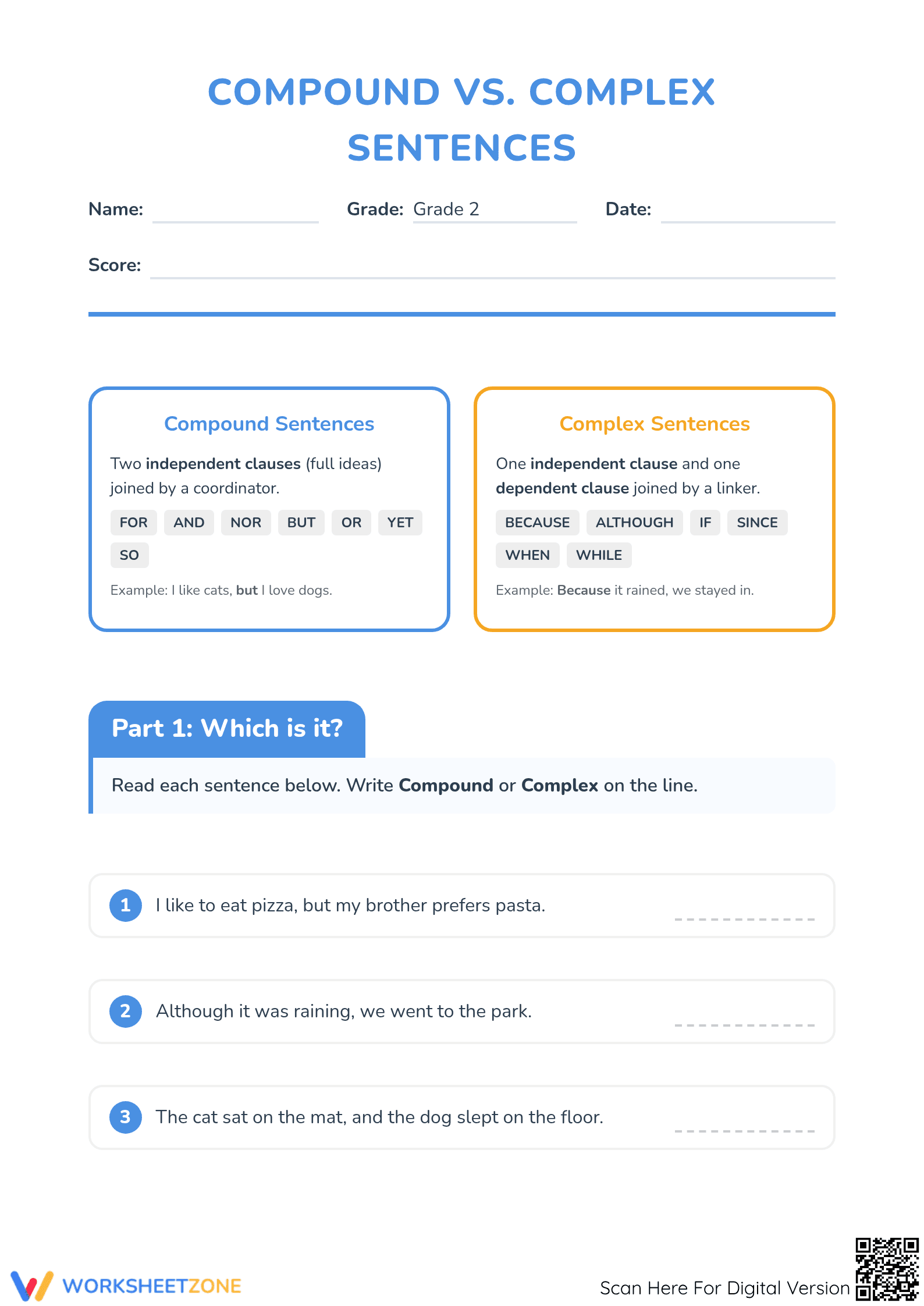
This Grade 2 English Language Arts worksheet helps students master the structural differences between compound and complex sentences. By identifying conjunctions and linkers, learners develop the foundational grammar skills necessary for sophisticated writing and proper punctuation usage. Students move from identification to active sentence construction in this comprehensive three-page practice set.
At a Glance
- Grade: 2 · Subject: English Language Arts
- Standard:
CCSS.ELA-LITERACY.L.2.1.F— Produce, expand, and rearrange complete simple and compound sentences accurately- Skill Focus: Sentence Structure Comparison
- Format: 3 pages · 15 problems · Answer key included · PDF
- Best For: Independent practice or small group review
- Time: 20–30 minutes
Inside this resource, you will find three distinct sections designed to scaffold student understanding. Page one features clear definitions and word banks for coordinators and linkers. The activities include "Which is it?" identification tasks, "Find the Link!" exercises focusing on conjunctions, and a "Sentence Builder" section where students combine independent ideas into cohesive structures.
The zero-prep workflow is designed for maximum efficiency. First, print the three-page PDF (30 seconds). Next, distribute the packets to students for independent or guided work (1 minute). Finally, use the provided answer key to quickly review student responses and identify common misconceptions regarding subordinating conjunctions or clause relationships (30 seconds). Total teacher preparation time is under two minutes.
This worksheet is primarily aligned to CCSS.ELA-LITERACY.L.2.1.F, which focuses on producing and expanding compound sentences. It also serves as an introductory bridge to CCSS.ELA-LITERACY.L.3.1.I by familiarizing second graders with complex sentence linkers like "because" and "although." Both standard codes can be copied directly into lesson plans, IEP goals, or district curriculum mapping tools.
Use this as a summative assessment after a unit on conjunctions or as a structured sub plan during ELA blocks. For a formative assessment tip, observe students during Part 2 to see if they can identify the "linker" without relying on the word bank; this indicates high-level mastery of sentence logic. Completion typically takes 25 minutes.
This resource is for Grade 2 students or Grade 3 learners needing a refresher on sentence variety. It is ideal for inclusion in writing centers or as a homework assignment. Naturally pair this worksheet with a mentor text passage to have students hunt for compound sentences in real-world literature.
According to the RAND AIRS 2024 report, explicit instruction in sentence-level mechanics is a critical predictor of later reading comprehension success. This worksheet targets the specific cognitive demand of distinguishing between coordinate and subordinate relationships in text. By using the standard code CCSS.ELA-LITERACY.L.2.1.F, educators can ensure they are meeting federal and state requirements for foundational literacy. The skill of producing expanded sentences allows students to move beyond basic "subject-verb" constructions, facilitating the development of a more mature voice. Research from Fisher & Frey (2014) emphasizes that "sentence combining" is one of the most effective strategies for improving student writing quality across all grade levels. This three-page set provides fifteen opportunities for students to practice these high-leverage skills in a structured, zero-prep format that is ready for immediate classroom implementation.


