


























Views
Downloads

Printable Compound Sentences Worksheet | Grade 2 ELA
Paste this activity's link or code into your existing LMS (Google Classroom, Canvas, Teams, Schoology, Moodle, etc.).
Students can open and work on the activity right away, with no student login required.
You'll still be able to track student progress and results from your teacher account.
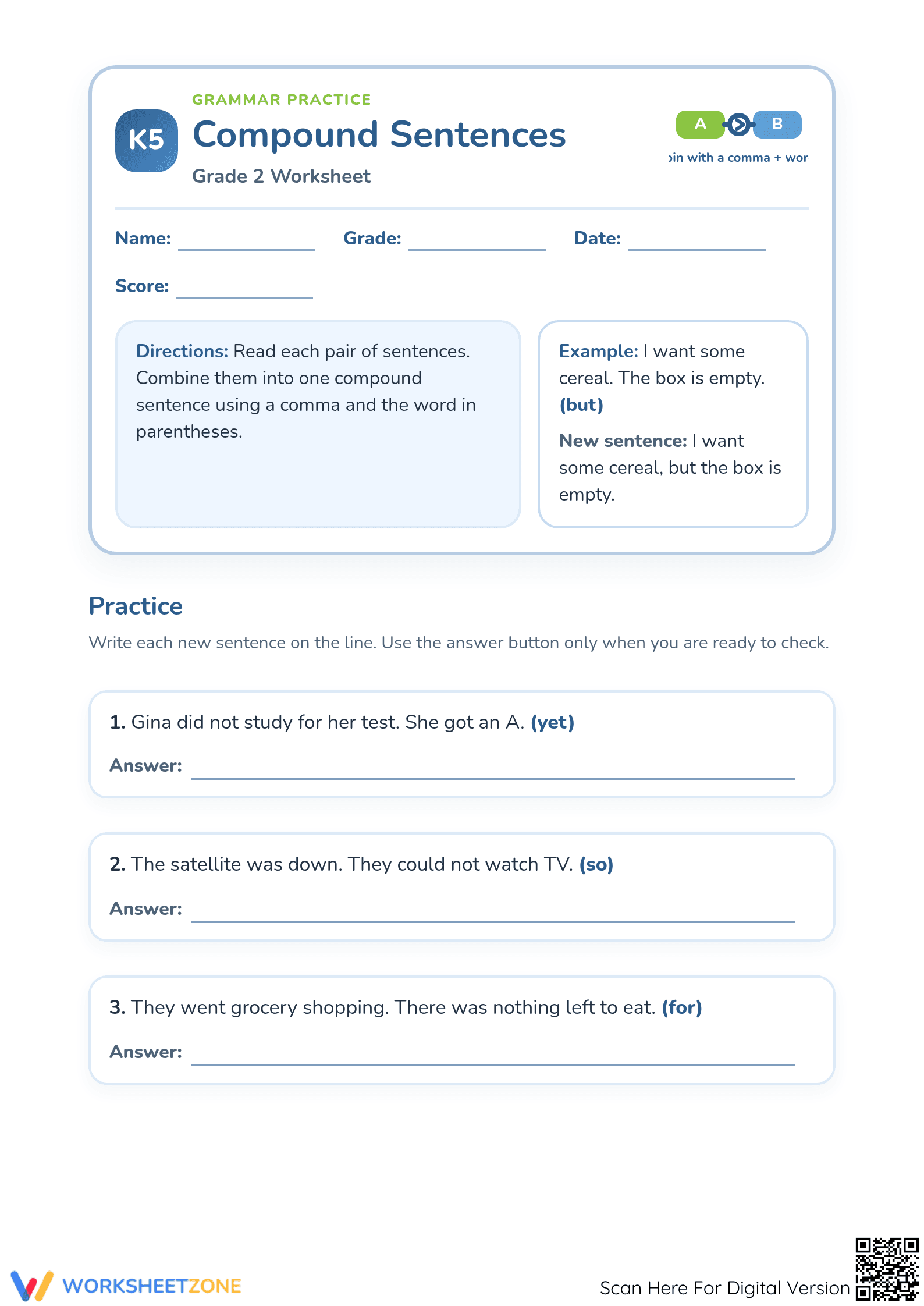
Mastering the art of combining ideas is a fundamental step in early writing development. This Grade 2 grammar resource provides a structured pathway for students to practice creating compound sentences using coordinating conjunctions like "and," "but," and "so." By working through these exercises, learners gain confidence in sentence variety and grammatical precision.
At a Glance
- Grade: 2 · Subject: English Language Arts
- Standard:
L.2.1.f— Produce and expand complete simple and compound sentences- Skill Focus: Coordinating conjunctions and comma placement
- Format: 3 pages · 12 problems · Answer key included · PDF
- Best For: Literacy centers and independent grammar practice
- Time: 15–20 minutes
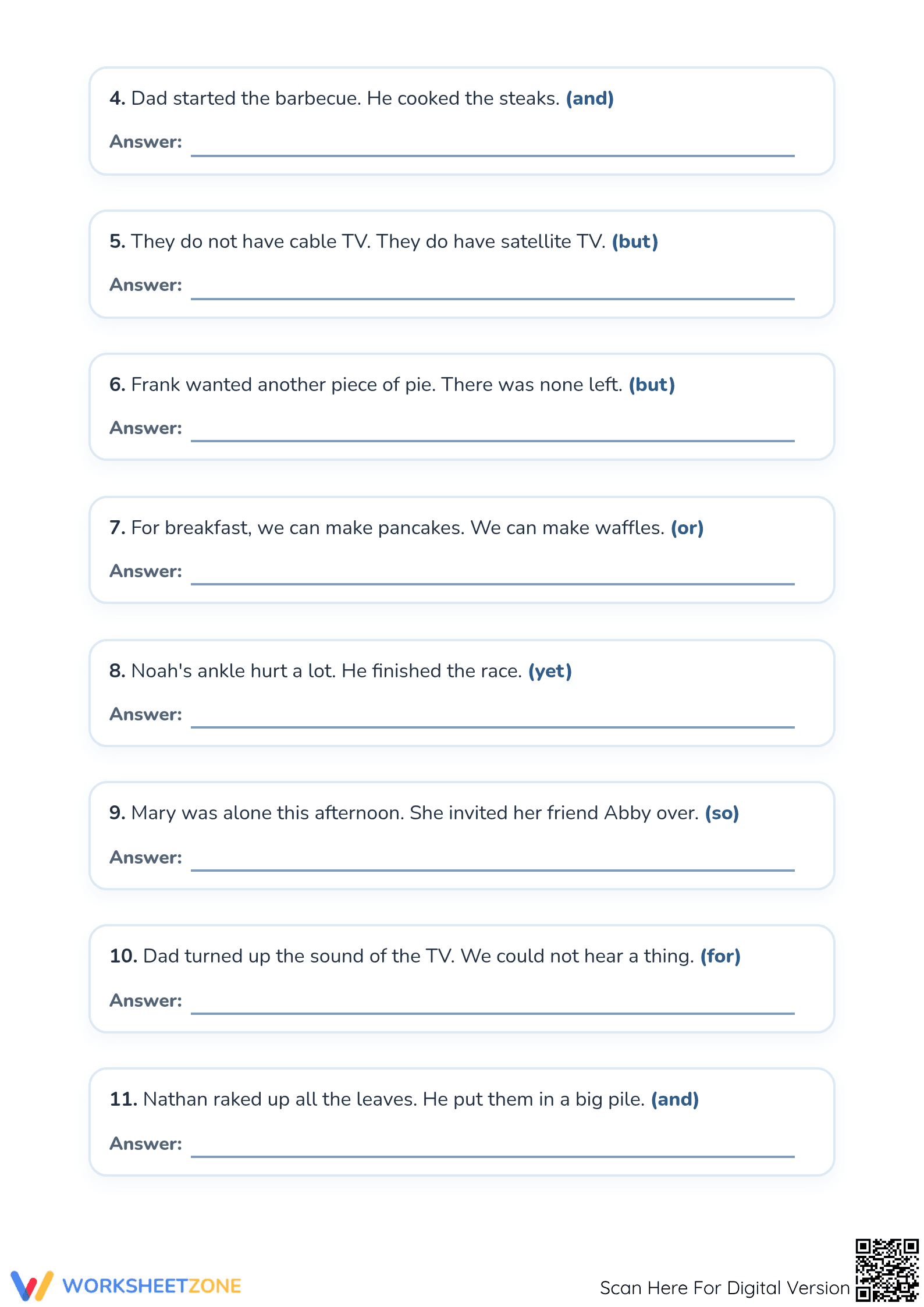
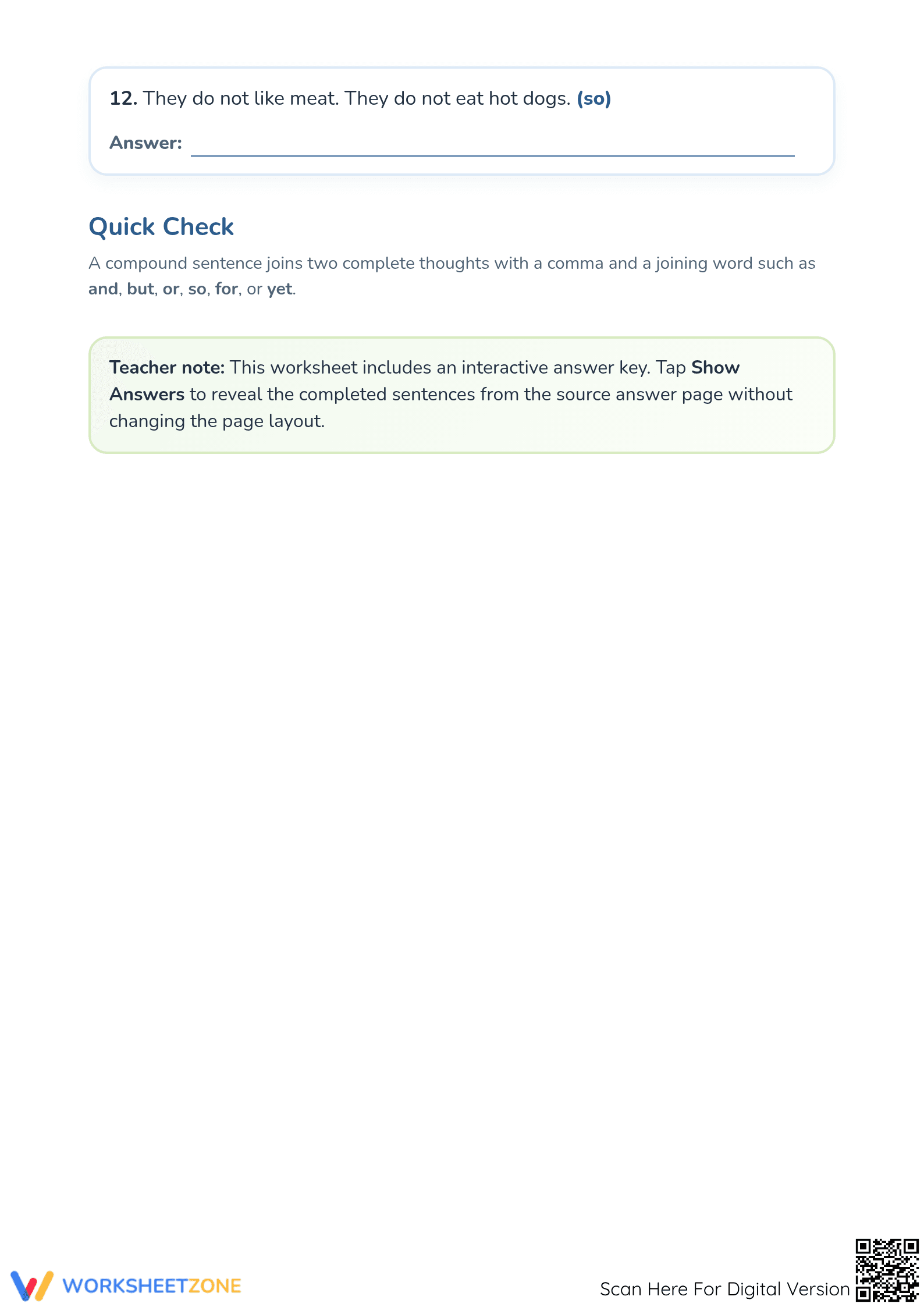
Inside this three-page PDF, you will find 12 sentence-combining tasks. Each item presents a pair of simple sentences and a target conjunction, such as "yet," "for," or "or." The layout is clean, providing ample room for young writers to rewrite their new sentences while maintaining proper punctuation. An interactive answer key feature ensures students receive immediate feedback.
Skill Progression
- Guided practice: The initial problems utilize high-frequency conjunctions like "and" and "but" to establish the basic pattern of joining two independent clauses.
- Supported practice: Middle tasks introduce more nuanced connectors such as "so" and "yet," requiring students to consider the logical relationship between the two joined ideas.
- Independent practice: The final set of problems challenges students to apply their knowledge to less common conjunctions like "for," ensuring a robust understanding of the FANBOYS acronym.
This gradual release of responsibility moves students from simple imitation toward genuine grammatical mastery.
Standards Alignment
This resource is rigorously aligned to CCSS.ELA-LITERACY.L.2.1.f, which requires second-grade students to "produce, expand, and rearrange complete simple and compound sentences." It specifically targets the syntactic complexity needed for grade-level writing standards. This standard code can be copied directly into lesson plans, IEP goals, or district curriculum mapping tools.
How to Use It
Use this worksheet during the independent practice phase of a grammar lesson after introducing coordinating conjunctions. It serves as an excellent formative assessment tool; simply observe if students consistently place the comma before the conjunction. For an extension, have students read their combined sentences aloud to hear the natural pause created by the comma.
Who It's For
This activity is ideal for general education second graders, as well as third-grade students who need a refresher on sentence mechanics. It is particularly helpful for English Language Learners who are moving beyond simple sentence structures. Pair this worksheet with a short reading passage to reinforce the connection between grammar and reading comprehension.
Research by Fisher & Frey (2014) emphasizes that sentence combining is a powerful tool for improving writing quality because it forces students to think about how ideas relate to one another rather than just listing isolated facts. The L.2.1.f standard focuses on producing and expanding compound sentences, a skill that serves as a prerequisite for more advanced rhetorical strategies in later elementary grades. By providing 12 specific instances for students to practice the physical act of inserting commas and conjunctions, this worksheet helps automate the process of grammatical encoding for young learners. As noted in the ScienceDirect TpT Analysis, high-frequency practice with low-stakes feedback is the most effective way to eliminate comma splices and run-on sentences in early elementary writers. This printable guide ensures that students have a clear, distraction-free environment to develop these essential syntactic muscles before they are asked to apply them in longer, high-stakes compositions or creative writing projects.


