


























Views
Downloads

Complex Sentences Worksheet | Printable Grade 2 ELA
Paste this activity's link or code into your existing LMS (Google Classroom, Canvas, Teams, Schoology, Moodle, etc.).
Students can open and work on the activity right away, with no student login required.
You'll still be able to track student progress and results from your teacher account.
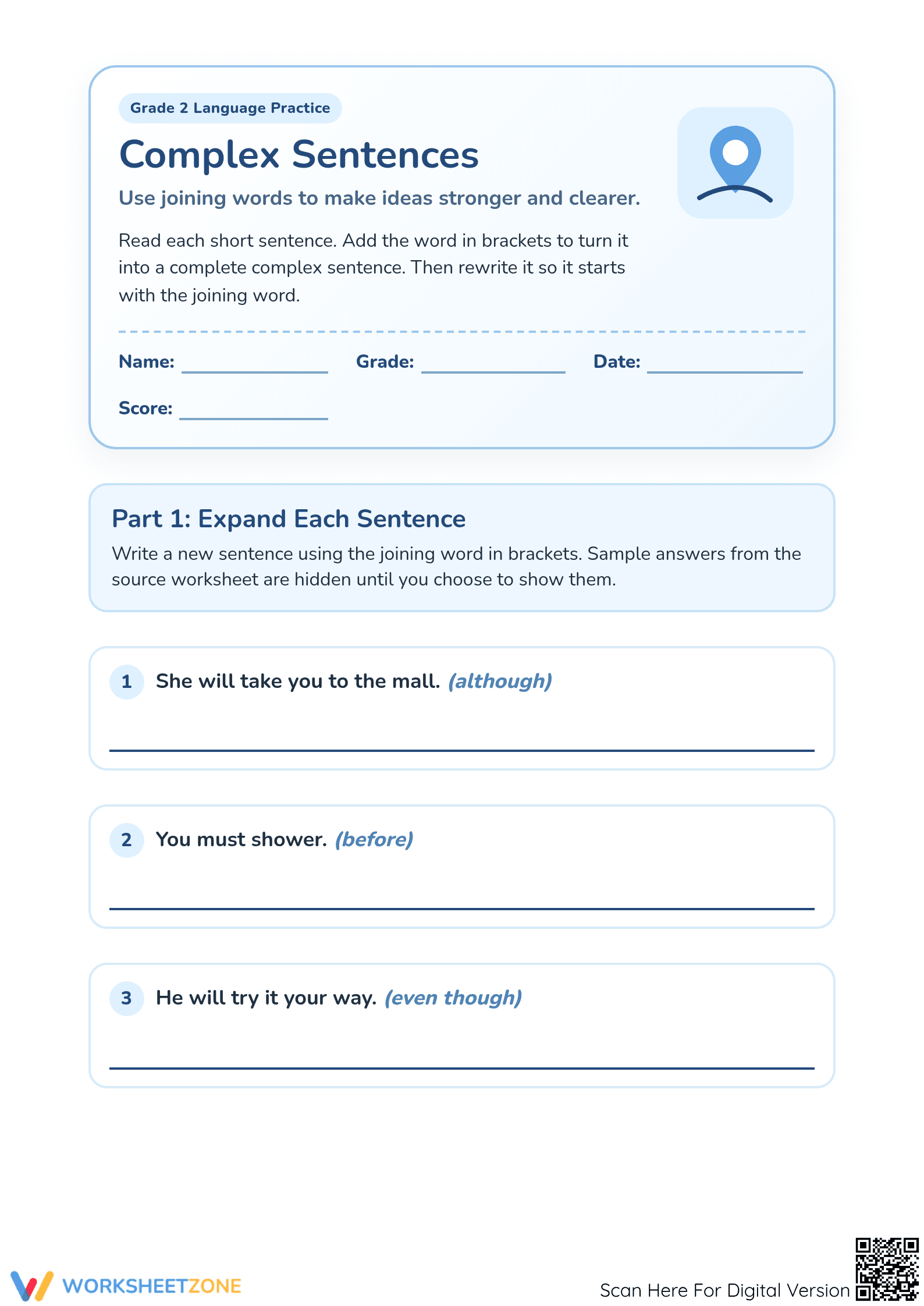
Building strong sentence structures is essential for early writers. This Grade 2 complex sentences worksheet provides intentional practice using subordinating conjunctions to join ideas. By transforming short sentences into sophisticated thoughts, learners improve writing clarity and prepare for advanced composition in higher elementary grades.
At a Glance
- Grade: 2 · Subject: English Language Arts
- Standard:
CCSS.ELA-LITERACY.L.2.1.F— Produce, expand, and complete simple and compound sentences accurately in writing- Skill Focus: Subordinating Conjunctions and Complex Sentences
- Format: 3 pages · 12 problems · Answer key included · PDF
- Best For: Small group grammar lessons or independent practice
- Time: 20–30 minutes
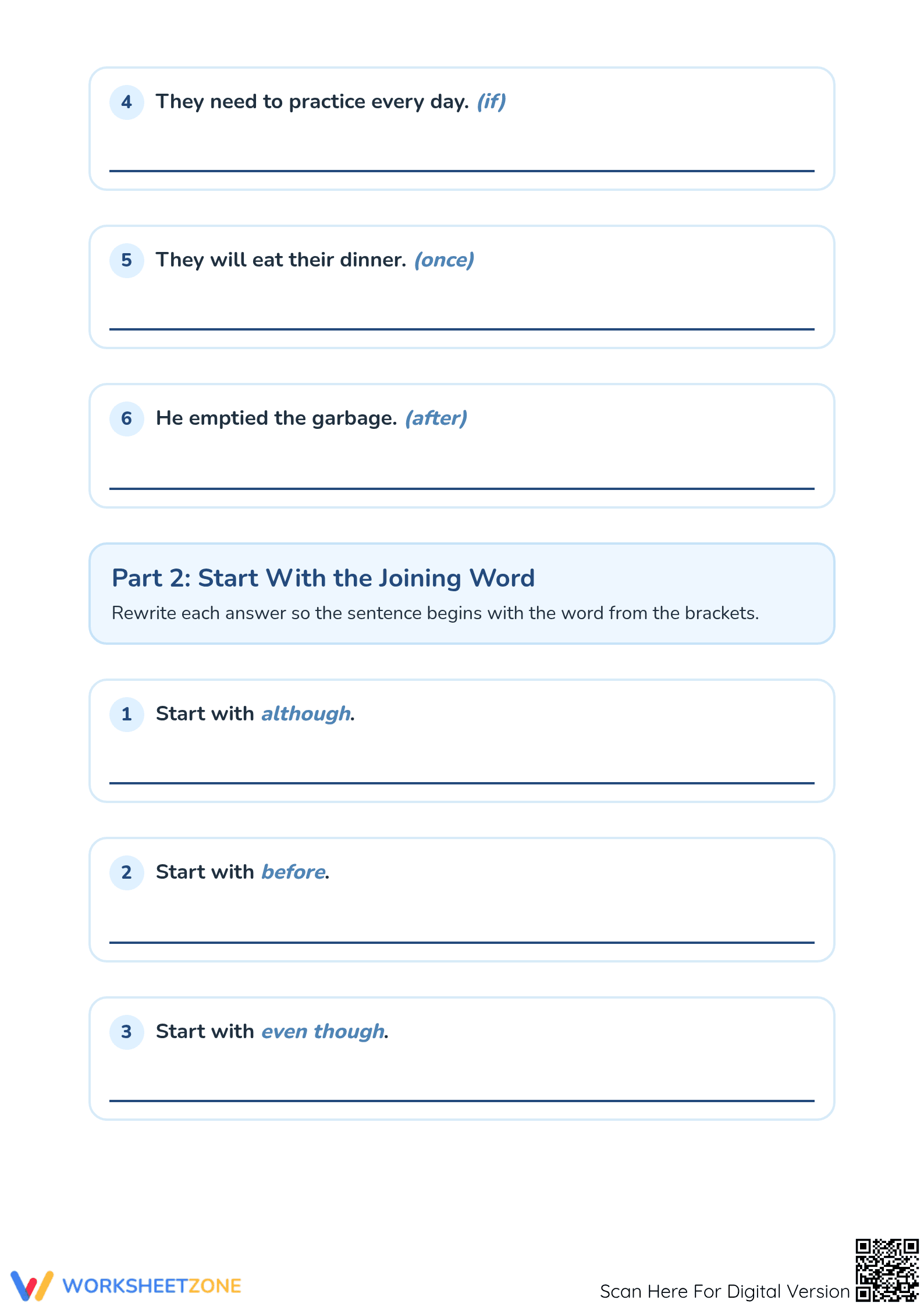
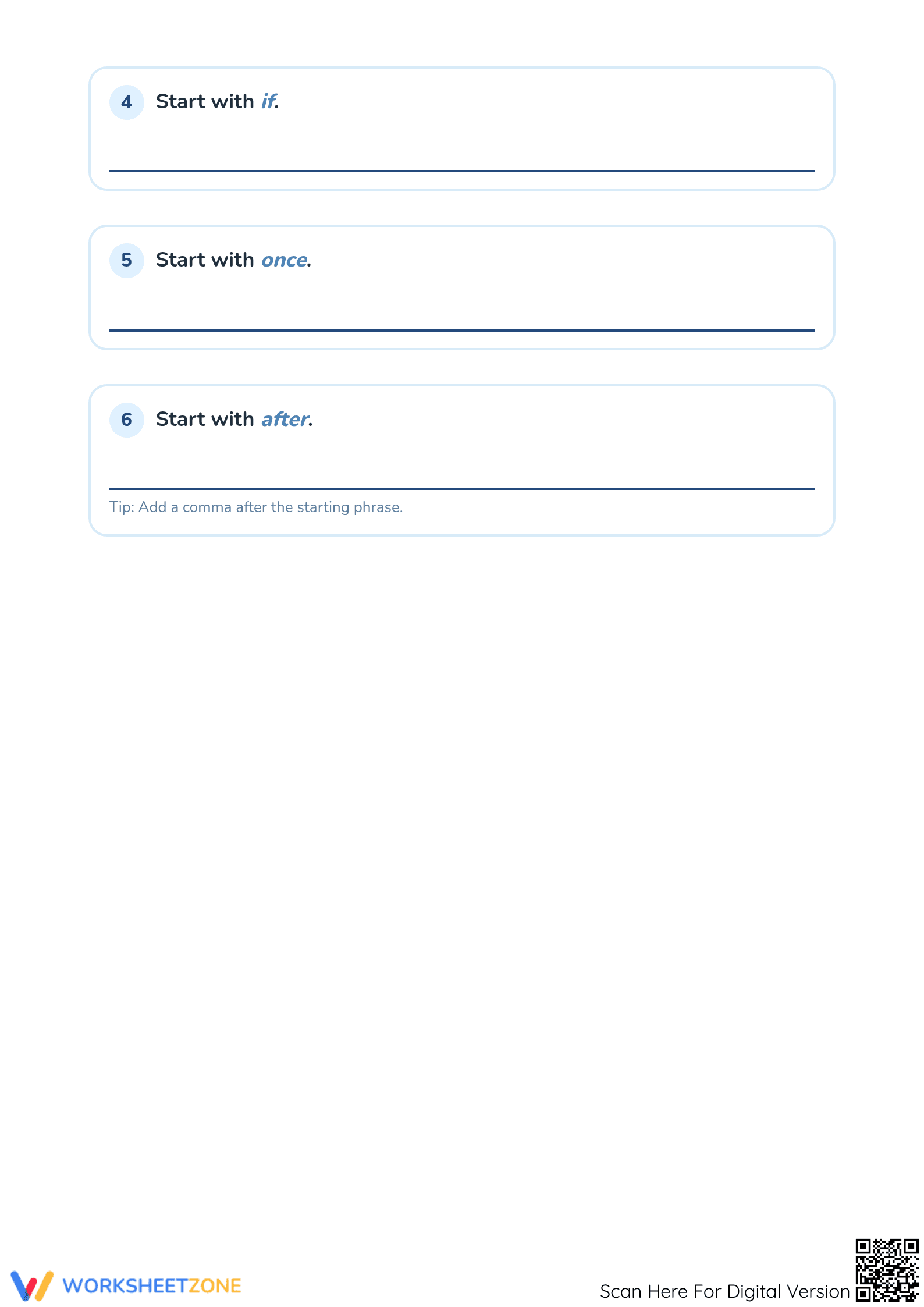
This 3-page packet includes twelve problems divided into two sections. "Part 1: Expand Each Sentence" gives students a simple sentence and a specific joining word like although or if to create a complex thought. "Part 2: Start With the Joining Word" requires rewriting those answers to begin with the conjunction. This highlights comma placement after introductory clauses, as noted in the tip on the final page of the PDF.
Skill Progression
- Guided Practice: Students integrate bracketed conjunctions into 6 initial sentences with direct teacher modeling, focusing on maintaining logical meaning.
- Supported Practice: In the next 6 tasks, learners manipulate sentence syntax by moving joining words to the introductory position with specific syntax cues.
- Independent Practice: Learners review all 12 expanded sentences for grammatical accuracy, ensuring correct comma placement and clause structure across both parts.
This sequence reinforces the gradual-release instructional model by transitioning from "I Do" modeling to "You Do" independent application of complex sentence rules.
Standards Alignment
This resource is strictly aligned with CCSS.ELA-LITERACY.L.2.1.F, which requires students to "produce, expand, and complete simple and compound sentences." Introducing complex structures through subordinating conjunctions bridges the gap toward higher elementary expectations. The worksheet supports writing strands by encouraging students to vary sentence length and complexity. Both standard codes can be copied directly into lesson plans, IEP goals, or curriculum mapping tools to document grammar instruction.
How to Use It
Use the first problems as a whole-class demonstration to model how words like "even though" relate two ideas. For a formative assessment moment, observe students during Part 2 to check for correct comma placement after the introductory phrase. This worksheet is ideal as a post-lesson check after teaching specific conjunctions. Students typically complete the entire packet within a 20 to 30-minute window, making it a perfect addition to a writing center or sub plan.
Who It's For
This resource is designed for Grade 2 students ready to experiment with more sophisticated grammar. It is particularly effective for English Language Learners (ELLs) who benefit from the explicit scaffolding provided by the bracketed conjunctions. Teachers can pair this worksheet with a grammar anchor chart to help students identify complex sentences in context before attempting to write their own.
Systematic instruction in sentence-combining, as supported by RAND AIRS 2024 analysis, effectively improves elementary writing quality. This worksheet implements these findings, guiding Grade 2 students to manipulate sentence structures aligned with CCSS.ELA-LITERACY.L.2.1.F, rather than merely identifying errors. Practicing conjunctions like "although" and "if" develops linguistic flexibility for expressing nuanced ideas (e.g., contrast, cause/effect). This reinforces syntactic patterns found in complex texts, aligning with the science of reading. Through this sequence, learners internalize clause placement and punctuation rules, bridging oral language to formal writing. Targeted practice ensures students gain prerequisite skills for Grade 3 narrative and informational tasks, fostering confident writers through intentional, standard-aligned practice.


