


























Views
Downloads


Complete Writing Debatable Claims Worksheet | Grade 6 ELA
Paste this activity's link or code into your existing LMS (Google Classroom, Canvas, Teams, Schoology, Moodle, etc.).
Students can open and work on the activity right away, with no student login required.
You'll still be able to track student progress and results from your teacher account.
Students learn to construct clear, defensible, and debatable claims for argumentative writing through a realistic school policy scenario. This five-page resource guides sixth graders to separate facts from subjective opinions and craft focused thesis statements supported by evidence, preparing them for formal argumentative essays and text-based writing tasks.
At a Glance
- Grade: 6 · Subject: ELA
- Standard:
W.6.1.a— Introduce precise claims and organize clear reasons to support an argument- Skill Focus: Writing Debatable Claims
- Format: 5 pages · 8 problems · Answer key included · PDF
- Best For: Argument writing units and claim workshops
- Time: 35–45 minutes
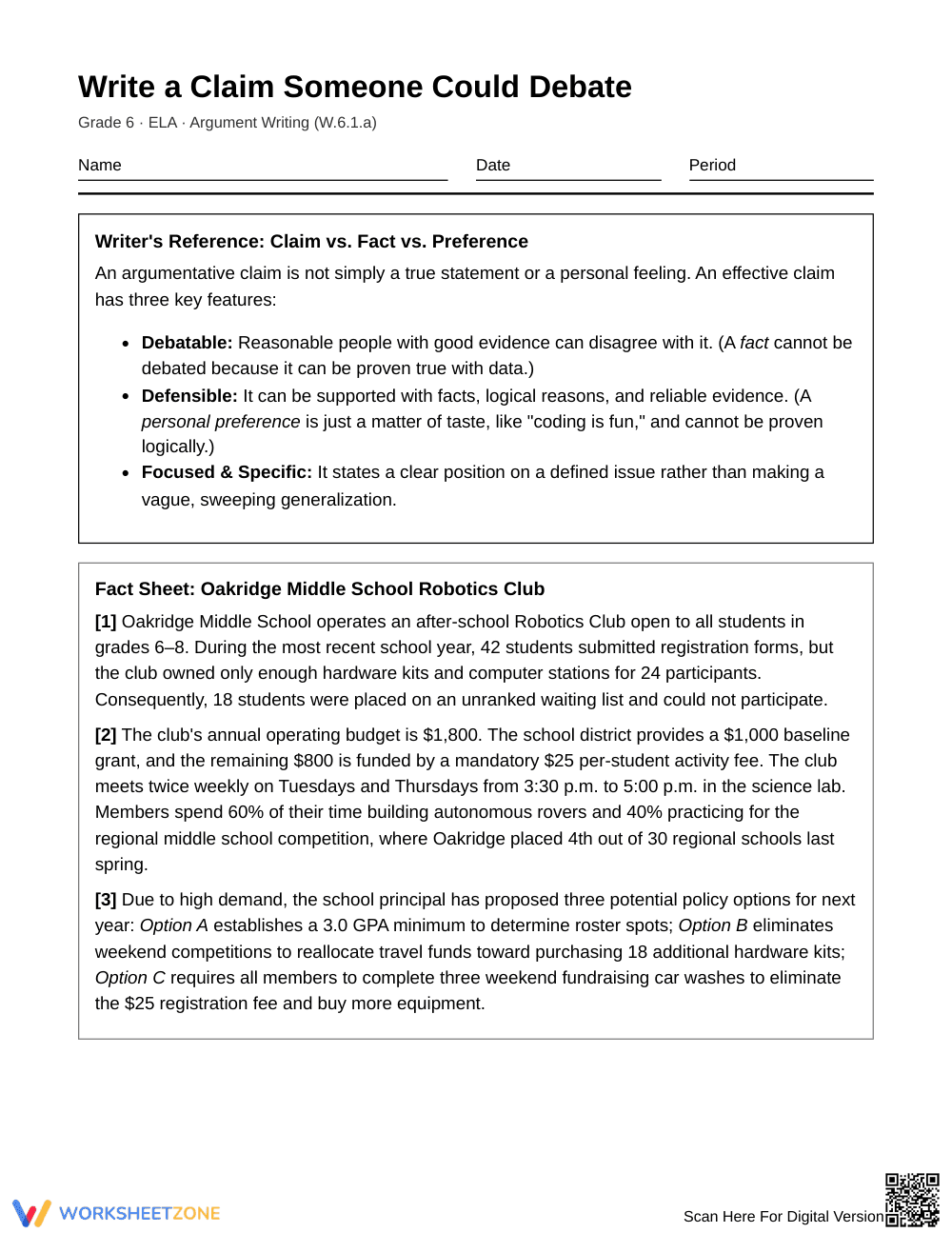
What's Inside: This instructional set includes a reference guide defining claims versus facts and preferences, a data-rich fact sheet detailing a school robotics club dilemma, and 8 scaffolded tasks across 5 student and teacher pages. Students classify statements, narrow broad statements, write counter-claims with rebuttals, and draft an introductory paragraph with an integrated revision checklist alongside a 3-page comprehensive answer key.
Skill Progression
- Guided practice (Tasks 1–2): Students analyze pre-written statements against the reference criteria, categorizing them as facts, preferences, or claims with explicit reasoning.
- Supported practice (Tasks 3–6): Learners transform subjective opinions into defensible statements, narrow overly broad assertions, formulate two-part claims with reasons, and draft counter-claims.
- Independent practice (Tasks 7–8): Sixth graders independently compose a formal argument introduction paragraph utilizing their developed claim and evaluate their draft using a three-point revision matrix.
This structured progression leverages the gradual release of responsibility model, shifting students from concept recognition to authentic argument formulation.
Standards Alignment
This worksheet aligns directly to `W.6.1.a`: "Introduce claim(s) and organize the reasons and evidence clearly." Students build the foundational skill of articulating a distinct stance on a contested issue prior to composing extended multi-paragraph essays. Both standard codes can be copied directly into lesson plans, IEP goals, or district curriculum mapping tools.
How to Use It
Deploy this activity during direct instruction as an argument writing kick-off workshop, or after initial lessons on text evidence to reinforce thesis development. During work time, formatively check whether students formulate actual debatable positions rather than unquestioned factual statements on Item 5. Plan for a total completion time of 35 to 45 minutes.
Who It's For
This resource supports general education sixth-grade ELA classrooms, middle school writing intervention groups, and English language learners needing explicit sentence-level claim modeling. Pair this worksheet with an anchor chart outlining argument structure or an evidence-based reading passage on extracurricular funding.
Sixth-grade argument literacy requires students to distinguish factual assertions and personal viewpoints from evidence-based, defensible claims under CCSS standard W.6.1.a. According to research from Fisher & Frey (2014) on gradual release of responsibility, scaffolded instructional progressions that move from explicit classification to guided sentence transformation significantly increase student mastery in complex writing tasks. By analyzing concrete school policy scenarios, sixth graders learn to introduce clear claims and organize supporting reasons with structural precision. This targeted worksheet provides eight deliberate practice opportunities across five pages, ensuring middle school writers develop the analytical stamina and compositional clarity required for rigorous argumentative discourse. The accompanying revision rubric reinforces metacognitive editing strategies aligned with national writing standards, making this an essential tool for evidence-based ELA instruction.


