




























Views
Downloads




Complete Summary Length Comparison Worksheet | Grade 7 ELA

Paste this activity's link or code into your existing LMS (Google Classroom, Canvas, Teams, Schoology, Moodle, etc.).
Students can open and work on the activity right away, with no student login required.
You'll still be able to track student progress and results from your teacher account.
This Grade 7 informational reading worksheet trains students to analyze how central ideas and supporting details shift across summaries of varying lengths. Working through paired informational passages about a student-led radio station, learners identify essential claims, detect factual distortions, and evaluate information density across 10 structured analytical tasks.
At a Glance
- Grade: 7 · Subject: ELA
- Standard:
RI.7.2— Determine central ideas and write objective summaries without personal opinions- Skill Focus: Comparing summary lengths and detail density
- Format: 5 pages · 10 problems · Answer key included · PDF
- Best For: Informational text summary analysis units
- Time: 35–45 minutes
What's Inside
The 5-page printable resource provides a core concept anchor box defining concise versus expanded summaries, two paired informational passages totaling four paragraphs, and 10 targeted tasks across three progressive sections. Tasks include multiple-choice identification, short-response structural explanations, summary evaluation, and distortion analysis, supported by a 3-page comprehensive answer key.
Skill Progression
- Guided Practice (Part A, Tasks 1–2): Students establish core evaluation criteria by identifying elements required in all objective summaries and defining how word counts dictate detail exclusion.
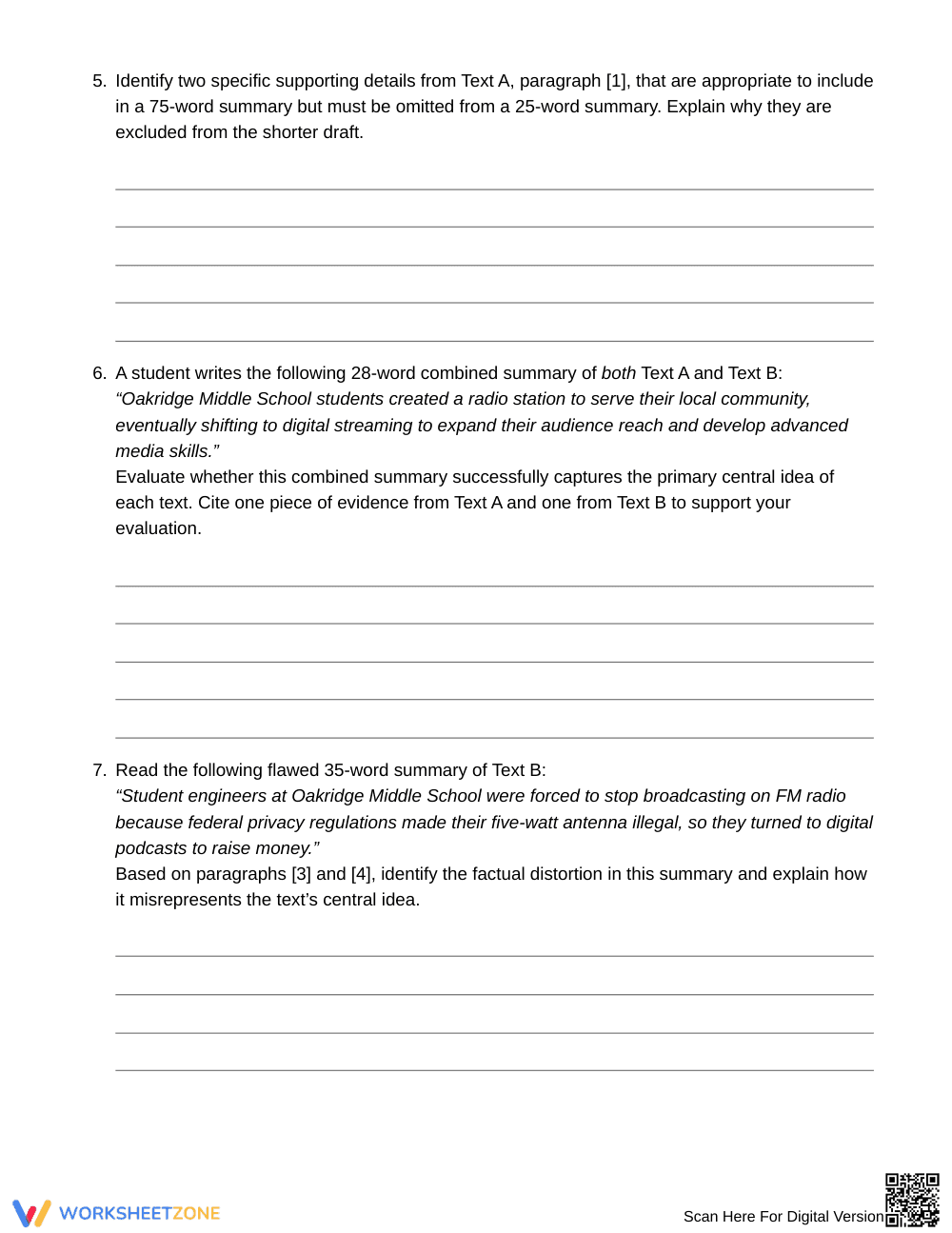
- Supported Practice (Part B, Tasks 3–8): Students analyze paired text excerpts, evaluate 22-word to 75-word summary drafts, detect factual distortions, and justify detail selection across texts.
- Independent Practice (Part C, Tasks 9–10): Students synthesize their learning by explaining knowledge gaps caused by over-condensed summaries and contrasting the functional utility of single-sentence versus multi-sentence summaries.
This structured progression reflects the gradual release of responsibility framework, transitioning learners from baseline criteria recognition to nuanced evaluation of textual density.
Standards Alignment
This worksheet directly targets `RI.7.2`: Determine two or more central ideas in a text and analyze their development over the course of the text; provide an objective summary of the text. Students practice isolating central themes from secondary evidence and ensuring summaries remain neutral and accurate regardless of length constraints. Both standard codes can be copied directly into lesson plans, IEP goals, or district curriculum mapping tools.
How to Use It
Deploy this activity after direct instruction on central ideas and objective summaries. Use Part A as a whole-class warm-up before assigning Parts B and C for paired partner work or independent practice. During work time, formatively assess whether students confuse necessary central claims with secondary supporting examples when evaluating concise drafts. Expected completion time is 35 to 45 minutes.
Who It's For
This resource serves general education Grade 7 ELA classrooms, reading intervention groups, and English language learners needing explicit criteria for informational writing. Pair this worksheet with an anchor chart on summary sentence frames or a direct instruction lesson on eliminating bias and nonessential details.
According to research by Fisher & Frey (2014) on close reading and text-dependent tasks, middle school students demonstrate greater reading comprehension when explicitly taught how summary density and text structure interact. This instructional worksheet targets standard `RI.7.2` by challenging seventh graders to examine how information density changes when condensing complex informational passages into varying lengths. By analyzing paired non-fiction texts about educational broadcasting, students evaluate draft summaries ranging from 10 to 75 words, isolate overarching claims, and detect factual misrepresentations. The progression from foundational criteria through text-dependent comparative critique equips learners with the analytical discernment required for standardized informational reading assessments and academic writing.


