




























Views
Downloads



Complete Straw-Man Counterclaim Worksheet | Grade 8 ELA

Paste this activity's link or code into your existing LMS (Google Classroom, Canvas, Teams, Schoology, Moodle, etc.).
Students can open and work on the activity right away, with no student login required.
You'll still be able to track student progress and results from your teacher account.
This rigorous Grade 8 argumentative writing worksheet equips students to identify, deconstruct, and repair straw-man fallacies in written arguments. By analyzing competing informational perspectives and diagnosing distorted student drafts, learners discover how authentic counterclaim representation strengthens academic credibility and rhetorical impact.
At a Glance
- Grade: 8 · Subject: ELA
- Standard:
W.8.1.a— Introduce claims, acknowledge and distinguish opposing claims, and organize reasons logically- Skill Focus: Repairing Straw-Man Counterclaims
- Format: 5 pages · 10 problems · Answer key included · PDF
- Best For: Argumentative writing counterclaim revision units
- Time: 45–60 minutes
What's Inside
This comprehensive 5-page instructional resource contains two balanced informational texts regarding school mobile device policies, a flawed argumentative draft loaded with straw-man caricatures, a structured comparison chart, and 10 scaffolded analytical and drafting prompts. A detailed 4-page answer key provides complete model revisions, evidence citations, and rhetorical justifications for swift grading.
Skill Progression
- Guided Practice (Tasks 1–3): Students diagnose logical distortions in a flawed student draft, pinpoint misrepresentations against Source B research, and complete a two-column caricature-versus-evidence comparison chart.
- Supported Practice (Tasks 4–8): Learners construct neutral counterclaim statements, integrate empirical evidence using formal signal phrases, articulate competing interpretations, and draft nuanced concessions and rebuttals.
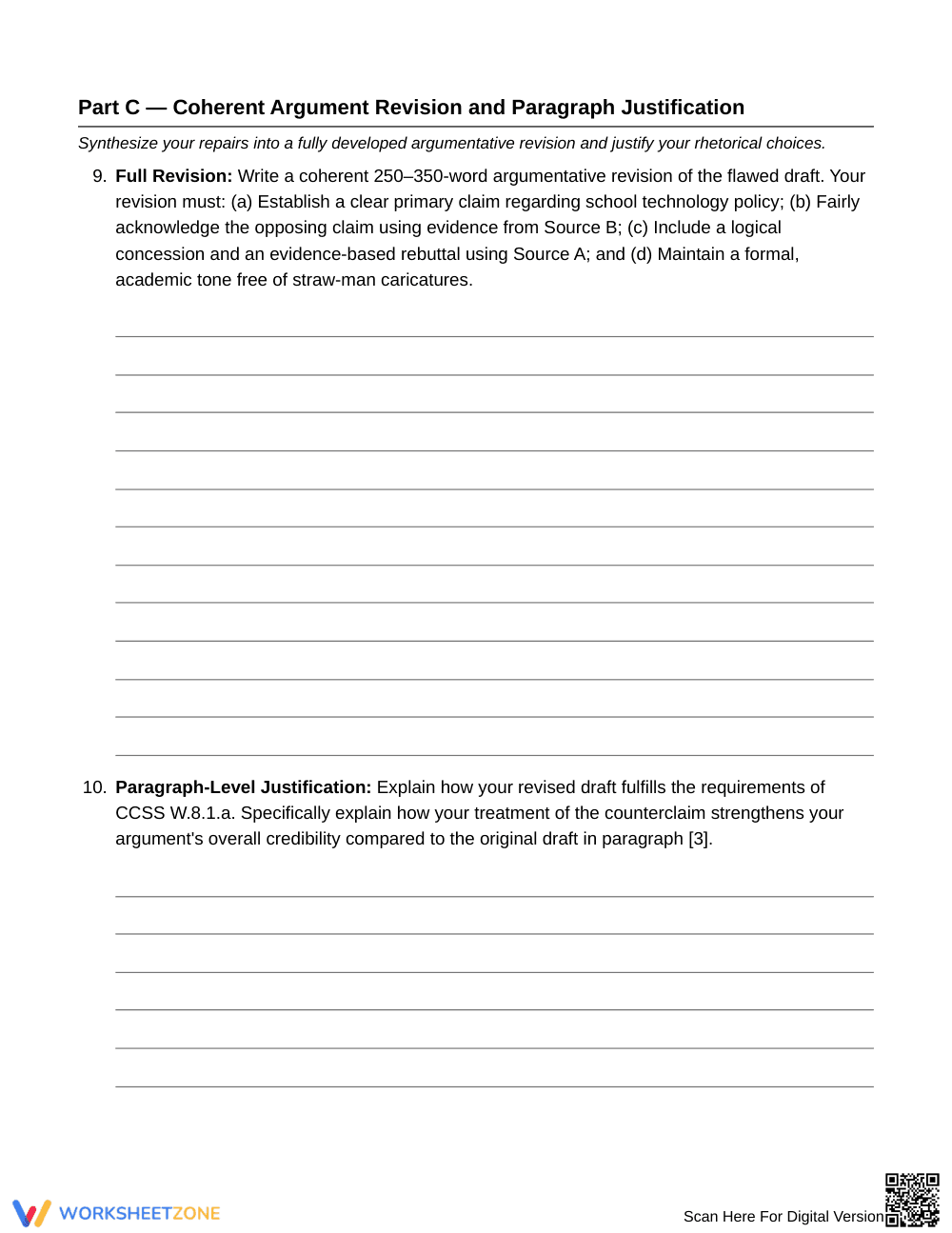
- Independent Practice (Tasks 9–10): Students synthesize their repairs into a 250–350-word revised argumentative paragraph and write an analytical justification explaining how their treatment of the opposition fulfills formal academic criteria.
This structured architecture follows the gradual release of responsibility model, guiding writers from critical diagnosis to independent, high-level argumentative synthesis.
Standards Alignment
This resource aligns directly with primary standard `W.8.1.a`: Introduce claim(s), acknowledge and distinguish the claim(s) from alternate or opposing claims, and organize the reasons and evidence logically. It also reinforces `RI.8.8` through fallacy evaluation. Both standard codes can be copied directly into lesson plans, IEP goals, or district curriculum mapping tools.
How to Use It
Deploy this worksheet after direct instruction on logical fallacies and prior to final essay drafting. For formative assessment, examine student responses to Task 6 (concessions) to ensure writers genuinely grant credit to opposing evidence rather than merely restating their original thesis. Expected completion time is 45 to 60 minutes in a single writing block or across two focused class periods.
Who It's For
Designed for Grade 8 ELA classrooms, secondary writing labs, and pre-AP English bridge courses. Pair this activity with an anchor chart on argumentative transition phrases or direct instruction on formal counter-argument structures.
According to Fisher & Frey (2014), explicit instruction in argumentative counter-framing and evidence-based rebuttals substantially enhances student perspective-taking and overall writing maturity. Addressing standard W.8.1.a, this instructional resource guides middle school writers to move past caricatured straw-man fallacies toward respectful, rigorous argumentation. By evaluating two paired texts—one examining digital equity and the other analyzing cognitive load—students examine authentic opposing claims, draft formal concessions, and construct logical rebuttals. Through 10 focused tasks, students develop the analytical discernment needed to acknowledge alternate viewpoints without weakening their primary claims. This 5-page curriculum-aligned packet provides middle school educators with an evidence-backed framework for teaching sophisticated argumentative structure and critical revision strategies.


