




























Views
Downloads



Complete Selective Permeability Worksheet | Grade 7 Science

Paste this activity's link or code into your existing LMS (Google Classroom, Canvas, Teams, Schoology, Moodle, etc.).
Students can open and work on the activity right away, with no student login required.
You'll still be able to track student progress and results from your teacher account.
This 5-page science worksheet trains Grade 7 students to predict equilibrium outcomes and fluid movements across selective membranes when only one substance can cross. Across 16 scaffolded problems, learners analyze solute gradients, calculate equilibrium concentrations, and determine osmotic water flow in biological systems.
At a Glance
- Grade: 7 · Subject: Science
- Standard: Middle School Life Science — Model how substances move across selectively permeable cell boundaries
- Skill Focus: Predict Outcomes When Only One Substance Can Cross
- Format: 5 pages · 16 problems · Answer key included · PDF
- Best For: Membrane transport practice and conceptual mastery
- Time: 45–60 minutes
What's Inside
This resource features 16 rigorous problems across three scaffolded parts, paired with a complete 2-page answer key. The worksheet opens with core permeability principles before engaging students in multiple-choice checks, quantitative concentration calculations, tabular analysis of four U-tube trials, and multi-step inverse modeling of dialysis sac experiments.
Skill Progression
- Guided practice (Part A, Problems 1–5): Foundational prompts with strong scaffolding direct students to predict net solute flow, evaluate dynamic equilibrium, and challenge membrane misconceptions.
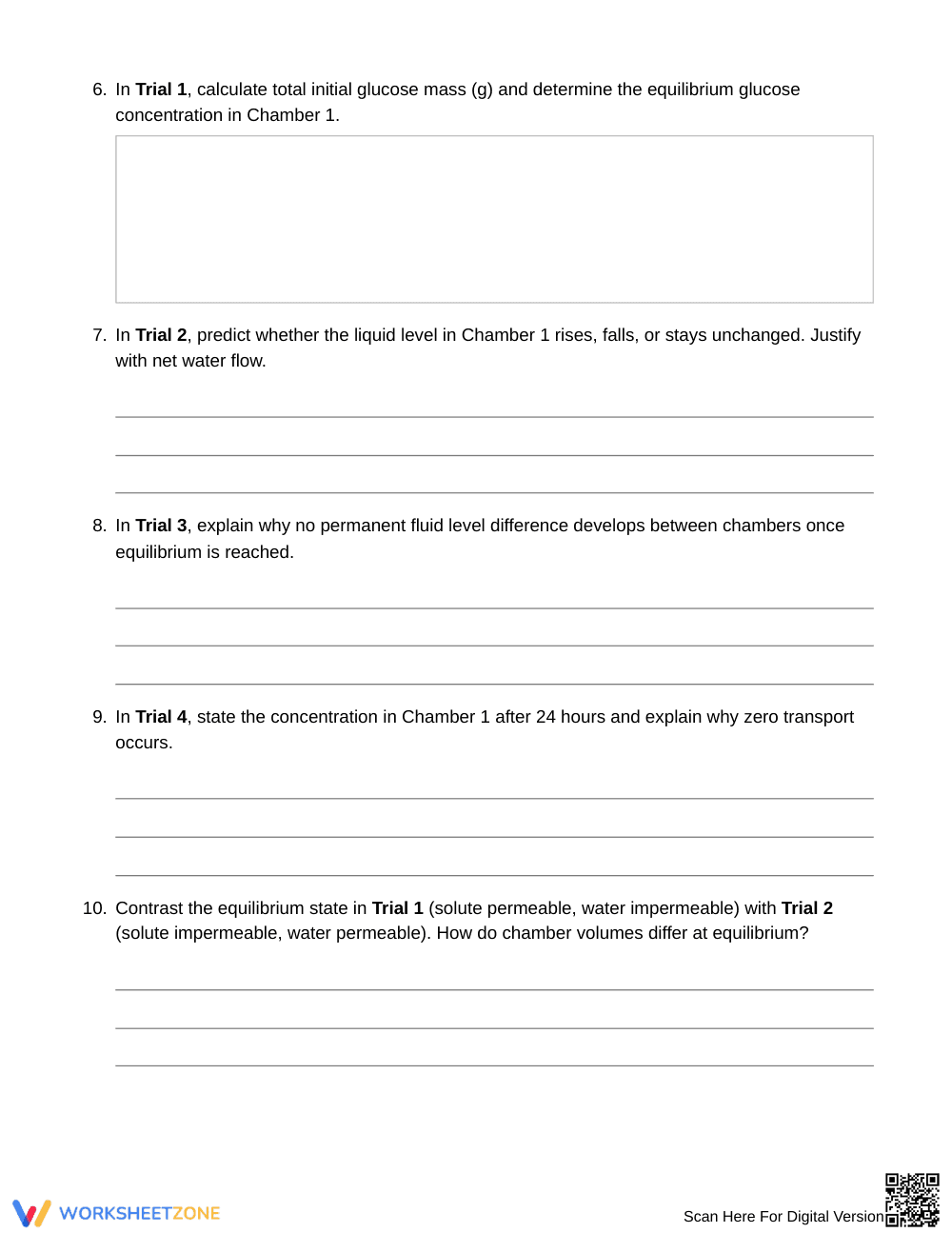
- Supported practice (Part B, Problems 6–10): Data-table analysis tasks provide moderate scaffolding, requiring students to interpret U-tube trials and compare equilibrium liquid volumes.
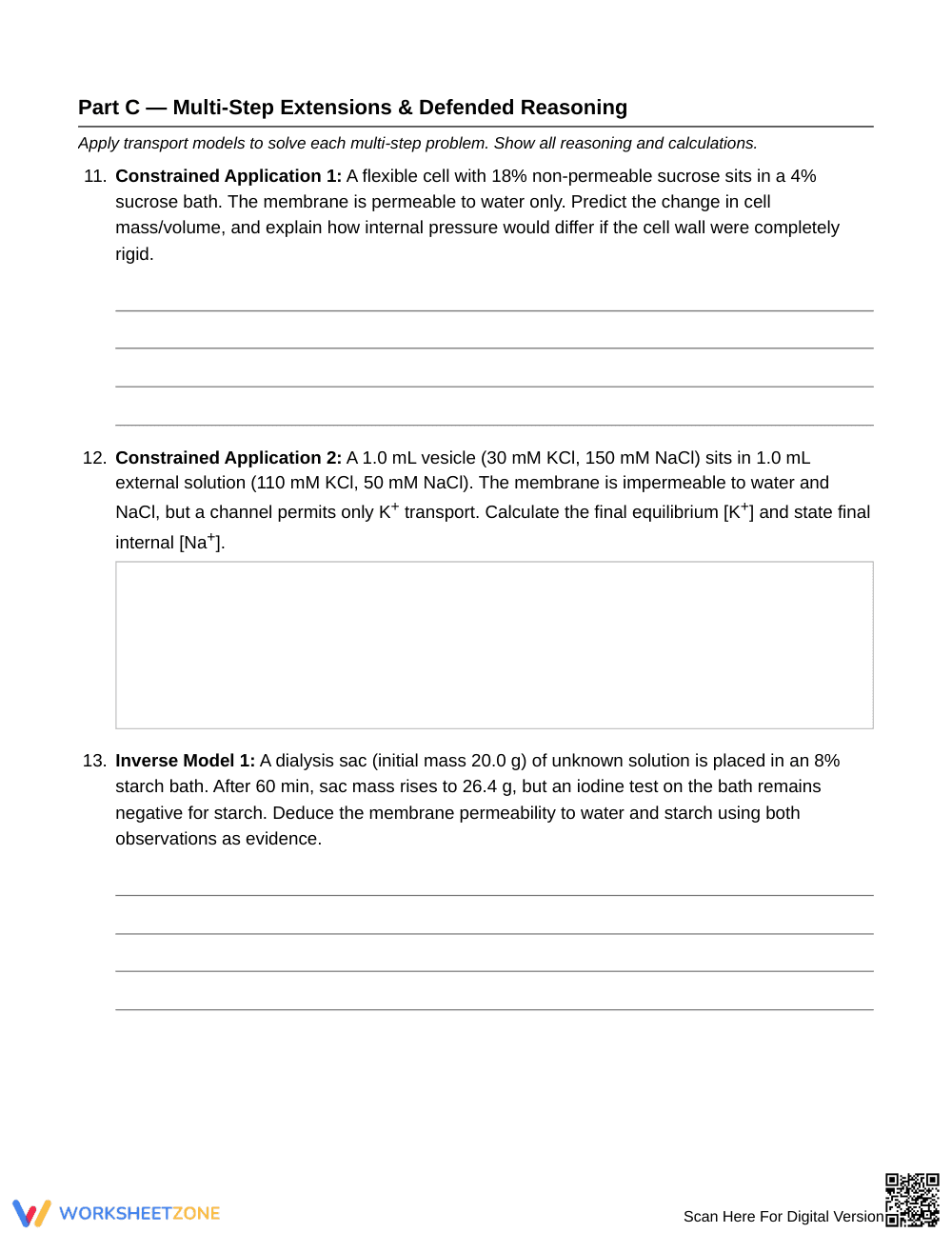
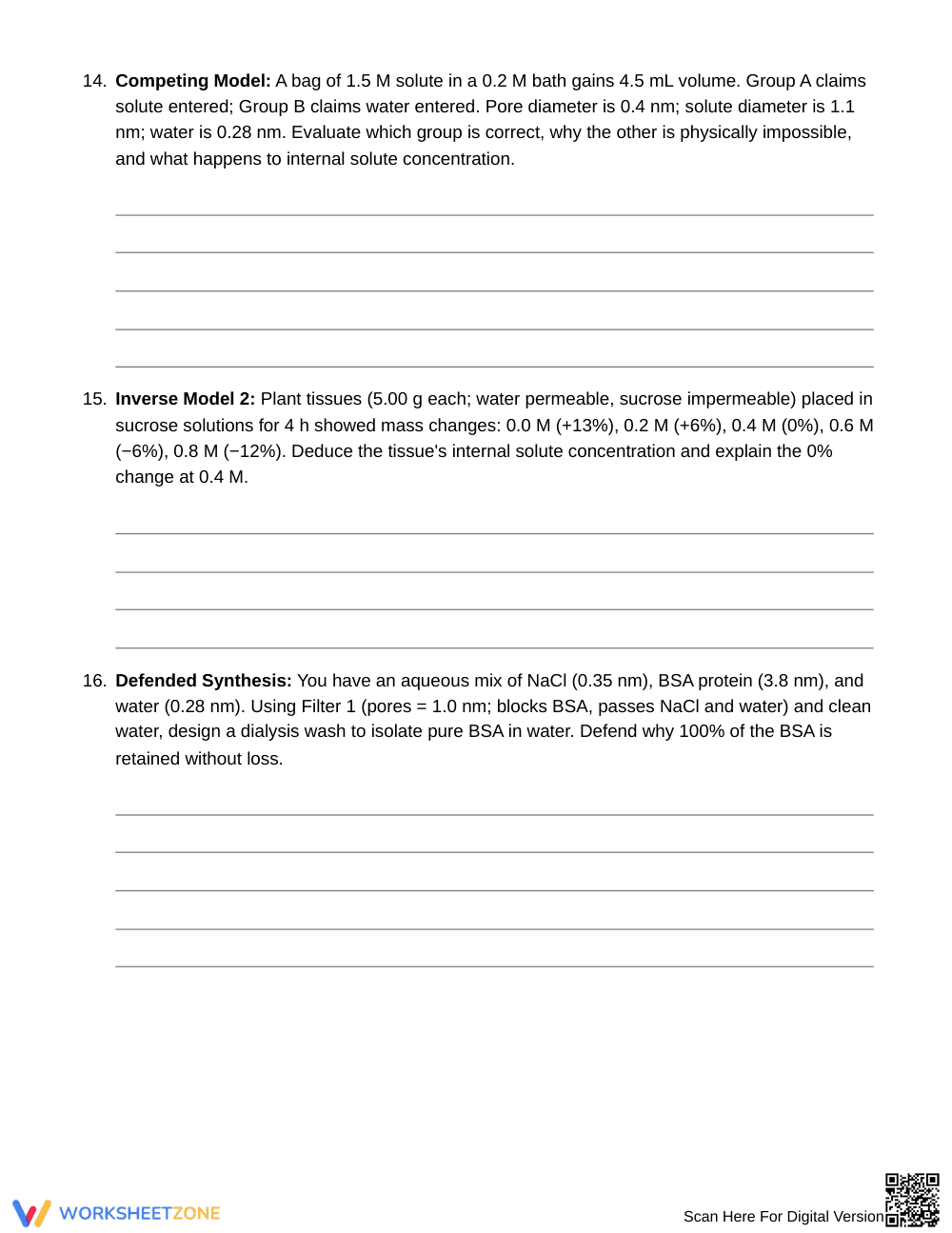
- Independent practice (Part C, Problems 11–16): Advanced modeling challenges require independent application to design dialysis procedures, calculate vesicle concentrations, and evaluate competing claims.
This sequence follows the gradual release of responsibility model, guiding students toward autonomous scientific reasoning.
Standards Alignment
This resource aligns with middle school life science standards on cell structure and function, which expect students to model how cell boundaries control substance transport. Students construct explanations using concentration gradients and pore dimensions. Both standard codes can be copied directly into lesson plans, IEP goals, or district curriculum mapping tools.
How to Use It
Assign this worksheet immediately following direct instruction on osmosis and diffusion. For mid-unit formative assessment, review Part B to identify whether students confuse solute movement with osmotic fluid volume changes. Students typically finish all three parts in 45 to 60 minutes of focused classwork.
Who It's For
This resource supports Grade 7 science classes, including differentiated support for English learners through explicit reference boxes and structured tables. Pair this worksheet with a hands-on dialysis tubing lab or cell membrane interactive simulation to solidify physical transport concepts before assigning the independent calculations in Part C.
Grounded in middle school life science standards for cell transport mechanisms, this structured curriculum asset teaches seventh-grade science students to predict outcomes when only one substance can cross a selectively permeable membrane. According to research on the gradual release of responsibility by Fisher & Frey (2014), academic success in complex scientific reasoning relies on systematically transitioning cognitive workload from structured models to autonomous investigation. This 5-page instructional sequence operationalizes that principle across 16 rigorous problems, beginning with rule-governed scenario analysis before advancing to experimental U-tube data interpretation and independent multi-step biophysical modeling. By demanding that students synthesize pore size dimensions, concentration gradients, and osmotic solvent shifts, the resource ensures learners develop authentic explanatory competence rather than relying on rote algorithmic recall. Science educators can implement this complete unit module to reliably document standards-aligned mastery during cell biology instructional sequences.


