


























Views
Downloads



Complete Seismic Wave Arrivals Worksheet | Grade 8 Science
Paste this activity's link or code into your existing LMS (Google Classroom, Canvas, Teams, Schoology, Moodle, etc.).
Students can open and work on the activity right away, with no student login required.
You'll still be able to track student progress and results from your teacher account.
This Grade 8 science worksheet equips middle school students to master the relationship between seismic wave arrivals and epicentral distance. Through 12 rigorous problems across 5 pages, learners analyze P-wave and S-wave travel times, compute lag intervals, evaluate station logs, and explore earthquake triangulation using authentic geophysical models.
At a Glance
- Grade: 8 · Subject: Science
- Standard: Earth & Space Science — Relate seismic wave propagation speeds to epicentral distance and travel time
- Skill Focus: Relate Wave Arrivals to Distance
- Format: 5 pages · 12 problems · Answer key included · PDF
- Best For: Earth systems and geophysics practice
- Time: 40–50 minutes
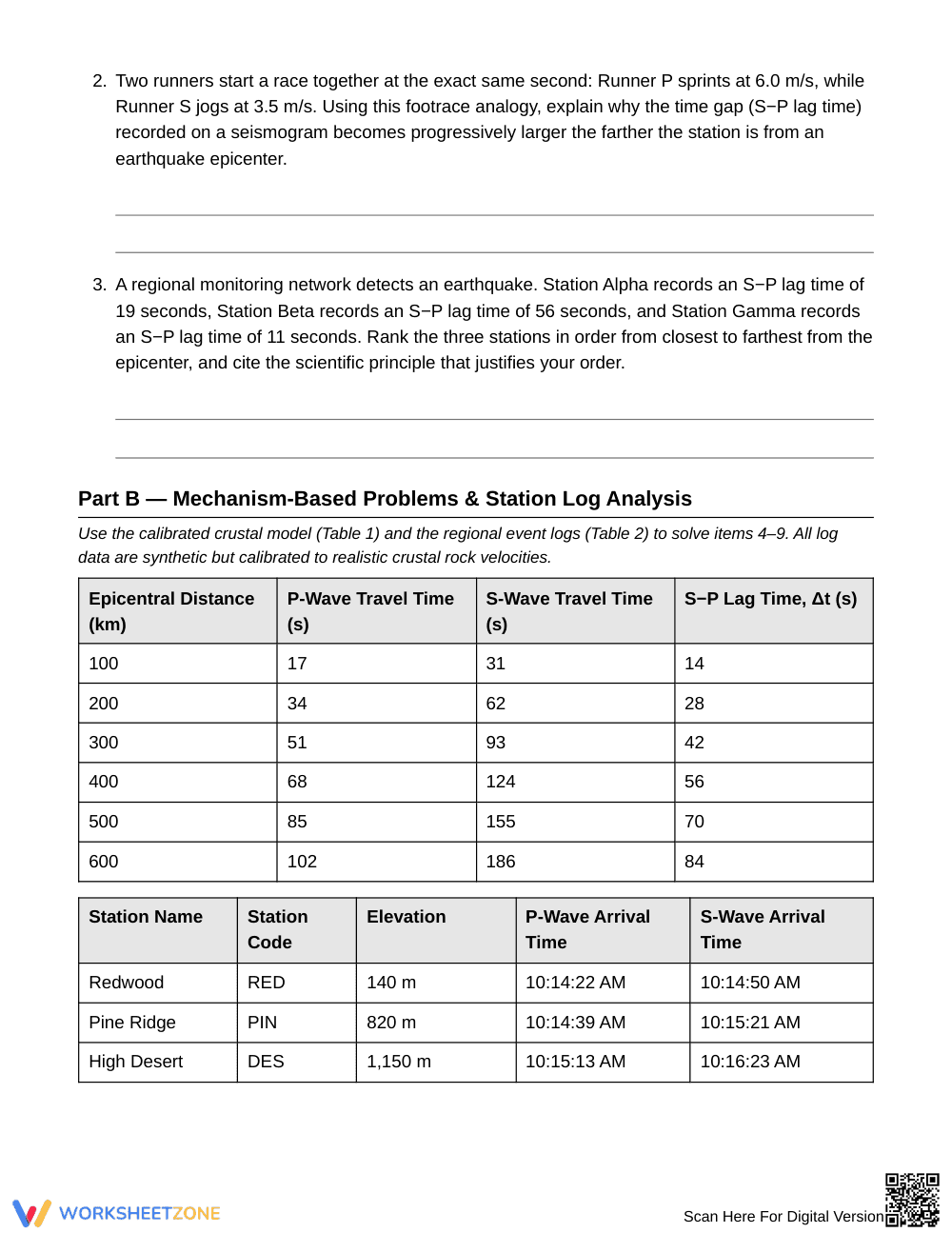
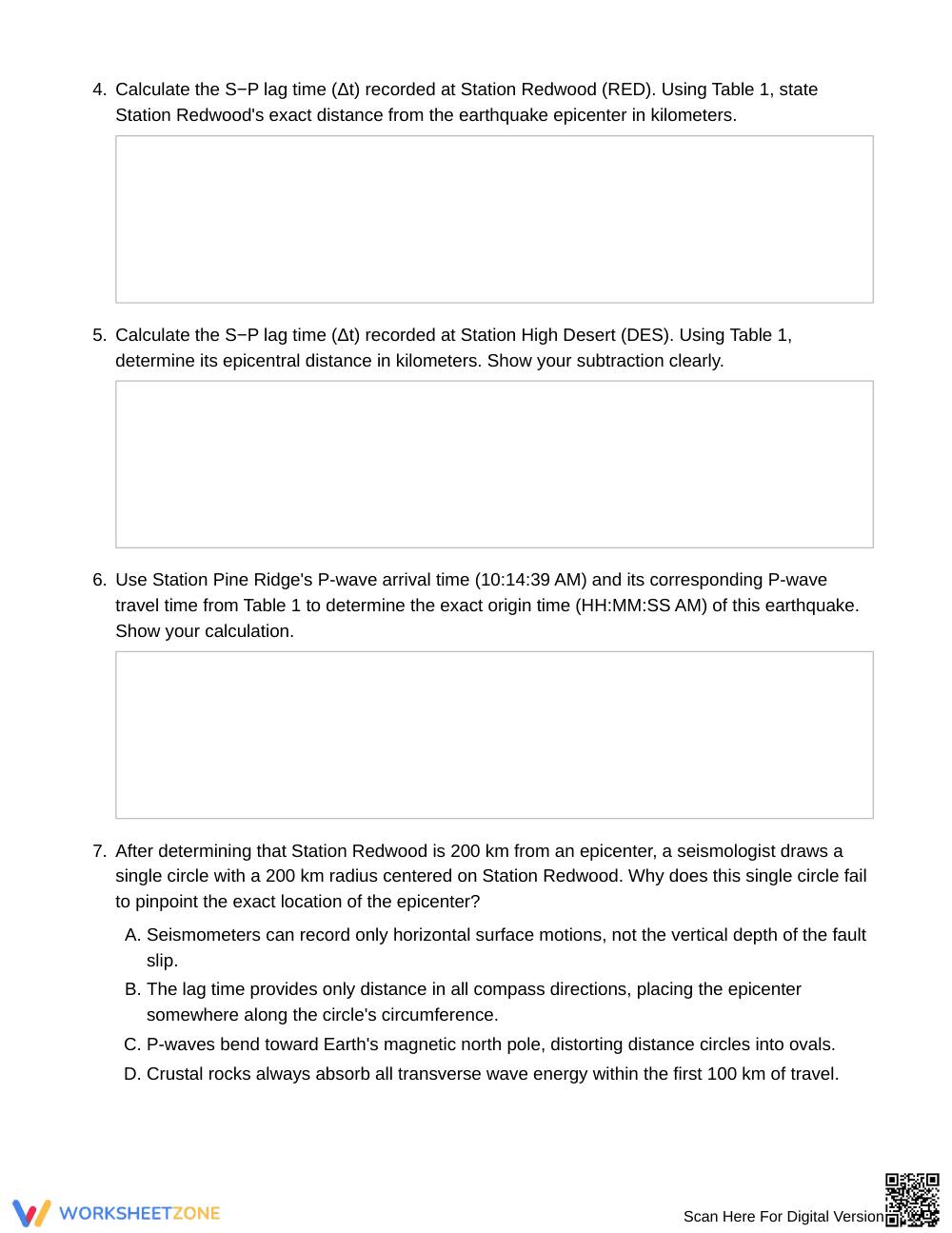
Students examine reference velocity data, synthetic station arrival logs, and travel-time tables across 12 scaffolded tasks. The 5-page worksheet includes conceptual multiple-choice checks, quantitative lag-time subtractions, origin time calculations, triangulation geometry evaluations, and medium-density wave speed predictions, supported by a complete 4-page answer key.
Skill Progression
- Guided Practice (Part A, Items 1–3): Students review compressional versus shear body waves, use a footrace velocity analogy, and rank station distances from raw lag times with baseline reference definitions.
- Supported Practice (Part B, Items 4–9): Working with calibrated crustal travel-time models and regional station logs, learners calculate arrival intervals, compute earthquake origin time, and justify three-station triangulation.
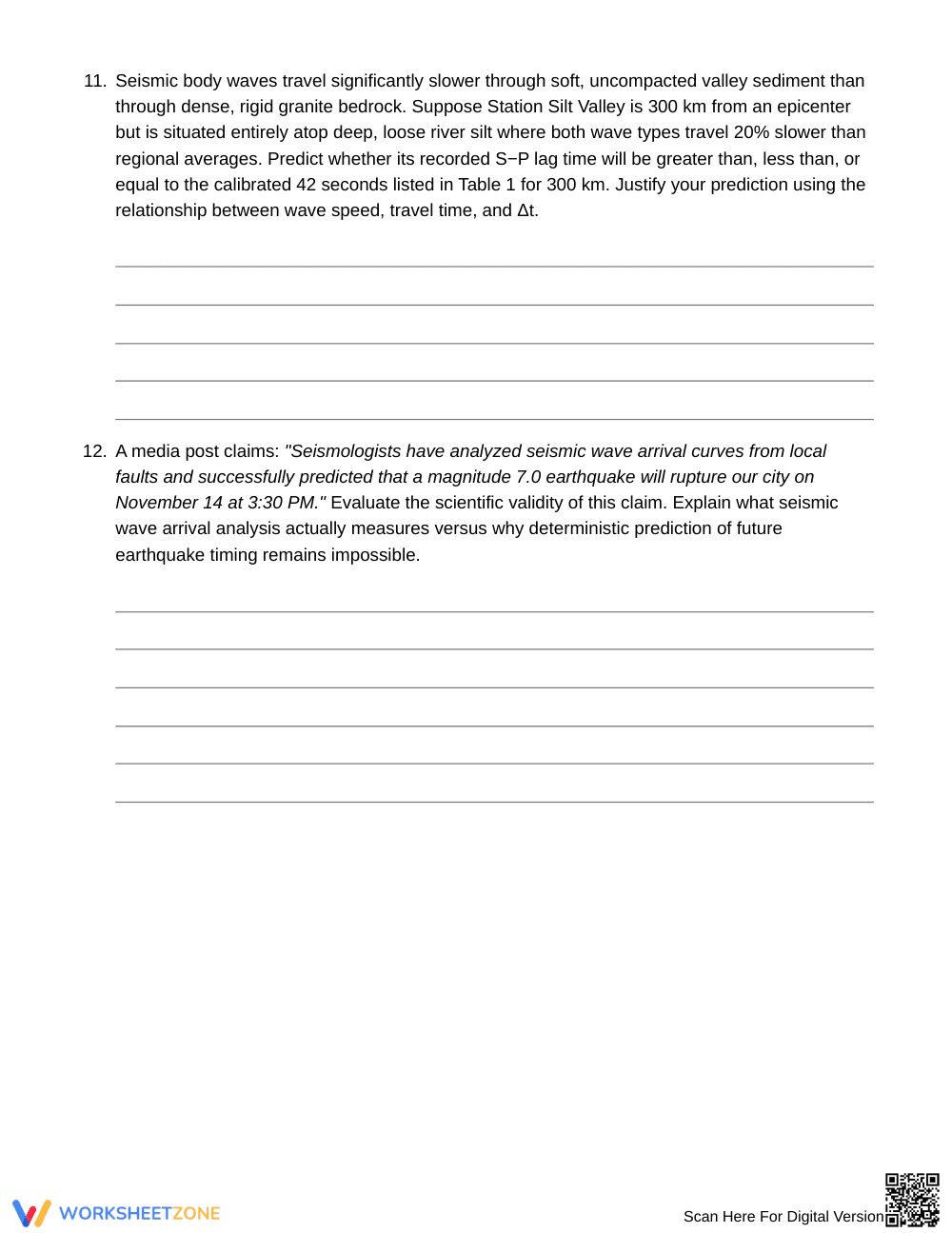
- Independent Practice (Part C, Items 10–12): Students apply principles independently to forecast arrival times at distant stations, predict wave velocity shifts through soft sediment, and critique media claims about earthquake forecasting.
This structured sequence reflects the gradual-release instructional model, moving from fundamental wave mechanics to quantitative log analysis and critical evaluation.
Standards Alignment
This activity aligns with middle school Earth and Space Science standards focusing on Earth systems, wave properties, and evidence-based geoscience data analysis. Students interpret travel-time tables and seismogram arrival differences to determine epicentral distances and fault rupture timing. Both standard codes can be copied directly into lesson plans, IEP goals, or district curriculum mapping tools.
How to Use It
Deploy this worksheet after direct instruction on P-waves and S-waves to solidify quantitative data interpretation. Alternatively, use it during small-group station rotations where students collaborate on travel-time calculations. During independent work, check Part B subtraction steps to ensure students do not confuse travel time with clock arrival time. Expect completion in 40 to 50 minutes.
Who It's For
This resource is designed for Grade 8 Earth science students exploring seismic activity and wave dynamics. Scaffolded velocity analogies support developing learners, while medium-density wave speed scenarios challenge advanced students. Pair this worksheet with a direct instruction lesson on fault rupture mechanics or an interactive seismograph simulation.
Middle school science curricula require students to analyze Earth systems by interpreting quantitative geophysical evidence, specifically relating seismic wave arrival intervals to epicentral distance. According to research on structured science learning by Fisher & Frey (2014), gradual-release scaffolding enables students to transition reliably from conceptual understanding of compressional and transverse body waves to complex multi-station triangulation. This 5-page instructional resource provides 12 targeted tasks that build quantitative competency through calibrated crustal velocity models, clock time subtraction, and empirical data analysis. By calculating S-P lag times and determining exact origin times from realistic station logs, learners demonstrate rigorous scientific reasoning central to secondary Earth science courses. The inclusion of predictive modeling questions reinforces how wave velocity varies across differing geological media, providing educators with a verifiable measure of student mastery in seismic geophysics.


