




























Views
Downloads




Complete Redshift & Spectra Worksheet | Grade 12 Science

Paste this activity's link or code into your existing LMS (Google Classroom, Canvas, Teams, Schoology, Moodle, etc.).
Students can open and work on the activity right away, with no student login required.
You'll still be able to track student progress and results from your teacher account.
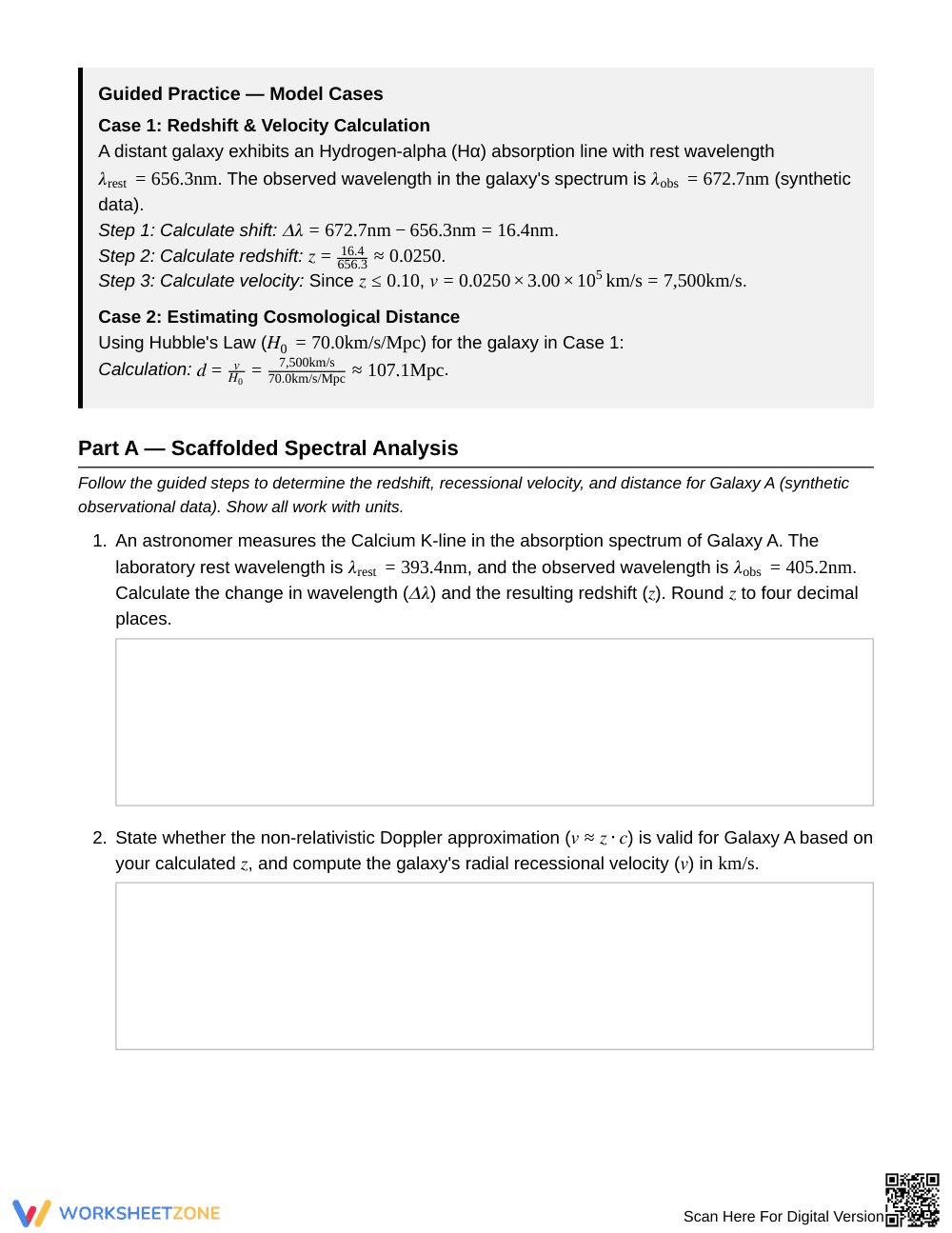
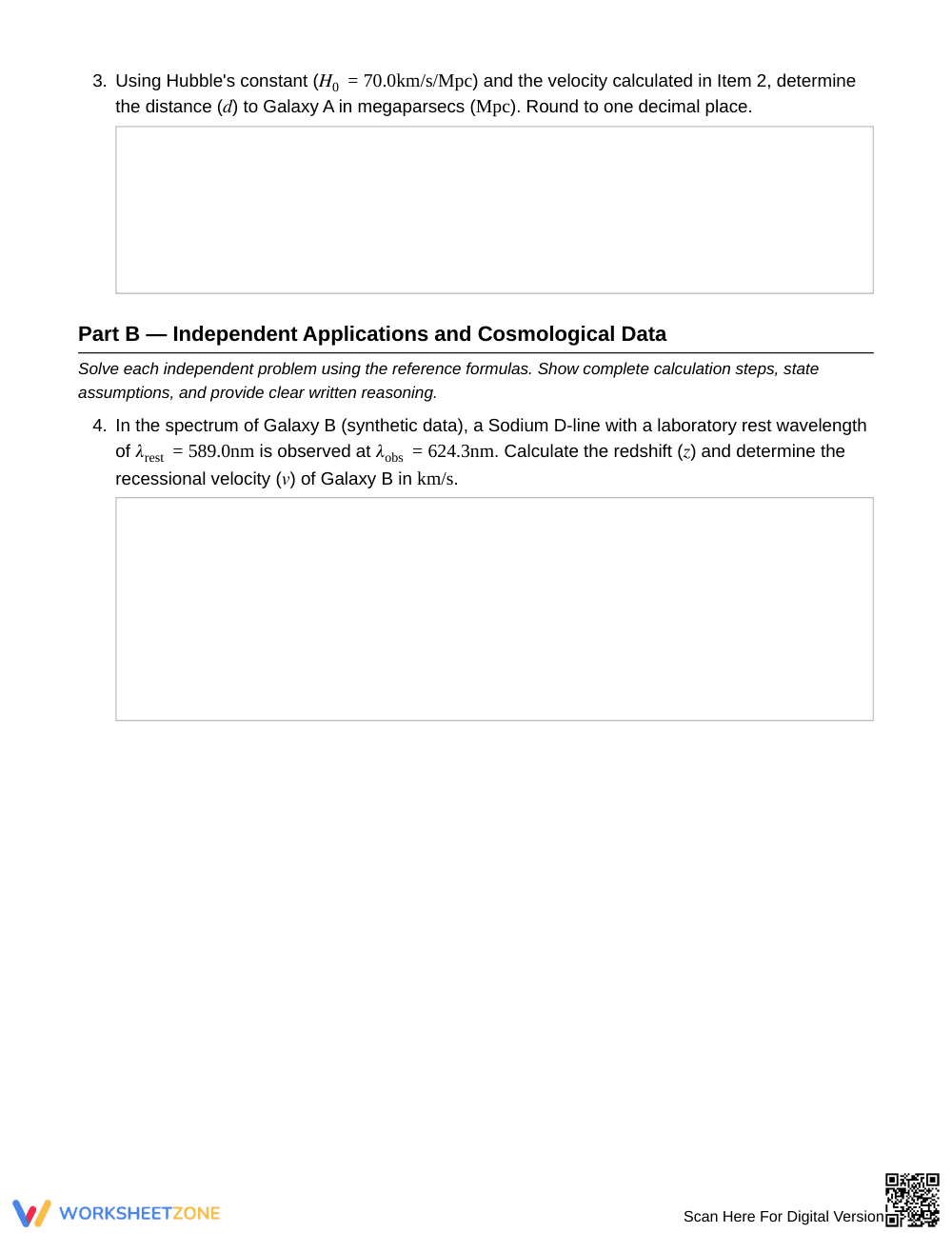
This Grade 12 Earth and Space Science worksheet builds quantitative mastery in calculating astronomical redshift from observed and rest-frame spectral wavelengths. Students determine wavelength shifts, compute radial recessional velocities using the non-relativistic Doppler approximation, and apply Hubble's Law to measure cosmological distances while evaluating observational evidence supporting the Big Bang theory.
At a Glance
- Grade: 12 · Subject: Earth and Space Science
- Curriculum Focus: Explanations of the Big Bang based on astronomical spectra and redshift
- Skill Focus: Calculating Redshift, Recessional Velocity, and Cosmological Distance
- Format: 6 pages · 10 problems · Answer key included · PDF
- Best For: High school physics or astronomy units
- Time: 45–60 minutes
What's Inside
This comprehensive 6-page printable resource features 10 structured analytical problems across three sequential sections. It includes a reference guide defining mathematical formulas and the three pillars of cosmological expansion, step-by-step worked model cases, comparative data tables with synthetic absorption spectra, conceptual evaluation prompts, and a complete 4-page step-by-step answer key.
Skill Progression
- Guided Practice: Reference formulas and 2 fully solved model cases demonstrate calculating spectral displacement, computing redshift ratios, and estimating distance via Hubble's constant.
- Supported Practice: Part A provides 3 scaffolded problems guiding learners step-by-step through Calcium K-line analysis, velocity threshold checks, and megaparsec distance calculations.
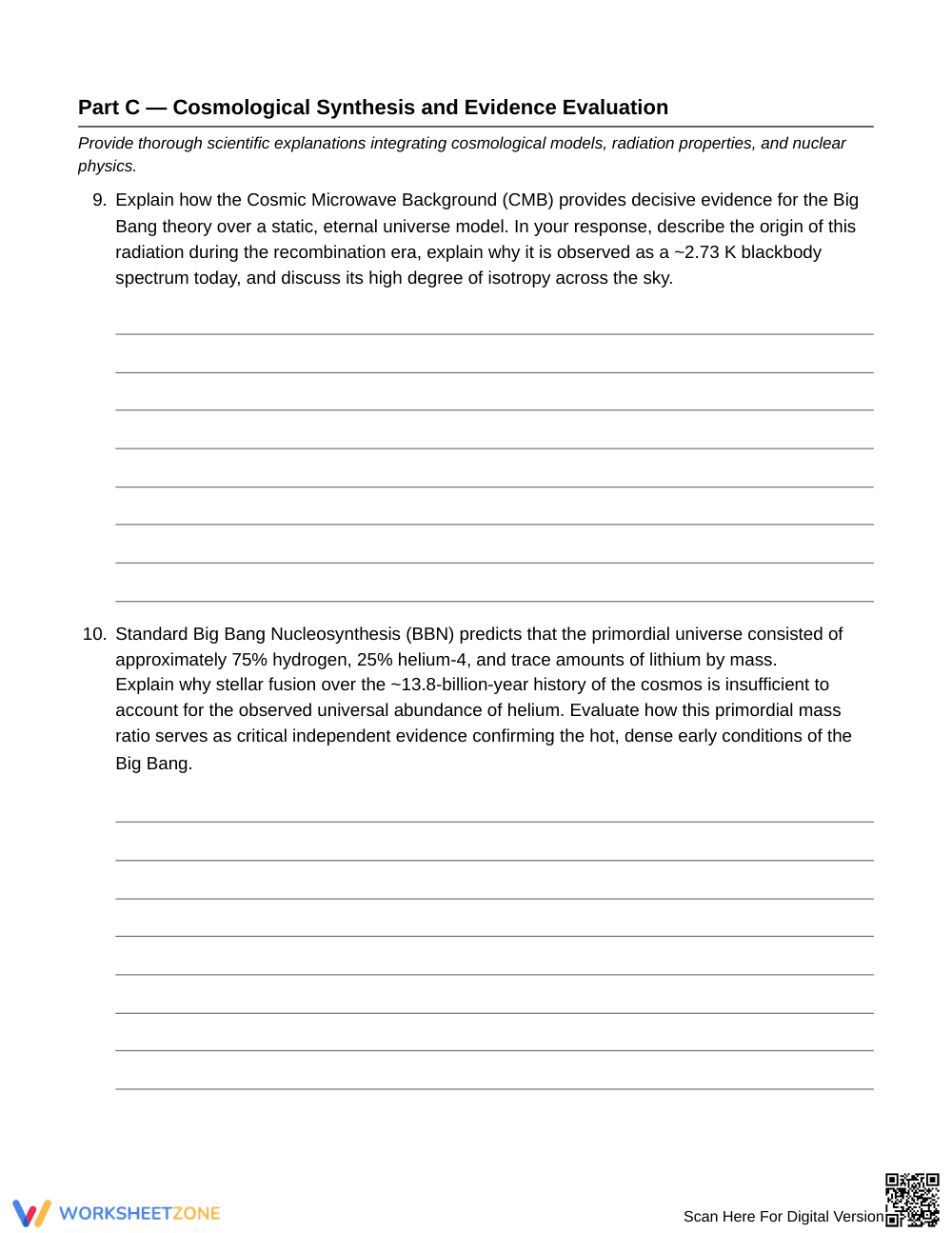
- Independent Practice: Parts B and C offer 5 rigorous multi-part items requiring independent formula application, spectral data table completion, blueshift anomaly explanations, and written evaluations of primordial nucleosynthesis.
This structured progression leverages an explicit gradual-release instructional model to transition high school seniors from formula recall to complex astrophysical reasoning.
Standards Alignment
This resource aligns with high school Earth and space science standards on cosmological expansion, specifically focusing on generating scientific explanations of the Big Bang theory using light spectra and Hubble's Law. It integrates quantitative mathematics with physical science concepts of wave propagation and cosmological nucleosynthesis. Both standard concepts can be copied directly into lesson plans, IEP goals, or district curriculum mapping tools.
How to Use It
Deploy this resource during the mid-unit application phase of an astrophysics or Earth science curriculum, directly following direct instruction on astronomical spectroscopy. As a formative assessment checkpoint, monitor whether students verify that z ≤ 0.10 before applying the non-relativistic velocity formula. Students typically complete the 10 core calculation and synthesis tasks in 45 to 60 minutes of focused classroom or laboratory time.
Who It's For
Designed for Grade 12 Earth and Space Science, Astronomy, or AP Physics students seeking rigorous quantitative practice with spectroscopic data. Pair this problem set directly with a laboratory emission spectroscopy demonstration or an interactive cosmological redshift simulation.
Fisher & Frey (2014) demonstrate that structured scaffolding through model cases and gradual-release problem sets significantly deepens high school students' procedural fluency in complex quantitative science tasks. This Grade 12 Earth and Space Science worksheet provides 10 scaffolded calculation items that train learners to calculate redshift from rest and observed spectral wavelengths, determine galaxy recessional velocities using the non-relativistic Doppler relationship, and calculate cosmological distances via Hubble's Law. By linking mathematical derivations to physical observations of cosmic microwave background radiation and primordial abundances, the resource reinforces empirical foundations of modern cosmology while building rigorous analytical problem-solving skills. Secondary educators can utilize these structured exercises during direct instruction, small group review, independent practice, or collaborative laboratory investigations to ensure advanced high school learners systematically master foundational astrophysical computations and evidence-based scientific reasoning with sustained academic confidence.


