


























Views
Downloads



Complete Quote Integration Worksheet | Grade 11 English III
Paste this activity's link or code into your existing LMS (Google Classroom, Canvas, Teams, Schoology, Moodle, etc.).
Students can open and work on the activity right away, with no student login required.
You'll still be able to track student progress and results from your teacher account.
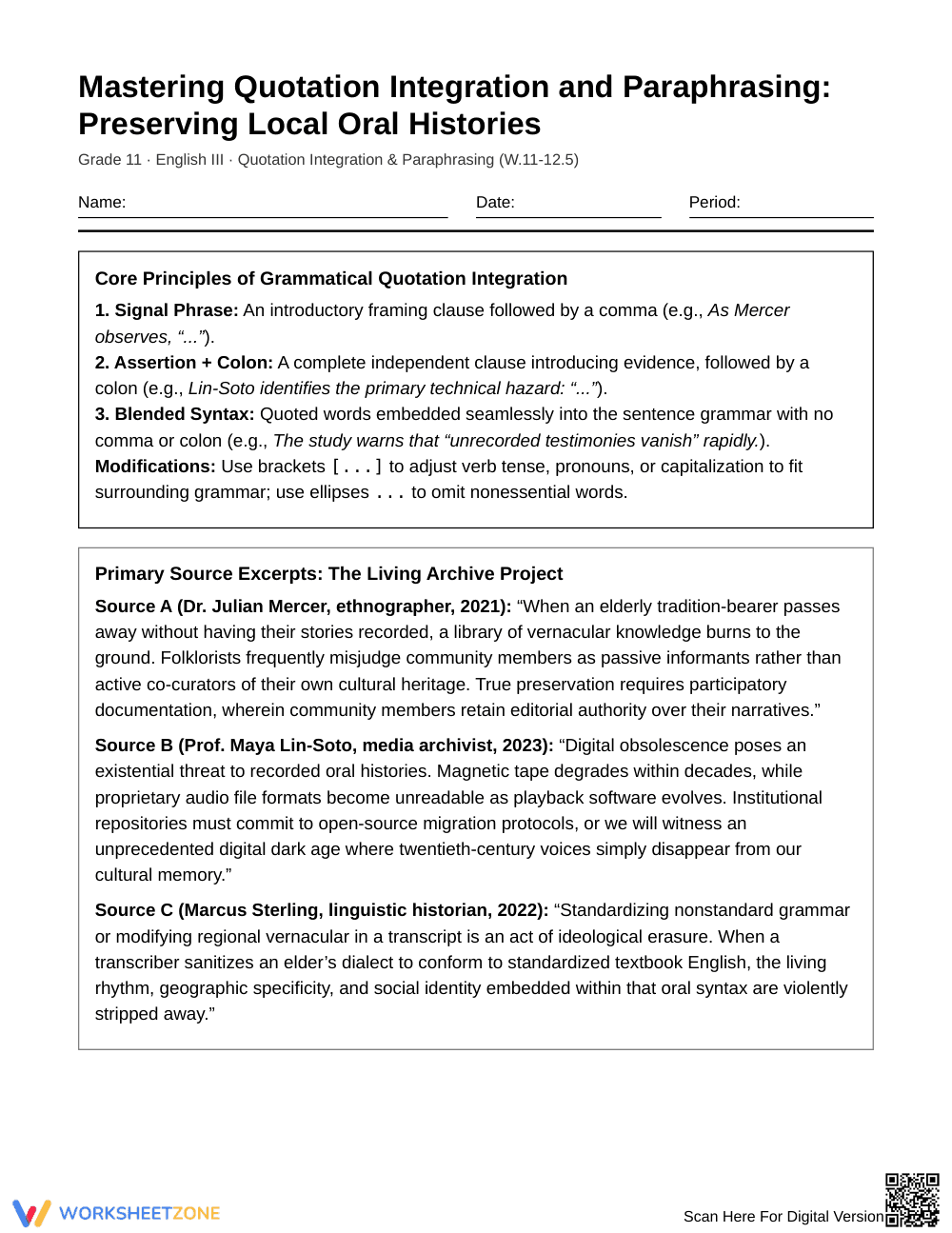
This Grade 11 writing worksheet guides students to build grammatically integrated quotations within analytical essays. Moving beyond dropped evidence, students master signal phrases, colon introductions, and blended syntax across 12 structured exercises. High school writers diagnose and repair mechanical flaws to develop syntactical precision for research writing.
At a Glance
- Grade: 11 · Subject: English III
- Standard:
W.11-12.5— Strengthen writing by planning, revising, editing, and integrating textual research evidence- Skill Focus: Build a Grammatically Integrated Quotation
- Format: 6 pages · 12 problems · Answer key included · PDF
- Best For: Secondary analytical research paper revision and writing workshop practice
- Time: 45–60 minutes of focused instruction
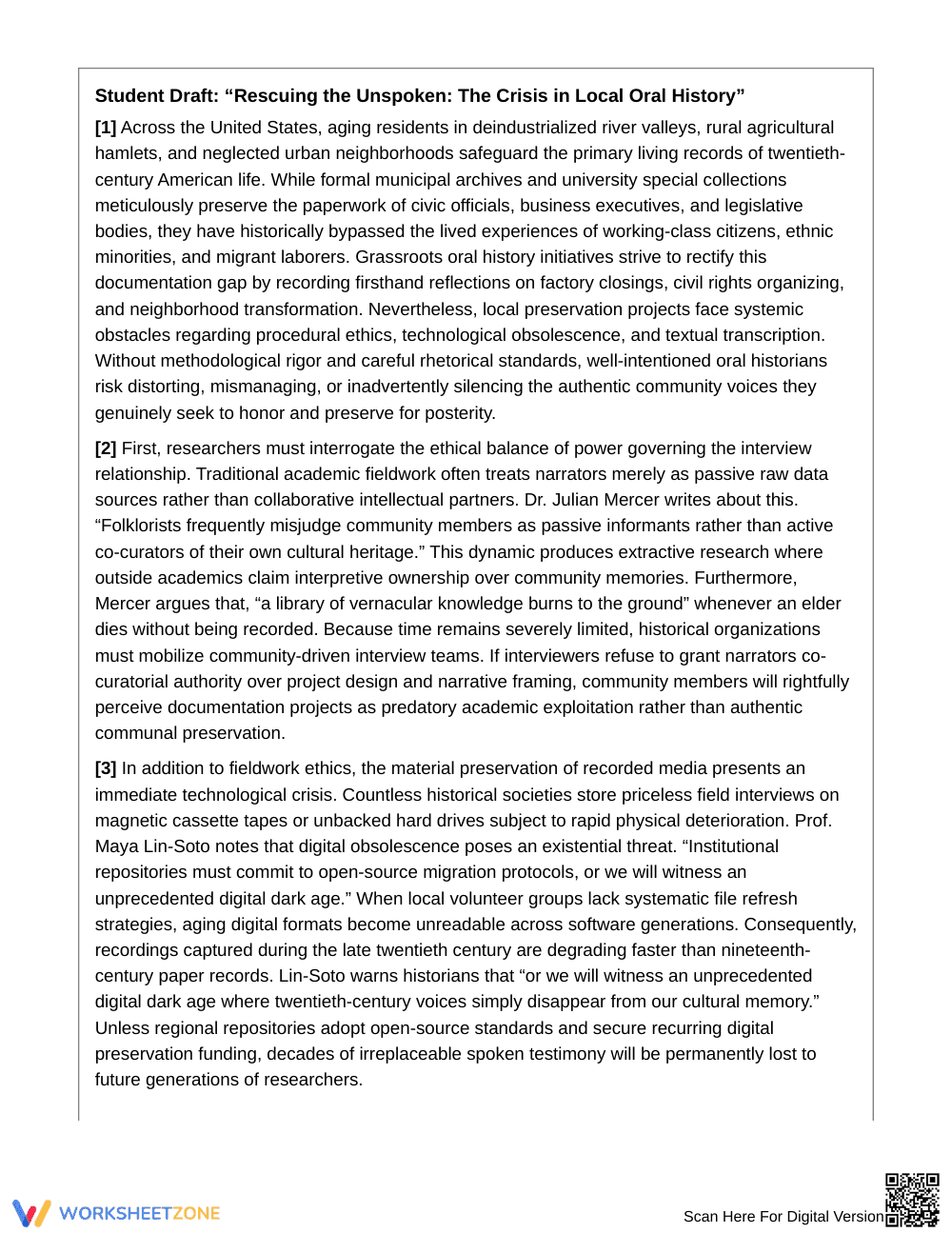
This 6-page worksheet features a foundational reference box detailing signal phrases, colon rules, blended syntax, and bracket or ellipsis modifications. Students evaluate an authentic four-paragraph draft addressing oral history preservation, completing 12 analytical tasks across three skill tiers. A thorough 3-page answer key provides complete diagnostic breakdowns and sample rewrites for every problem.
Skill Progression
- Guided Practice (Tasks 1–3): Students deconstruct mentor sentences, analyzing bracketed verb modifications, colon conditions, and punctuation-free blended quotations.
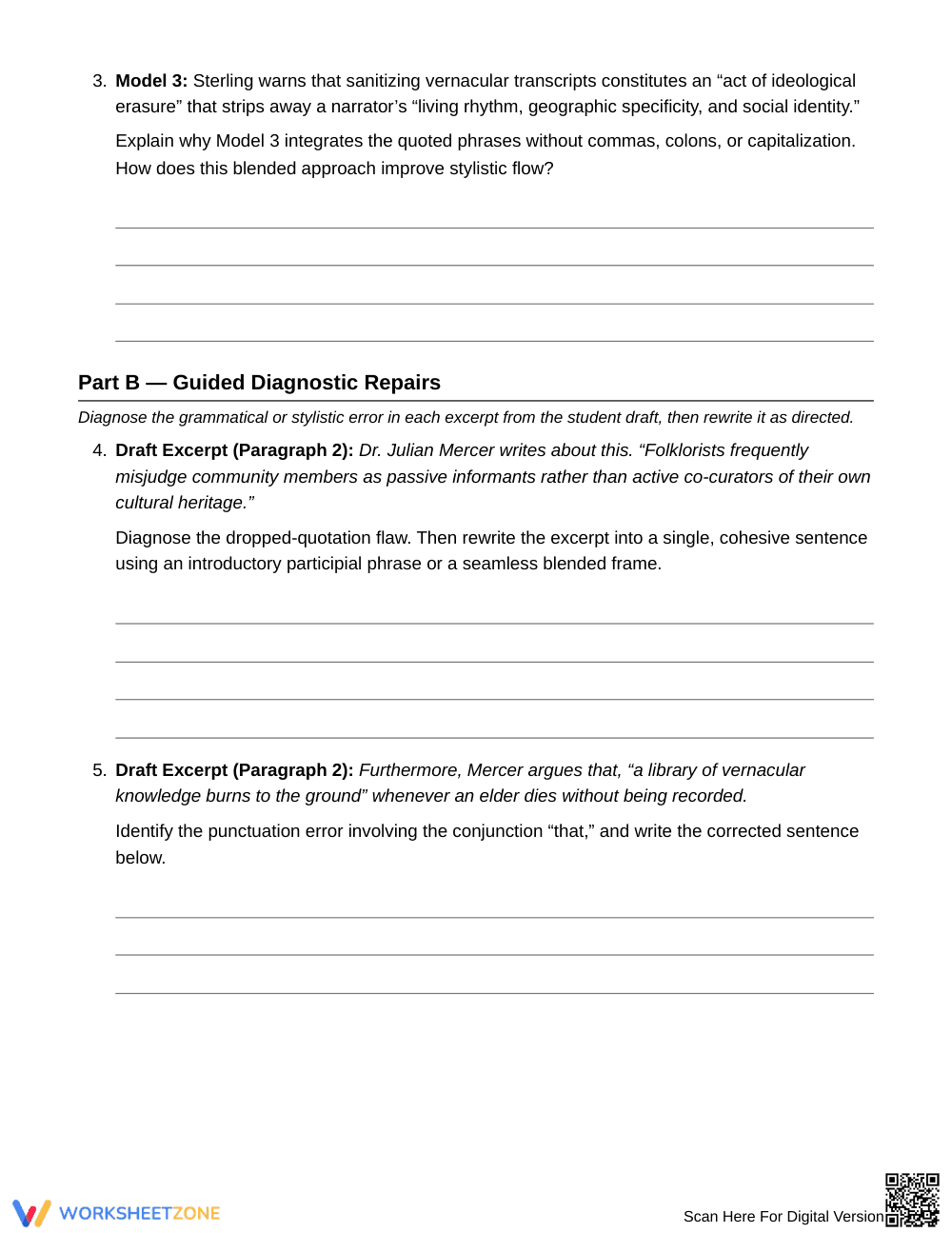
- Supported Practice (Tasks 4–9): Learners diagnose draft flaws, fixing dropped quotes, comma splices with "that," weak verbs, and point-of-view shifts.
- Independent Practice (Tasks 10–12): Writers independently synthesize multi-source evidence, embed brief quotations into complex sentences, and rewrite an entire analytical paragraph.
This sequence implements gradual release, transitioning students from structural analysis to autonomous revision.
Standards Alignment
This worksheet aligns directly to primary standard `W.11-12.5`, which tasks students with developing and strengthening writing through revising, editing, and rewriting. It also supports `RI.11-12.1` by requiring accurate textual evidence citation. Both standard codes can be copied directly into lesson plans, IEP goals, or district curriculum mapping tools.
How to Use It
Use this activity during essay revision workshops or evidence-based writing modules. Introduce the rule box during direct instruction, complete Part A as a class, and assign Parts B and C for individual practice over 45–60 minutes. As a formative assessment tip, check Task 5 immediately to ensure students omit commas after the conjunction "that."
Who It's For
This resource serves Grade 11 English III, AP Seminar, and AP Language students preparing for college research papers. It provides targeted scaffolds for writers struggling with syntactical flow while challenging advanced students with rigorous multi-source synthesis. Pair this worksheet with an essay rubric or citation anchor chart.
Integrating textual evidence fluidly into student writing represents a critical milestone in secondary literacy development. Aligned to standard W.11-12.5, this instructional resource targets the specific grammatical skill of building syntactically integrated quotations through signal phrases, colons, and blended sentence structures. As highlighted in research by Fisher & Frey (2014) on productive literacy instruction and gradual release of responsibility, secondary students acquire complex academic writing competencies most effectively when explicit structural modeling precedes diagnostic revision and unassisted production. When eleventh-grade writers learn to adjust verb tenses with brackets, eliminate dropped quotations, and control punctuation around subordinating conjunctions, their analytical writing demonstrates greater rhetorical authority and academic clarity. This six-page instructional sequence provides the deliberate, scaffolded practice necessary to eliminate recurring mechanical errors, ensuring high school students transfer robust evidence-integration strategies directly into authentic research papers, literary essays, and standardized document-based assessments.


