


























Views
Downloads



Complete Qualified Proposals Worksheet | Grade 6 ELA
Paste this activity's link or code into your existing LMS (Google Classroom, Canvas, Teams, Schoology, Moodle, etc.).
Students can open and work on the activity right away, with no student login required.
You'll still be able to track student progress and results from your teacher account.
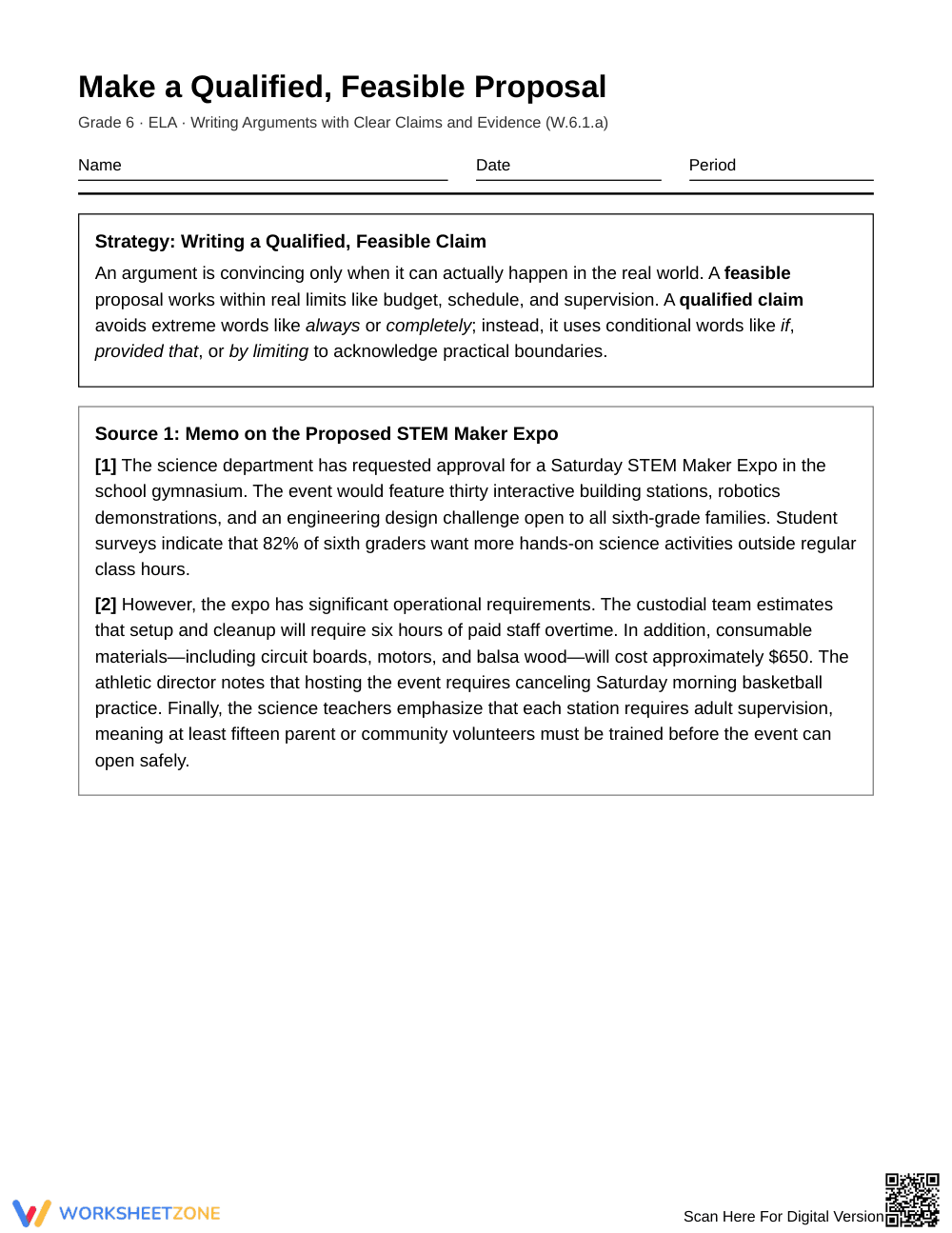
This five-page worksheet teaches sixth-grade writers how to craft qualified, feasible proposals grounded in real-world constraints. Through two authentic school-event memos, students analyze budgets, facility limits, and staffing needs before drafting argument paragraphs that cite specific evidence. By the final task, students distinguish absolute claims from practical proposals and revise weak drafts into polished, evidence-based arguments aligned to W.6.1.a.
At a Glance
- Grade: 6 · Subject: ELA
- Standard:
W.6.1.a— Introduce claims and organize reasons and evidence clearly- Skill Focus: Writing qualified, feasible proposals
- Format: 5 pages · 8 problems · Answer key included · PDF
- Best For: Argument writing practice after direct instruction
- Time: 35–50 minutes
What's Inside
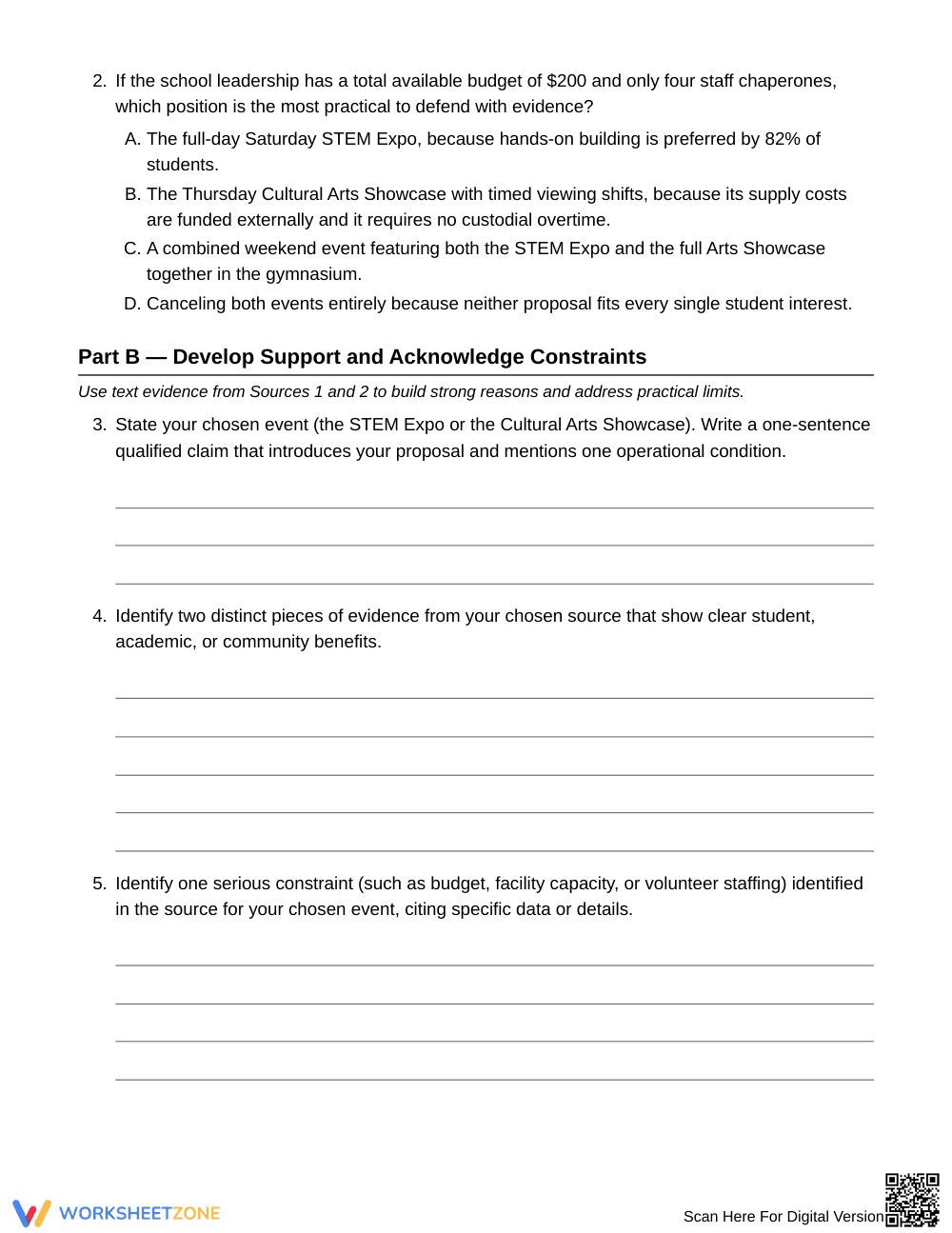
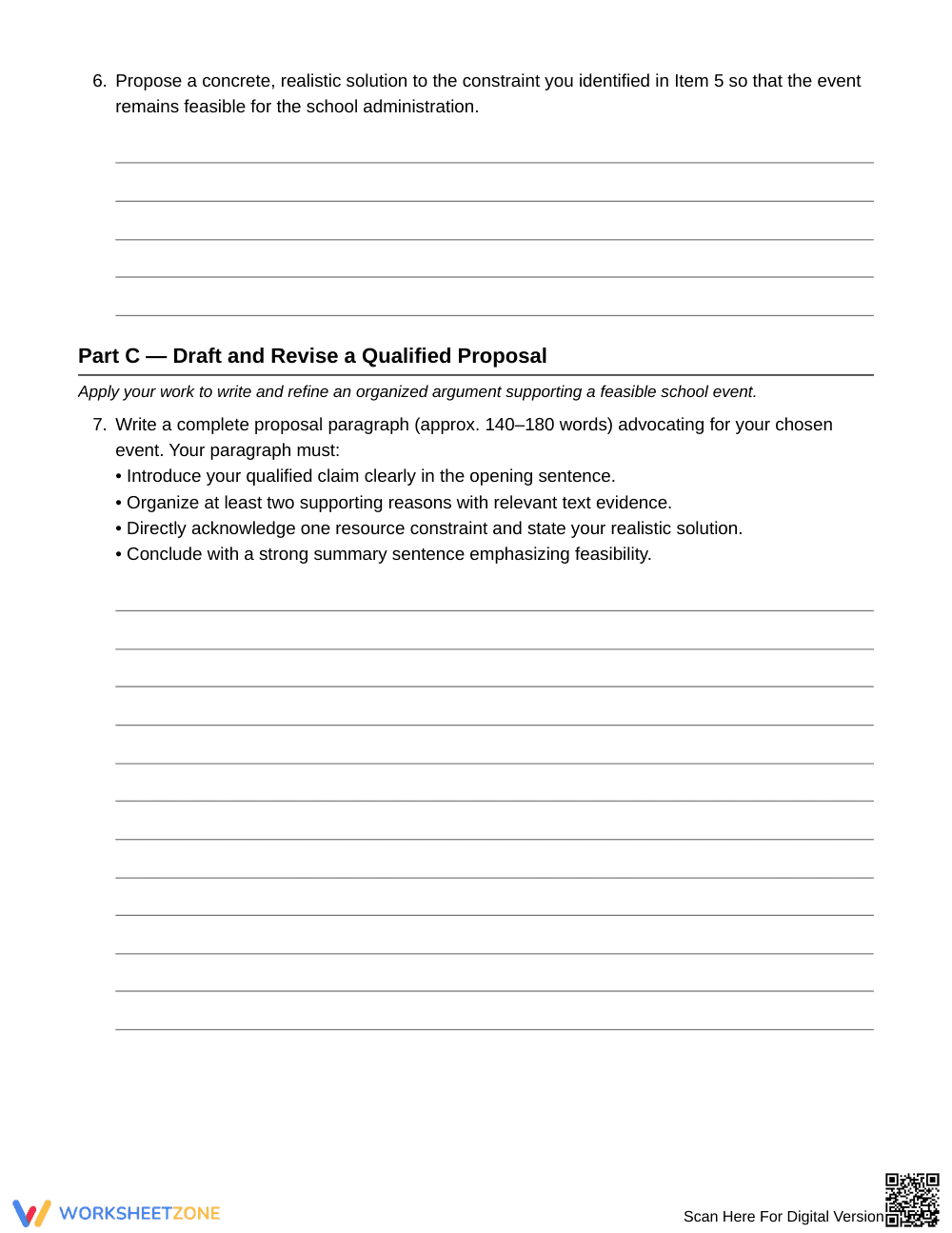
The worksheet opens with a strategy box defining feasibility and qualified language. Two source memos supply realistic data on costs, volunteer needs, fire-code limits, and scheduling conflicts. Part A presents two multiple-choice items evaluating practical constraints against a fixed budget. Part B offers four short-response tasks focusing on claims, evidence, constraints, and solutions. Part C includes a 140–180 word proposal paragraph and a draft revision task. A two-page answer key provides complete model responses.
Skill Progression
- Guided practice (Part A, Items 1–2): Multiple-choice items scaffold recognition of qualified versus absolute claims against source data.
- Supported practice (Part B, Items 3–6): Short-response prompts isolate discrete sub-skills, including claim writing, evidence selection, constraint analysis, and solution design.
- Independent practice (Part C, Items 7–8): Students draft a complete proposal paragraph and revise a flawed draft without scaffolding.
How to Use It
Assign this resource directly after a mini-lesson on conditional claims and evidence integration. Students can complete Parts A and B collaboratively in pairs, then write Part C independently. Scan opening sentences in Item 7 for conditional phrasing like provided that to assess mastery quickly during the 35–50 minute activity.
Who It's For
This resource suits on-grade sixth-grade writers building argument skills. Students needing support benefit from the strategy box and structured Part B prompts, while advanced writers are challenged by the open-ended revision task in Item 8. Pair this worksheet with an anchor chart of conditional qualifiers for further scaffolding.
Aligned to W.6.1.a, this worksheet targets the specific skill of writing qualified, feasible proposals—an essential area where many middle-grade students default to absolute language. According to Fisher & Frey (2014), gradual release of responsibility significantly improves student writing quality when each sub-skill is practiced in isolation before full composition. The eight tasks move from guided claim recognition through evidence gathering to independent drafting and revision, ensuring that students demonstrate mastery across multiple response types. With a two-page answer key, teachers gain an immediate scoring tool suitable for formative assessment, progress monitoring, or IEP documentation. The resource requires no additional preparation: source texts, prompts, and model answers are self-contained within five printable pages, making it practical for both regular instruction and substitute coverage in any sixth-grade ELA classroom focused on persuasive argument writing.


