




























Views
Downloads



Complete Pronoun Repair Worksheet | Grade 6 ELA

Paste this activity's link or code into your existing LMS (Google Classroom, Canvas, Teams, Schoology, Moodle, etc.).
Students can open and work on the activity right away, with no student login required.
You'll still be able to track student progress and results from your teacher account.
Help sixth-grade students master pronoun clarity by evaluating flawed revisions and correcting ambiguous references. This 5-page worksheet provides targeted practice analyzing vague antecedents and unintended meaning shifts, guiding learners to craft precise sentences that preserve the author's original intent across narrative and informational contexts.
At a Glance
- Grade: 6 · Subject: ELA
- Standard:
L.6.1.d— Recognize and correct vague pronouns that lack clear antecedents- Skill Focus: Diagnosing flawed pronoun repairs and rewriting for clarity
- Format: 5 pages · 10 problems · Answer key included · PDF
- Best For: Language conventions practice and targeted grammar revision
- Time: 30–45 minutes
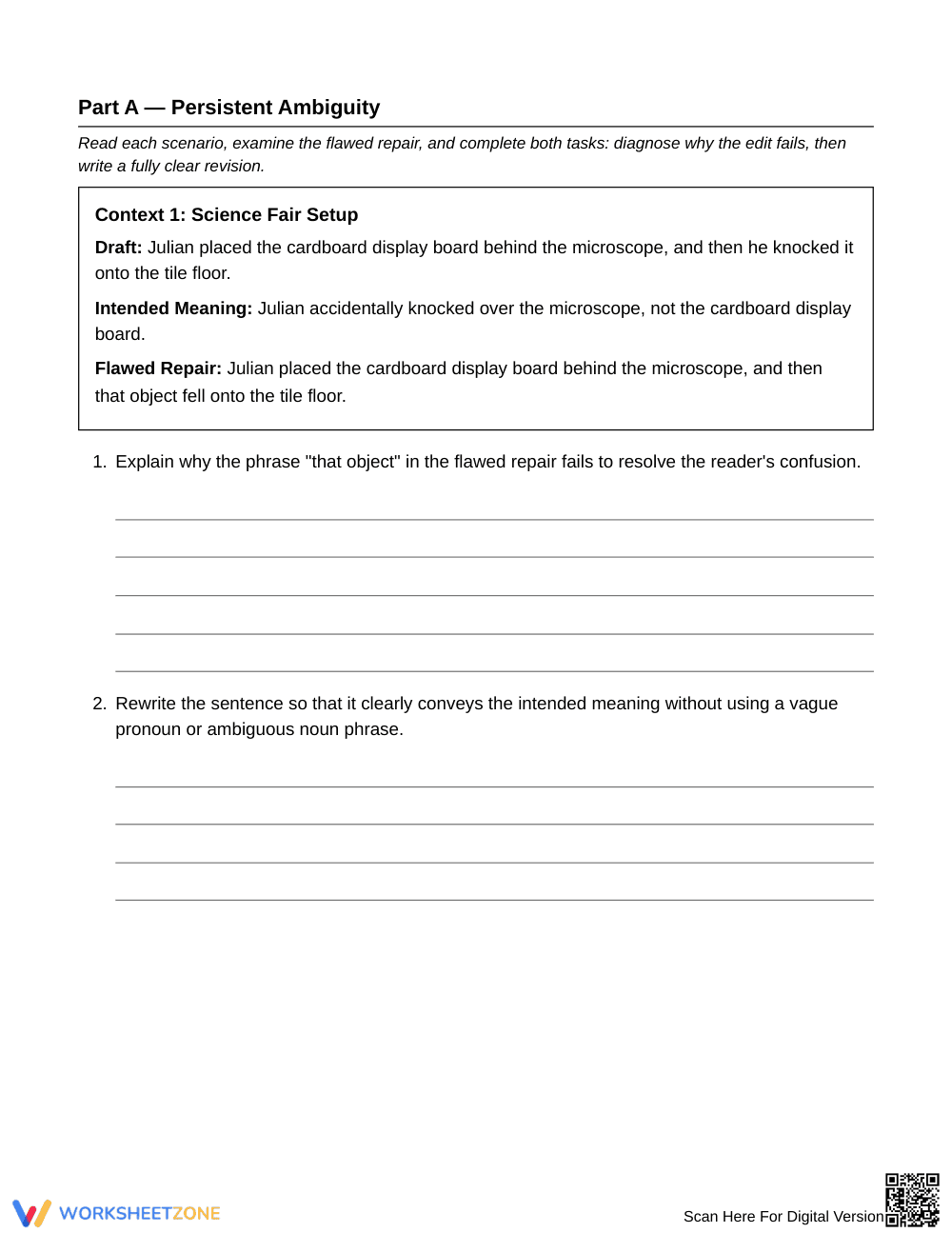
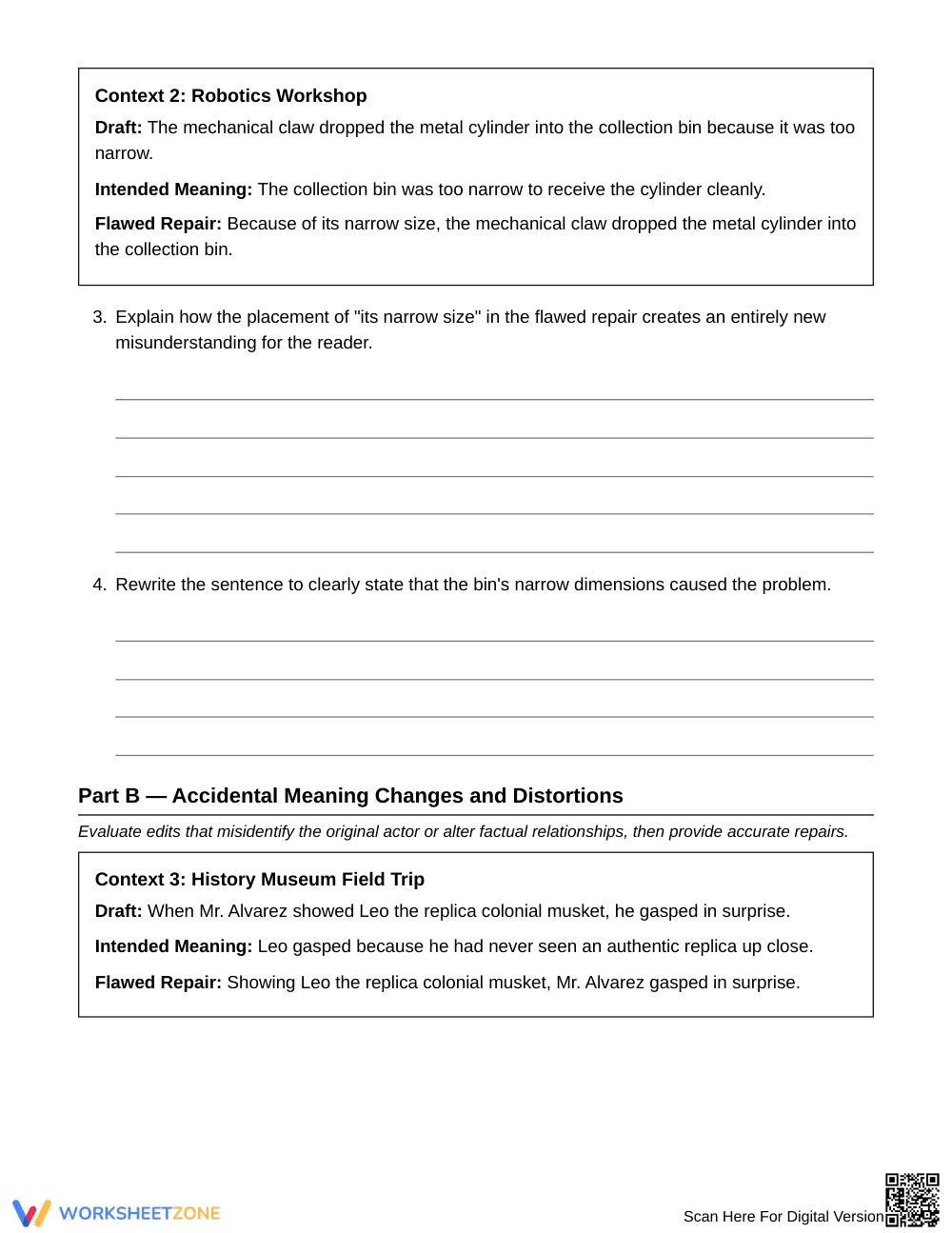
This 5-page resource includes 10 analytical and revision tasks organized into two distinct sections, backed by a 2-page answer key. A reference box and modeled example demonstrate why quick edits fail. Students examine five rich contexts, explaining specific grammatical errors before rewriting each sentence with total clarity.
Skill Progression
- Guided Practice: Students review an explicit reference rule box and a modeled exemplar dissecting how repeated pronouns leave antecedents unclear, establishing criteria for successful edits.
- Supported Practice (Tasks 1–4): In Part A, learners examine sentences containing persistent ambiguity, explaining why replacement phrases fail before executing their own targeted rewrites.
- Independent Practice (Tasks 5–10): In Part B, students independently evaluate flawed repairs that shift original meaning or misidentify subjects, rewriting each sentence for complete factual accuracy.
This structured progression utilizes a gradual-release model, moving students from analytical deconstruction to autonomous sentence revision.
Standards Alignment
This resource aligns directly to Common Core Standard `L.6.1.d`: Recognize and correct vague pronouns (i.e., ones with unclear or ambiguous antecedents). The exercise also reinforces supporting standard `W.6.5` by developing students' ability to strengthen writing through planning, revising, and editing for clarity and purpose. Both standard codes can be copied directly into lesson plans, IEP goals, or district curriculum mapping tools.
How to Use It
Deploy this worksheet after direct instruction on pronoun agreement during your writing revision unit. Use Part A as a collaborative partner exercise where students articulate why flawed repairs fail, then assign Part B independently. As a formative check, observe whether students correctly identify the intended antecedent before rewriting. Completion takes approximately 30 to 45 minutes.
Who It's For
This activity supports sixth-grade ELA students refining their syntax, as well as writers needing targeted language intervention. Pair this worksheet with an anchor chart on vague pronoun strategies or a peer-editing workshop to maximize transfer into authentic student writing.
According to research on explicit writing instruction synthesized by Fisher & Frey (2014), students develop deeper grammatical competence when they actively diagnose syntax errors rather than merely selecting multiple-choice corrections. Common Core standard L.6.1.d requires middle school writers to recognize and correct vague pronouns with ambiguous antecedents, a critical threshold skill for clear academic and informational composition. When students evaluate why an editing attempt fails—whether through persistent reference ambiguity or accidental shifts in meaning—they build the metacognitive awareness needed to monitor and refine their own drafts during the independent revision process. By coupling structured error analysis with immediate, context-driven sentence production across 10 focused tasks, this instructional resource reinforces foundational language conventions and ensures learners bridge analytical grammar understanding with authentic, expressive writing fluency in upper elementary and middle school classrooms.


