




























Views
Downloads



Complete Pronoun Clarity Worksheet | Grade 6 ELA

Paste this activity's link or code into your existing LMS (Google Classroom, Canvas, Teams, Schoology, Moodle, etc.).
Students can open and work on the activity right away, with no student login required.
You'll still be able to track student progress and results from your teacher account.
Mastering pronoun reference requires middle school writers to evaluate whether a pronoun has a clear antecedent or creates confusion. This Grade 6 ELA worksheet guides students through 10 analytical tasks based on a technical passage, teaching them to identify clear pronouns, revise ambiguous references, and compare stylistic revisions for precision.
At a Glance
- Grade: 6 · Subject: ELA
- Standard:
L.6.1.d— Recognize and correct vague pronouns with unclear or ambiguous antecedents- Skill Focus: Pronoun Clarity and Vague Pronouns
- Format: 5 pages · 10 problems · Answer key included · PDF
- Best For: Grammar review and targeted editing practice
- Time: 35–45 minutes
This 5-page instructional resource contains an informational reading passage titled 'Team Update: Solar Rover Challenge,' paired with explicit Clarity Criteria explaining when to keep or revise pronouns. The activity includes 10 rigorous items organized across three distinct analytical sections, followed by an exhaustive 3-page teacher answer key that models complete grammatical justifications and multiple correction pathways.
Skill Progression
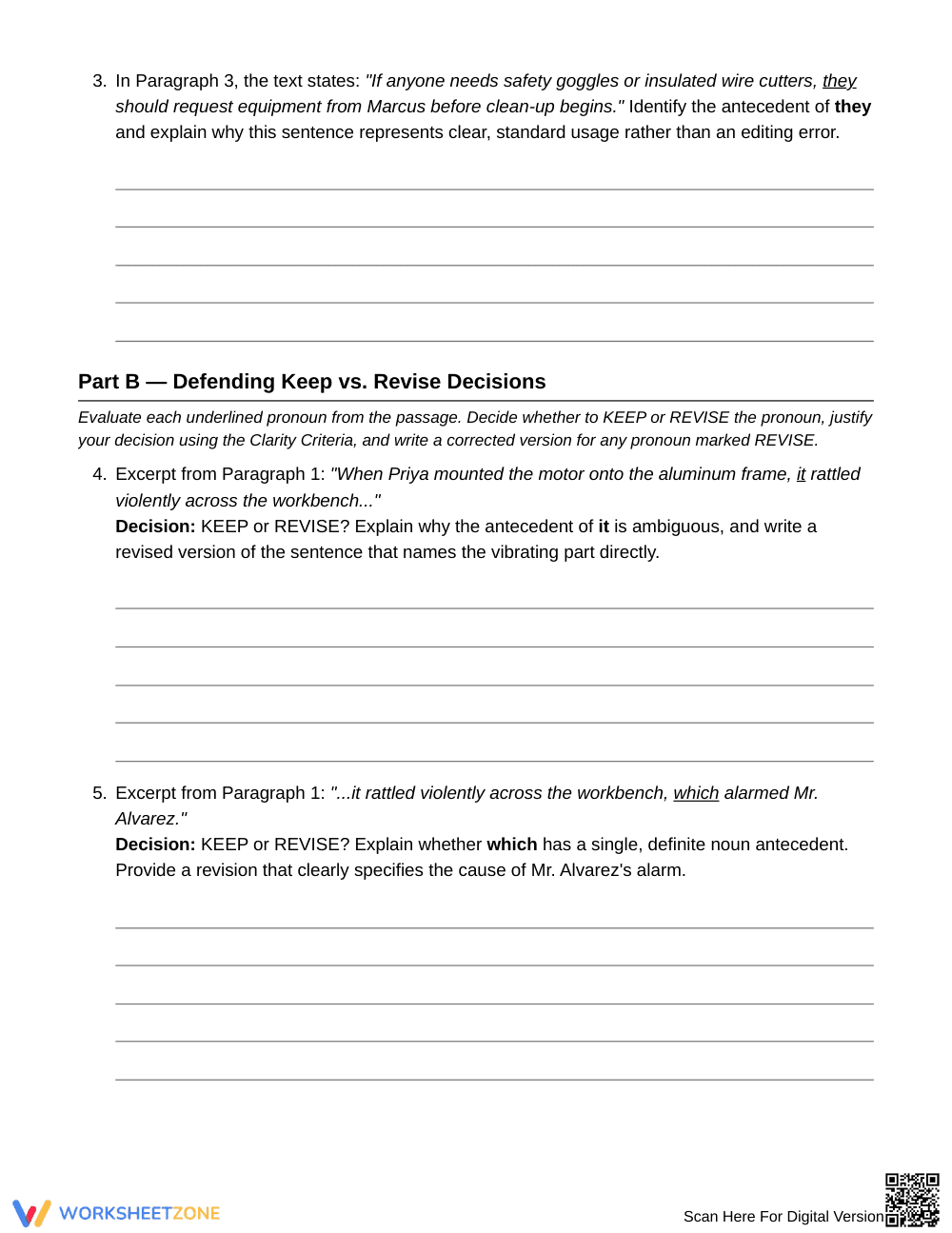
- Guided practice (Part A — 3 items): Students evaluate unambiguous pronouns such as subject pronouns and standard singular 'they,' explaining why each reference is grammatically sound.
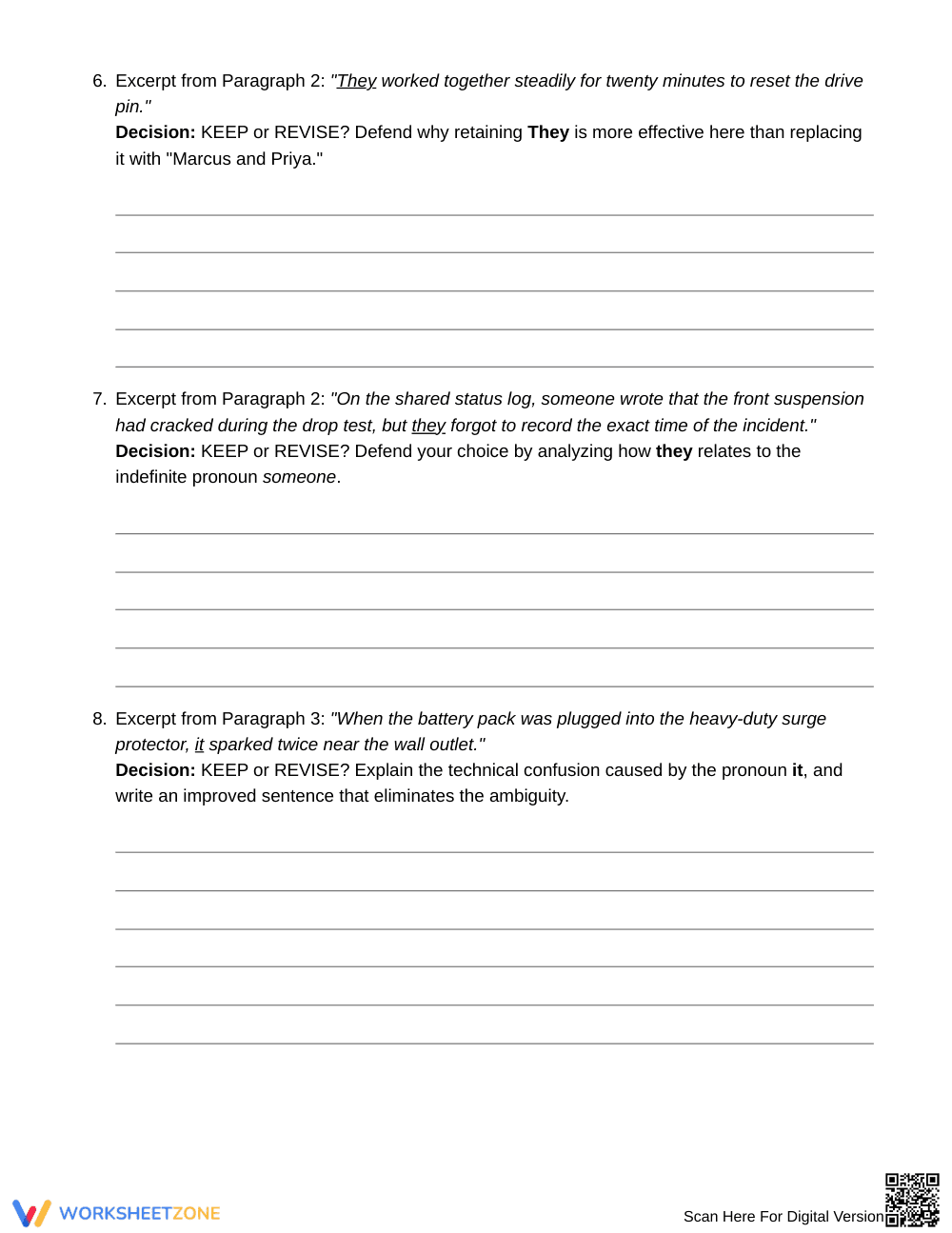
- Supported practice (Part B — 5 items): Learners evaluate ambiguous pronouns, defend keep-or-revise decisions using criteria rules, and rewrite sentences containing vague referents.
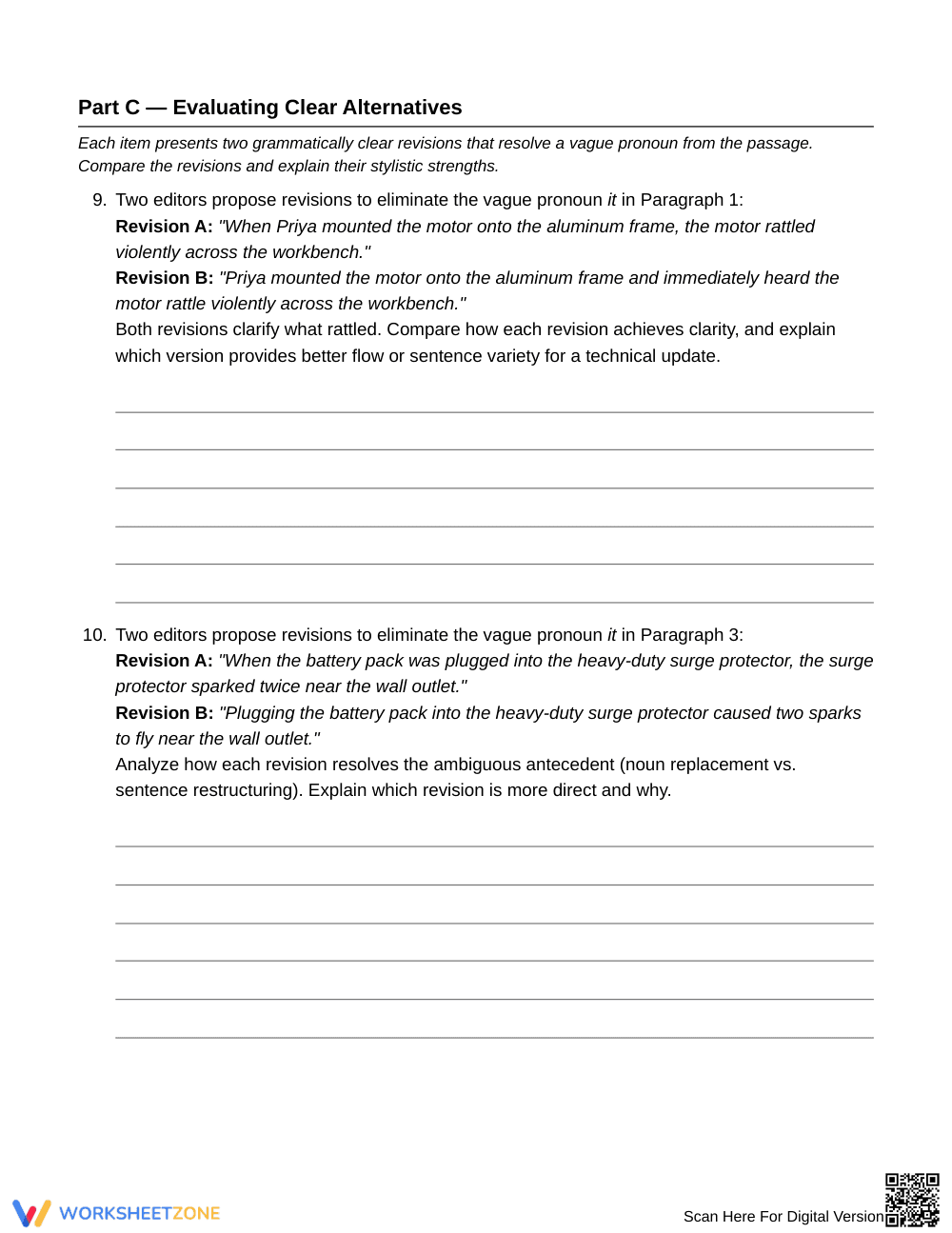
- Independent practice (Part C — 2 items): Students critically compare two alternative revisions of ambiguous sentences, evaluating direct noun replacement versus structural sentence redesign.
This structured progression reflects the gradual release of responsibility framework, moving learners from antecedent identification to sophisticated syntactic decision-making.
Standards Alignment
This worksheet directly aligns with L.6.1.d, which requires students to recognize and correct vague pronouns (those with unclear or ambiguous antecedents). Students also practice L.6.1 by demonstrating command of standard English grammar and conventions during text revision. Both standard codes can be copied directly into lesson plans, IEP goals, or district curriculum mapping tools.
How to Use It
Deploy this worksheet after direct instruction on pronoun-antecedent agreement as guided partner practice or an independent assessment. It can also serve as targeted remediation during writing workshop conferences. While circulating, observe whether students identify broad references like 'which' pointing to entire clauses rather than single nouns. Expect students to complete all three parts in 35 to 45 minutes.
Who It's For
This resource is designed for Grade 6 general education students, ESL learners refining English pronoun mechanics, and middle school writers needing structured editing routines. Scaffold learning by pairing this activity with an antecedent anchor chart or a mentor text analysis lesson focusing on technical writing clarity.
According to research on explicit grammar instruction documented in Fisher & Frey (2014), student writing proficiency improves significantly when analytical grammar exercises are embedded in meaningful text contexts rather than isolated sentence drills. This Grade 6 instructional resource operationalizes standard L.6.1.d by requiring learners to recognize and correct vague pronouns within an authentic technical report. By evaluating antecedents across multiple connected paragraphs, students examine how pronoun ambiguity disrupts reading comprehension and technical communication in real-world scenarios. The three-tiered task sequence moves students beyond rote pronoun identification into rigorous evaluative discourse, requiring them to justify editing decisions and compare competing structural revisions. Integrating explicit clarity criteria with authentic prose reinforces syntactic precision, ensuring students develop sustainable, transferable editing habits that systematically improve their independent narrative, informative, and argumentative writing across all academic content areas.


