




























Views
Downloads



Complete Predicting Light Paths Worksheet | Grade 6 Science

Paste this activity's link or code into your existing LMS (Google Classroom, Canvas, Teams, Schoology, Moodle, etc.).
Students can open and work on the activity right away, with no student login required.
You'll still be able to track student progress and results from your teacher account.
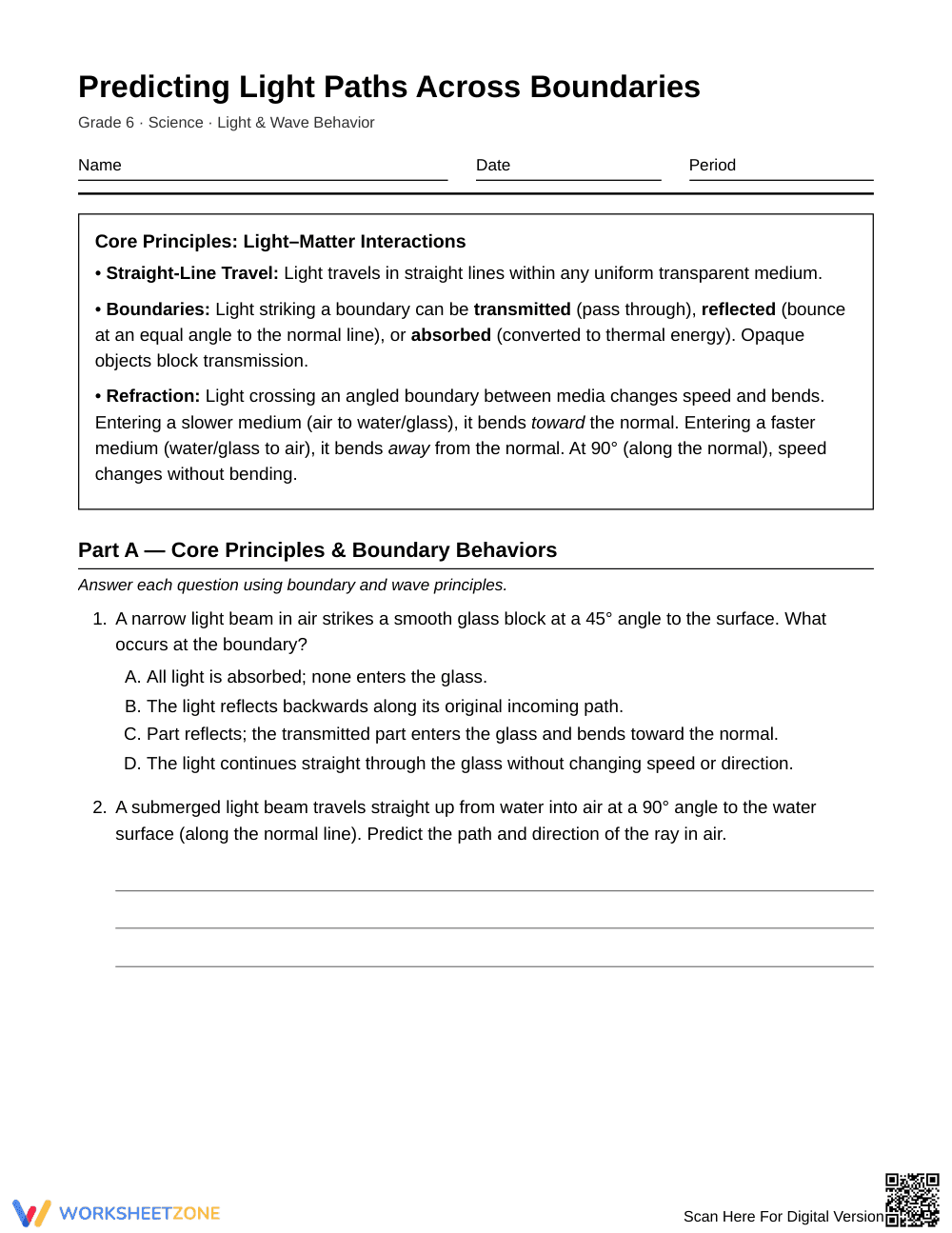
This Grade 6 science worksheet builds student mastery in predicting how light interacts with matter across media boundaries. Students analyze straight-line travel, reflection, absorption, and refraction to trace ray paths through single barriers, multi-material systems, and complex optical scenarios with scientific reasoning.
At a Glance
- Grade: 6 · Subject: Science
- Standard: Light and Wave Behavior — Predict and trace light ray paths across boundaries between different materials
- Skill Focus: Predict a Path Through Two Different Materials
- Format: 5 pages · 14 problems · Answer key included · PDF
- Best For: Middle school physical science wave practice
- Time: 40–50 minutes
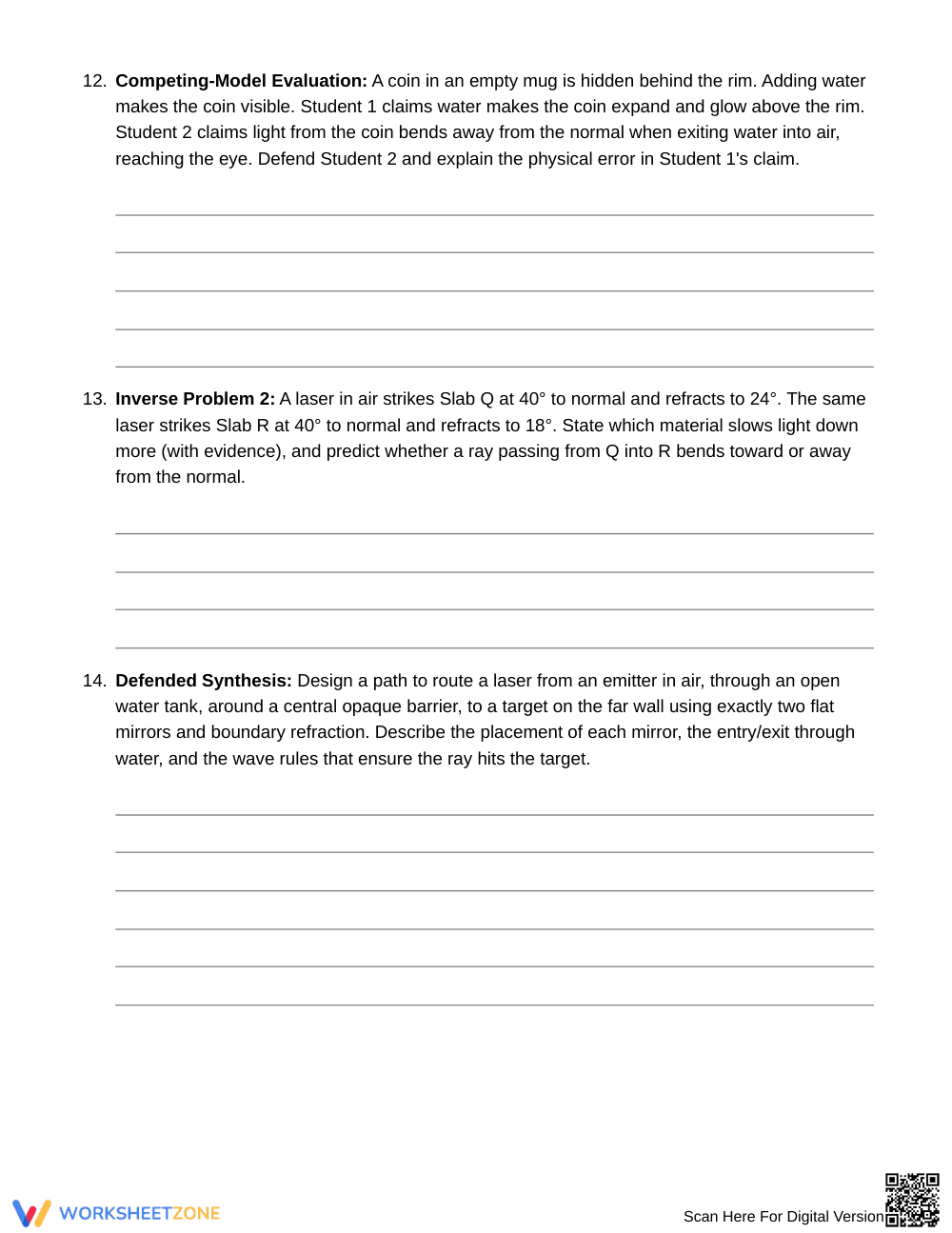
Across 5 pages, students complete 14 problems supported by a core principles summary box. The worksheet features conceptual multiple-choice items, data table analysis, ray tracing, and optical design tasks. A complete 2-page answer key provides solutions and explanations for easy grading.
Skill Progression
- Guided practice (Part A, 4 problems): Students use a reference rule box to evaluate single-boundary light behaviors, normal-line ray angles, and material opacity.
- Supported practice (Part B, 4 problems): Students analyze multi-layer barrier systems, interpret a transmission data table, and explain refraction effects like the broken pencil illusion.
- Independent practice (Part C, 6 problems): Students solve multi-step ray challenges, evaluate competing scientific claims, and design a multi-mirror laser route around obstacles.
This progression follows a gradual-release model from guided recall to independent optical modeling.
Standards Alignment
This resource aligns with middle school physical science standards on wave properties and light-matter interactions. Students demonstrate that light reflects, absorbs, or refracts at material boundaries. Both standard codes can be copied directly into lesson plans, IEP goals, or district curriculum mapping tools.
How to Use It
Use this worksheet after direct instruction on wave reflection and refraction. Have students complete Parts A and B during class before evaluating Part C extensions in collaborative pairs. For formative assessment, check student explanations on the Part B data table to ensure they correctly distinguish reflection from absorption. Expect completion in 40 to 50 minutes.
Who It's For
This resource is designed for Grade 6 physical science students and introductory wave units. The included reference box supports struggling learners, while the system design task challenges advanced thinkers. Pair this worksheet with a hands-on ray-box lab or an interactive wave simulation.
According to Fisher & Frey (2014), structured gradual-release frameworks significantly enhance conceptual mastery in middle school science by shifting cognitive responsibility through scaffolded problem sequences. This 14-task physical science resource embodies that instructional architecture, supporting students as they learn to predict light paths through two different materials and analyze boundary behaviors. Beginning with fundamental definitions of reflection, transmission, and refraction, learners advance systematically toward complex multi-material systems, tabular data interpretation, and multi-mirror optical design. Research indicates that embedding explicit reference principles alongside rigorous multi-step modeling fosters deeper scientific reasoning and eliminates persistent misconceptions regarding how light travels across transparent and opaque media. Teachers can deploy these structured tasks during physical science units on light and wave behavior to confirm that students achieve authentic mastery in ray modeling, angle predictions, and evidence-based scientific argumentation across diverse classroom settings.


