


























Views
Downloads




Complete Network Hardware Word Search | Grades 6–7 ELA
Paste this activity's link or code into your existing LMS (Google Classroom, Canvas, Teams, Schoology, Moodle, etc.).
Students can open and work on the activity right away, with no student login required.
You'll still be able to track student progress and results from your teacher account.
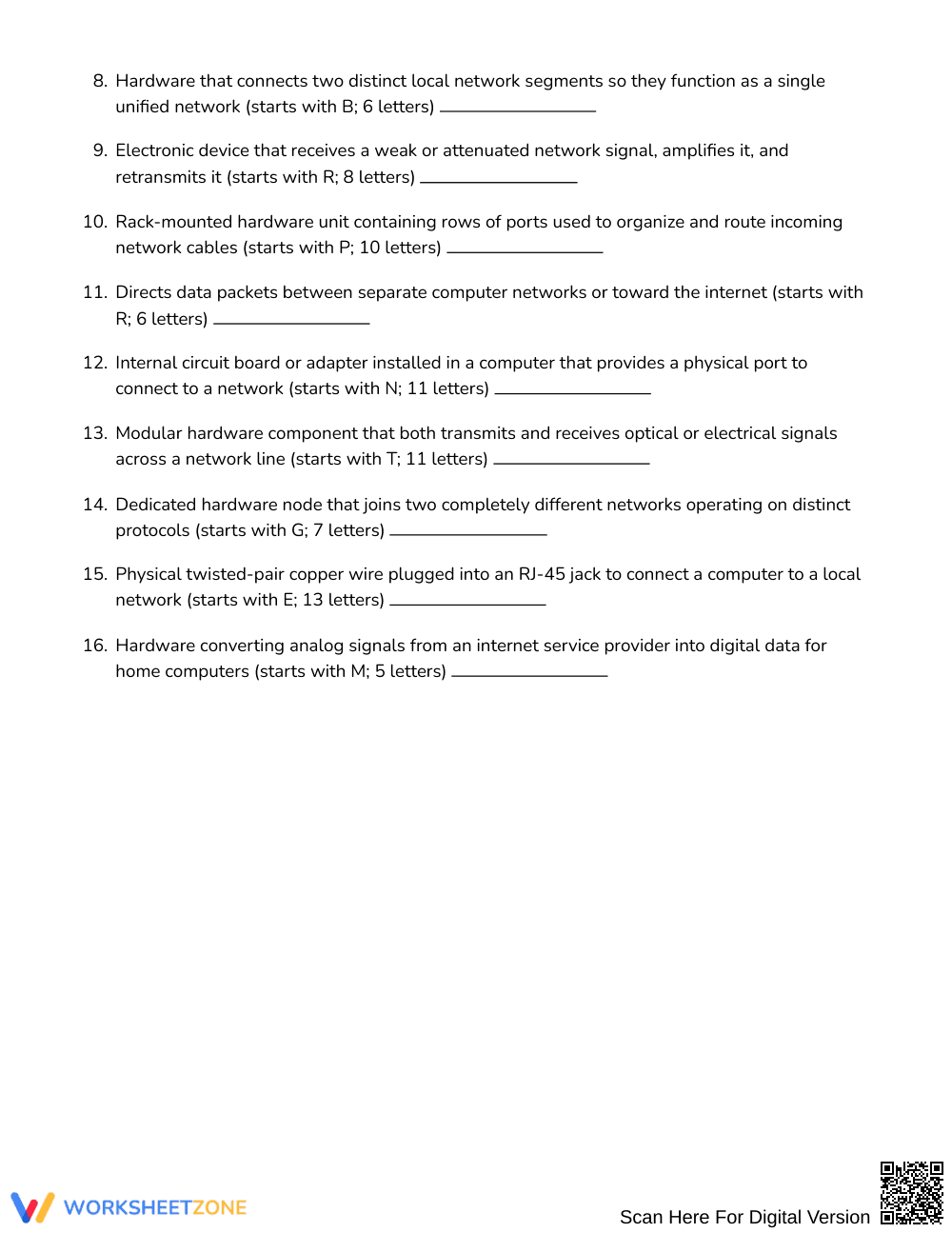
This Grades 6–7 computer network hardware word search reinforces technical vocabulary through clue-based problem solving. Students analyze technical definitions for key networking components, deduce the matching terminology, and locate all 16 target words within an expansive letter grid. This activity strengthens domain-specific reading comprehension and functional literacy in computer science.
At a Glance
- Grade: Grades 6–7 · Subject: English Language Arts (ELA) · Unit: Vocabulary
- Standard: Not standards-assessed — read functional technical clues to identify domain-specific network vocabulary
- Skill Focus: Network hardware components and technical definitions
- Format: 3 student pages · 16 words · 4 answer key pages · PDF
- Best For: Middle school technical vocabulary review and early finishers
- Time: 25–35 minutes
The resource spans 3 student pages accompanied by 4 answer key pages. Instead of a simple word list, students work from 16 technical clues defining components like routers, switches, and transceivers. Students read each definition to identify the vocabulary term before searching the puzzle, reinforcing active recall.
Puzzle Structure and Mechanics
This word search challenges students using an 18 x 18 letter grid designed without a word bank. Learners must solve 16 distinct technical clues to determine the exact hardware terms. Hidden words run in all eight possible directions: North, Northeast, East, Southeast, South, Southwest, West, and Northwest. By requiring multi-directional scanning and deductive vocabulary retrieval, the puzzle provides rigorous mental engagement.
Standards Alignment
This activity is designed for vocabulary enrichment and is not aligned to a specific academic standard. Middle school ELA and technical literacy curricula frequently require students to acquire domain-specific terminology from informational passages. This resource supports that broader goal by familiarizing students with foundational computer networking hardware vocabulary.
How to Use It
Incorporate this puzzle after direct instruction on computer systems or during a technical informational text unit. Distribute the sheets for independent practice or pair students for collaborative problem-solving. Circulate to ensure students deduce terms like gateway or bridge from clues before scanning the grid. Completion typically requires 25 to 35 minutes.
Who It's For
This resource is tailored for Grades 6–7 students in ELA, computer literacy, or STEM exploratory courses. It serves general education classes, gifted enrichment, and students who benefit from engaging vocabulary reinforcement. Pair this puzzle with an informational reading passage on network architecture or a computer hardware diagram to bridge hands-on literacy and technology skills.
Domain-specific vocabulary acquisition forms a critical pillar of adolescent literacy and technical reading comprehension. Fisher & Frey (2014) emphasize that intentional vocabulary instruction must move beyond rote memorization, requiring students to retrieve meanings through contextual clues and collaborative linguistic tasks. This Grades 6–7 network hardware word search applies these instructional principles by omitting a standard word bank and prompting learners to deduce 16 precise technical terms from functional definitions before locating them within an 18 x 18 letter grid. Although designed as general vocabulary enrichment rather than a standards-assessed task, the resource builds functional literacy in computer architecture and informational text navigation. Structured retrieval practice strengthens long-term lexical retention, equipping middle school students to comprehend advanced technical passages across STEM and English Language Arts curricula while developing critical visual scanning and deduction skills.


