




























Views
Downloads



Complete Narrative Dialogue Worksheet | Grade 6 ELA

Paste this activity's link or code into your existing LMS (Google Classroom, Canvas, Teams, Schoology, Moodle, etc.).
Students can open and work on the activity right away, with no student login required.
You'll still be able to track student progress and results from your teacher account.
This narrative writing worksheet guides grade 6 students to craft dialogue that propels plot events and develops authentic character motivations. Working through a robotics club scenario, learners replace static conversation with dynamic pacing, ensuring every spoken line introduces tension, reveals character choices, or accelerates scene action toward a resolution.
At a Glance
- Grade: 6 · Subject: ELA
- Standard:
W.6.3.b— Use dialogue and pacing to develop experiences, events, and characters- Skill Focus: Propelling narrative plot through dialogue and action beats
- Format: 5 pages · 8 problems · Answer key included · PDF
- Best For: Narrative pacing practice and writer's workshop
- Time: 40–50 minutes
What's Inside
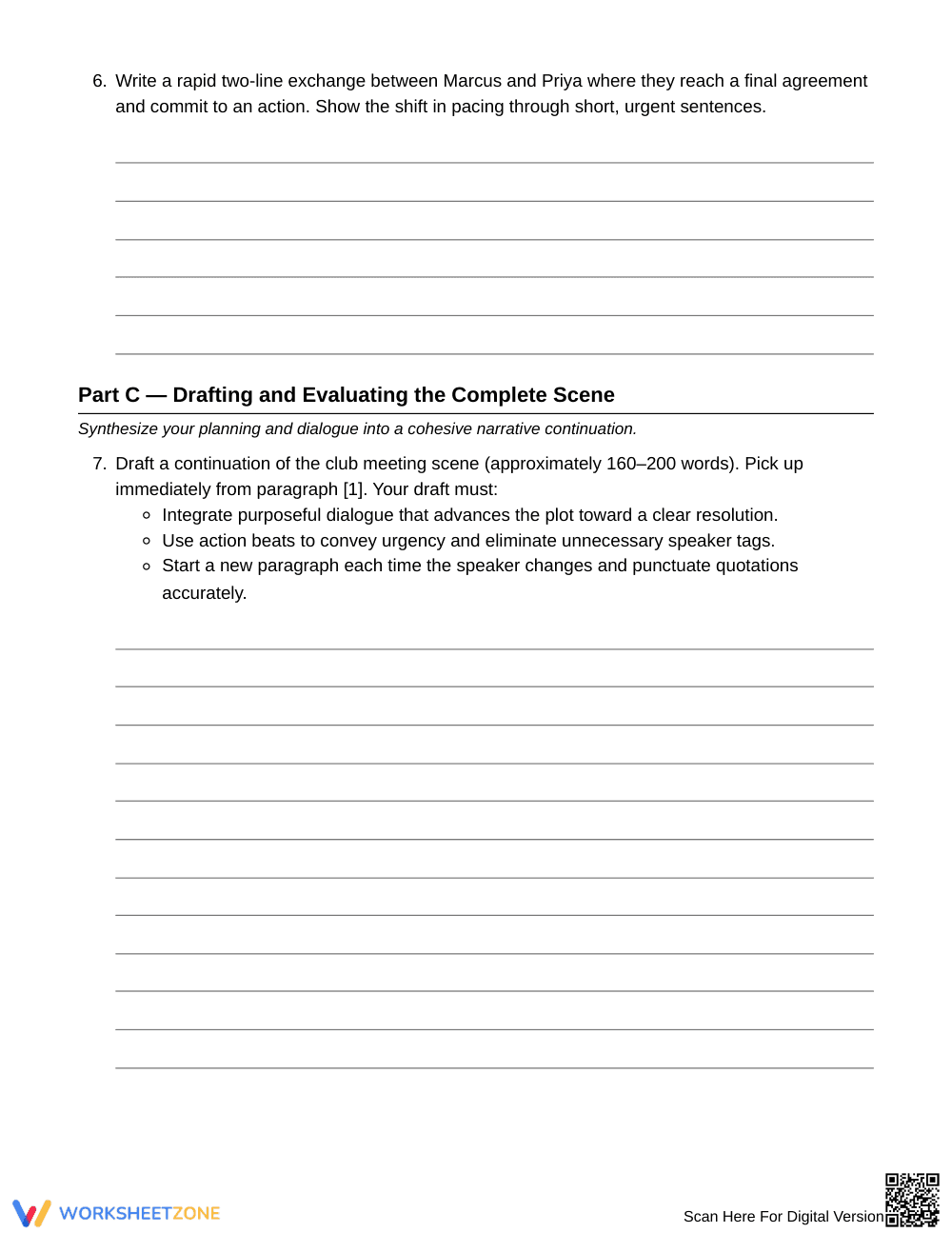
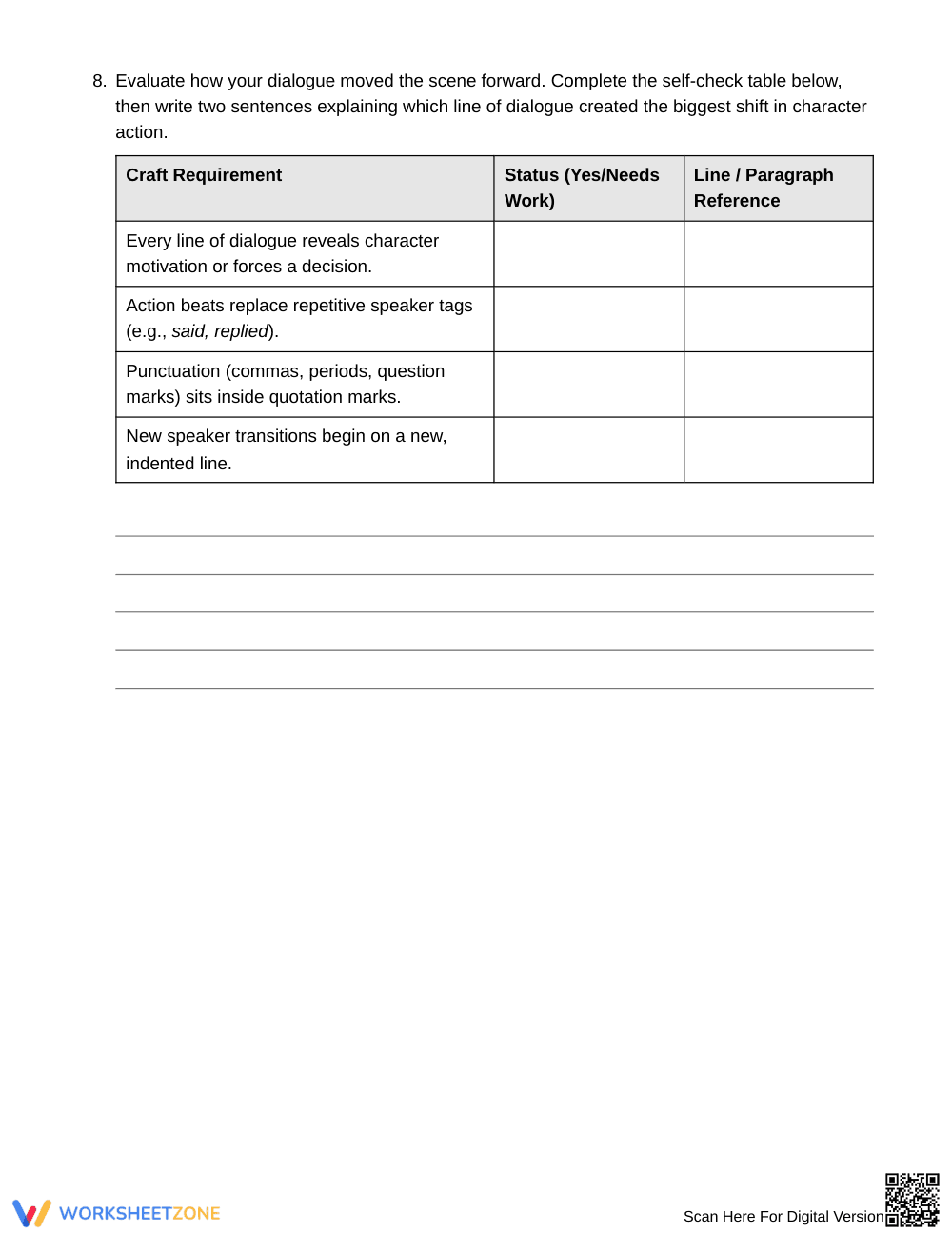
The 5-page packet features 8 structured tasks centered on a shared narrative scenario. Students review core conventions in the Writer's Toolkit, analyze character stakes, compose four targeted dialogue exchanges using action beats, draft a complete 160-to-200-word scene continuation, and complete a self-evaluation checklist. A 3-page exemplar answer key provides model student responses.
Skill Progression
- Guided practice (Part A, 2 tasks): Students analyze narrative stakes and define a turning point before writing.
- Supported practice (Part B, 4 tasks): Writers craft targeted character lines paired with action beats that replace repetitive tags.
- Independent practice (Part C, 2 tasks): Students compose an extended scene continuation and evaluate dialogue using four craft criteria.
This sequence follows the gradual release of responsibility model, moving students from scene analysis to confident, independent narrative drafting.
Standards Alignment
This worksheet directly aligns with W.6.3.b: Use narrative techniques, such as dialogue, pacing, and description, to develop experiences, events, and characters. Supporting standard L.6.2 reinforces dialogue comma and quotation conventions. Both standard codes can be copied directly into lesson plans, IEP goals, or district curriculum mapping tools.
How to Use It
Use this worksheet during the drafting phase of narrative writing units. In a mid-unit workshop, have students complete Parts A and B in pairs before writing independently. For revision clinics, assign it to writers whose drafts contain static dialogue tags. As students write, monitor that action beats substitute for phrases like "he said." Expect 40 to 50 minutes for completion.
Who It's For
This activity supports grade 6 ELA classrooms, middle school creative writing electives, and intervention groups needing explicit dialogue structure. English learners benefit from clear punctuation rules and modeled action beats. Pair this worksheet with a short mentor text or an anchor chart highlighting dialogue pacing to deepen craft mastery.
Aligned with standard W.6.3.b, this narrative writing resource develops middle school students' ability to use dialogue and action beats to advance plot events and reveal character dynamics. According to Fisher & Frey (2014), purposeful writing instruction relies on structured cognitive apprentice models where explicit mentor frameworks transition gradually into independent drafting. When sixth graders learn to replace mechanical attribution tags with meaningful narrative beats, their prose demonstrates significant gains in pacing, character voice, and structural tension. By isolating the three core functions of dialogue—conveying urgency, driving character conflict, and substituting physical actions for basic speech tags—this worksheet transforms conversational writing into a rigorous storytelling mechanism. Middle grade students practice manipulating scene tempo while simultaneously reinforcing grammatical conventions surrounding dialogue punctuation. The embedded self-assessment checklist ensures that student writers evaluate their dialogue choices critically against concrete craft benchmarks, fostering independent metacognitive revision habits essential for long-term narrative writing proficiency.


