


























Views
Downloads
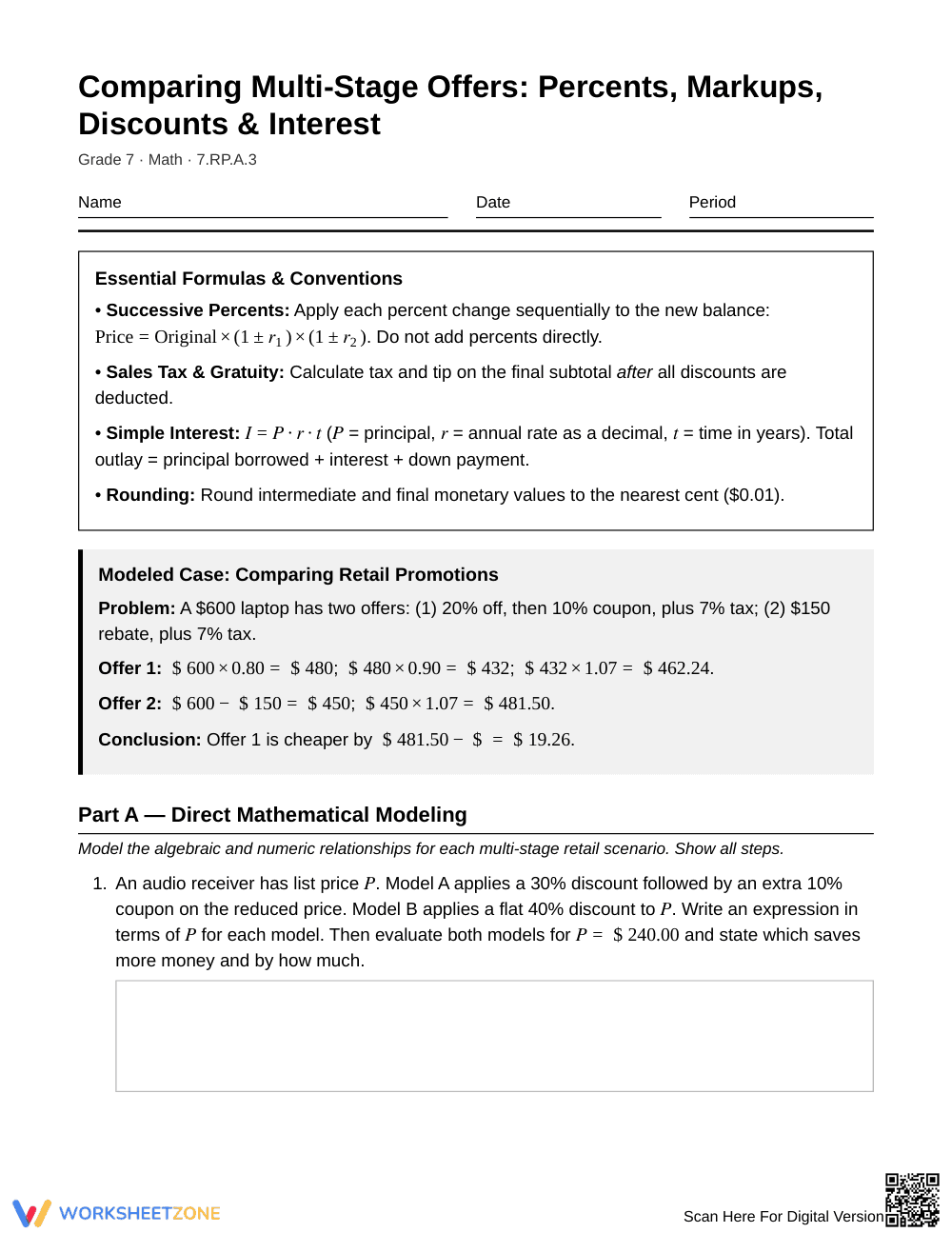
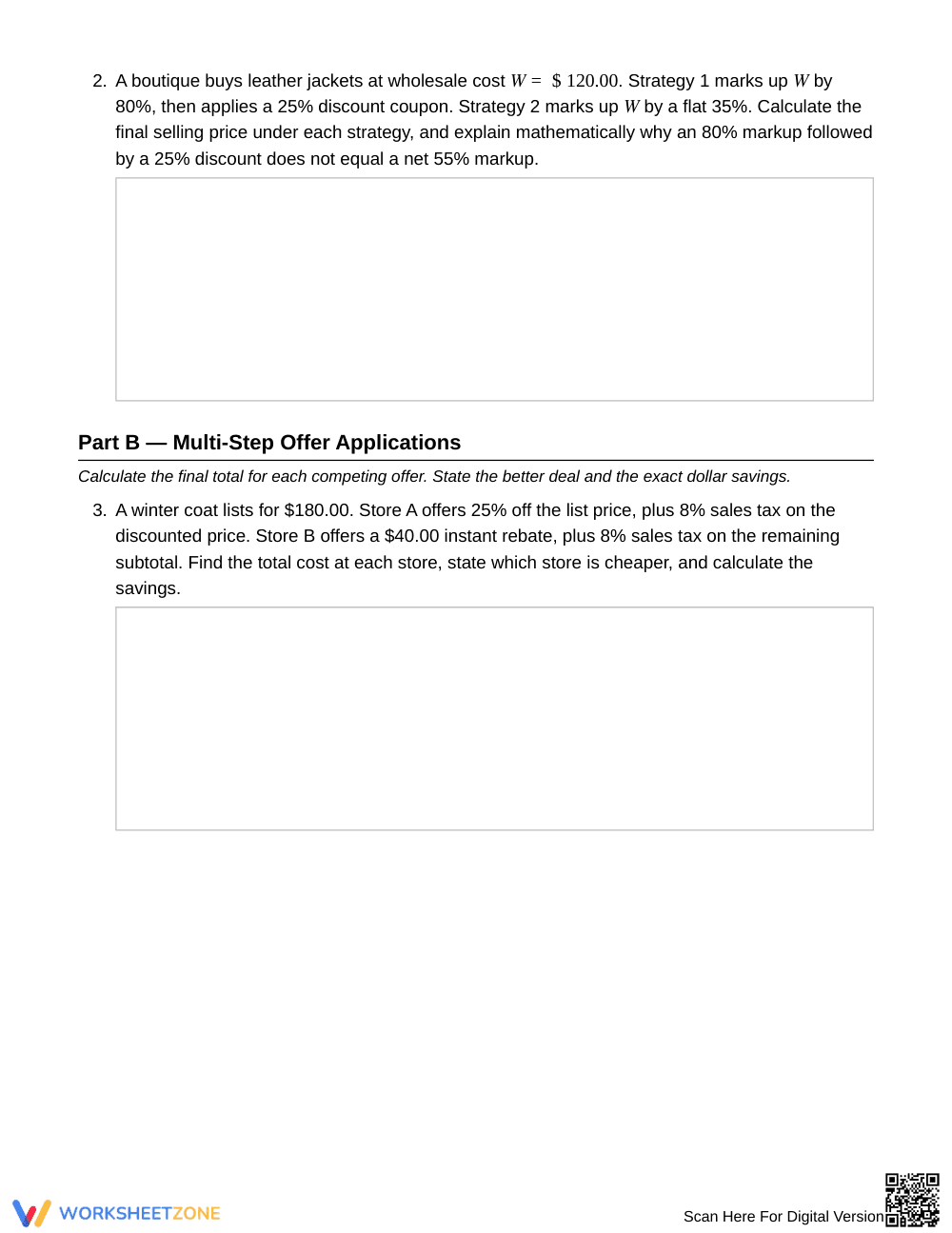
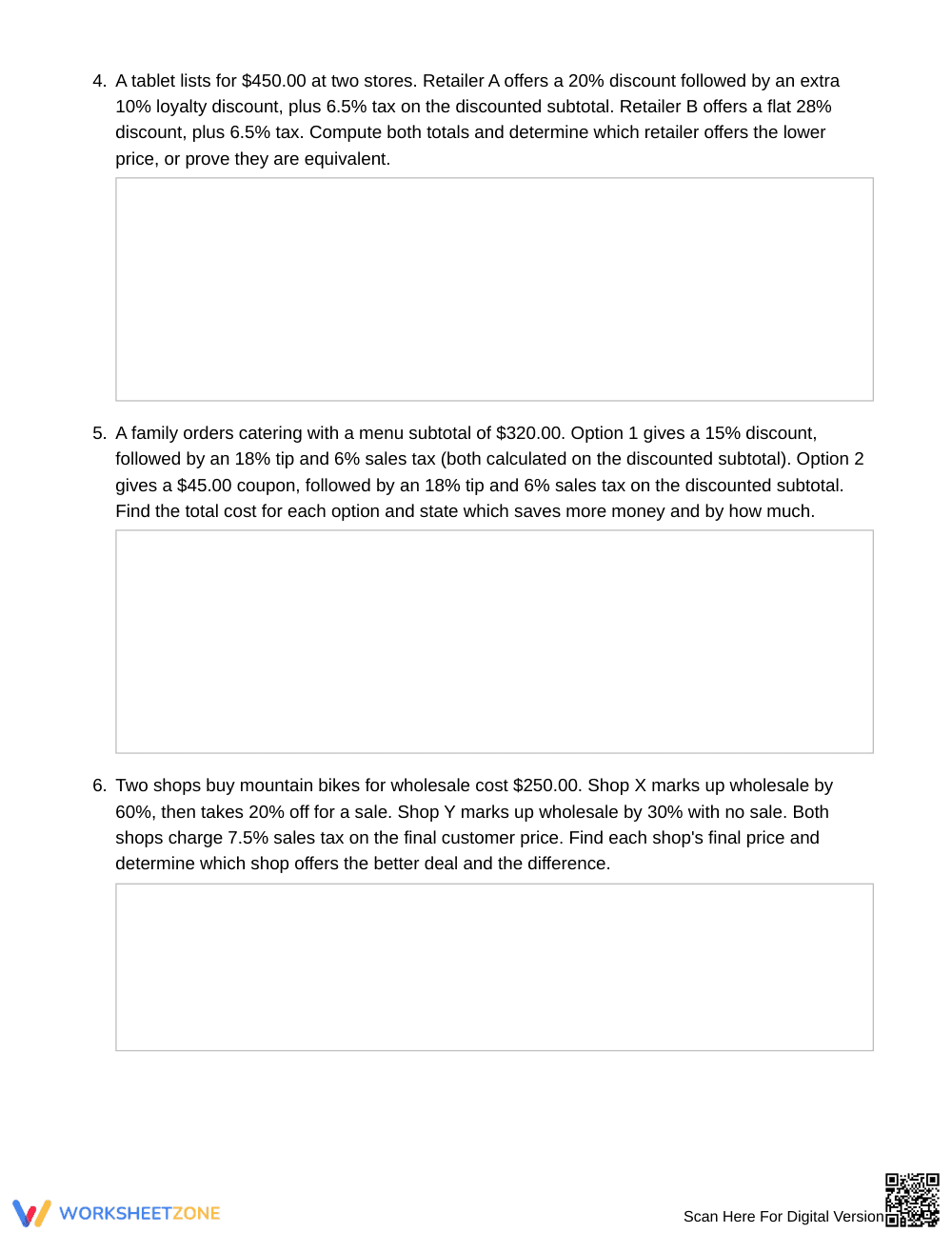
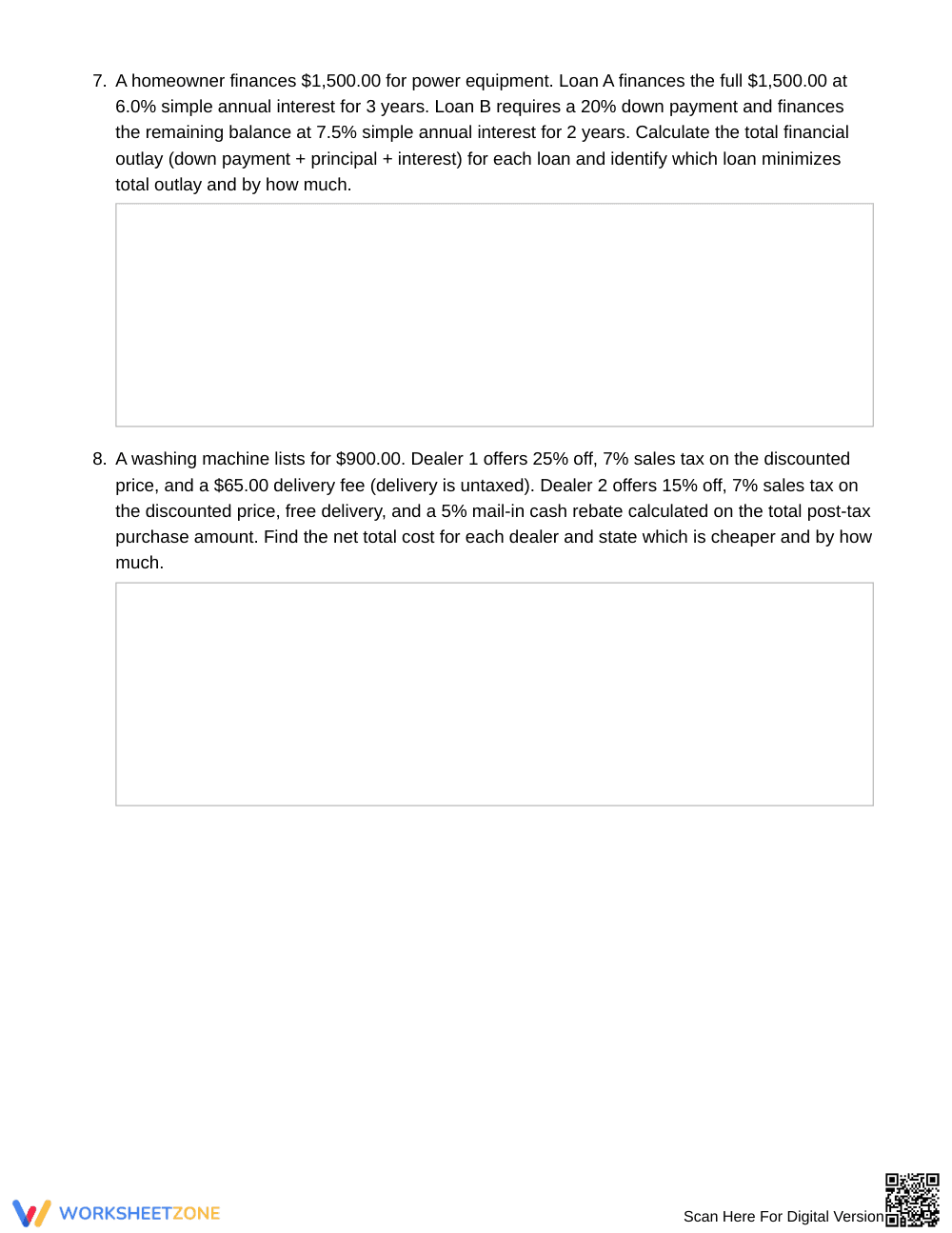

Complete Multi-Stage Offers Worksheet | Grade 7 Math
Paste this activity's link or code into your existing LMS (Google Classroom, Canvas, Teams, Schoology, Moodle, etc.).
Students can open and work on the activity right away, with no student login required.
You'll still be able to track student progress and results from your teacher account.
This Grade 7 proportional reasoning worksheet guides students to analyze and compare competing multi-stage commercial transactions. Learners apply successive percentages, markups, discounts, sales tax, gratuity, and simple interest formulas to calculate exact net costs, evaluate real-world budget constraints, and determine the most cost-effective financial option across 10 rigorous multi-step word problems.
At a Glance
- Grade: 7 · Subject: Math
- Standard:
7.RP.A.3— Solve multi-step percent problems involving discounts, markups, taxes, tips, and interest- Skill Focus: Compare Two Multi-Stage Offers
- Format: 5 pages · 10 problems · Answer key included · PDF
- Best For: Independent practice or financial math unit review
- Time: 45–60 minutes
What's Inside: This 5-page printable resource provides a reference box of essential formulas and conventions, a fully worked modeled case, 10 structured student tasks arranged across three developmental sections, and a comprehensive 3-page step-by-step answer key that details all intermediate calculations and rounding to the nearest cent.
Skill Progression
- Guided Practice (Part A — 2 tasks): Direct mathematical modeling problems where students write algebraic expressions and compute equivalent rates to explain why sequential percent changes cannot simply be added together.
- Supported Practice (Part B — 6 tasks): Applied multi-step comparisons evaluating competing retail promotions, rebate coupons, catering gratuities, dealer markups, and simple interest loan structures.
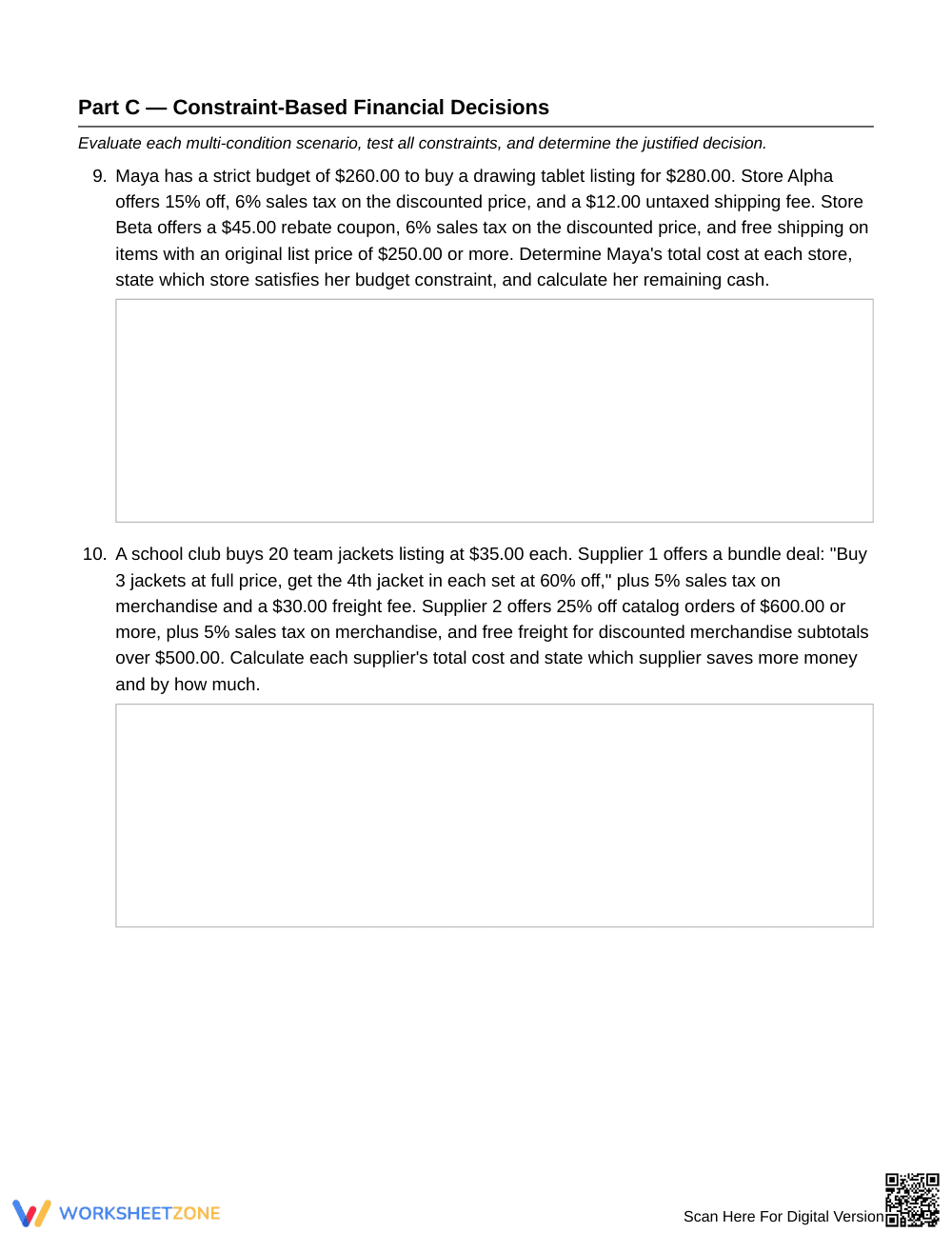
- Independent Practice (Part C — 2 tasks): High-cognitive demand constraint scenarios requiring students to test multi-tier shipping conditions, volume discount thresholds, and strict budget caps to justify financial choices.
This structure follows a gradual-release instructional model that transitions learners from foundational algebraic notation to autonomous multi-variable decision analysis.
Standards Alignment
Primary Standard: `7.RP.A.3` — Use proportional relationships to solve multistep ratio and percent problems, including simple interest, tax, markups and markdowns, gratuities and commissions, fees, percent increase and decrease, and percent error. Both standard codes can be copied directly into lesson plans, IEP goals, or district curriculum mapping tools.
How to Use It
Administer this worksheet after direct instruction on sequential percent changes and simple interest formulas. Use Part A during guided practice to check for the common misconception that successive discounts can be combined by addition. Allocate 45 to 60 minutes for student completion, using Part C as an exit ticket or formative assessment checkpoint to evaluate whether students can apply compound conditions independently.
Who It's For
This activity is designed for Grade 7 general mathematics, accelerated Grade 6 math classes, or Grade 8 remediation in financial literacy. Pair this printable with an anchor chart on multi-step percent change or use it alongside direct instruction on consumer math applications.
According to Fisher & Frey (2014), structured problem sets that scaffold complex financial scenarios enable middle school mathematics students to transfer ratio and proportional reasoning skills to authentic decision-making contexts. This Grade 7 resource directly targets standard 7.RP.A.3 by challenging students to compute sequential discounts, sales tax, fees, and interest rates across competing consumer offers. By requiring learners to show explicit numeric steps, verify intermediate monetary subtotals, and evaluate budget constraints, the worksheet builds enduring computational fluency and conceptual mastery in multi-step proportional problem solving.


