


























Views
Downloads


Complete Moving Key Sections Worksheet | Grade 7 ELA
Paste this activity's link or code into your existing LMS (Google Classroom, Canvas, Teams, Schoology, Moodle, etc.).
Students can open and work on the activity right away, with no student login required.
You'll still be able to track student progress and results from your teacher account.
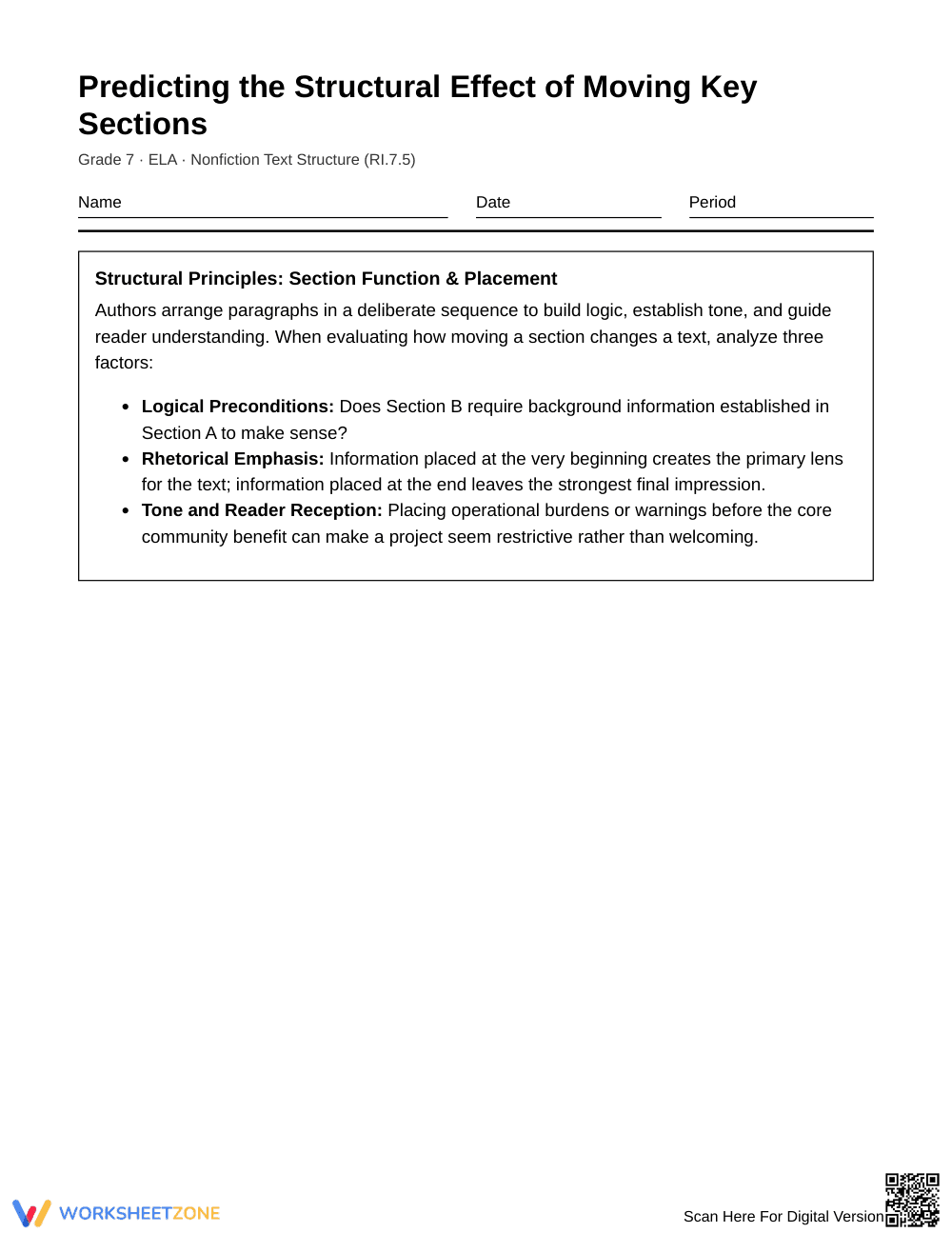
This Grade 7 ELA worksheet builds analytical mastery by evaluating how paragraph sequence shapes an author's meaning and tone. Working with two nonfiction passages, students examine baseline structures and predict how moving key sections alters reader interpretation, preparing them for complex informational text standards.
At a Glance
- Grade: 7 · Subject: ELA
- Standard:
RI.7.5— Analyze how a major section contributes to the whole text's structure- Skill Focus: Predict the Effect of Moving a Key Section
- Format: 5 pages · 8 problems · Answer key included · PDF
- Best For: Text structure analysis and guided practice
- Time: 40–50 minutes
What's Inside
This 5-page resource features two companion informational texts regarding a community tool library, an anchor reference box detailing core structural principles, and 8 rigorous analytical tasks. Students progress from baseline structural evaluation to relocation hypotheses and qualified defense. A 2-page answer key provides complete model responses and grading rationales.
Skill Progression
- Guided practice (Part A — 2 tasks): Students utilize the structural reference box to analyze Text A's current organization, explaining bridging paragraphs and concluding economic metrics.
- Supported practice (Part B — 4 tasks): Learners evaluate targeted relocations, predicting how moving counterarguments, swapping operational details, or combining texts impacts rhetorical tone.
- Independent practice (Part C — 2 tasks): Students synthesize both texts without scaffolds to defend organizational sequences and argue qualified positions on structural mergers.
This intentional sequence follows the gradual release of responsibility model, guiding learners from structural identification to independent critical evaluation.
Standards Alignment
This worksheet aligns with `RI.7.5`: Analyze the structure an author uses to organize a text, including how major sections contribute to the whole. Supporting standard `RI.7.1` is reinforced as students cite evidence to defend their structural predictions. Both standard codes can be copied directly into lesson plans, IEP goals, or district curriculum mapping tools.
How to Use It
Use this activity during text-structure units as paired practice or an assessment checkpoint. As students work on Part B, check whether they observe how moving operational rules affects reader goodwill; missed tone shifts signal a need to review rhetorical positioning. The assignment takes 40 to 50 minutes.
Who It's For
This worksheet supports Grade 7 ELA classes, advanced Grade 6 students, and Grade 8 intervention groups mastering informational organization. Differentiate by providing colored highlighters for transitional phrases or encouraging structured partner talk. Pair this resource with direct instruction on expository patterns or a nonfiction mentor text.
Mastering Common Core standard `RI.7.5` requires middle school students to move beyond passive reading and evaluate how organizational architecture dictates reader comprehension. According to Fisher & Frey (2014), engaging learners in predictive manipulation of informational text structure significantly deepens reading comprehension and metacognitive awareness. By testing how moving key sections alters rhetorical emphasis, logical preconditions, and authorial tone, this worksheet transforms abstract organizational concepts into tangible analytical experiments. Students actively examine how moving procedural warnings, economic evidence, and certification mandates reshapes reader reception across two interconnected informational texts. This deliberate focus on structural rearrangement bridges close reading with analytical writing, equipping Grade 7 learners to dissect complex nonfiction arguments systematically. The structured progression ensures that students build defensible, qualified claims grounded in textual evidence, providing educators with transparent formative data on paragraph-level comprehension and rhetorical reasoning.


