


























Views
Downloads




Complete Mixed-Number Division Worksheet | Grade 6 Math
Paste this activity's link or code into your existing LMS (Google Classroom, Canvas, Teams, Schoology, Moodle, etc.).
Students can open and work on the activity right away, with no student login required.
You'll still be able to track student progress and results from your teacher account.
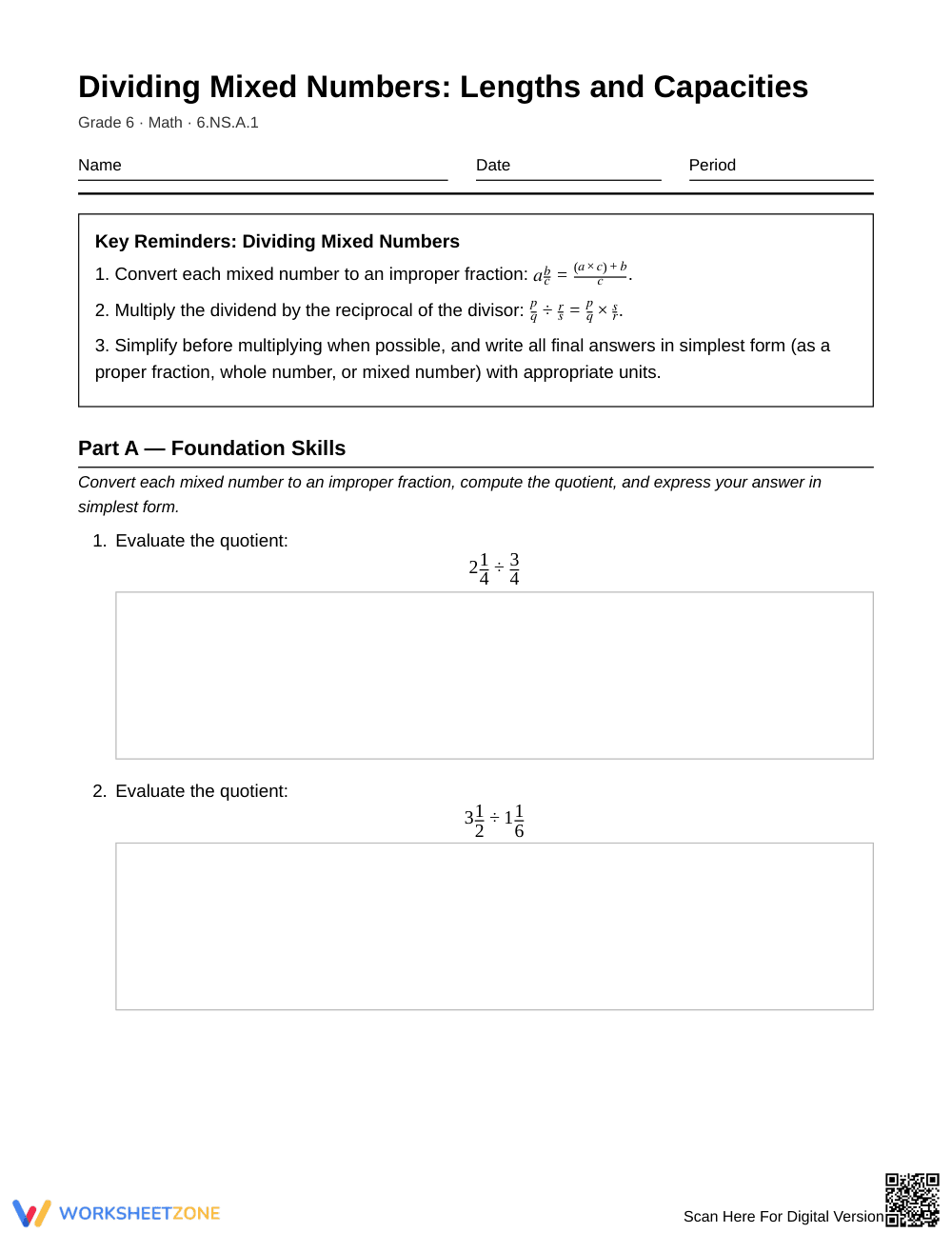
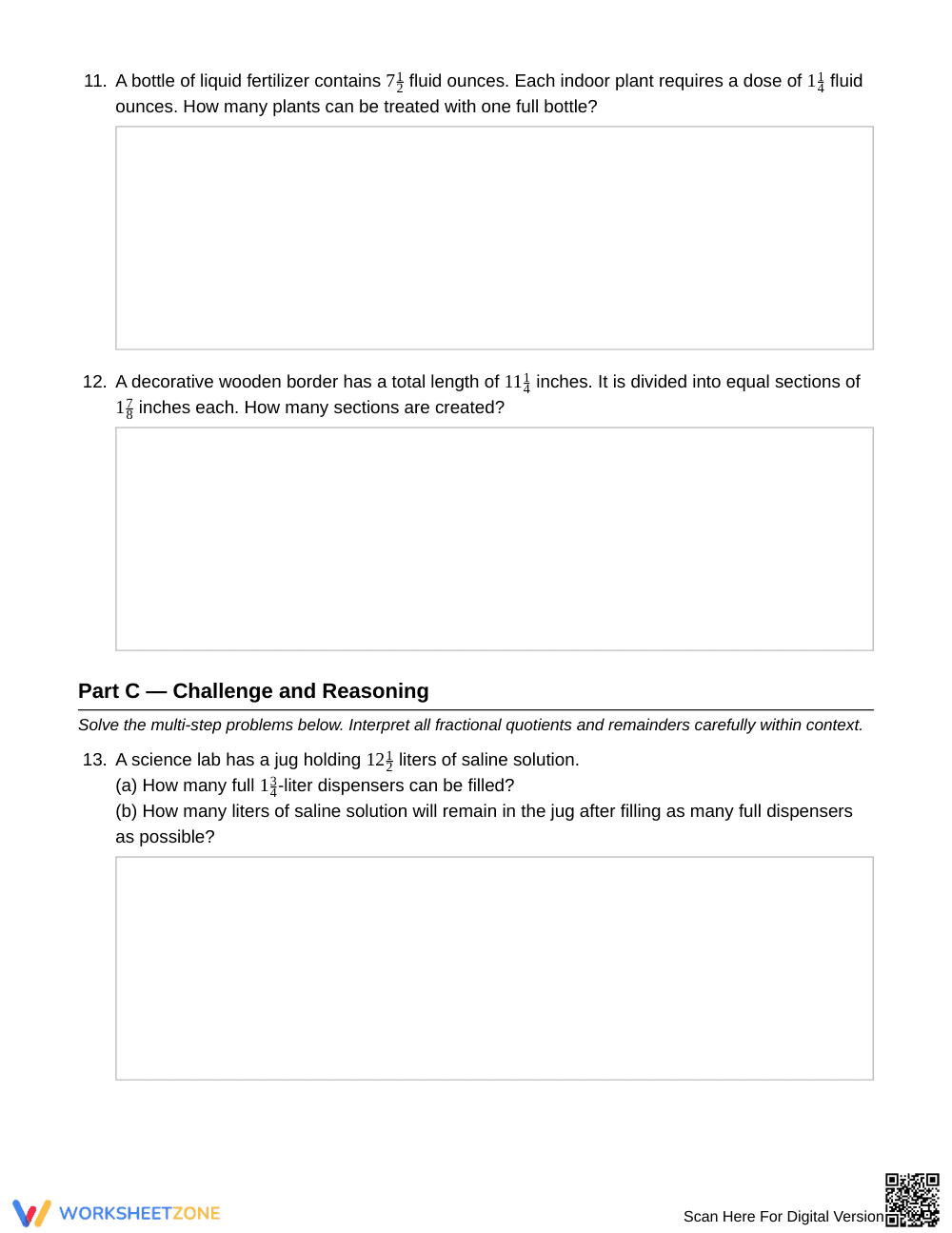
This Grade 6 math worksheet strengthens fraction division fluency by guiding students through 16 real-world length and capacity problems. Learners convert mixed numbers to improper fractions, multiply by reciprocals, and simplify quotients to build accuracy. Connecting numerical algorithms to measurement contexts solidifies conceptual mastery across multi-step division scenarios.
At a Glance
- Grade: 6 · Subject: Math
- Standard:
6.NS.A.1— Compute quotients of fractions and solve word problems involving fraction division- Skill Focus: Mixed-number division and measurement applications
- Format: 5 pages · 16 problems · 3-page answer key included · Printable PDF
- Best For: Independent student reinforcement and applied problem solving
- Time: 40–50 minutes per session
What's Inside
This 5-page worksheet includes 16 problems across three sections, paired with a complete 3-page step-by-step answer key. It features a top "Key Reminders" box defining conversion and reciprocal steps, foundational calculation items, contextual measurement word problems, an algebraic missing-value problem, and multi-part reasoning tasks requiring careful remainder interpretation.
Skill Progression
- Guided practice (Part A): 4 baseline problems establish conversion and reciprocal mechanics with visible reference rules.
- Supported practice (Part B): 8 applied word problems require setting up equations and tracking measurement units.
- Independent practice (Part C): 4 multi-step non-routine problems require area formulas, multi-step bow-cutting, and remainder analysis.
This progression leverages the gradual release model, guiding learners from basic procedural recall to autonomous contextual problem solving.
Standards Alignment
Primary instruction aligns to `6.NS.A.1`: Interpret and compute quotients of fractions, and solve word problems involving fraction division. Foundational support connects to `5.NF.B.7` regarding unit fraction operations. Both standard codes can be copied directly into lesson plans, IEP goals, or district curriculum mapping tools.
How to Use It
Assign this worksheet after direct instruction on the fraction division algorithm. Have students complete Part A and Part B collaboratively, observing whether they invert divisors accurately before multiplying. Use Part C for individual assessment or enrichment within a 40- to 50-minute math block.
Who It's For
This resource suits Grade 6 general education classrooms, math intervention groups, and resource rooms needing structured fraction practice. Struggling students benefit from the embedded procedural reminders, while advanced learners tackle multi-step remainder analysis. Pair this worksheet directly with a fraction-strip anchor chart or tape diagram lesson.
According to Fisher & Frey (2014), structured progression through the gradual release of responsibility framework significantly enhances conceptual retention when students tackle complex multi-step mathematical operations. This Grade 6 instructional resource operationalizes that evidence-based approach to address standard 6.NS.A.1, which requires students to interpret quotients of fractions and solve contextual fraction division word problems. By sequencing tasks from foundational procedural evaluation to real-world measurement applications and contextual remainder analysis, learners develop durable computational fluency alongside authentic problem-solving skills. The deliberate progression scaffolds student independence by first cementing improper fraction conversion and reciprocal multiplication, then applying those routines across diverse length and capacity units. As documented by Fisher & Frey (2014), providing clear reference models followed by collaborative application and unassisted synthesis ensures that students internalize fraction division algorithms rather than merely memorizing mechanical calculation steps, resulting in sustained procedural accuracy and conceptual mastery.


