


























Views
Downloads




Complete Living Cell Needs Worksheet | Grade 6 Science
Paste this activity's link or code into your existing LMS (Google Classroom, Canvas, Teams, Schoology, Moodle, etc.).
Students can open and work on the activity right away, with no student login required.
You'll still be able to track student progress and results from your teacher account.
This life science worksheet equips Grade 6 students to explain the needs of living cells and connect structures to vital life functions. Through data analysis and structured prompts, learners evaluate how membranes, cytoplasm, vacuoles, and chloroplasts sustain life and respond to environmental changes.
At a Glance
- Grade: 6 · Subject: Science
- Standard: Middle School Life Science — Explain how cellular structures support life functions and organism survival
- Skill Focus: Explain Needs of a Living Cell
- Format: 5 pages · 10 problems · Full answer key included · PDF
- Best For: Mid-unit formative assessment or laboratory follow-up
- Time: 40–50 minutes
What's Inside
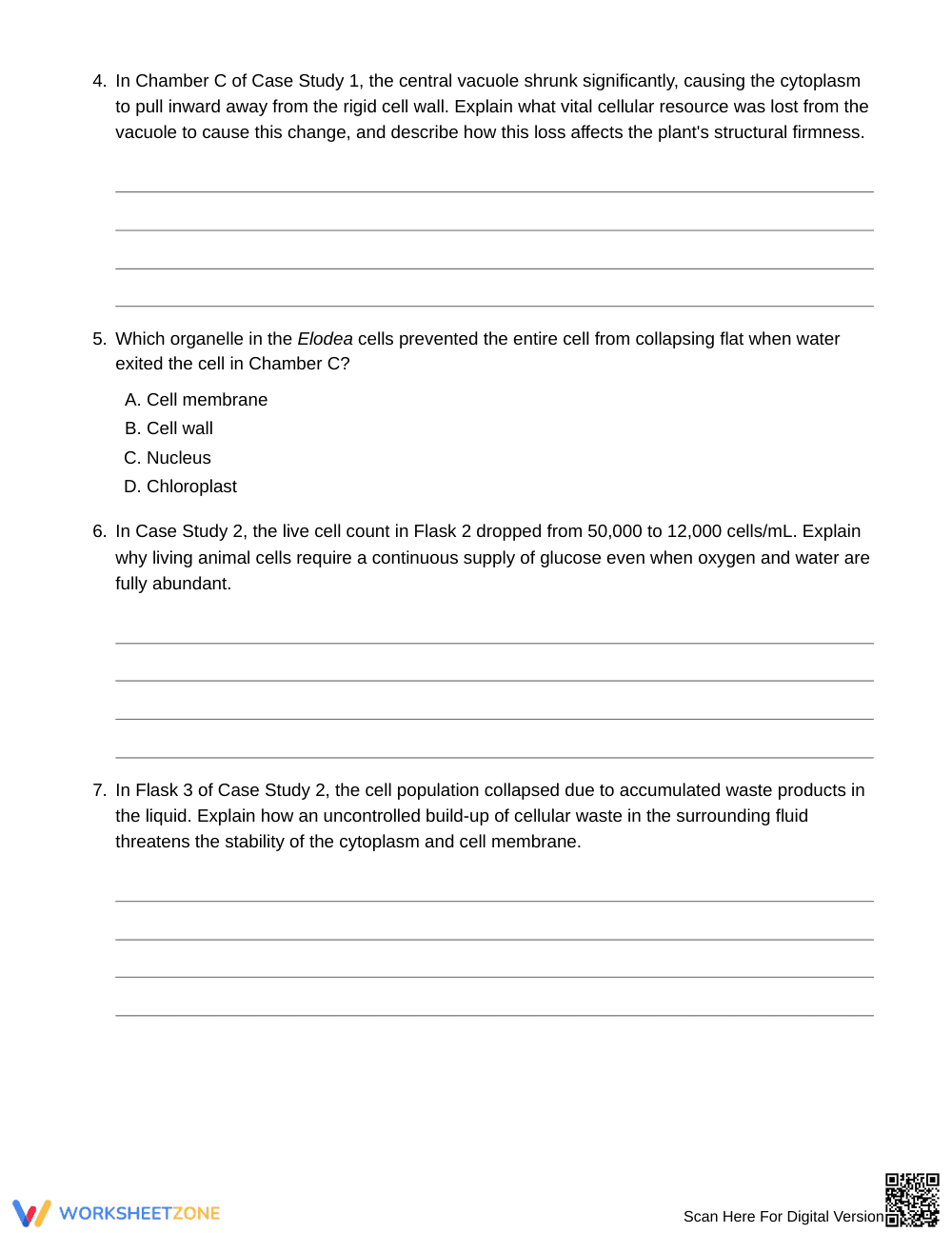
This 5-page resource includes 2 student pages with 10 problems and a 3-page teacher answer key. A foundational reference box reviews core organelles: cell membrane, cytoplasm, nucleus, vacuole, cell wall, and chloroplast. Students analyze two synthetic case studies with data tables examining Elodea plant cells and cultured mammalian cells through short-answer questions, multiple-choice items, and claim evaluations.
Skill Progression
- Guided practice (Items 1–2): Students examine cellular constraints, identifying structural barriers and explaining osmotic changes.
- Supported practice (Items 3–8): Learners interpret experimental data tables, linking light and nutrient variables to cellular functions.
- Independent practice (Items 9–10): Students evaluate student claims, using biological evidence to disprove invalid scientific reasoning.
This sequence implements a gradual release model, guiding learners from structural recall to independent data evaluation.
Standards Alignment
This worksheet aligns with middle school life science standards that require students to explain how cell structures sustain life and process materials. A supporting standard addresses cellular system interactions and energy production. These standard descriptions can be copied directly into lesson plans, IEP goals, or district curriculum mapping tools.
How to Use It
Use this worksheet after direct instruction on cell organelles or following a microscope wet-mount lab. Have students complete Part A in pairs before analyzing the case studies independently. As students work, check whether they identify chloroplasts and vacuoles as key factors in the Elodea data. Expected completion time is 40 to 50 minutes.
Who It's For
This resource serves Grade 6 science classes exploring cell biology. Provide highlighters for students needing reading support to track data rows across chambers and flasks. Pair this activity with an interactive organelle anchor chart or introductory video on cell transport.
According to Fisher & Frey (2014), structured cognitive scaffolding enables middle school students to successfully transition from basic content knowledge to rigorous scientific evaluation. This Grade 6 life science worksheet guides students to explain the needs of a living cell through purposeful data interpretation and critical analysis. By examining simulated laboratory trials of plant and animal tissue under environmental stress, learners directly evaluate how membranes regulate transport, how chloroplasts produce essential glucose, and how vacuoles maintain internal turgor pressure. The multi-tiered task structure moves systematically from organelle identification to the critique of flawed scientific claims, providing actionable diagnostic evidence of student mastery. By anchoring abstract cellular mechanisms to concrete biological scenarios, this resource strengthens analytical reasoning and scientific literacy, helping educators pinpoint misconceptions regarding cellular respiration, photosynthesis, and waste management across diverse learning environments.


