


























Views
Downloads




Complete Incident Consequences Worksheet | Grade 8 ELA
Paste this activity's link or code into your existing LMS (Google Classroom, Canvas, Teams, Schoology, Moodle, etc.).
Students can open and work on the activity right away, with no student login required.
You'll still be able to track student progress and results from your teacher account.
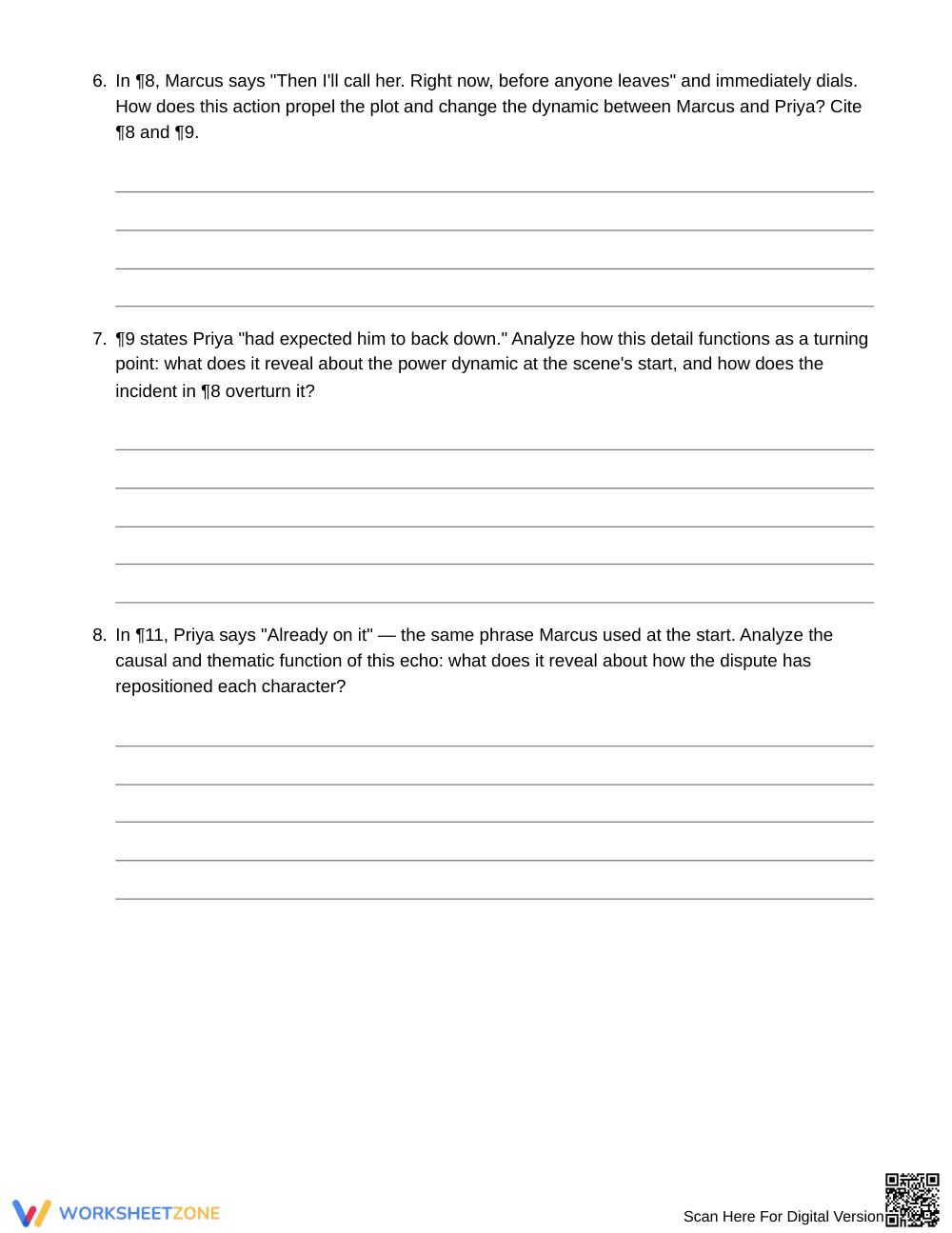
This Grade 8 ELA worksheet teaches students to trace the immediate consequences of dialogue and incidents in a literary text. Through 10 structured tasks built around a realistic-fiction passage, students identify causal functions, cite paragraph evidence, and explain how character actions propel the plot, reveal motives, or force decisions.
At a Glance
- Grade: 8 · Subject: ELA
- Standard:
RL.8.3— Analyze how dialogue or incidents propel action, reveal character, or provoke a decision- Skill Focus: Tracing an incident’s immediate consequences
- Format: 5 pages · 10 problems · Answer key included · PDF
- Best For: Guided and independent literary analysis practice
- Time: 35–50 minutes
What’s Inside
The worksheet opens with a focus-skill rule box defining three causal functions: propelling action, revealing motives, and forcing decisions. It includes a modeled annotation demonstrating expected analytical depth. The featured passage, “The Blocking Dispute,” presents an 11-paragraph scene set in a school theater, followed by 10 scaffolded tasks and a complete answer key.
Skill Progression
- Guided Practice (Part A — 3 problems): Students trace causal chains with structured prompts that identify the target function and cite cross-referenced paragraphs.
- Supported Practice (Part B — 5 problems): Students independently identify causal functions, choose text evidence, and explain consequences without prompt-level cues.
- Independent Practice (Part C — 2 problems): Students evaluate competing interpretations, justify the stronger reading with dual paragraph citations, and critique flaws in the rejected claim.
How to Use It
Aligned to RL.8.3 and supporting RL.8.1, this resource works well after direct instruction on literary cause and effect. Have students complete Part A in pairs before tackling Parts B and C independently. Check student work to ensure they explain causal mechanisms rather than relying on superficial character labels. Expected completion time is 35 to 50 minutes.
Who It’s For
This resource supports Grade 8 English language arts teachers seeking focused material for literary analysis units. The built-in scaffolding assists struggling readers with clear models, while the comparative evaluation items challenge advanced learners to defend evidence-based claims.
This five-page, ten-problem worksheet targets RL.8.3, the Grade 8 standard requiring students to analyze how dialogue or incidents propel action, reveal character, or provoke a decision. Students practice tracing immediate consequences through a realistic-fiction passage, moving from modeled annotation through scaffolded evidence linking to independent interpretive evaluation. According to Fisher & Frey (2014), gradual release of responsibility significantly increases student ownership of analytical reasoning when each phase explicitly models the thinking expected in the next step. The worksheet embeds that intentional progression: three guided items, five supported items, and two independent interpretation tasks, all requiring paragraph-level citation. A complete answer key supports self-checking, peer review, or direct teacher scoring. Furthermore, it gives educators reliable formative diagnostic data to address common literary analysis misconceptions. Ultimately, this classroom-ready resource is suitable for whole-class instruction, targeted small-group intervention, or independent practice in any standards-aligned Grade 8 ELA curriculum setting.


