




























Views
Downloads


Complete Heat Calculations Worksheet | Grade 11 Chemistry

Paste this activity's link or code into your existing LMS (Google Classroom, Canvas, Teams, Schoology, Moodle, etc.).
Students can open and work on the activity right away, with no student login required.
You'll still be able to track student progress and results from your teacher account.
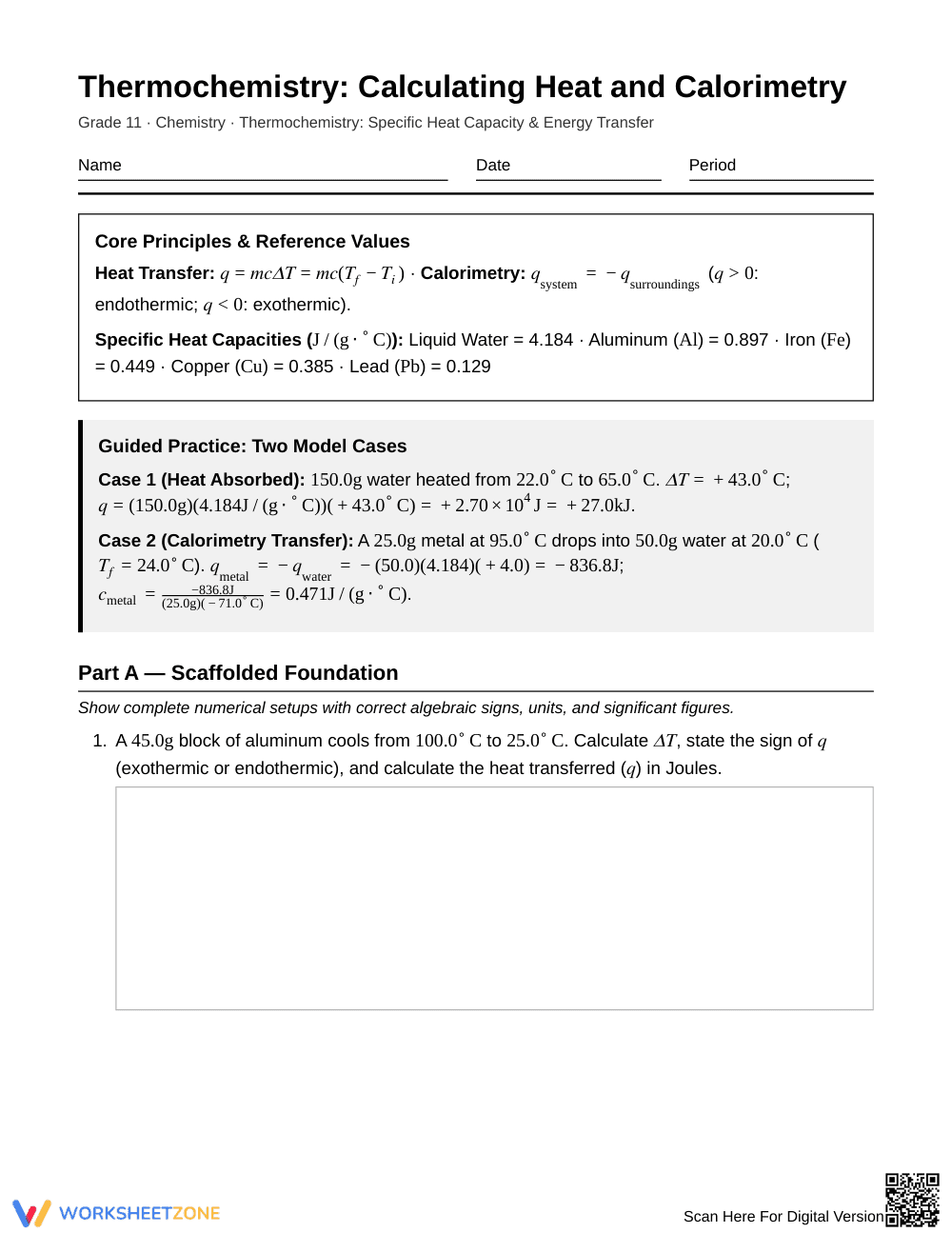
This Grade 11 chemistry worksheet equips students to master heat calculations using q=mcΔT and calorimetry principles. Learners calculate heat absorbed, final temperatures, and specific heat capacities while analyzing energy conservation across chemical reactions and physical mixtures, building fluency in quantitative thermochemistry.
At a Glance
- Grade: 11 · Subject: Chemistry
- Standard: Thermochemistry — Calculate thermal energy transfer and equilibrium states using specific heat capacity
- Skill Focus: Calculate Heat with q=mcΔT
- Format: 4 printable pages · 10 multi-part problems · Detailed answer key included · PDF
- Best For: Independent classroom practice and quantitative calorimetry lab preparation
- Time: 45–60 instructional minutes
What's Inside
This 4-page worksheet contains 10 thermochemistry problems supported by specific heat reference values and two worked model cases. Students solve numerical heat transfer problems, multi-step calorimetry scenarios, and written conceptual analysis questions, supported by a 2-page answer key with step-by-step mathematical setups.
Skill Progression
- Guided practice: Students review reference values and two annotated model cases demonstrating heat absorption and calorimetry equations.
- Supported practice: Part A includes 3 scaffolded problems requiring calculated temperature changes, sign assignments, and heat calculations in Joules.
- Independent practice: Parts B and C deliver 5 calorimetry applications and 2 conceptual error analysis prompts requiring written justifications.
This sequence follows the gradual release of responsibility model, guiding students toward independent problem-solving mastery.
Standards Alignment
This resource aligns with high school physical science standards for thermochemistry and energy transfer. Students use mathematical models to calculate energy changes, applying the law of conservation of energy to determine equilibrium temperatures and specific heat capacities. Both standard codes can be copied directly into lesson plans, IEP goals, or district curriculum mapping tools.
How to Use It
Assign this worksheet following direct instruction on calorimetry and enthalpy. During guided practice, observe whether students properly assign negative signs to exothermic heat releases in Part B. Allow 45 to 60 minutes for completion, or assign Part C as a formative exit ticket.
Who It's For
Designed for Grade 11 chemistry students, this resource reinforces quantitative problem solving while challenging advanced learners with realistic solution calorimetry data. Pair this worksheet with a laboratory calorimeter investigation or a thermodynamic formula reference chart.
This Grade 11 thermochemistry worksheet develops rigorous quantitative competence in calculating heat transfer and thermal equilibrium using q=mcΔT. Grounded in the instructional framework articulated by Fisher & Frey (2014), the structured sequence advances students systematically through modeled examples, foundational formula application, and complex calorimetry problem solving. High school learners often struggle with sign conventions and distinguishing thermal energy from temperature; this resource targets those persistent misconceptions through explicit sign tracking and qualitative reflection prompts. By bridging mathematical manipulation with physical energy conservation principles, the 10 multi-part tasks cultivate deep conceptual mastery alongside procedural fluency. Chemistry educators can utilize these 4 student pages for targeted skill acquisition, pre-laboratory preparation, or diagnostic formative assessment. The accompanying two-page answer key details complete dimensional analysis and algebraic solutions, equipping teachers to deliver targeted interventions that reliably advance student achievement in physical science coursework.


