


























Views
Downloads

Complete Gradients & ATP Dependence Worksheet | Grade 10
Paste this activity's link or code into your existing LMS (Google Classroom, Canvas, Teams, Schoology, Moodle, etc.).
Students can open and work on the activity right away, with no student login required.
You'll still be able to track student progress and results from your teacher account.
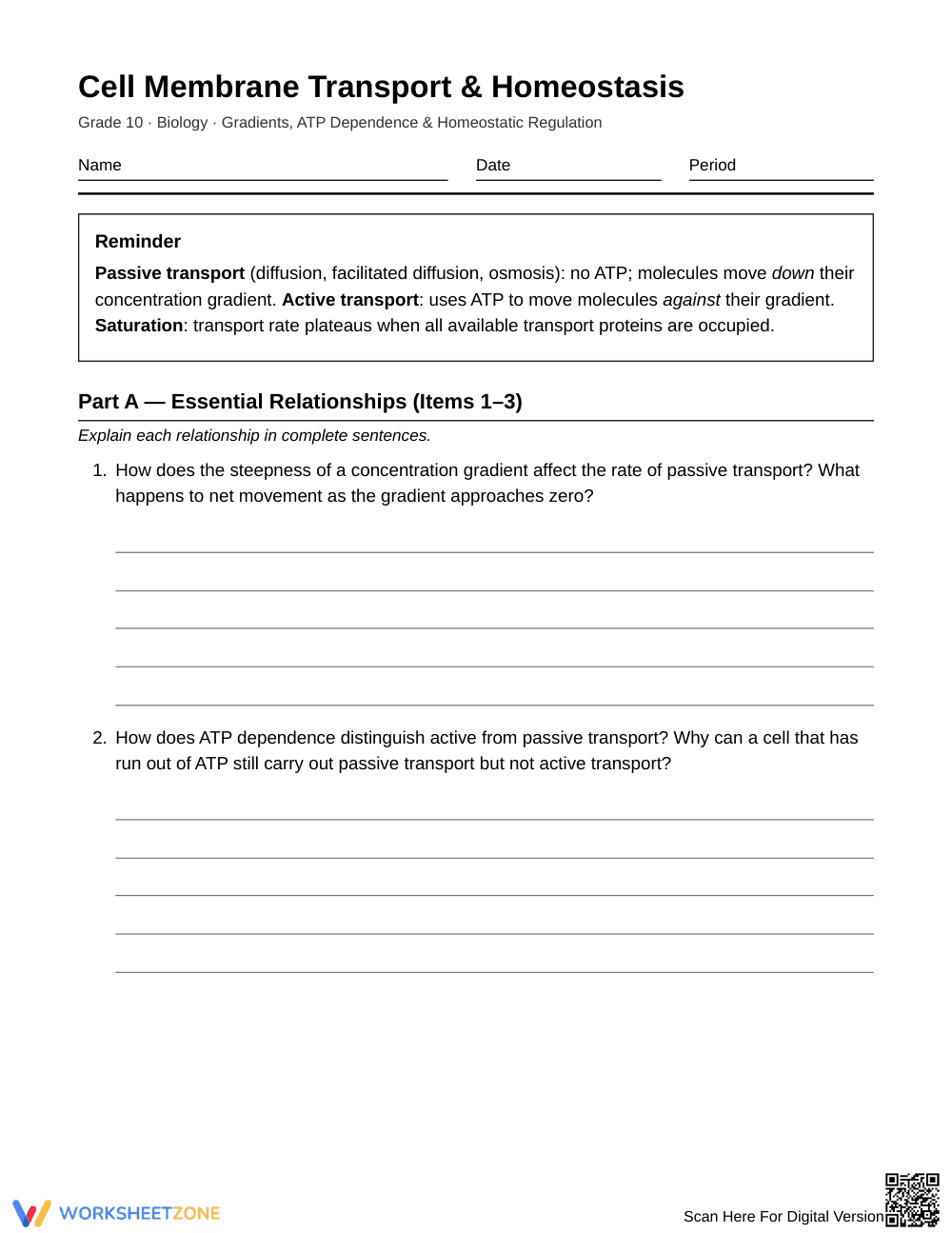
This Grade 10 Biology worksheet builds students' ability to explain how concentration gradients drive passive transport and how ATP dependence distinguishes active transport. Across 12 problems, learners analyze synthetic data sets, classify solutions by tonicity, calculate ATP requirements, interpret saturation curves, and predict cellular outcomes when energy supply is disrupted, all skills central to understanding cell membrane transport and homeostasis.
At a Glance
- Grade: 10 · Subject: Biology
- Standard: Cell Membrane Transport — Explain how gradients and ATP dependence govern passive and active transport
- Skill Focus: Gradients and ATP dependence in membrane transport
- Format: 5 pages · 12 problems · Answer key included · PDF
- Best For: Practice after direct instruction on transport
- Time: 35–50 minutes
What's Inside
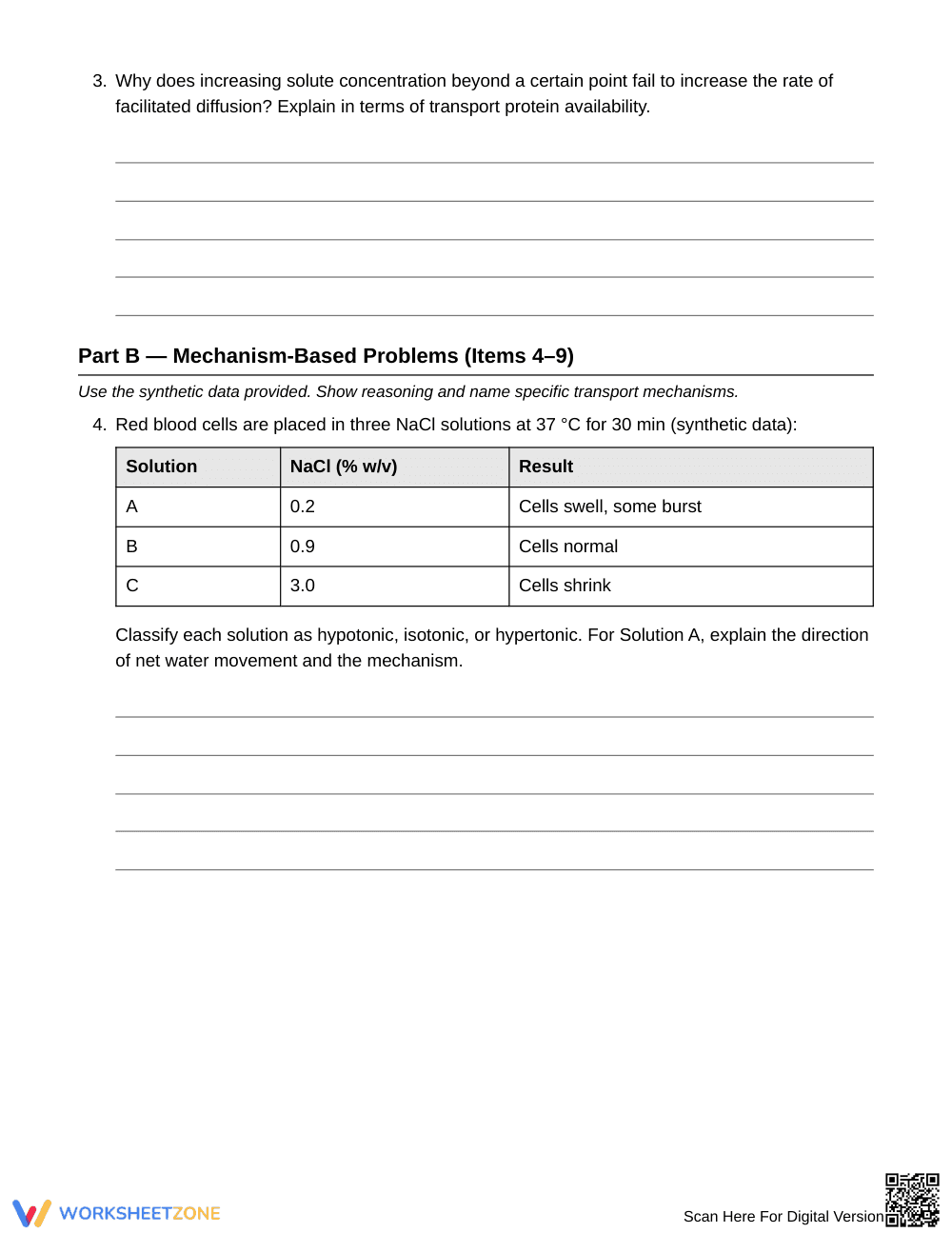
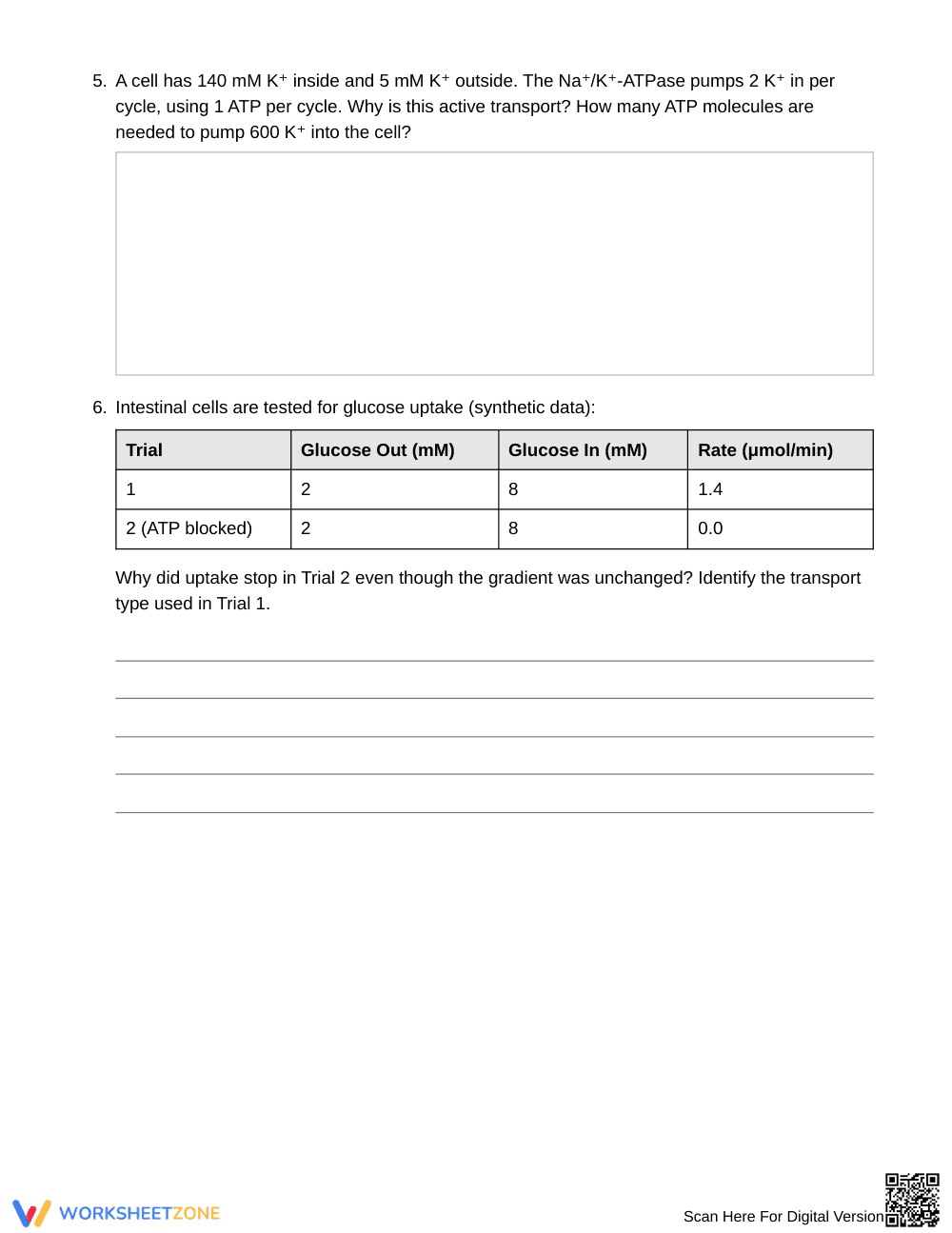
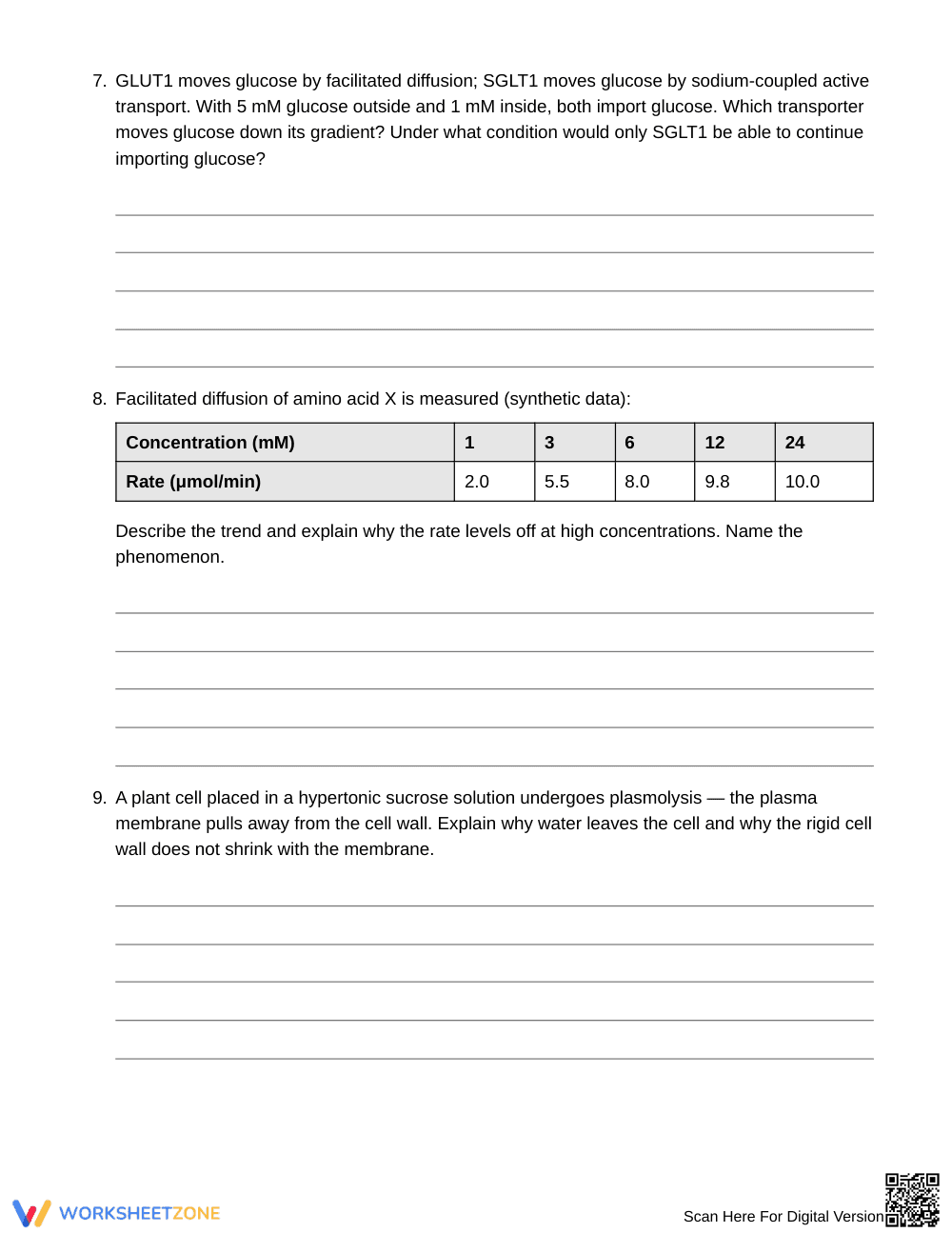
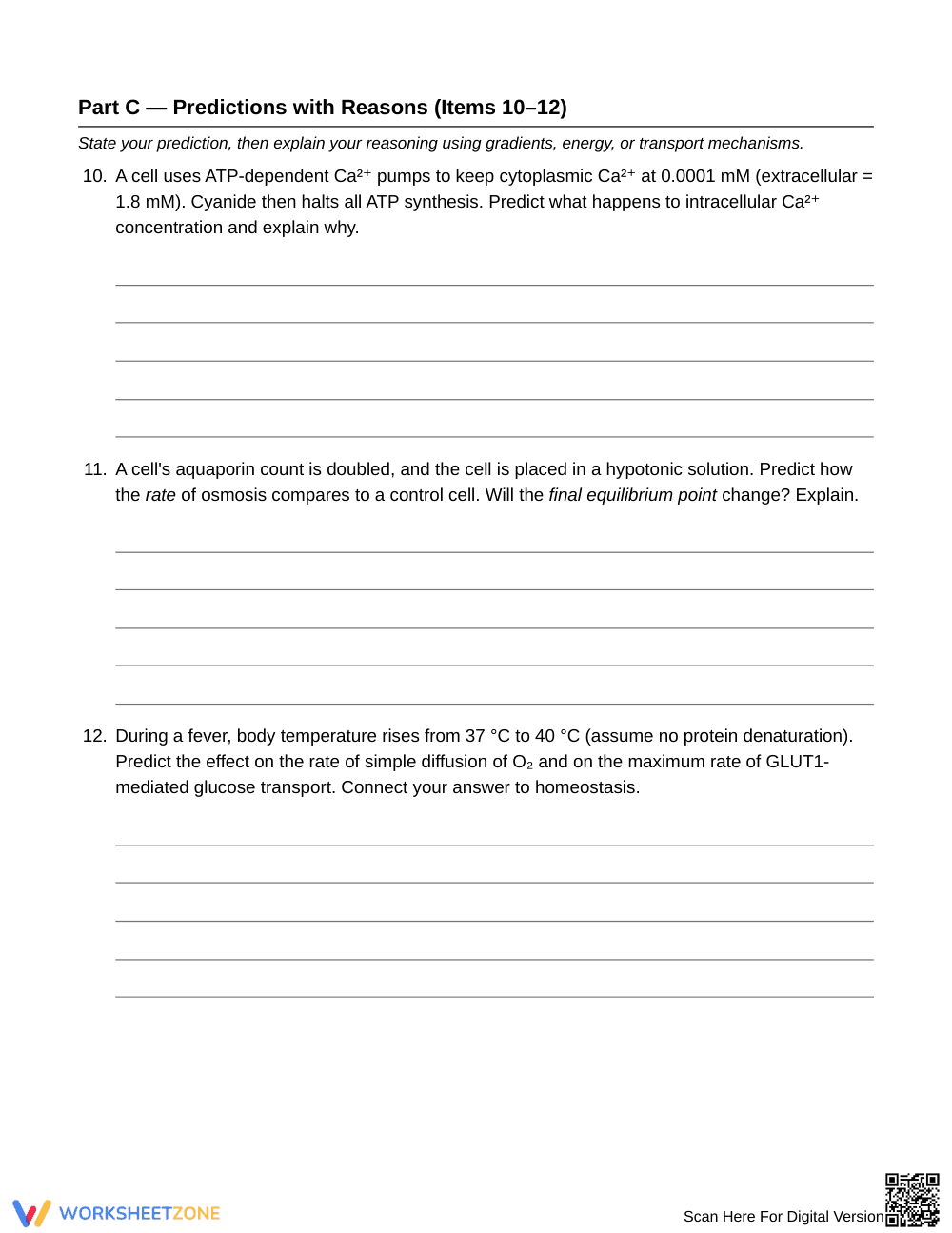
The worksheet begins with a reference box defining passive transport, active transport, and saturation. Part A (Items 1–3) poses open-response questions on gradient steepness, ATP reliance, and carrier protein limits. Part B (Items 4–9) features six data-anchored problems involving red blood cells in saline, Na⁺/K⁺-ATPase calculations, glucose transporter comparisons (GLUT1 versus SGLT1), amino acid saturation curves, and plant cell plasmolysis. Part C (Items 10–12) challenges students to predict cellular outcomes when ATP production is blocked or channel density changes. A complete three-page answer key provides detailed model explanations.
Skill Progression
- Guided Practice (Items 1–3): Students define foundational relationships in complete sentences using the reference box for support.
- Supported Practice (Items 4–9): Learners analyze data tables to classify solutions, calculate energy needs, and interpret transport curves.
- Independent Practice (Items 10–12): Scaffolds drop away as students apply causal reasoning to predict and justify biological outcomes.
Standards Alignment
This resource focuses on cell biology principles concerning how biological membranes regulate matter movement. Students demonstrate how concentration gradients drive passive diffusion and why active transport depends on ATP hydrolysis. These foundational ideas support high school biology benchmarks in cellular structure, function, and homeostatic regulation.
How to Use It
Administer this worksheet following direct instruction on membrane transport. Part A works well as a formative checkpoint, while Parts B and C can be completed individually or in collaborative pairs. A helpful teaching tip: listen during Part B to confirm students accurately contrast movement down a gradient versus against a gradient.
This five-page biology worksheet strengthens students' ability to explain how concentration gradients and ATP dependence regulate cell membrane transport in high school biology. Across 12 structured tasks, tenth-grade learners analyze synthetic data sets, evaluate solution tonicity, calculate cellular energy expenditure, and predict physiological responses when ATP synthesis stops. According to research reviewed in the RAND AIRS 2024 report, rigorous data-driven practice tasks help students build coherent scientific explanations by connecting molecular mechanisms directly to observed cellular outcomes. The resource provides a detailed three-page answer key with complete model responses, synthetic data tables for saturation and diffusion rates, and a reference box that reinforces essential vocabulary throughout every exercise. Secondary science educators can readily use this practical resource for guided classroom practice, paired problem solving, independent homework, or targeted review before comprehensive unit exams with minimal advance preparation.


