


























Views
Downloads


Complete False Cause Claims Worksheet | Grade 10 English II
Paste this activity's link or code into your existing LMS (Google Classroom, Canvas, Teams, Schoology, Moodle, etc.).
Students can open and work on the activity right away, with no student login required.
You'll still be able to track student progress and results from your teacher account.
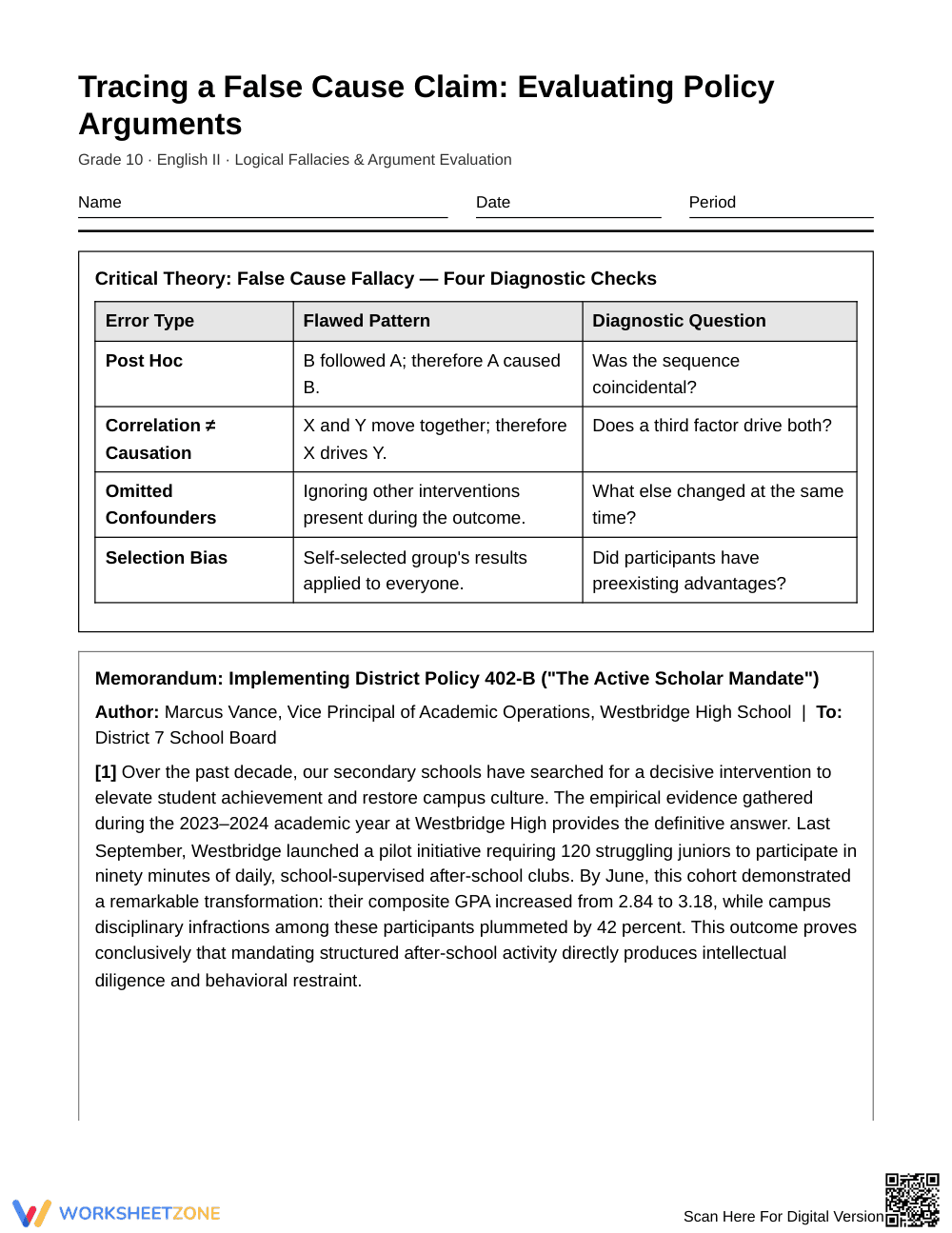
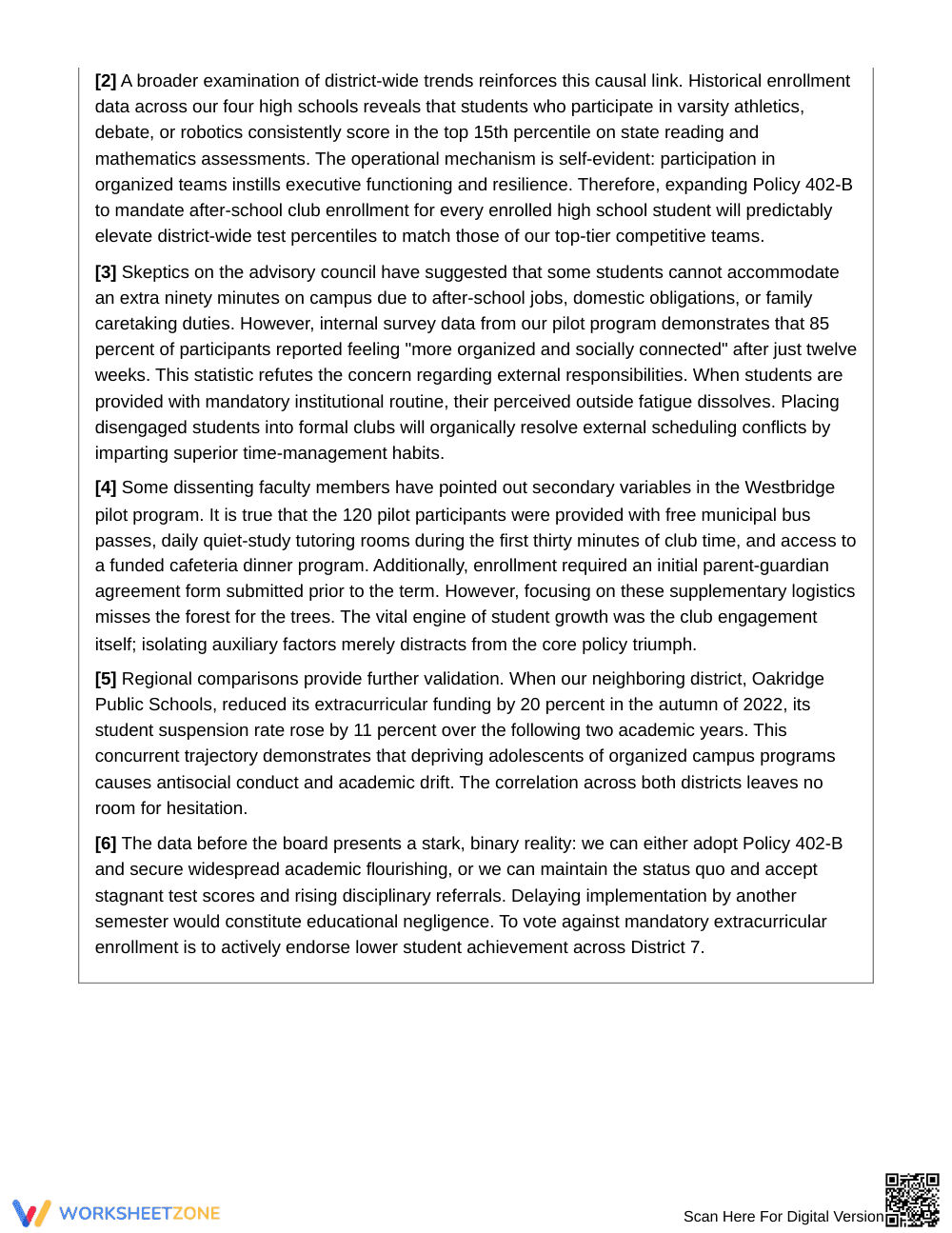
This Grade 10 English II worksheet trains students to identify and evaluate false cause claims in argumentative writing. Analyzing an authentic school board memorandum, learners examine omitted confounders, post hoc fallacies, and selection bias to distinguish valid causal arguments from correlation, building essential evaluative reading skills.
At a Glance
- Grade: 10 · Subject: English II
- Standard:
RI.9-10.8— Evaluate argument validity, claim sufficiency, and fallacious reasoning in informational texts- Skill Focus: Tracing False Cause Fallacies
- Format: 6 pages · 10 problems · Answer key included · PDF
- Best For: High school argument evaluation unit practice
- Time: 45–60 minutes
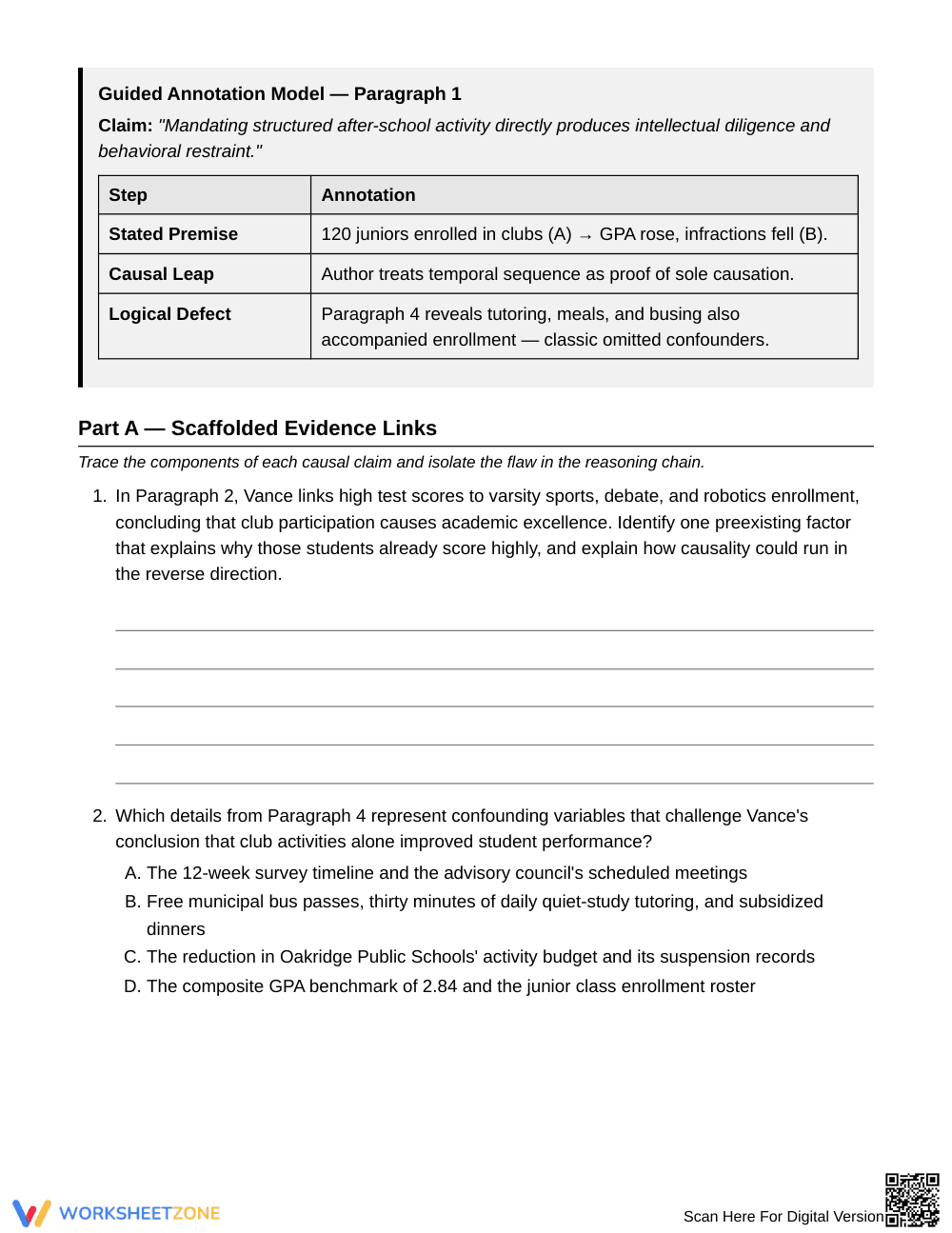
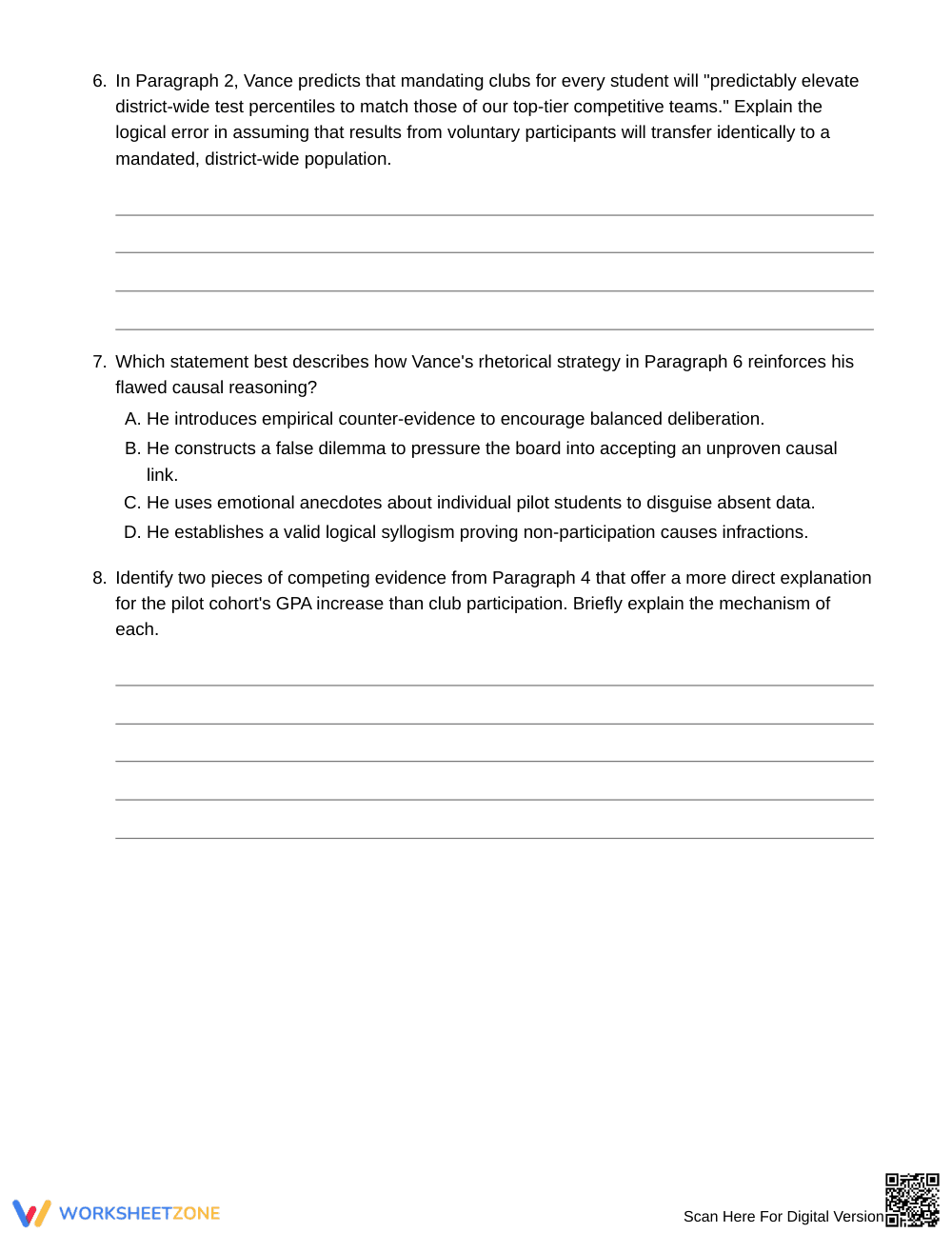
This 6-page packet features a diagnostic reference table of four causal errors, an authentic six-paragraph policy memorandum, and a guided annotation model. Across 10 rigorous tasks, students complete text-dependent multiple-choice questions and analytical short responses, supported by a complete 3-page answer key.
Skill Progression
- Guided practice: A step-by-step model annotates stated premises, causal leaps, and logical defects.
- Supported practice (Part A — 3 problems): Students isolate confounding variables and post hoc fallacies using structured text prompts.
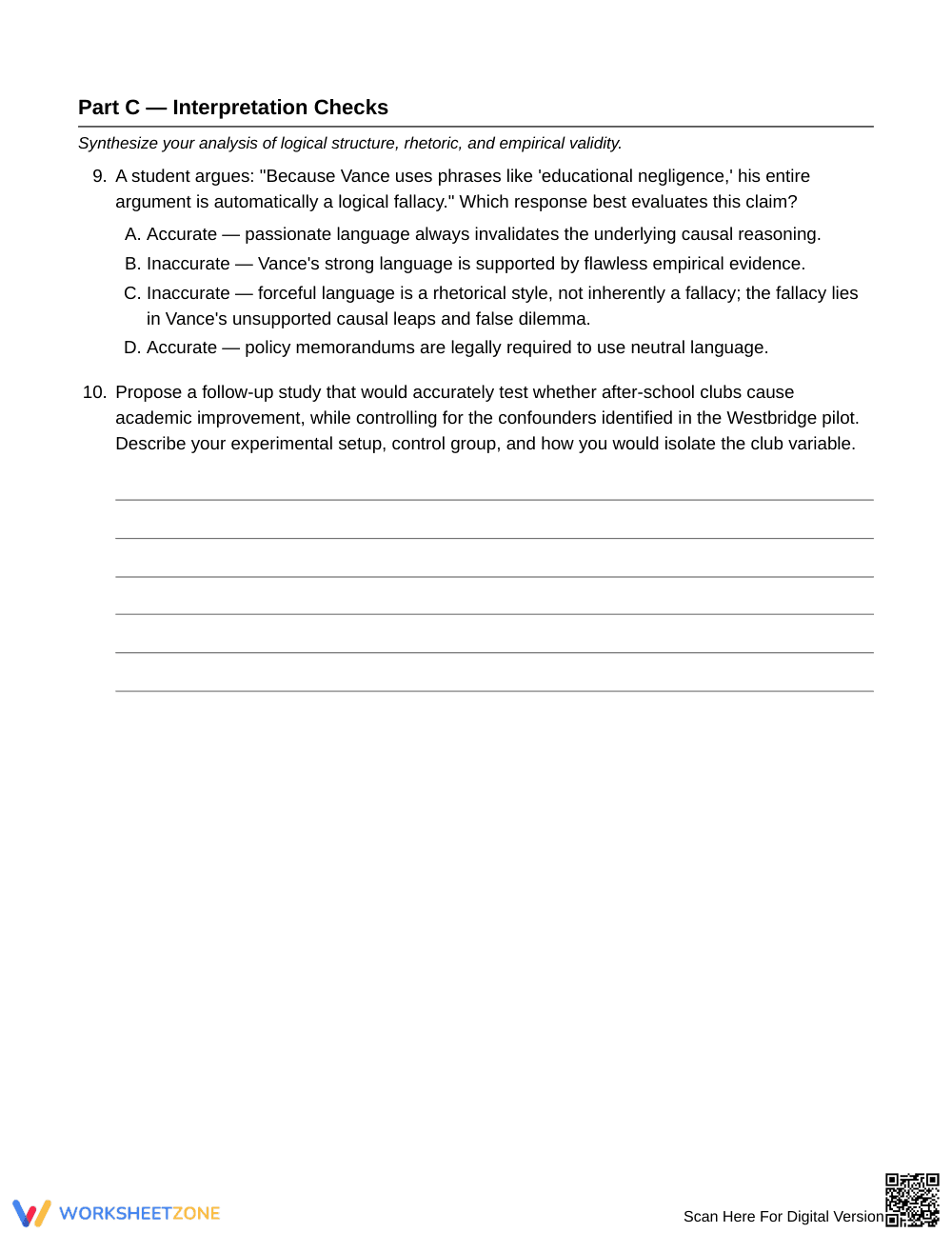
- Independent practice (Parts B & C — 7 problems): Students critique selection bias, detect false dilemmas, and design controlled experimental investigations.
This gradual-release structure moves learners from scaffolded identification to autonomous logical critique.
Standards Alignment
Aligned to RI.9-10.8: Delineate and evaluate the argument and specific claims in a text, assessing whether reasoning is valid and evidence is sufficient. It also supports CCRA.R.8 by assessing logical validity. Both standard codes can be copied directly into lesson plans, IEP goals, or district curriculum mapping tools.
How to Use It
Use this worksheet after direct instruction on informal fallacies. Model the text annotation collaboratively before releasing students to complete Part A in pairs or Parts B and C independently. Formatively check whether students spot omitted variables in Paragraph 4 during work time. Completion takes 45 to 60 minutes.
Who It's For
Designed for Grade 10 English II learners, this packet supports general and honors students with diagnostic tables and structured models. Pair this activity with an anchor chart on logical fallacies or a persuasive writing unit to deepen critical analysis.
Mastering standard RI.9-10.8 requires secondary readers to dissect argument validity and isolate fallacious causal claims within complex non-fiction texts. According to Fisher & Frey (2014), explicit instructional scaffolding through modeled annotations, diagnostic criteria, and structured text evaluation significantly accelerates high school students' capacity to critique flawed rhetorical reasoning independently. This comprehensive 6-page English II resource operationalizes causal fallacy analysis through a targeted 10-task progression examining post hoc assumptions, omitted confounders, and selection bias in a realistic school board policy proposal. By systematically transitioning learners from guided premise mapping to independent experimental design, the packet ensures students distinguish genuine causality from coincidental correlation and false dilemmas. Complete with diagnostic check criteria, detailed text annotations, and an exhaustive 3-page answer key, this resource delivers rigorous, measurable instructional support for secondary critical reading standards.


