


























Views
Downloads




Complete Evidence Repair Worksheet | Grade 10 English II
Paste this activity's link or code into your existing LMS (Google Classroom, Canvas, Teams, Schoology, Moodle, etc.).
Students can open and work on the activity right away, with no student login required.
You'll still be able to track student progress and results from your teacher account.
This Grade 10 analytical writing worksheet trains students to eliminate unintegrated evidence dumps and descriptive plot summary from their essays. Writers examine flawed mentor drafts, embed textual fragments into original syntax, and craft arguable thesis statements supported by nuanced literary commentary.
At a Glance
- Grade: 10 · Subject: English II
- Standard:
W.9-10.5— Strengthen writing through focused planning, revising, and rewriting- Skill Focus: Repairing Evidence Dumps and Plot Summary
- Format: 6 pages · 10 problems · Answer key included · PDF
- Best For: Analytical paragraph and thesis revision
- Time: 45–60 minutes
Students read an original narrative excerpt, "The Warden's Register," accompanied by a weak analytical draft. This 6-page printable features 10 scaffolded tasks, an explicit thesis-revision framework, a metacognitive quality audit table, and an extensive 4-page answer key detailing exemplar student revisions.
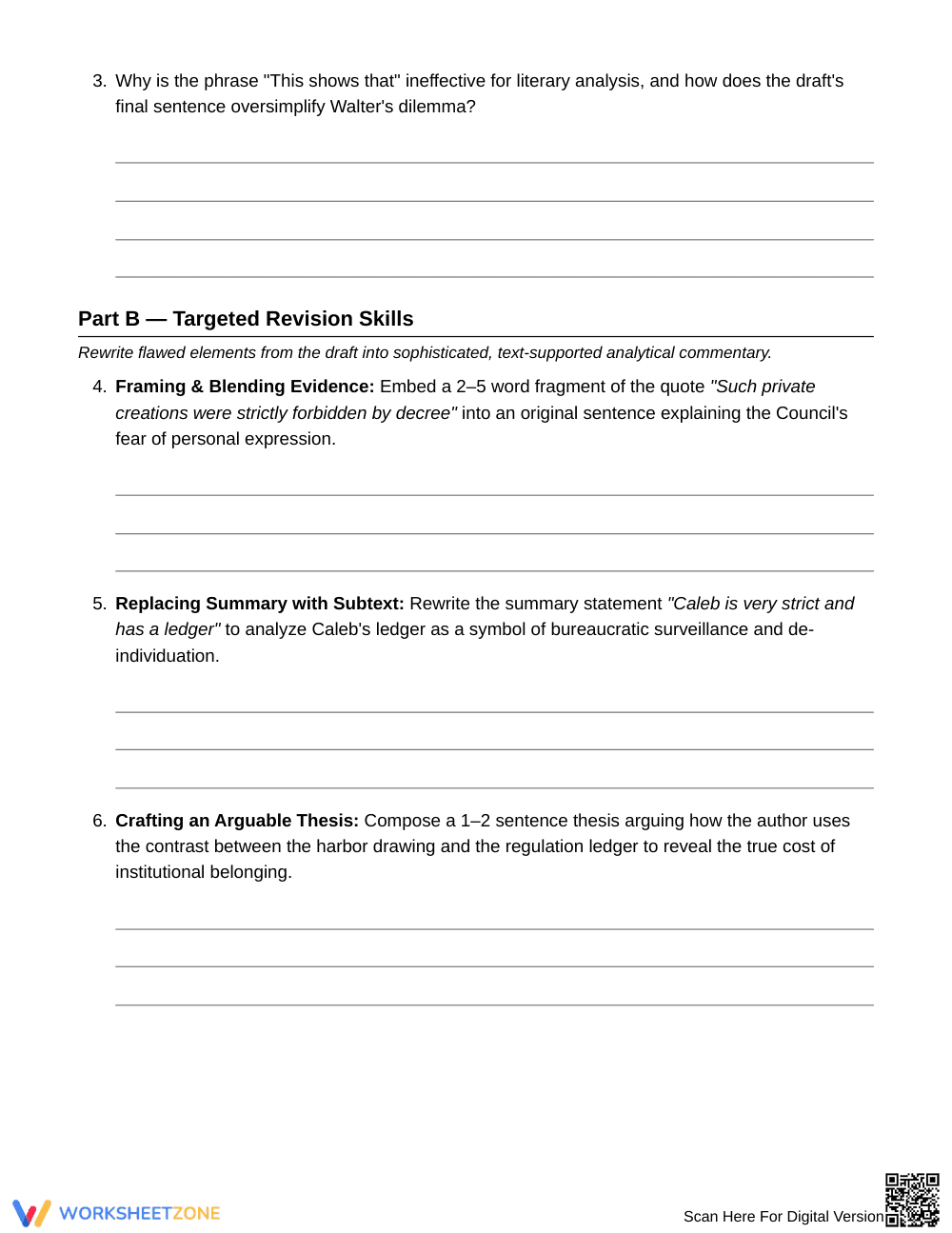
- Guided practice (Tasks 1–3): Students diagnose structural flaws in a sample draft, identifying unintegrated quotations, weak thesis statements, and ineffective transitional phrasing.
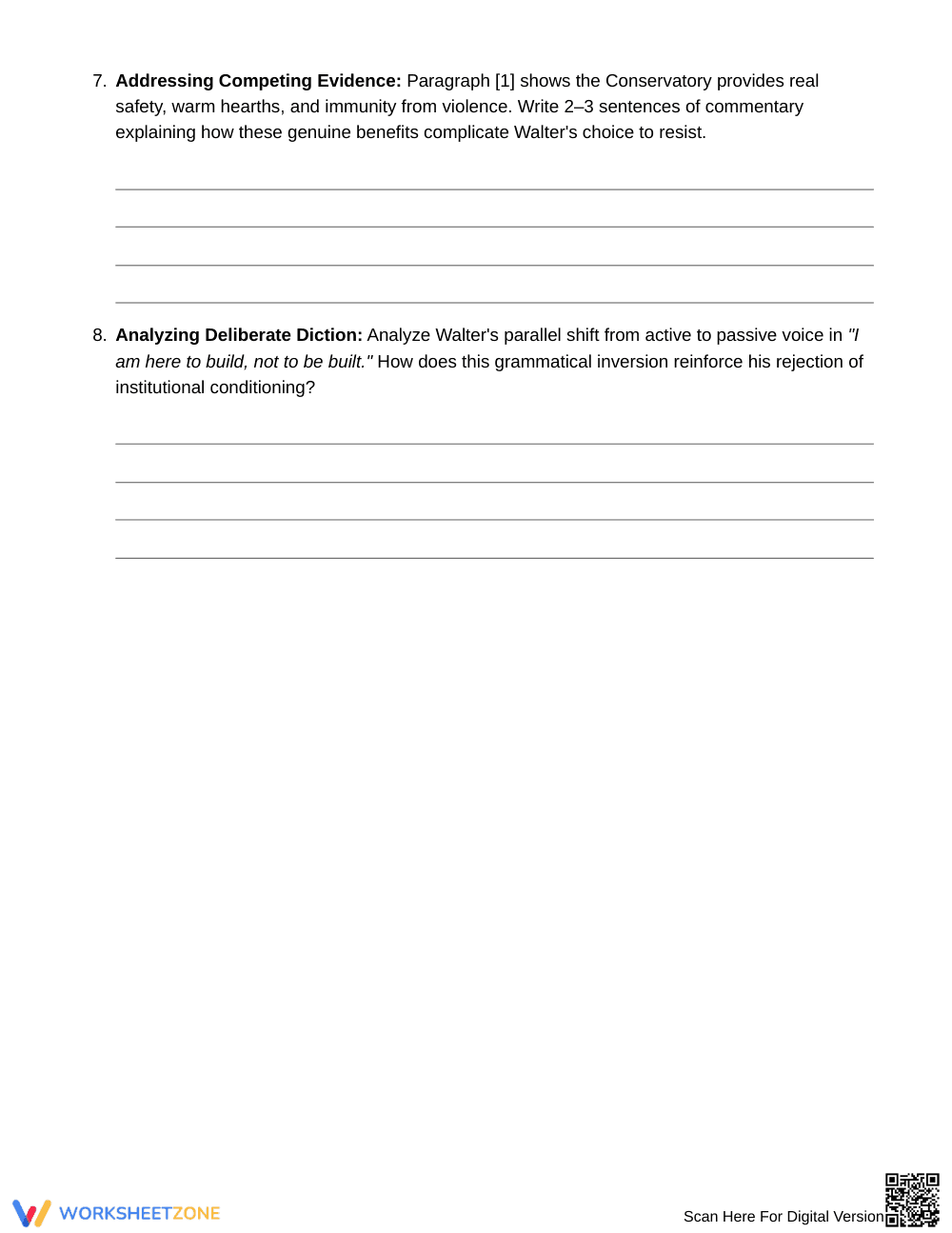
- Supported practice (Tasks 4–8): Writers rewrite flawed lines, embedding quote fragments, replacing plot summary with subtextual analysis, and unpacking authorial diction.
- Independent practice (Tasks 9–10): Students synthesize their skills to draft an original 180–230 word analytical paragraph and evaluate their work using a self-audit chart.
This progression follows the gradual-release model, advancing students systematically from critical analysis to independent mastery.
This worksheet directly addresses `W.9-10.5`, which focuses on developing and strengthening writing through targeted revision and editing. It also supports `RL.9-10.1` by training students to cite thorough textual evidence while evaluating literary themes. Both standard codes can be copied directly into lesson plans, IEP goals, or district curriculum mapping tools.
Deploy this resource during an analytical essay unit or as targeted intervention following draft feedback. Use Tasks 1–3 for a whole-class warm-up, then assign Tasks 4–10 for independent or paired completion over 45 to 60 minutes. Formatively assess Task 5 to ensure students interpret symbolic meaning rather than expanding summary.
Tailored for Grade 10 English II students, this activity aids learners struggling to bridge the gap between plot recall and analytical reasoning. Pair this worksheet with an anchor chart of analytical verbs or direct instruction on sentence-combining strategies.
Mastering analytical paragraph structure under W.9-10.5 requires high school students to move beyond descriptive plot recitation toward intentional textual synthesis and craft examination. As established by Fisher & Frey (2014) in their research on scaffolded literacy instruction, adolescent writers achieve significantly higher rates of analytical transfer when explicit error modeling precedes guided sentence reconstruction and independent paragraph generation. This Grade 10 English II resource provides an evidence-based pathway for repairing unintegrated quotation dumps and passive summary into nuanced literary commentary. By dissecting flawed models, embedding concise textual fragments, and conducting metacognitive self-audits, secondary students internalize the disciplinary habits necessary for sophisticated essay composition. The curriculum-aligned exercise equips learners with concrete revision heuristics that directly strengthen textual analysis, enabling tenth graders to evaluate authorial craft, dissect institutional symbolism, and build arguable thesis statements with measurable academic clarity.


