




























Views
Downloads



Complete Evaluating Arguments Worksheet | Grade 7 ELA

Paste this activity's link or code into your existing LMS (Google Classroom, Canvas, Teams, Schoology, Moodle, etc.).
Students can open and work on the activity right away, with no student login required.
You'll still be able to track student progress and results from your teacher account.
This Grade 7 reading worksheet guides students to analyze informational arguments, distinguish sound reasoning from unsupported claims, and assess factual evidence. Working with an engaging proposal for an Oakridge Youth Center study zone, learners evaluate persuasive structures, uncover logical gaps, and determine whether cited statistics adequately justify an author's conclusions.
At a Glance
- Grade: 7 · Subject: ELA
- Standard:
RI.7.8— Trace and evaluate arguments and claims, assessing whether reasoning is sound and evidence sufficient- Skill Focus: Argument-Evaluation Check and Evidence Analysis
- Format: 5 pages · 12 problems · Complete 3-page answer key included · PDF
- Best For: Mid-unit argument analysis and close reading practice
- Time: 40–50 minutes
What's Inside
This 5-page printable packet centers on an informational proposal regarding a community youth center study area. A reference header defines claims, reasoning, and evidence standards before students complete 12 analytical tasks across three progressive sections. Materials feature multiple-choice items, text-dependent short answers, an evidence matrix, and a 3-page teacher answer key with model explanations.
Skill Progression
- Guided practice (Tasks 1–3): Students trace the text's central claim, identify decibel data proving noise issues, and locate evidence confirming budget feasibility.
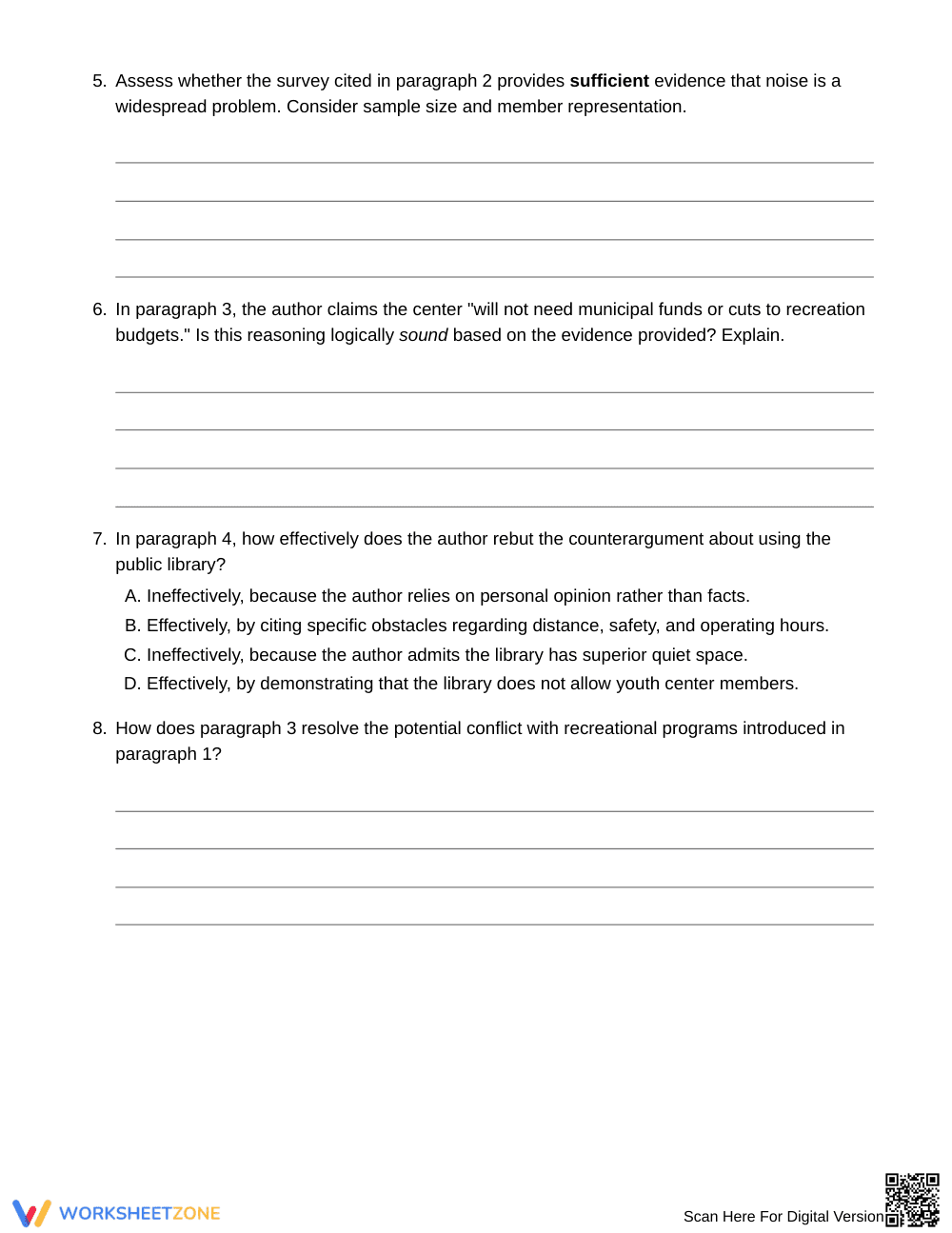
- Supported practice (Tasks 4–9): Learners evaluate evidence relevance, survey sample sufficiency, authorial logic, and counterargument rebuttals regarding public library access.
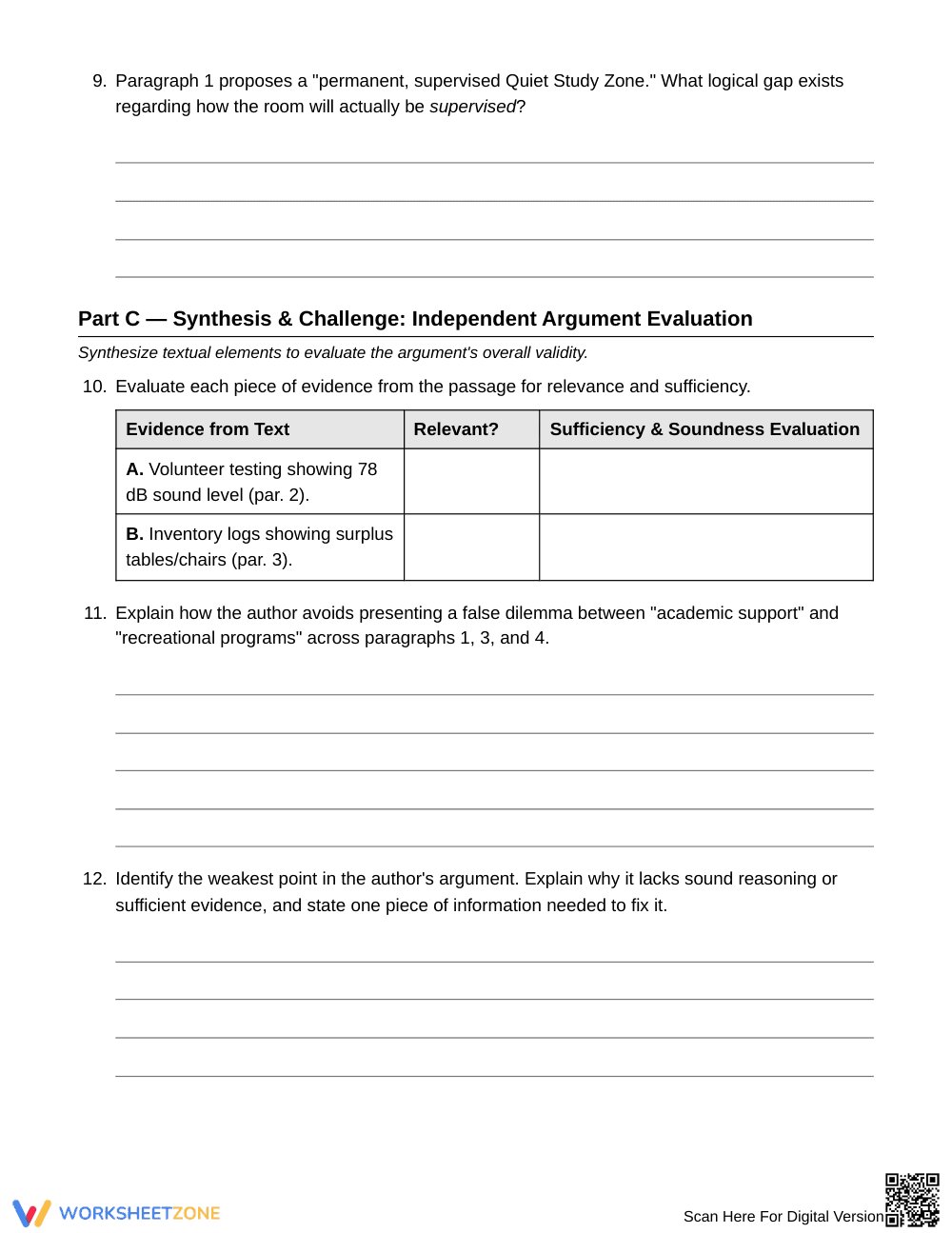
- Independent practice (Tasks 10–12): Students complete an evidence evaluation chart, examine false dilemmas, and critique the proposal's primary logical oversight.
This progression applies a gradual-release model, moving learners from guided comprehension to independent critical evaluation.
Standards Alignment
This worksheet aligns to standard `RI.7.8`: Trace and evaluate the argument and specific claims in a text, assessing whether the reasoning is sound and the evidence is relevant and sufficient to support the claims. It also supports `RI.7.1` by requiring explicit textual citations. Both standard codes can be copied directly into lesson plans, IEP goals, or district curriculum mapping tools.
How to Use It
Implement this resource after direct instruction on sound reasoning and logical fallacies. For whole-class instruction, read the text together, model Part A, and transition students into partner work for Parts B and C. As a formative assessment tip, check Task 5 to ensure students assess sample size sufficiency rather than just summarizing findings. Expect completion within 40 to 50 minutes.
Who It's For
This packet is built for seventh-grade ELA classrooms, reading intervention tiers, and advanced sixth-grade cohorts. Embedded definitions assist striving readers, while evaluative prompts challenge grade-level learners. Pair this resource with a visual anchor chart outlining argumentative evidence criteria and common logical fallacies.
Under standard RI.7.8, seventh-grade students must master evaluating informational arguments by tracing claims, testing logical soundness, and determining whether textual data is relevant and sufficient. Educational research by Fisher & Frey (2014) on the gradual release of responsibility confirms that literacy learners develop superior critical analysis when structured tasks transition systematically from foundational identification to independent synthesis. By framing argument evaluation around an accessible, authentic municipal youth center proposal, this resource operationalizes close reading principles without cognitive overload. Students do not merely highlight facts; they actively dissect survey sample validity, scrutinize decibel measurement analogies, and detect unaddressed operational oversight in civic proposals. This deliberate progression reinforces reading comprehension, analytical writing, and disciplinary literacy, equipping middle school students with the rigorous evaluative discernment demanded across secondary educational assessments, standardized testing environments, and real-world civic discourse.


