


























Views
Downloads



Complete Equivalent Quotients Worksheet | Grade 6 Math
Paste this activity's link or code into your existing LMS (Google Classroom, Canvas, Teams, Schoology, Moodle, etc.).
Students can open and work on the activity right away, with no student login required.
You'll still be able to track student progress and results from your teacher account.
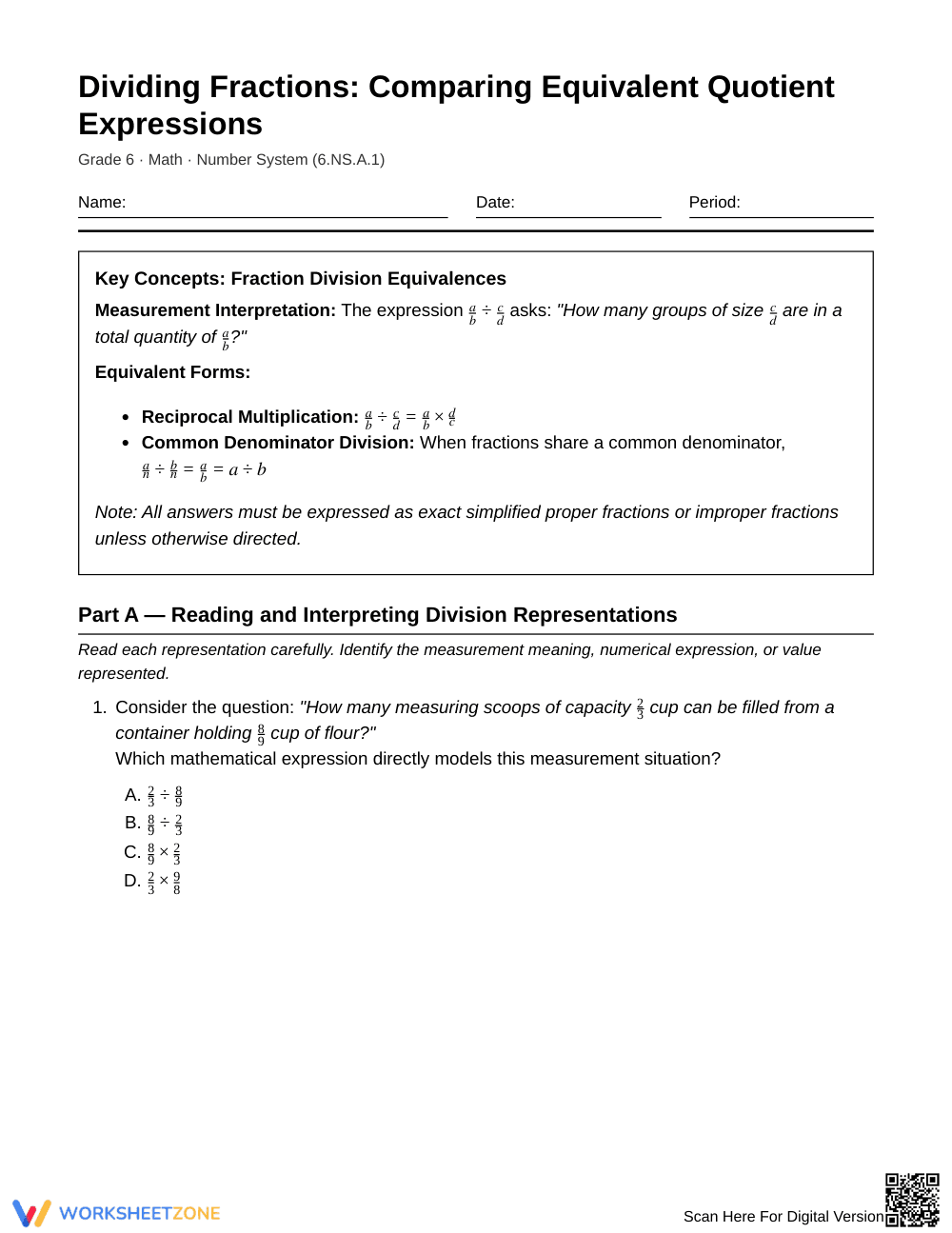
This Grade 6 math worksheet strengthens conceptual understanding and procedural fluency with fraction division by guiding students to analyze, transform, and compare equivalent quotient expressions. Students explore measurement division models, reciprocal multiplication, and common-denominator algorithms to evaluate mathematical claims and develop flexible problem-solving strategies.
At a Glance
- Grade: 6 · Subject: Math
- Standard:
6.NS.A.1— Interpret and compute quotients of fractions to solve division problems- Skill Focus: Compare Equivalent Quotient Expressions
- Format: 5 pages · 12 problems · Answer key included · PDF
- Best For: Conceptual practice and error analysis
- Time: 30–45 minutes
What's Inside
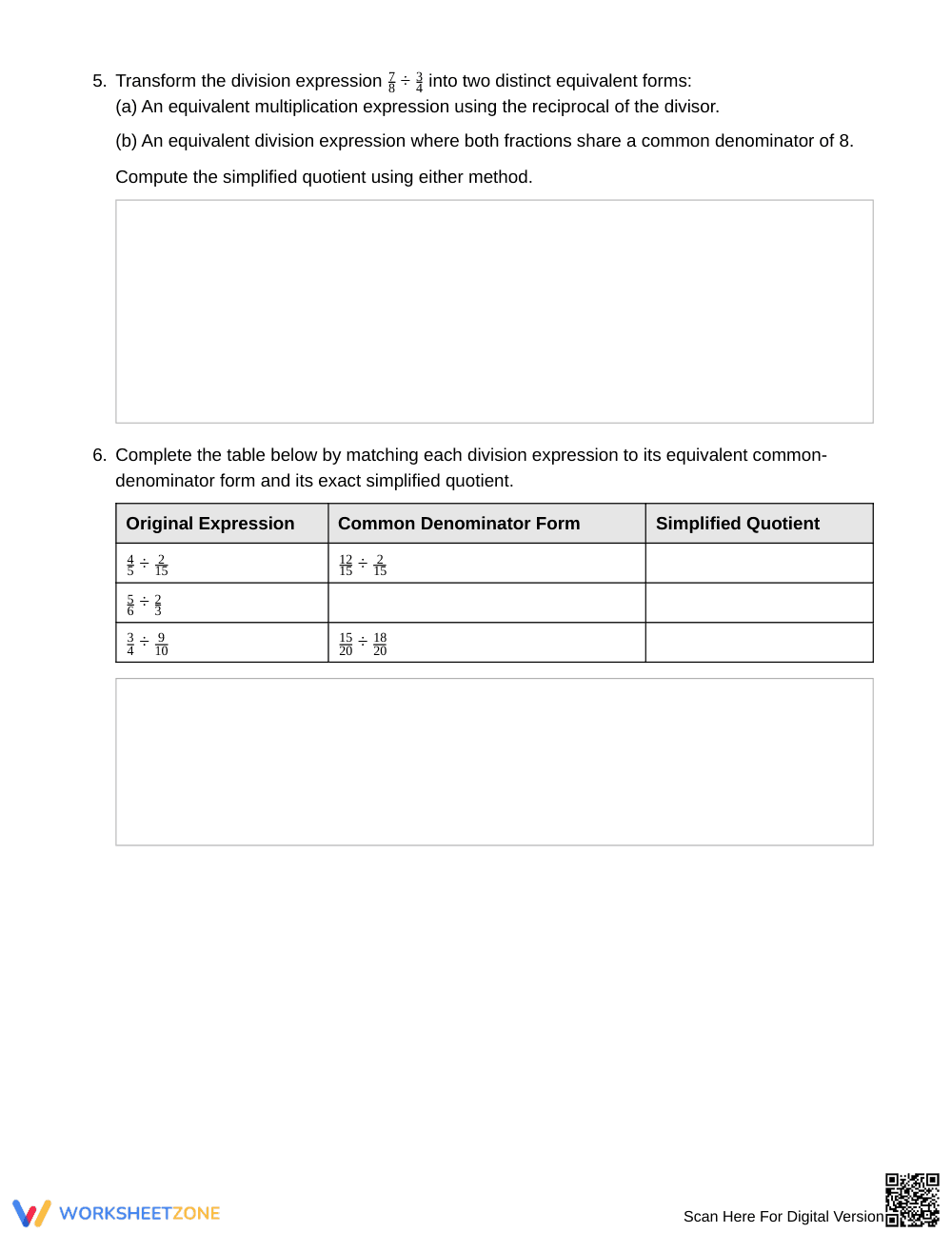
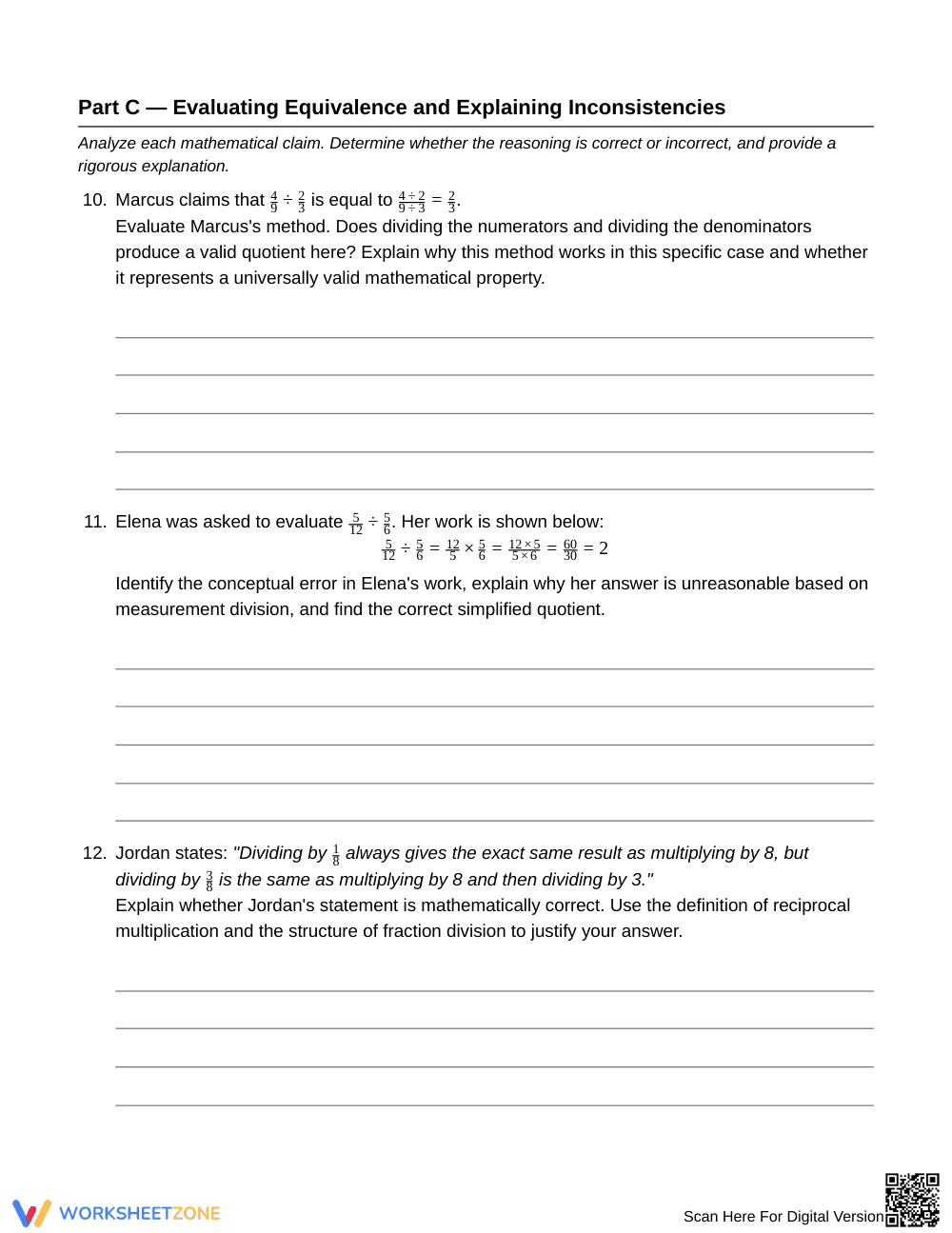
The 5-page printable activity features 12 multi-tiered tasks beginning with a foundational reference box defining measurement division, reciprocal multiplication, and common-denominator division rules. Students work through tape diagrams, matching tables, inequality comparisons, and non-routine error analyses. A complete 3-page answer key provides step-by-step solutions and conceptual explanations for every prompt.
Skill Progression
- Guided practice: Part A (3 problems) reinforces visual tape diagrams and measurement interpretations with targeted prompts connecting word contexts to division expressions.
- Supported practice: Part B (6 problems) challenges learners to transform expressions into common-denominator and reciprocal forms, fill comparison tables, and test inequalities.
- Independent practice: Part C (3 problems) requires critical evaluation of peer methods, conceptual error diagnosis, and written justification of division properties.
This structured progression follows the gradual release of responsibility model, ensuring students master fraction mechanics before analyzing abstract algebraic proofs.
Standards Alignment
This resource aligns directly with standard `6.NS.A.1`: Interpret and compute quotients of fractions, and solve word problems involving division of fractions by fractions by using visual fraction models and equations to represent the problem. It supports conceptual connections between multiplication reciprocals and equal-group division. Both standard codes can be copied directly into lesson plans, IEP goals, or district curriculum mapping tools.
How to Use It
Deploy this worksheet after direct instruction on reciprocal multiplication to solidify conceptual links between models and algorithms. Use Part A and Part B during small-group collaborative practice where students verify equivalences together. Use Part C as an exit ticket or formative assessment checkpoint; monitor student explanations to catch reciprocal errors before summative testing. Expect completion within 30 to 45 minutes.
Who It's For
Designed for Grade 6 general education math students, this resource also provides targeted intervention for Grade 7 learners needing fraction remediation and enrichment for advanced Grade 5 students. Pair this worksheet alongside a fraction bar anchor chart or physical fraction tiles during guided math rotations to support visual and kinesthetic learners.
According to research by Fisher & Frey (2014) on effective scaffolded instruction, students demonstrate significantly higher retention and conceptual mastery when procedural math tasks are paired with structured verbal and written justifications. Standard 6.NS.A.1 demands that sixth-grade students move beyond rote algorithmic execution of "invert and multiply" to deeply understand fraction division through visual measurement models, reciprocal relationships, and common denominators. Comparing equivalent quotient expressions allows learners to recognize underlying structural patterns in rational number arithmetic, preventing common procedural misconceptions. By integrating guided visual interpretation, algebraic transformation, and error analysis, this 12-problem worksheet equips middle school educators with an evidence-based resource that bridges concrete representations and abstract mathematical reasoning. The comprehensive structure reinforces both procedural fluency and rigorous mathematical discourse, supporting diverse learners across varying stages of instructional readiness and sustained academic growth in Grade 6 mathematics.


