




























Views
Downloads


Complete Early Universe Word Search | Grade 6 Science

Paste this activity's link or code into your existing LMS (Google Classroom, Canvas, Teams, Schoology, Moodle, etc.).
Students can open and work on the activity right away, with no student login required.
You'll still be able to track student progress and results from your teacher account.
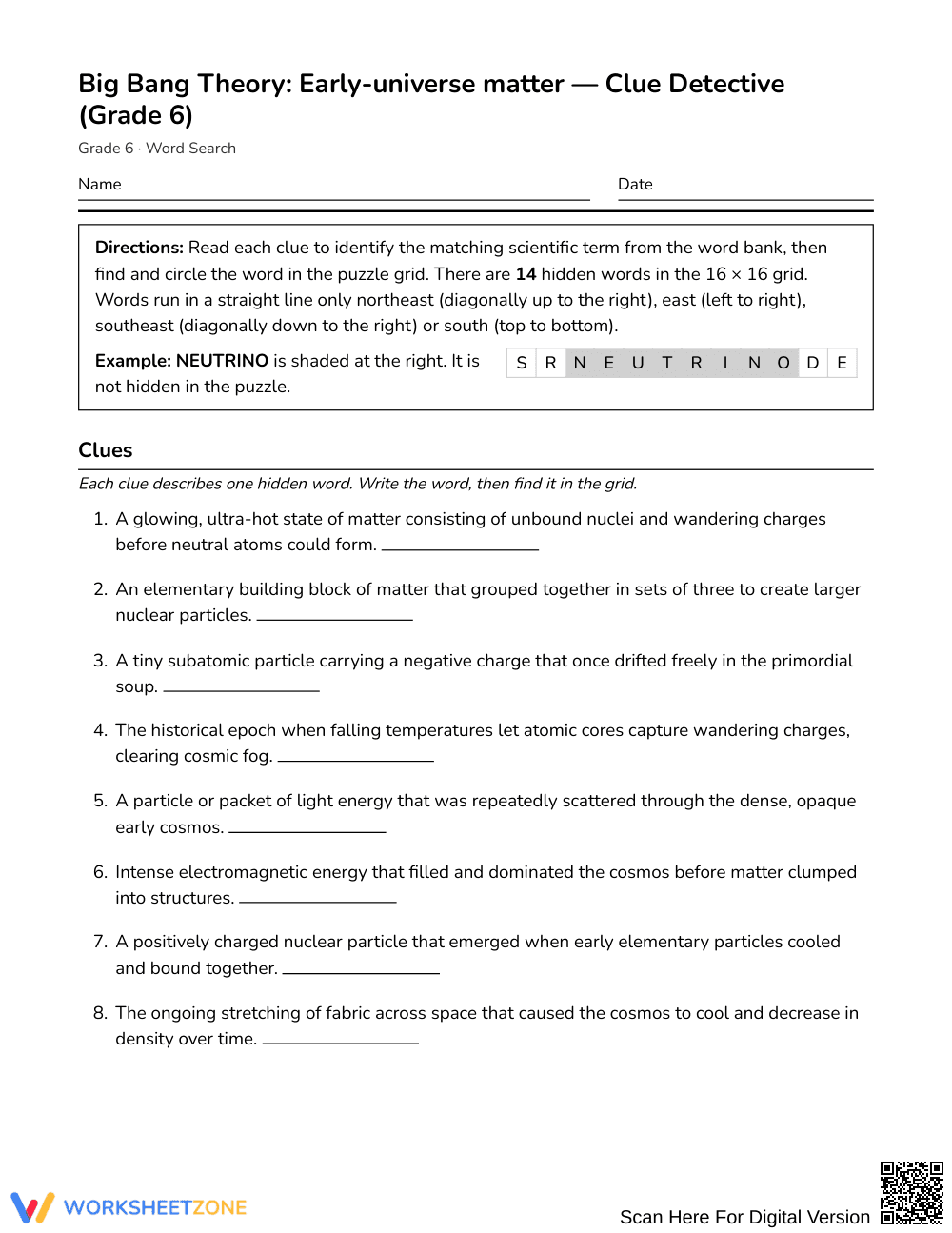
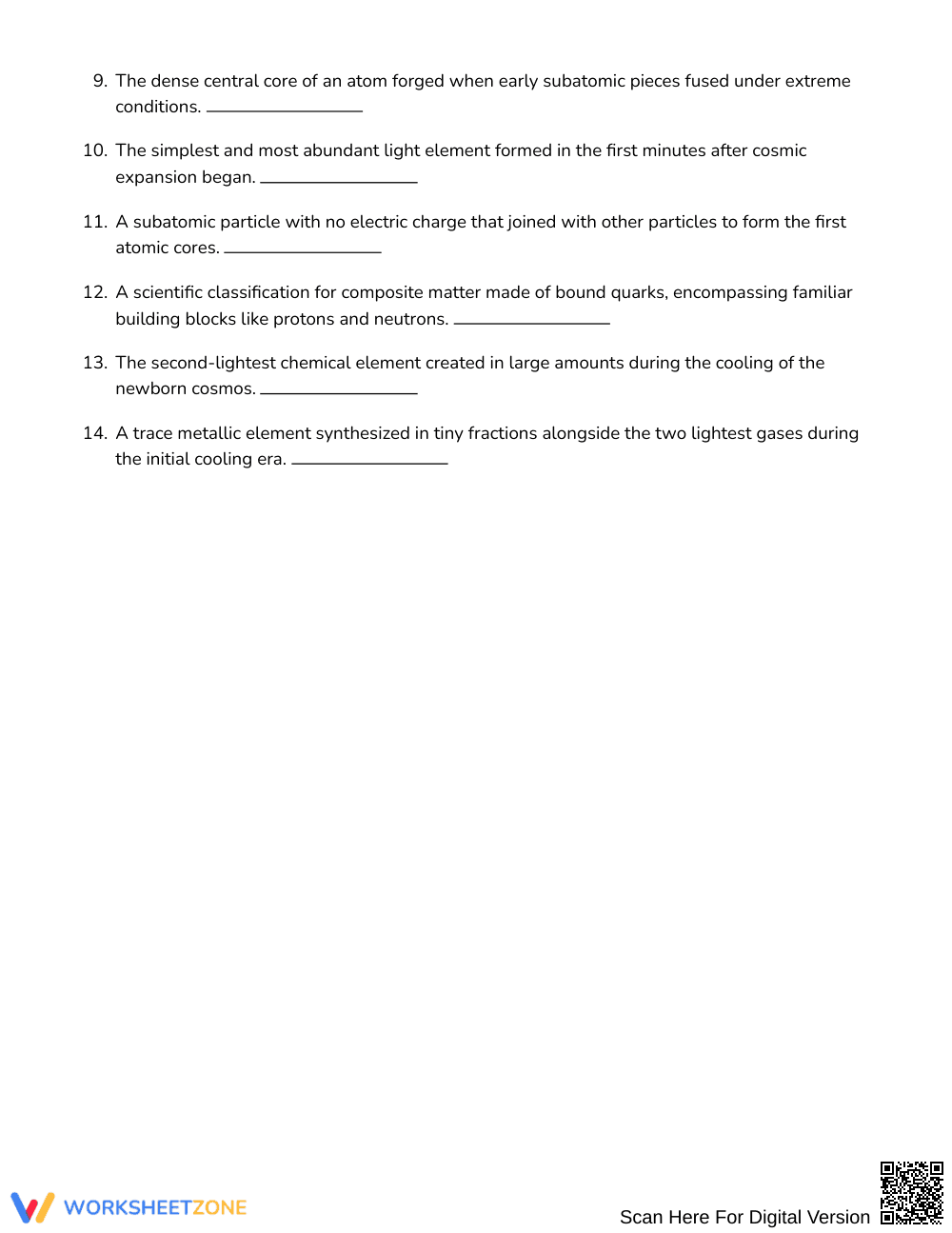
This astronomy word search strengthens Grade 6 science literacy by challenging students to identify and locate 14 key vocabulary terms related to early-universe matter. Students read rigorous astronomical clues to match concepts like quarks, plasma, and cosmic expansion before finding each term, reinforcing core physical science terminology through active recall and contextual puzzle solving.
At a Glance
- Grade: Grade 6 · Subject: Science
- Standard: Not standards-assessed — vocabulary enrichment
- Skill Focus: Early-universe matter
- Format: 3 pages · 14 words · Answer key included · PDF
- Best For: Vocabulary review and science warm-ups
- Time: 20–30 minutes
Inside this 3-page printable science resource, students receive a comprehensive puzzle featuring 14 vocabulary words paired with scientific definitions. Rather than simply copying words, learners read contextual clues describing cosmic history to deduce each target term from a shuffled word bank. A complete 3-page answer key provides clear visual coordinates and highlighted placements for rapid checking.
Puzzle Structure & Mechanics
Designed for focused cognitive engagement, this word search avoids passive searching through purposeful design:
- Grid Dimensions: A balanced 16 × 16 letter grid offers appropriate density for middle school learners without visual clutter.
- Search Directions: Target terms run in four distinct directions—northeast, east, southeast, and south—encouraging systematic visual scanning.
- Clue Detective Format: Students match rich astronomical descriptions to shuffled word bank entries before searching, cementing conceptual definitions.
Standards Alignment
This resource serves as targeted vocabulary enrichment and is not aligned to an assessed state standard. It reinforces essential conceptual domain language supporting middle school cosmology and physical science units by familiarizing students with fundamental subatomic particles, light elements, and early cosmic expansion processes prior to formal assessment.
How to Use It
Deploy this activity after direct instruction on the Big Bang theory as an engaging post-lesson review, or assign it before a unit test to consolidate scientific terms. During independent work, circulate to observe which clues prompt hesitation, pinpointing terms like recombination or baryon that require reteaching. Most students complete the activity within 20 to 30 minutes.
Who It's For
This activity is designed for Grade 6 science classrooms exploring space science and astronomy. It offers accessible entry points for diverse learners, providing word bank support for emerging readers while challenging advanced students with rigorous physics definitions. Pair this puzzle with an introductory reading passage on cosmic timeline milestones or an anchor chart displaying early-universe states of matter.
Academic vocabulary acquisition in middle school science requires repeated exposure to specialized terminology embedded in meaningful context. According to Fisher & Frey (2014), intentional word-learning tasks that require students to manipulate definitions and connect academic language to conceptual frameworks accelerate domain comprehension and reading fluency across content areas. This 14-word puzzle activity reinforces foundational early-universe matter concepts—such as subatomic building blocks, primordial light elements, and radiation decoupling—by shifting students from passive letter spotting to active, clue-driven recall. By requiring learners to analyze 14 rigorous descriptive prompts before scanning the 16 by 16 letter grid, the resource bridges general literacy skills with rigorous astronomical content. Integrating structured vocabulary puzzles into regular science routines provides learners with the low-stakes cognitive practice needed to internalize complex physical science terms, supporting long-term retention across multi-week earth and space science instructional units.


