




























Views
Downloads


Complete DNA Structure Worksheet | Grades 8-12 Science

Paste this activity's link or code into your existing LMS (Google Classroom, Canvas, Teams, Schoology, Moodle, etc.).
Students can open and work on the activity right away, with no student login required.
You'll still be able to track student progress and results from your teacher account.
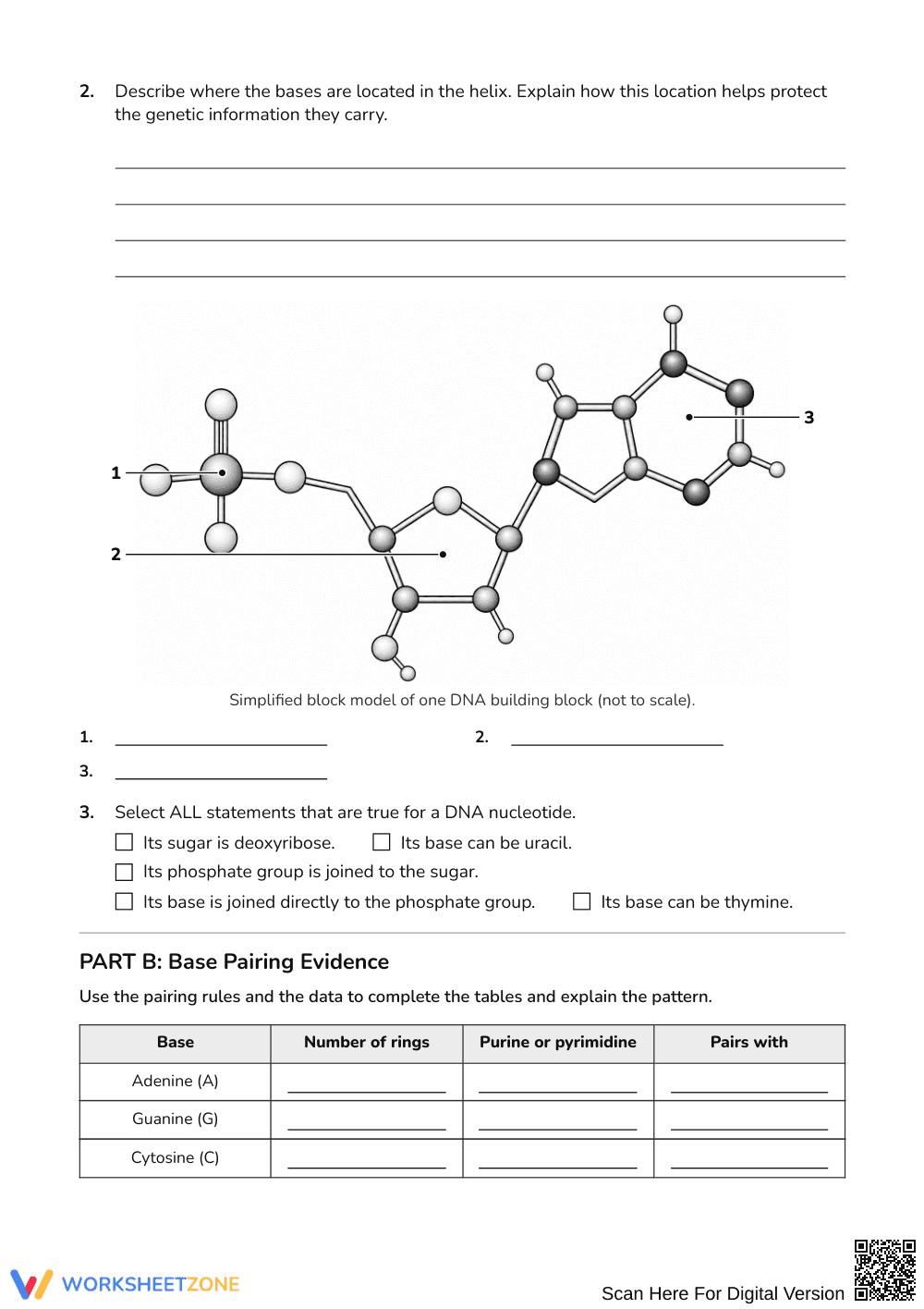
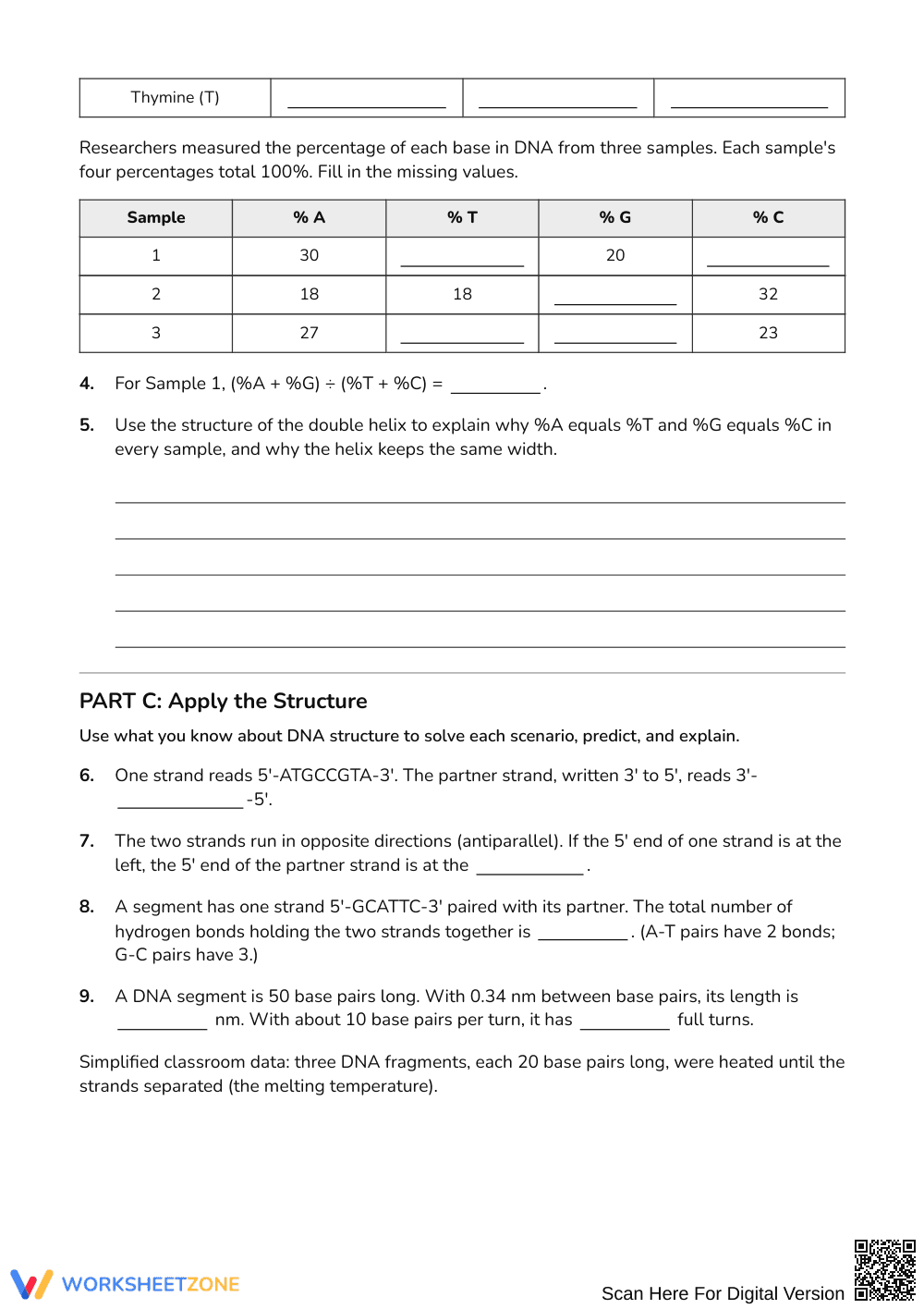
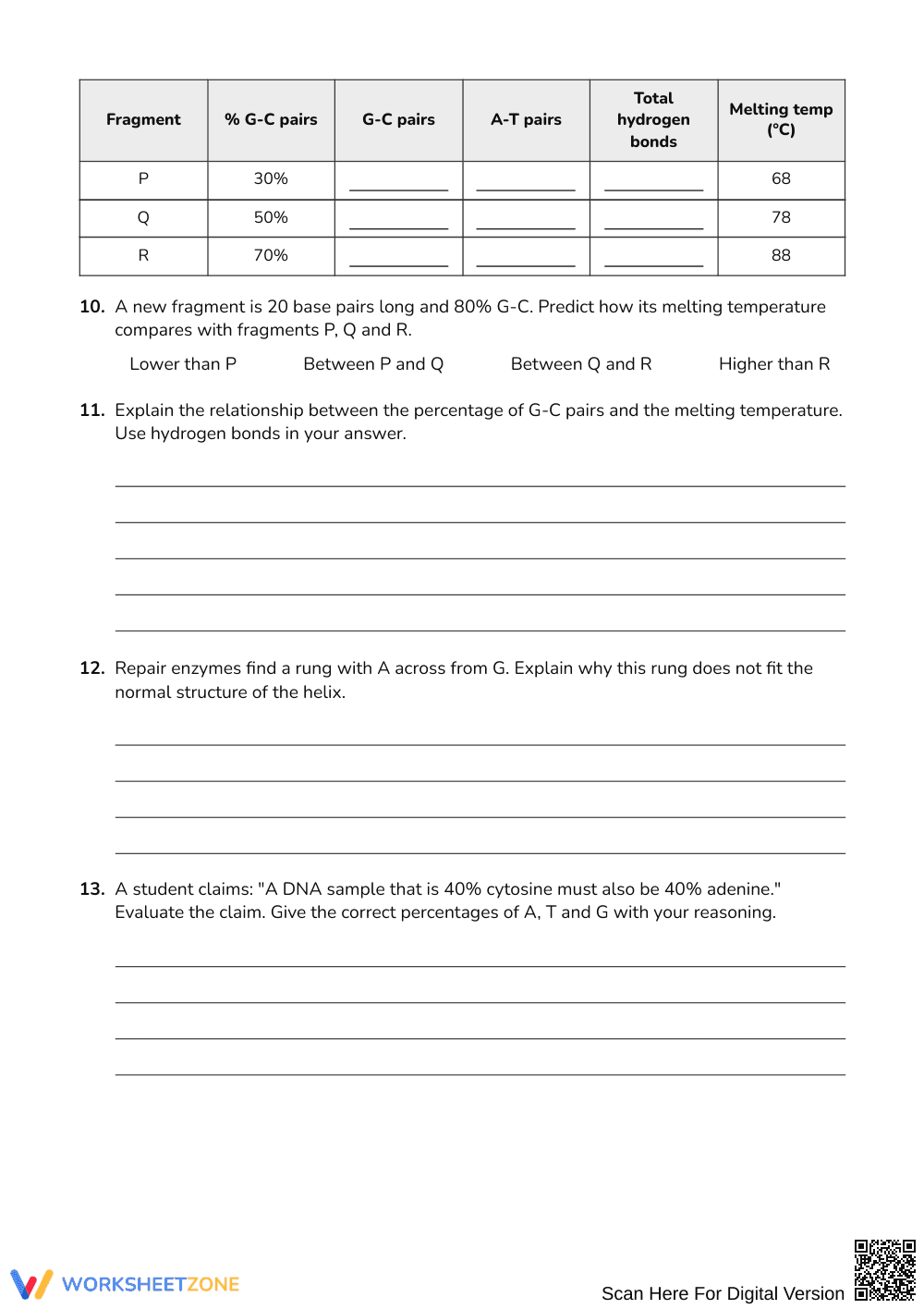
This DNA structure worksheet builds biological understanding by guiding students through structural models, Chargaff's base pairing data, and biophysical predictions. Learners progress systematically from identifying nucleotide anatomy to calculating hydrogen bonds and explaining thermal melting stability in nucleic acids.
At a Glance
- Grade: Grades 8–12 · Subject: Science
- Standard: Model DNA structure and explain how complementary base pairing preserves genetic information
- Skill Focus: DNA molecular structure and base pairing
- Format: 4 pages · 48 problems · Answer key included · PDF
- Best For: High school biology practice
- Time: 45–60 minutes
Inside, students find 4 pages featuring 48 targeted tasks across three scaffolded sections. The resource includes labeled double helix diagrams, a nucleotide block model, data tables detailing Chargaff's base ratios, and quantitative heating curves. A complete 4-page answer key provides explanations, calculation steps, and molecular reasoning.
Skill Progression
- Guided practice (Part A): Students examine diagrams to label backbone components, nitrogenous bases, and grooves, followed by checks on nucleotide anatomy.
- Supported practice (Part B): Learners complete comparative purine-pyrimidine tables and analyze base composition data across three distinct DNA samples.
- Independent practice (Part C): Students solve scenarios requiring antiparallel strand generation, hydrogen bond counts, and melting temperature predictions.
This sequence follows an intentional gradual-release model, shifting learners from visual recall to high-level scientific explanation.
Curriculum Alignment
This worksheet supports secondary biology standards requiring students to model the structural components of DNA and explain how complementary base pairing preserves genetic information. By connecting chemical bonding to physical stability, the tasks reinforce high school life science core ideas regarding inheritance and molecular organization. Educators can integrate these objectives directly into standard biology lesson plans or curriculum maps.
How to Use It
Use this resource after introducing nucleic acid biochemistry, or deploy it as an intensive review prior to genetics assessments. During completion, conduct formative checks by observing whether students correctly apply the 3:2 hydrogen bond ratio when comparing GC and AT melting dynamics. Expected completion time is 45 to 60 minutes.
Who It's For
This worksheet supports general biology students, Advanced Placement Biology candidates, and learners needing structured molecular genetics reinforcement. Struggling students benefit from visual models, while advanced learners explore biophysical thermal denaturation. Pair this activity with a physical nucleotide modeling kit or an introductory double helix lesson.
Secondary science classrooms frequently encounter student misconceptions regarding nucleic acid stability, where learners conflate strong covalent backbone bonds with weaker inter-strand hydrogen bonds. According to Fisher & Frey (2014), structured instructional progressions that bridge visual identification, mathematical data analysis, and predictive scientific explanation significantly enhance conceptual retention in complex science disciplines. This 48-task resource operationalizes that architecture across 4 scaffolded pages, moving students from basic nucleotide labeling to quantitative evaluations of base pairing percentages and DNA strand denaturation temperatures. The included 4-page answer key clarifies reasoning behind antiparallel strand orientation, purine-pyrimidine ring geometry, and hydrogen bond thermodynamics. Integrating these targeted analytic exercises into molecular genetics units equips secondary students to master complex biological modeling, eliminate persistent structural misunderstandings, and build durable scientific mastery necessary for advanced life science coursework across high school biology curricula.


