


























Views
Downloads

Complete DNA Strand Synthesis Worksheet | Grade 10 Biology
Paste this activity's link or code into your existing LMS (Google Classroom, Canvas, Teams, Schoology, Moodle, etc.).
Students can open and work on the activity right away, with no student login required.
You'll still be able to track student progress and results from your teacher account.
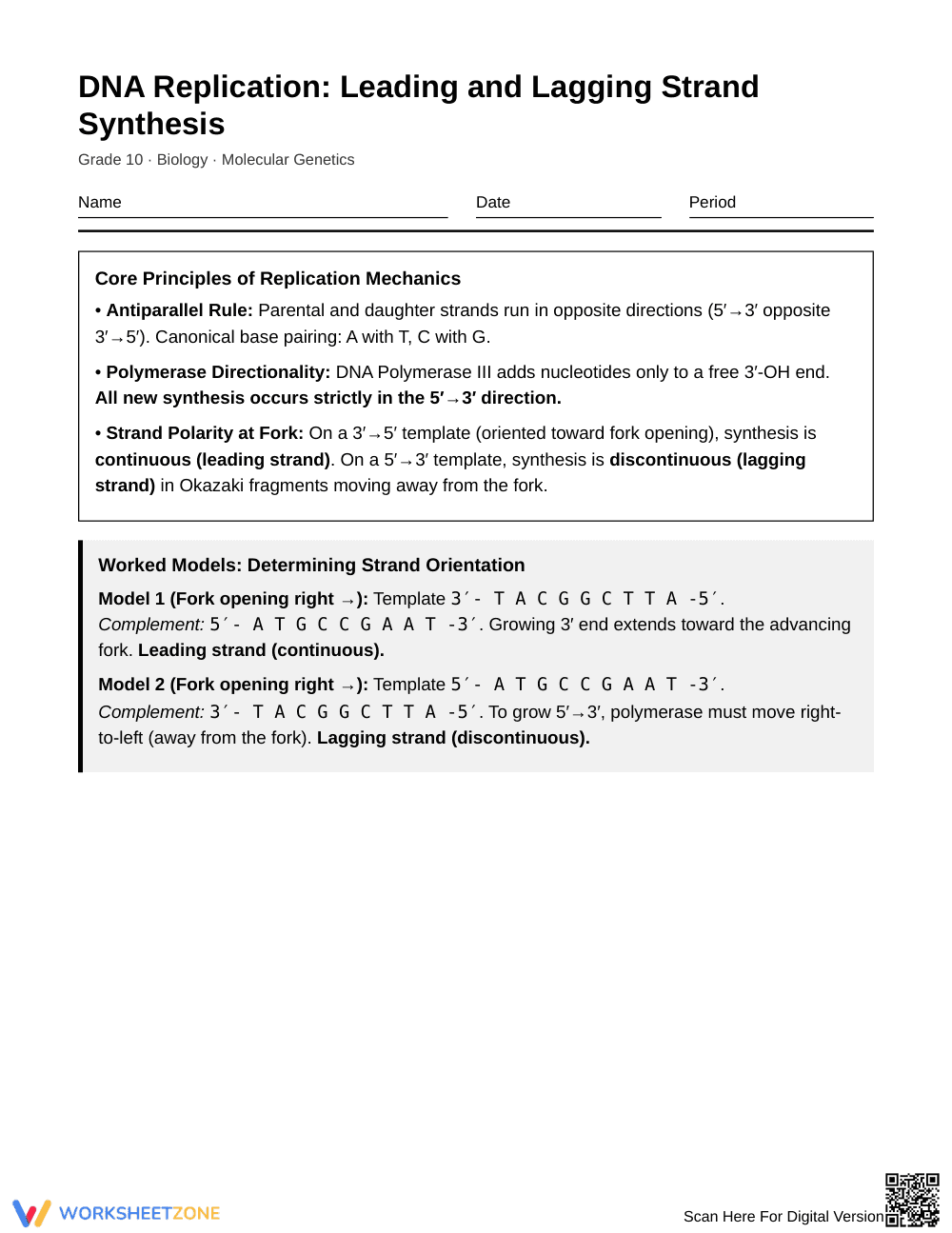
Mastering molecular genetics requires high school biology students to navigate directional enzymes and antiparallel DNA templates. This comprehensive worksheet provides structured practice tracing leading and lagging strand synthesis at the replication fork. Students determine 5′-to-3′ polarity, analyze Okazaki fragment ligation, and explain enzymatic constraints to build durable conceptual mastery of DNA replication mechanics.
At a Glance
- Grade: 10 · Subject: Biology
- Standard: Molecular Genetics — Model DNA structure, replication directionality, and leading versus lagging synthesis mechanics
- Skill Focus: Trace Leading and Lagging Strand Synthesis
- Format: 5 pages · 10 problems · Answer key included · PDF
- Best For: Guided practice after direct instruction
- Time: 40–50 minutes
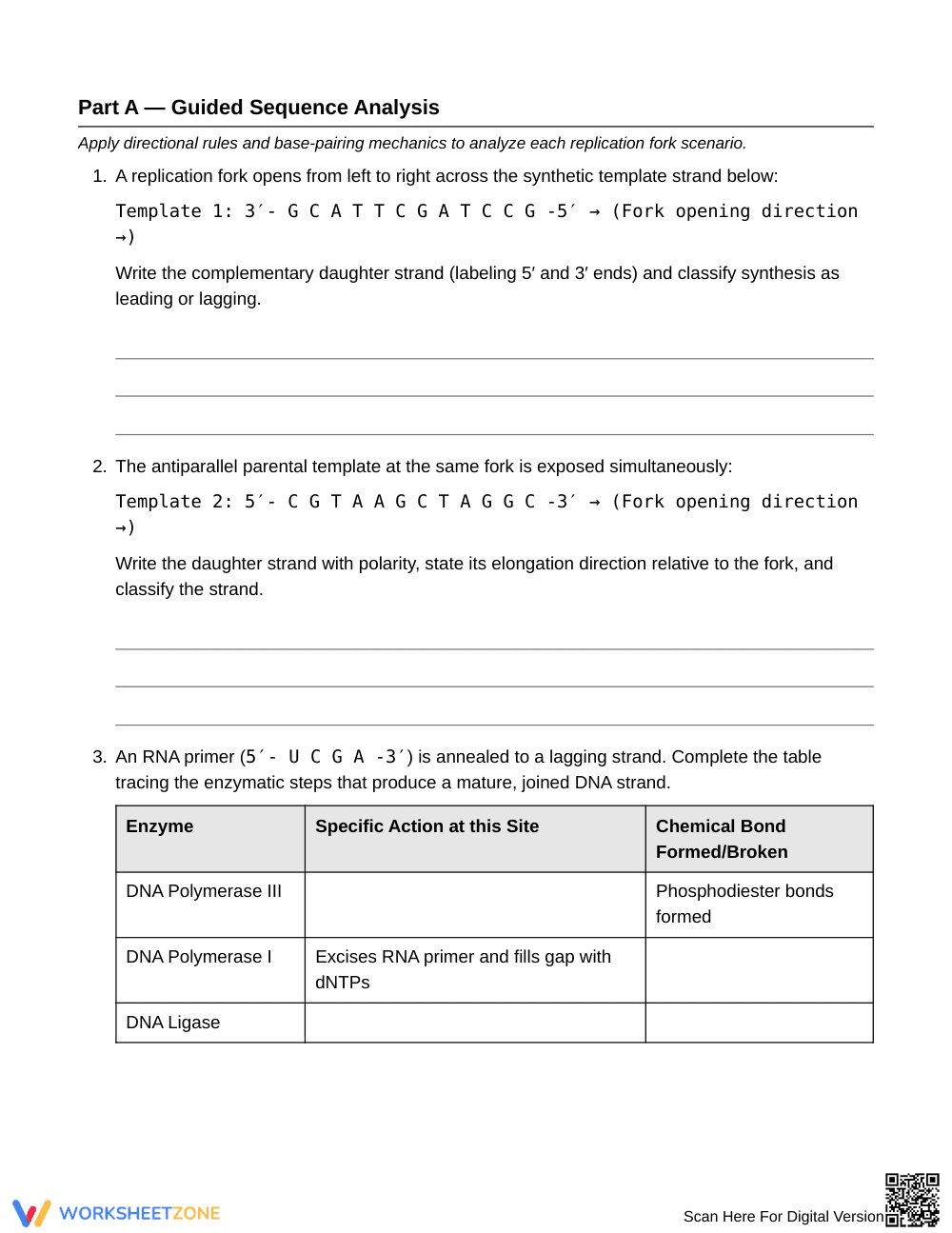
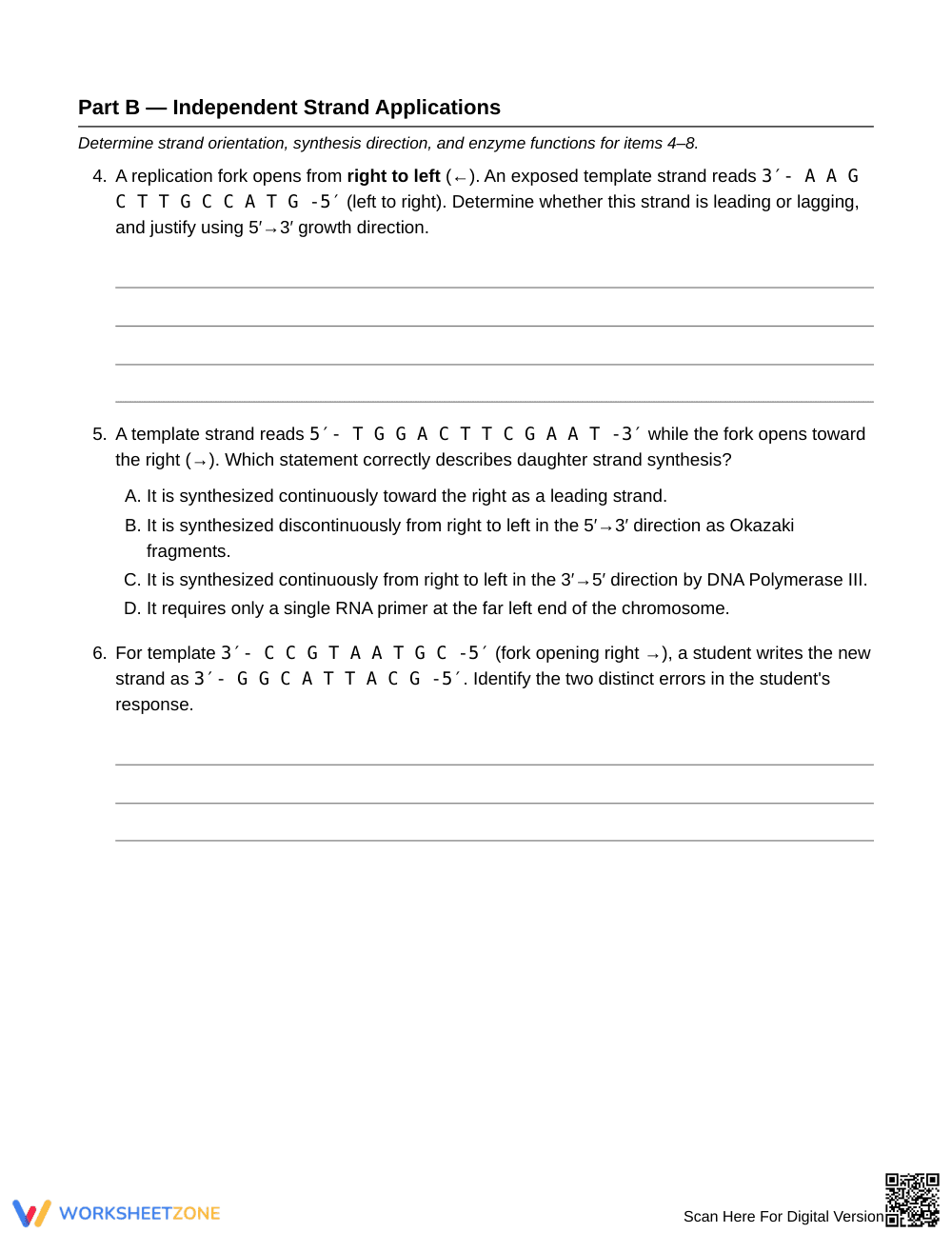
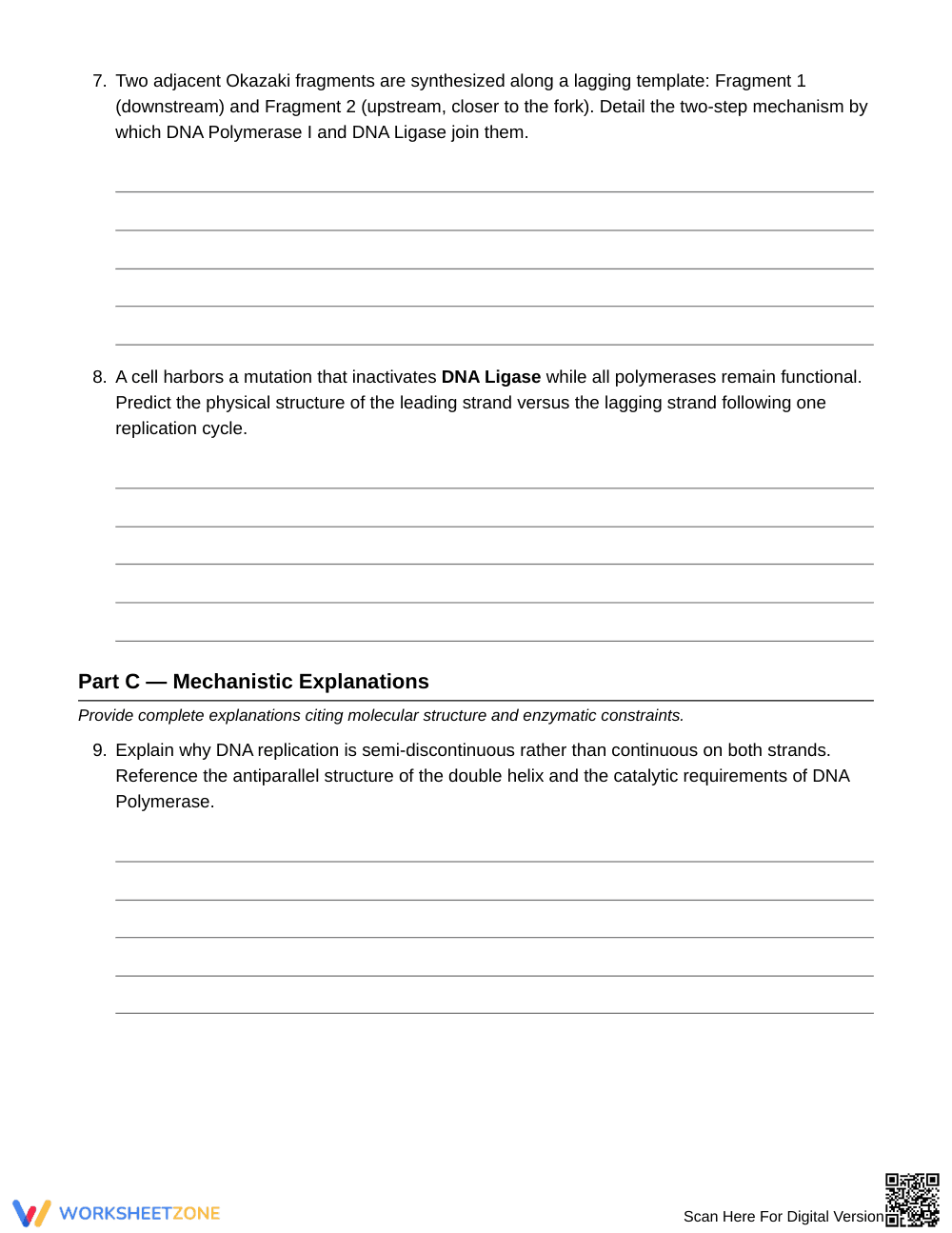
This 5-page instructional resource includes a concise core principles reference box with worked models, a sequence analysis table, multiple-choice discrimination items, error analysis, and free-response mechanistic explanations. A thorough 3-page answer key provides step-by-step solutions, strand polarity diagrams, and model written justifications for every task.
Skill Progression
- Guided practice (Tasks 1–3): Students review worked models and use directional rules to determine complementary strand polarity and complete an enzymatic step table for primer excision.
- Supported practice (Tasks 4–6): Learners independently identify fork directions, evaluate multiple-choice scenarios involving Okazaki fragments, and perform targeted error analysis on student work.
- Independent practice (Tasks 7–10): Students synthesize complex mechanics, predicting structural outcomes of ligase mutations and writing extended explanations of semi-discontinuous replication constraints.
This structured scaffolding embodies the gradual release of responsibility model, ensuring students master strand polarity before tackling multi-step conceptual explanations.
Standards Alignment
This resource aligns with high school molecular biology standards addressing the structure and replication of DNA, specifically focusing on how enzyme specificity and template antiparallelism dictate continuous and discontinuous synthesis. This standard description can be copied directly into lesson plans, IEP goals, or district curriculum mapping tools.
How to Use It
Deploy this worksheet immediately after direct instruction on DNA replication enzymes (helicase, primase, DNA polymerase III, DNA polymerase I, and ligase). Use Part A as collaborative partner practice where you formatively check whether students correctly orient the 3′-OH end toward or away from the opening fork. Assign Parts B and C as independent formative assessment to be completed within 40 to 50 minutes.
Who It's For
This worksheet is designed for Grade 10 general biology and honors biology students studying molecular genetics. Teachers can support struggling learners with the included worked models and antiparallel reference rules while challenging advanced students with the mutation prediction prompts. Pair this activity directly with a physical nucleotide modeling kit or an animated replication fork visualizer.
High school biology instruction in molecular genetics often falters when students encounter directional polarity during DNA replication. By prompting learners to trace leading and lagging strand synthesis across 10 targeted tasks, this resource reinforces how antiparallel templates dictate discontinuous Okazaki fragment assembly. According to Fisher & Frey (2014), structured instructional scaffolds that transition from worked sequence models to independent mechanistic problem-solving significantly enhance conceptual retention and analytical reasoning in secondary science education. Students systematically apply 5′-to-3′ catalytic rules, identify replication fork directionality, and justify enzyme functions including DNA Polymerase I and DNA Ligase. This rigorous progression ensures students move beyond rote memorization of enzyme names to deeply understand the structural constraints governing semi-discontinuous replication in living cells.


