


























Views
Downloads



Complete DNA Strand Direction Worksheet | Grade 10 Biology
Paste this activity's link or code into your existing LMS (Google Classroom, Canvas, Teams, Schoology, Moodle, etc.).
Students can open and work on the activity right away, with no student login required.
You'll still be able to track student progress and results from your teacher account.
This Grade 10 biology worksheet equips students to master DNA replication mechanics, emphasizing semiconservative copying and antiparallel strand direction. Through targeted sequence analysis and mechanistic prompts, high school learners determine enzymatic orientation, predict replication fork dynamics, and calculate complementary base percentages across leading and lagging strands.
At a Glance
- Grade: 10 · Subject: Biology
- Standard: High School Biology Standards — Model semiconservative DNA replication and determine antiparallel strand directionality
- Skill Focus: Semiconservative Copying and Strand Direction
- Format: 5 pages · 12 problems · Answer key included · PDF
- Best For: Guided practice and formative assessment
- Time: 45–60 minutes
What's Inside
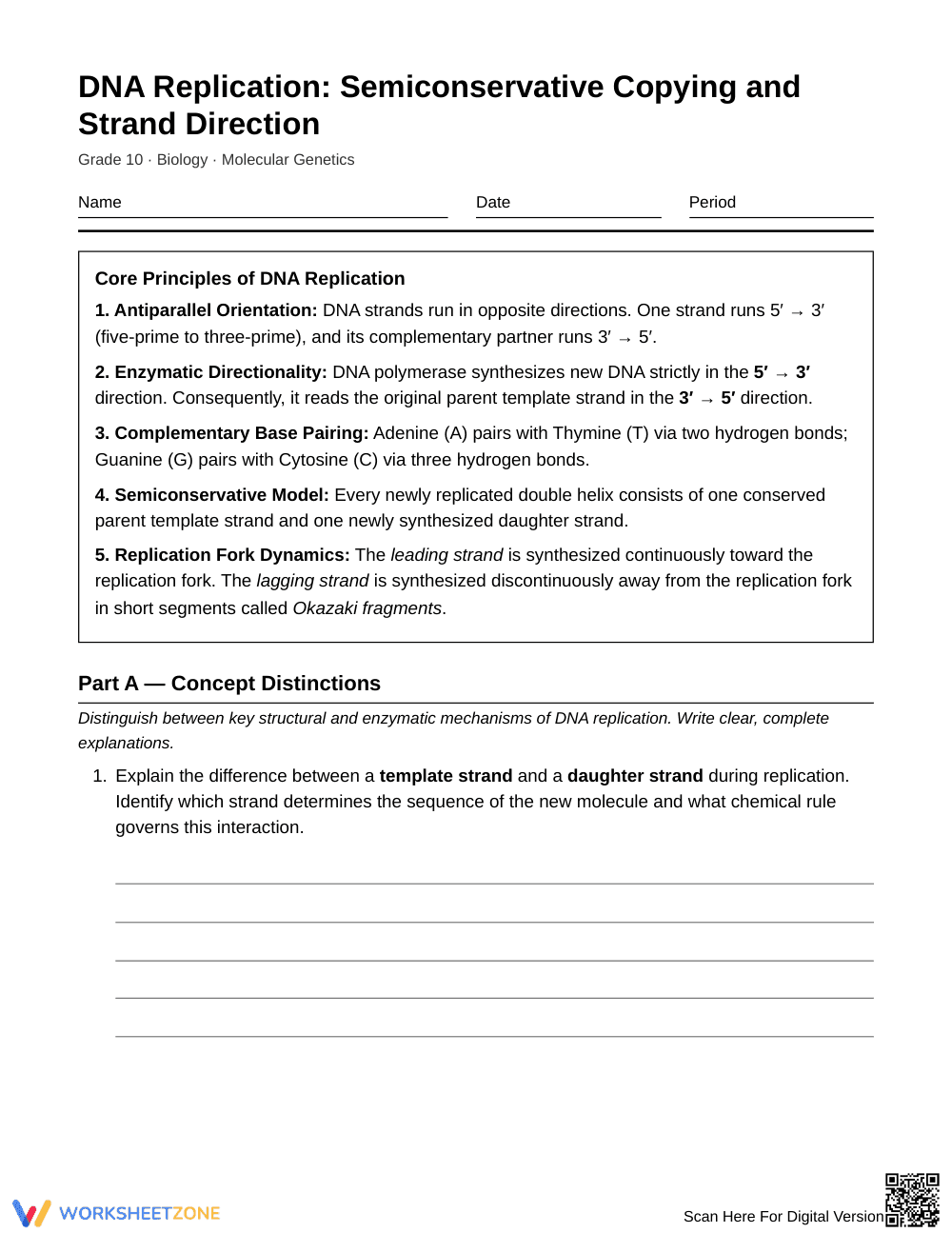
This five-page resource features twelve rigorous student problems supported by a five-point reference box summarizing core replication principles: antiparallel orientation, 5′ to 3′ enzymatic directionality, and fork dynamics. The assignment includes written concept distinctions, sequence determinations, and experimental data predictions. A comprehensive three-page answer key provides complete rationales and calculations.
Skill Progression
- Guided practice (Part A, 4 tasks): Students define foundational mechanisms using reference scaffolds, distinguishing template from daughter strands, contrasting leading versus lagging strands, and comparing conservative and semiconservative models.
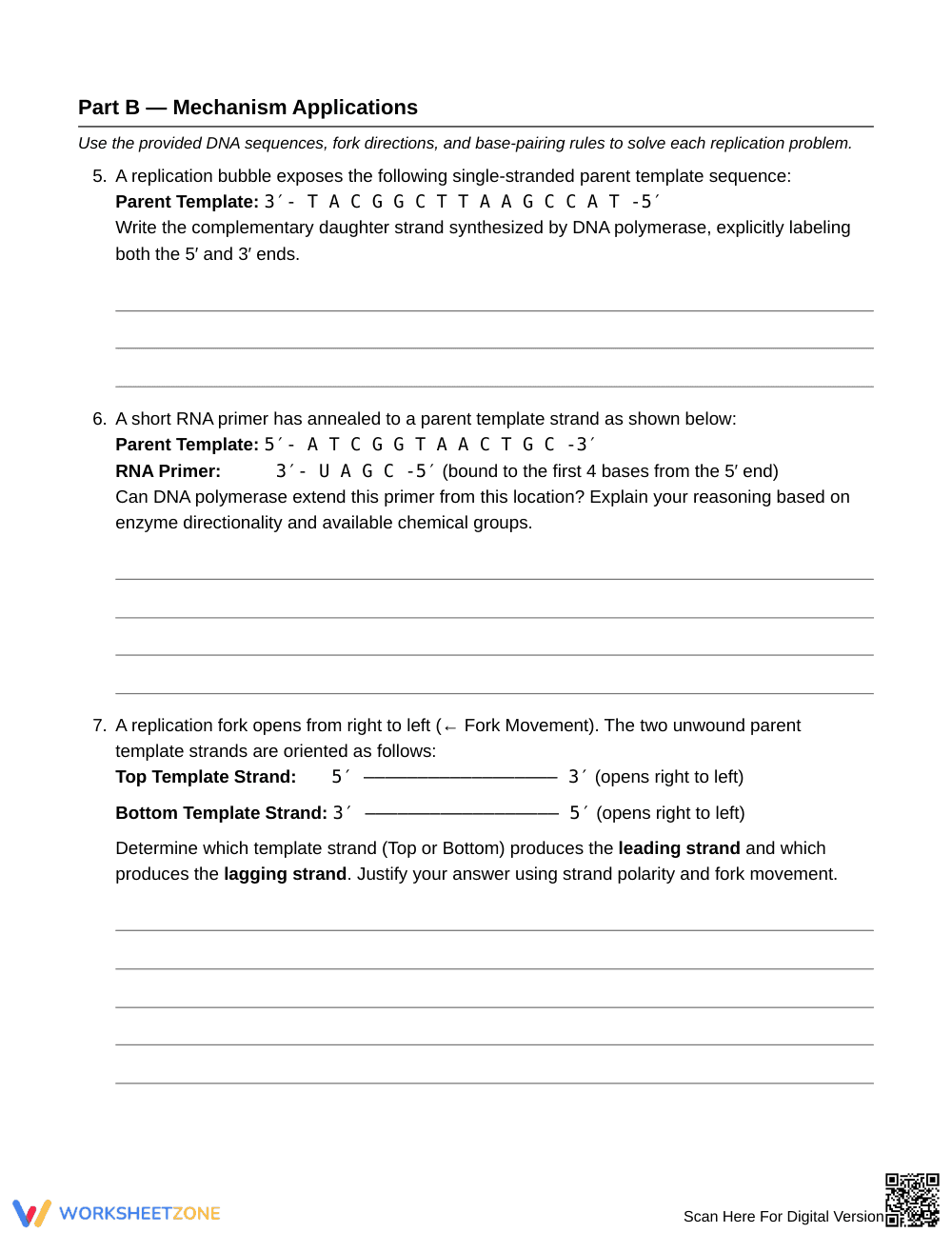
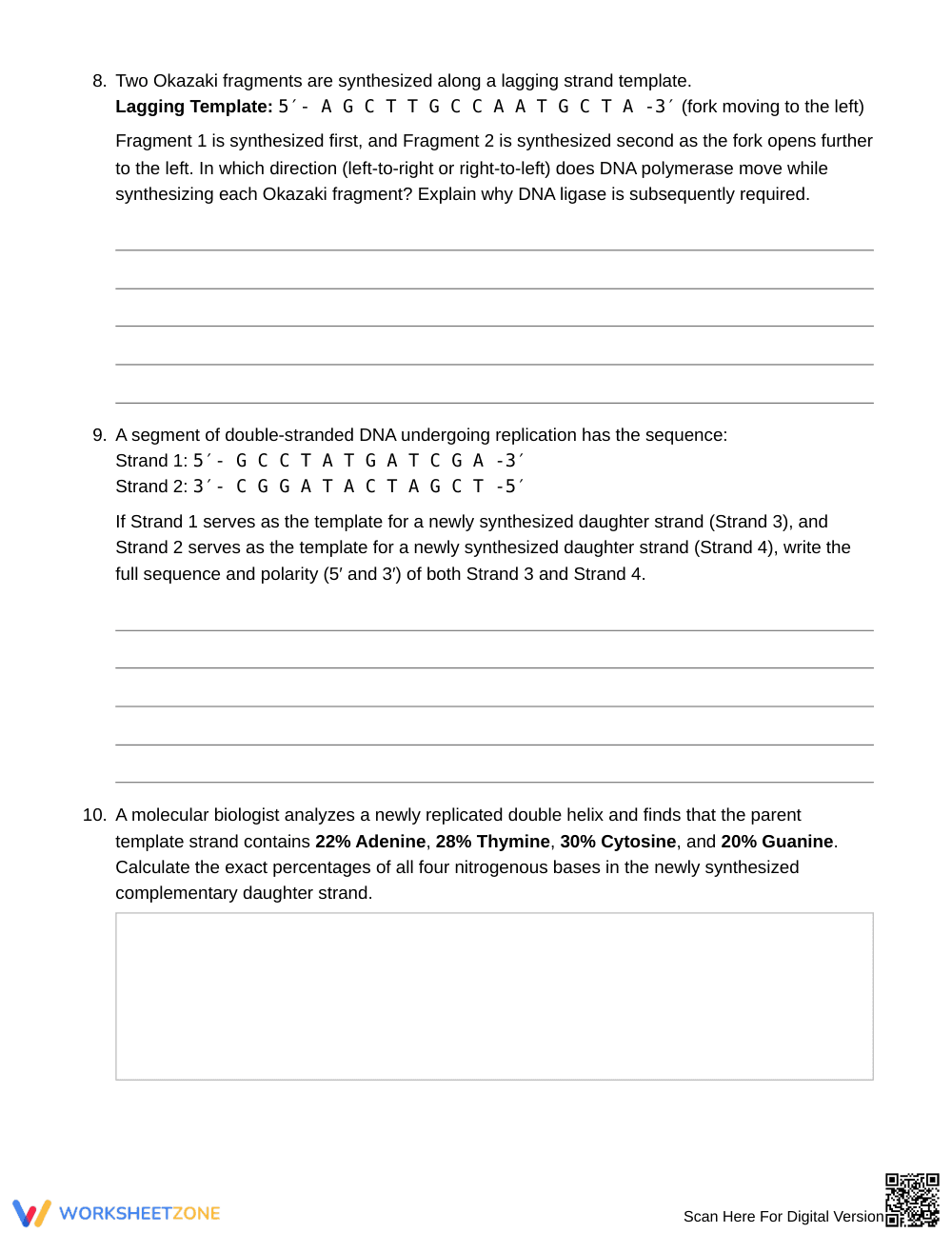
- Supported practice (Part B, 6 tasks): Learners apply chemical rules to concrete DNA sequences, determining primer extension feasibility, labeling daughter strand polarities, and calculating complementary base ratios.
- Independent practice (Part C, 2 tasks): Students evaluate multi-step experimental scenarios without scaffolds, predicting isotope densities in Meselson-Stahl bacterial cultures and analyzing enzyme inhibition phenotypes.
This sequence follows a gradual-release model, moving students from conceptual recall to complex experimental synthesis.
Standards Alignment
This resource aligns with high school biology molecular genetics standards requiring students to construct explanations for how DNA sequences replicate faithfully via semiconservative copying and complementary base pairing. Both standard codes can be copied directly into lesson plans, IEP goals, or district curriculum mapping tools.
How to Use It
Implement this worksheet immediately following direct instruction on DNA replication enzymes and fork movement. It functions effectively as a collaborative workshop where student pairs verify 5′ and 3′ polarities, or as an independent post-lab assessment. Formatively monitor whether students incorrectly synthesize strands in the 3′ to 5′ direction during Part B sequence tasks. Expected completion time is 45 to 60 minutes.
Who It's For
This worksheet serves Grade 10 biology students, honors biology cohorts, and introductory AP Biology learners studying molecular genetics. For differentiated support, encourage struggling students to color-code 5′ and 3′ carbon positions before drawing daughter strands. Pair this print-and-go worksheet directly with a physical molecular model kit or replication fork diagram.
Research synthesized by Fisher & Frey (2014) demonstrates that biology students achieve greater conceptual retention when instructional materials structure problem-solving through a gradual-release framework. This Grade 10 DNA replication worksheet targets semiconservative copying and strand directionality through 12 structured tasks that advance from foundational concept distinction to unprompted experimental prediction. By requiring students to determine 5′ to 3′ enzymatic synthesis orientation, predict Okazaki fragment movement along lagging templates, and analyze Meselson-Stahl isotope distribution across multiple cell divisions, the activity builds deep mechanistic comprehension. The integration of 5 reference principles scaffolds early items, enabling students to independently evaluate complex enzyme-inhibition phenotypes by the final section. Teachers utilizing this resource obtain verifiable formative assessment data regarding student mastery of replication fork polarity, leading-strand continuity, and complementary base-pairing mathematics across a focused 45-minute to 60-minute instructional block.


