


























Views
Downloads



Complete DNA Replication Models Worksheet | Grade 10 Biology
Paste this activity's link or code into your existing LMS (Google Classroom, Canvas, Teams, Schoology, Moodle, etc.).
Students can open and work on the activity right away, with no student login required.
You'll still be able to track student progress and results from your teacher account.
This Grade 10 biology worksheet equips students to evaluate empirical evidence and defend the semiconservative model of DNA replication. Students interpret isotope density centrifugation results, trace antiparallel complementary strand synthesis, and mathematically refute alternative conservative and dispersive models through rigorous scientific reasoning and data interpretation.
At a Glance
- Grade: 10 · Subject: Biology
- Standard: High School Genetics — Construct evidence-based explanations for semiconservative DNA replication
- Skill Focus: Defend Semiconservative Replication from Results
- Format: 4 pages · 8 problems · Answer key included · PDF
- Best For: Molecular genetics concept mastery
- Time: 40–50 minutes
What's Inside
This 4-page printable resource contains 8 rigorous tasks paired with a complete 2-page answer key featuring sample explanations and mathematical calculations. The worksheet opens with a core principles reference box covering isotope sedimentation and enzymatic polarity before transitioning into data identification, mechanistic explanation, and quantitative model refutation.
Skill Progression
- Guided practice (Part I, Tasks 1–2): Students analyze initial Generation 1 isotope data and radiolabeled nucleotide sequences to identify observations supporting antiparallel synthesis and refuting conservative replication.
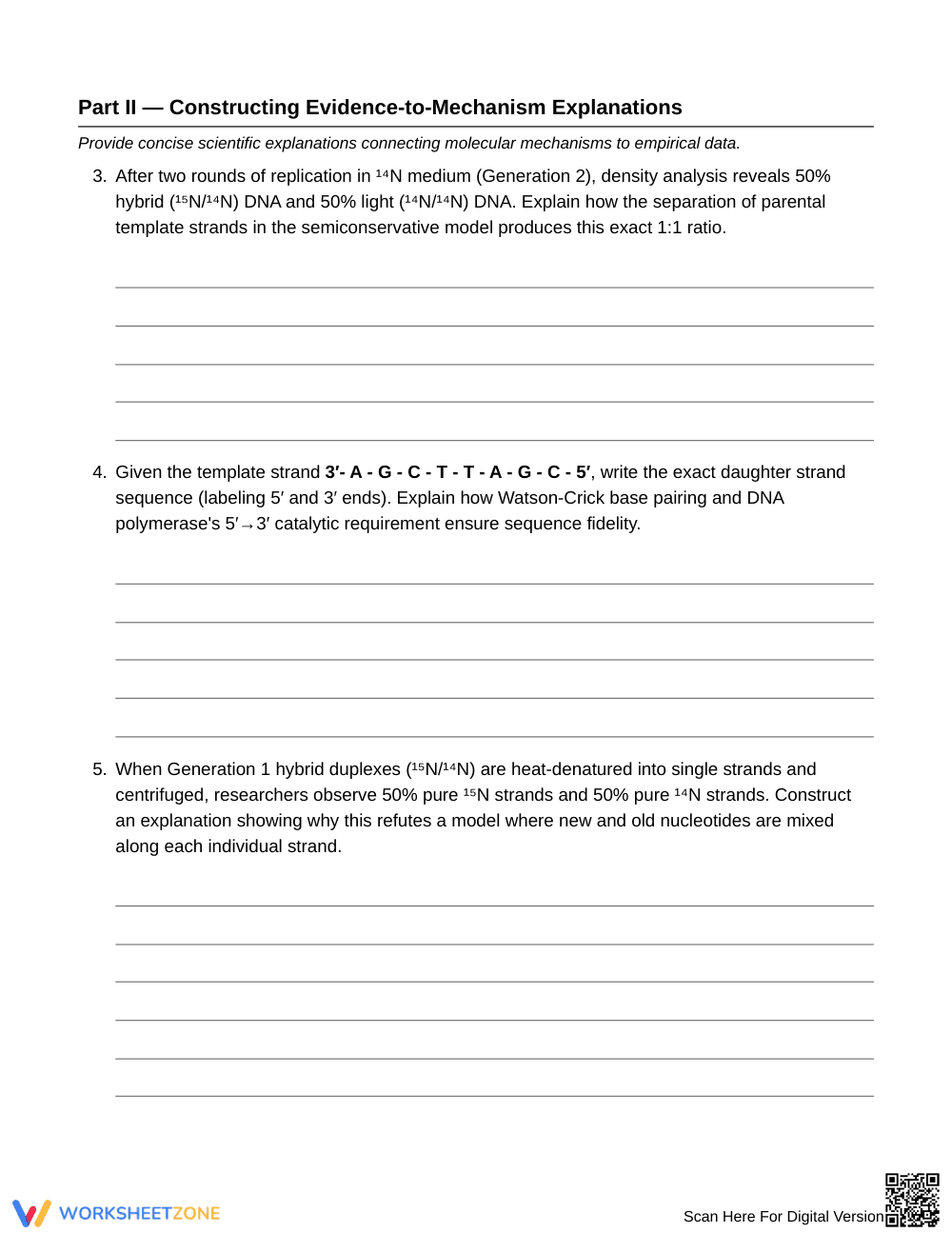
- Supported practice (Part II, Tasks 3–6): Students construct written explanations connecting 5′→3′ enzymatic mechanics, template denaturation, and replication fork directionality to observed 1:1 strand ratios.
- Independent practice (Part III, Tasks 7–8): Students calculate multi-generation duplex yields and evaluate quantitative predictions to disprove dispersive and conservative inheritance models.
This structure follows a gradual-release framework, moving learners from conceptual identification to independent mathematical refutation.
Standards Alignment
This activity aligns with high school molecular biology standards requiring students to construct explanations based on evidence for how the structure of DNA determines replication fidelity and template conservation. Supporting standards address evaluating competing scientific explanations against empirical data. Both standard concepts can be copied directly into lesson plans, IEP goals, or district curriculum mapping tools.
How to Use It
Assign this worksheet directly after direct instruction on the Meselson-Stahl experiment or as a collaborative review activity before molecular genetics assessments. During completion, monitor how students explain the intermediate-density band in Generation 1; students frequently confuse hybrid duplex formation with dispersive mixing. The full 8-task progression requires approximately 40–50 minutes of instructional time.
Who It's For
Designed for Grade 10 General Biology, Honors Biology, and introductory AP Biology students mastering molecular genetics. Struggling learners benefit from the reference box defining isotope densities, while advanced students engage with multi-generation mathematical modeling. Pair this worksheet with an interactive Meselson-Stahl centrifuge animation for optimal conceptual integration.
Defending scientific models through empirical data is a core milestone in secondary biology. When learners analyze isotope centrifugation results and calculate duplex distributions across cell divisions, they transform abstract biochemical facts into functional scientific reasoning. According to Fisher & Frey (2014), structured progression through guided identification, mechanistic explanation, and competing claim evaluation systematically builds deep disciplinary literacy and conceptual mastery. This 4-page worksheet guides Grade 10 students through 8 rigorous tasks designed to defend semiconservative replication while refuting alternative conservative and dispersive hypotheses. By connecting 5′→3′ DNA polymerase catalytic requirements to nitrogen-isotope banding patterns, students gain a durable understanding of molecular inheritance and experimental design. The integrated 2-page answer key provides complete model responses and step-by-step ratio calculations, ensuring teachers can efficiently assess evidence-based scientific argumentation and address common student misconceptions regarding hybrid DNA duplexes during molecular genetics units.


