


























Views
Downloads



Complete DNA Replication Error Worksheet | Grade 10 Biology
Paste this activity's link or code into your existing LMS (Google Classroom, Canvas, Teams, Schoology, Moodle, etc.).
Students can open and work on the activity right away, with no student login required.
You'll still be able to track student progress and results from your teacher account.
This molecular genetics worksheet guides tenth-grade biology students through the biochemical mechanisms of DNA replication errors and mutation fixation. Students track base misincorporations, model heteroduplex intermediates across consecutive replication cycles, and analyze how uncorrected replication mistakes become permanent genetic changes.
At a Glance
- Grade: 10 · Subject: Biology
- Standard: High School Life Science — Model DNA replication fidelity and error persistence
- Skill Focus: DNA replication error persistence and mutation fixation
- Format: 5 pages · 10 problems · Answer key included · PDF
- Best For: Genetics practice and guided problem-solving
- Time: 45–60 minutes
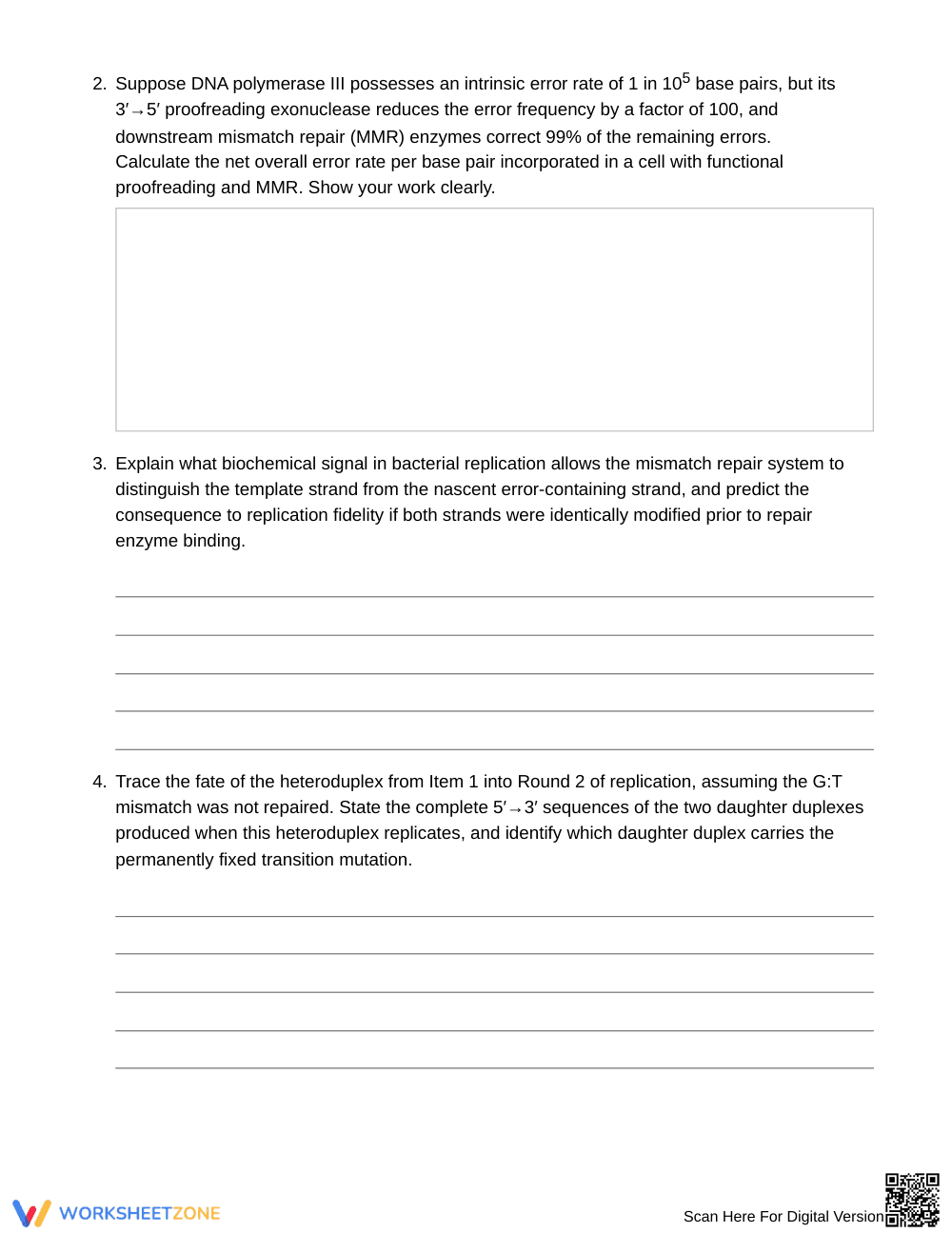
Inside, students solve 10 multi-part analytical problems across four focused sections. The 5-page worksheet includes double-stranded sequence tracking, error rate calculations, lineage tables, and competing replication hypotheses. A detailed 4-page answer key provides complete strand polarity diagrams, calculations, and justifications.
- Guided Practice (Part A): Items 1 to 4 provide foundational sequence tracking where students examine wild-type duplexes, calculate net error rates, and identify heteroduplex intermediates.
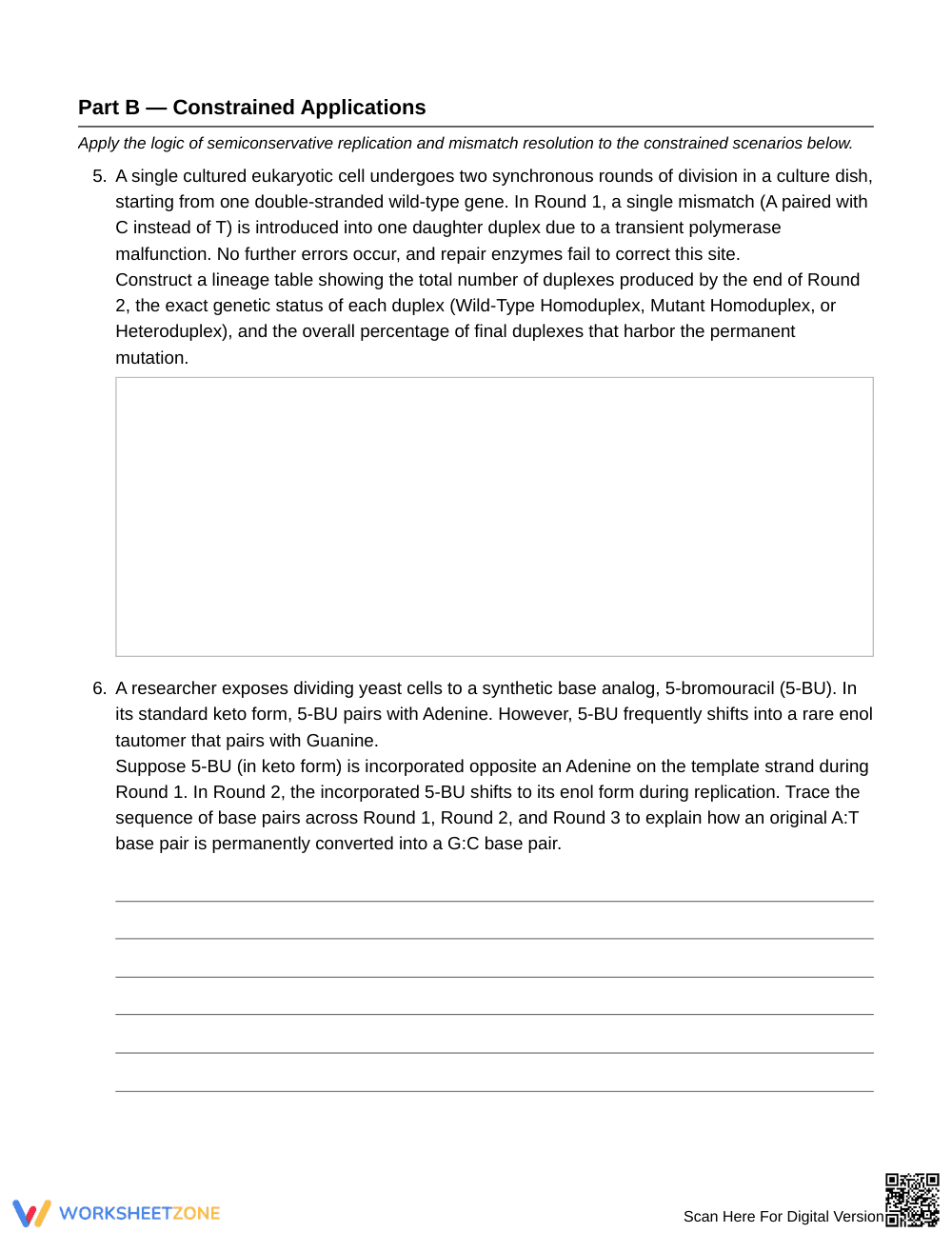
- Supported Practice (Part B): Items 5 and 6 present constrained scenarios, requiring students to construct lineage tables and trace tautomeric shifts across replication rounds.
- Independent Practice (Parts C & D): Items 7 to 10 challenge learners with mathematical back-calculations, competing replication models, and an extended written synthesis defending evolutionary fidelity.
This sequence follows a gradual-release instructional model, advancing students from initial sequence tracking to high-level evolutionary synthesis.
This resource aligns with high school molecular biology standards requiring students to communicate how DNA replication ensures genetic continuity while allowing variations. Students explain proofreading enzymes and demonstrate how unresolved heteroduplexes become permanent mutations in subsequent replication rounds. These standard descriptions can be copied directly into lesson plans, IEP goals, or district curriculum mapping tools.
Deploy this worksheet after direct instruction on semiconservative replication and proofreading. Use Part A for guided classwork to check understanding of strand polarity and heteroduplex formation. Assign Parts B through D for partner practice or homework. Formatively check whether students recognize that a mismatch requires a second replication round to become a permanent homoduplex mutation. Expected completion time is 45 to 60 minutes.
This resource is designed for Grade 10 Biology and Honors Biology students studying genetics. Teachers can differentiate by providing the introductory principles box to struggling learners while assigning the competing-model problems in Part C as an extension. Pair this worksheet with a DNA replication fork animation or molecular modeling kit.
According to Fisher & Frey (2014), structured progression through guided sequence tracking, constrained lineage modeling, and independent defense tasks establishes durable mastery in complex molecular genetics. This Grade 10 biology resource directly develops students' ability to explain how uncorrected base mismatches persist across consecutive replication cycles to become permanent homoduplex mutations in cellular lineages. By systematically evaluating polymerase error rates, exonuclease proofreading mechanisms, and post-replicative mismatch repair discrimination, students build conceptual understanding of replication fidelity. The multi-tiered analysis connects micro-level single nucleotide misincorporations with macro-level evolutionary adaptations, trade-offs, and population genetics. Biology educators can integrate these 10 analytical problems to bridge theoretical lecture concepts and rigorous mechanistic reasoning, ensuring high school learners acquire the evaluative skills needed for advanced life science coursework, standardized scientific inquiry, and molecular genetics mastery across modern science curricula.


