


























Views
Downloads



Complete DNA Proofreading Worksheet | Grade 10 Biology
Paste this activity's link or code into your existing LMS (Google Classroom, Canvas, Teams, Schoology, Moodle, etc.).
Students can open and work on the activity right away, with no student login required.
You'll still be able to track student progress and results from your teacher account.
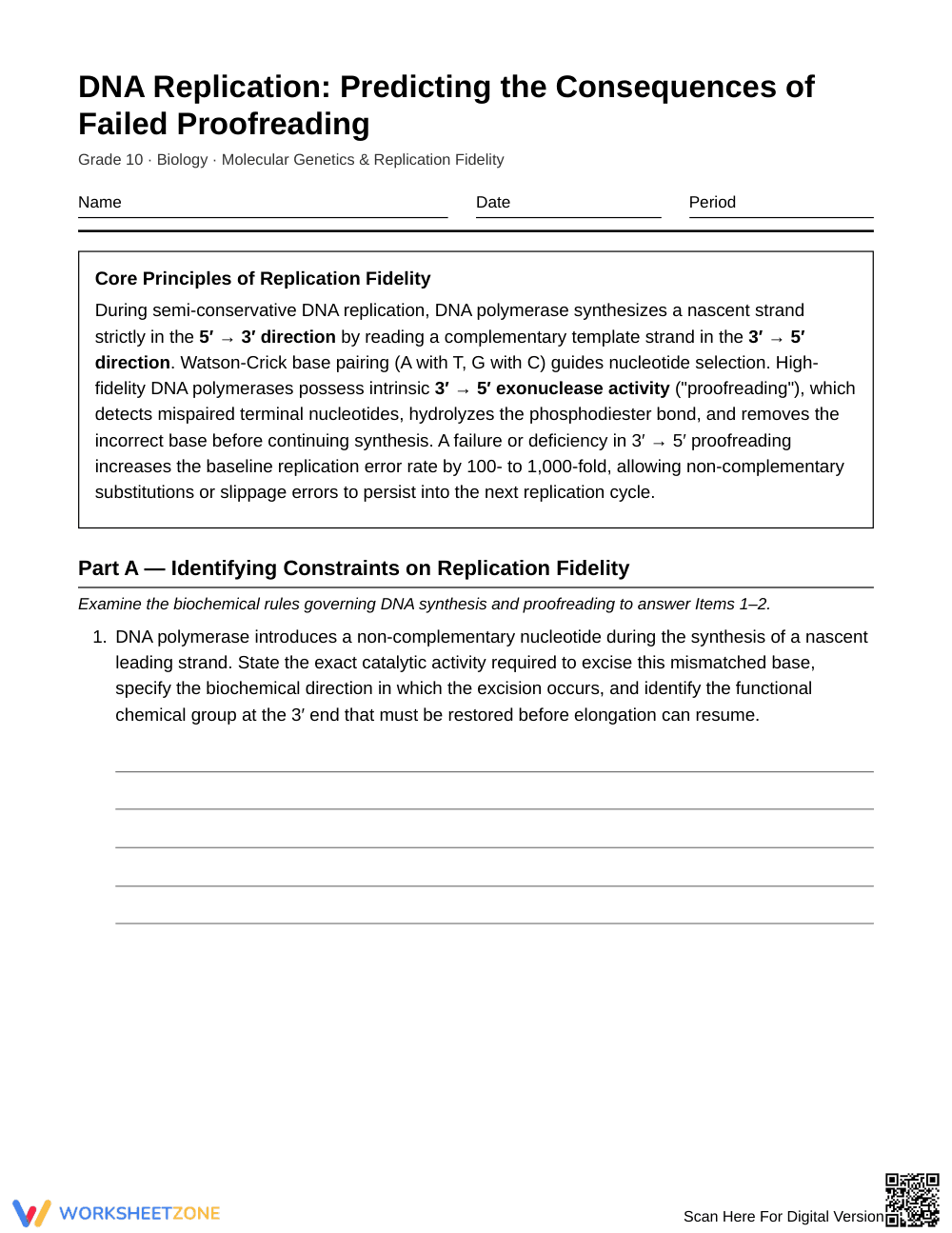
This high school biology worksheet trains students to predict the biochemical and cellular consequences of failed proofreading during DNA replication. Through authentic sequence analysis and mechanistic modeling, learners investigate how 3′ to 5′ exonuclease deficiencies lead to permanent nucleotide substitutions, frameshift mutations, and altered phenotypic expression across successive cell division cycles.
At a Glance
- Grade: 10 · Subject: Biology
- Core Concept: Model DNA replication fidelity and predict protein structural outcomes
- Skill Focus: Predict a Consequence of Failed Proofreading
- Format: 5 pages · 10 problems · Answer key included · PDF
- Best For: Advanced genetics problem-solving and unit review
- Time: 45–60 minutes
What's Inside
This comprehensive 5-page resource includes 10 rigorous, multi-part analytical problems structured across three progressive sections. Students examine molecular constraints on polymerase fidelity, trace synthetic DNA duplexes through replication and transcription cycles, and evaluate complex scientific claims. A complete 3-page teacher answer key provides full nucleotide sequence diagrams, codon translations, and mechanistic explanations.
Skill Progression
- Guided Practice (Items 1–2): Students analyze the foundational biochemistry of 3′ to 5′ exonuclease activity, energetic constraints on proofreading directionality, and the requirement for free 3′-hydroxyl groups.
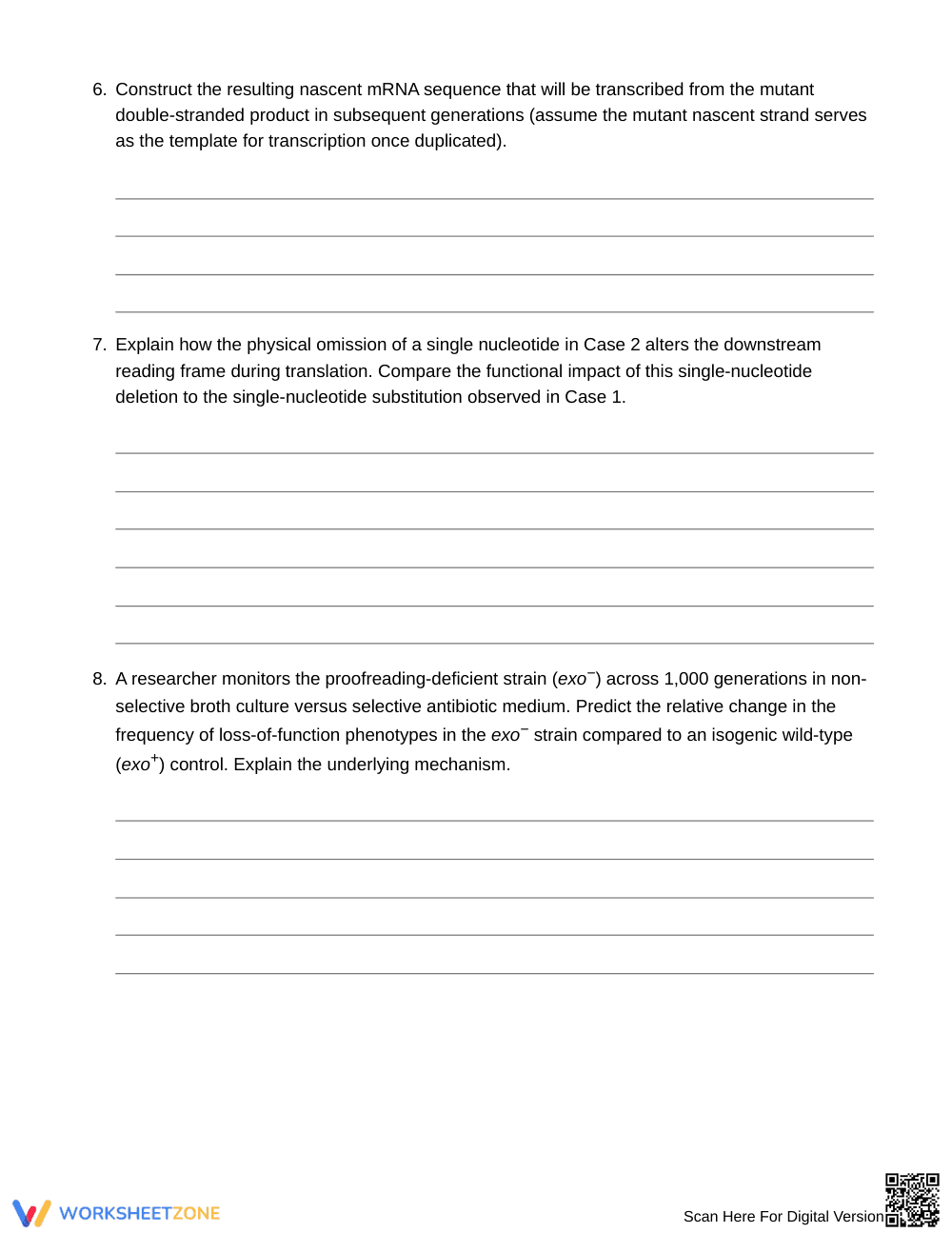
- Supported Practice (Items 3–8): Working through bounded case studies, learners track point mutations and replication slippage deletions across generations, transcribing mRNA and determining downstream translational impacts.
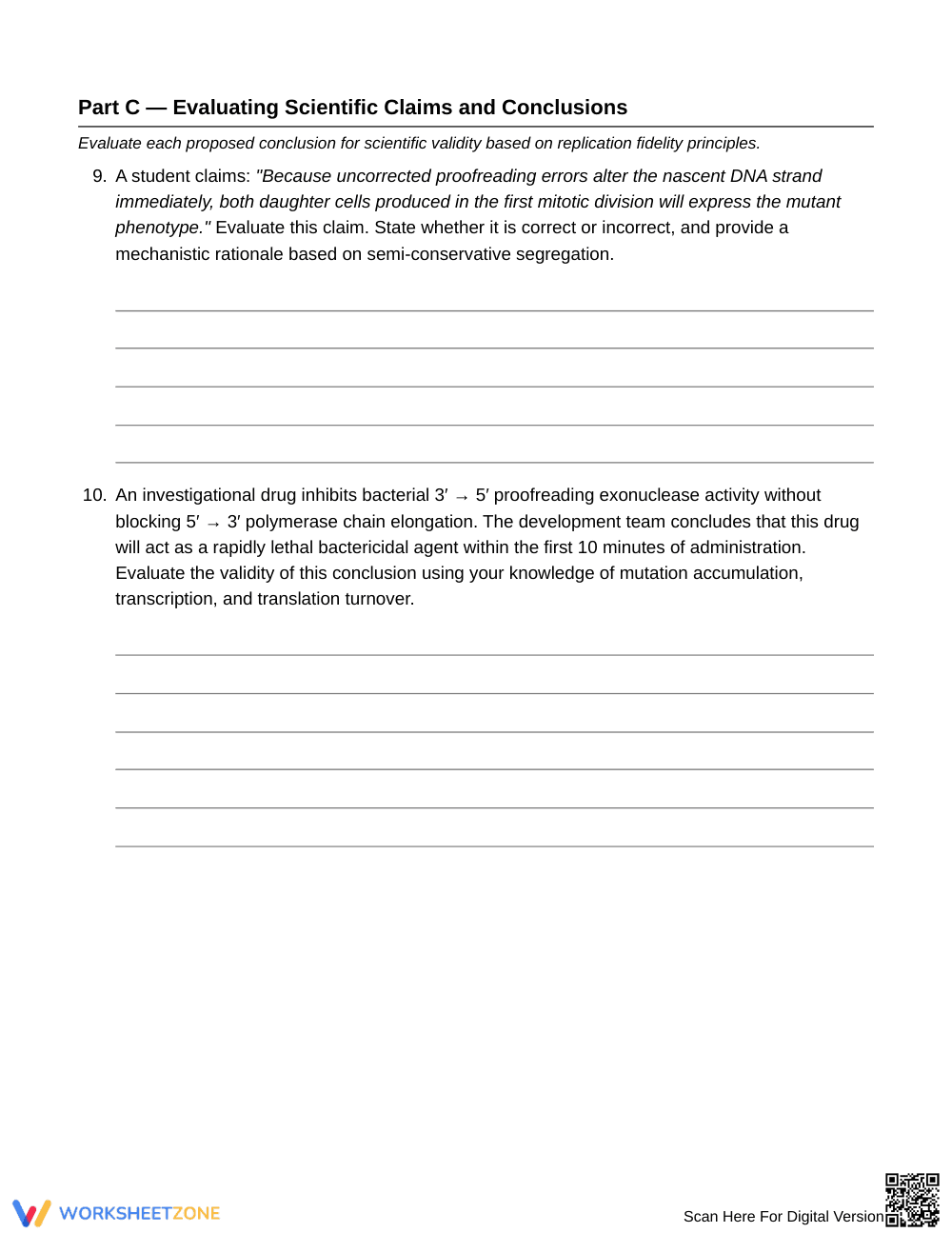
- Independent Practice (Items 9–10): Students critically evaluate claims regarding immediate phenotypic expression in daughter cells and judge the pharmacodynamics of proofreading-inhibiting antimicrobial compounds.
This structured sequence leverages gradual release to move students from chemical principles to complex multi-generational genetics analysis.
Standards Alignment
Aligned to core high school life science standards addressing molecular genetics, cellular division, and protein synthesis. Students construct explanations based on evidence for how the structure of DNA determines the structure of proteins and how replication errors introduce genetic variation. Both standard concepts can be copied directly into lesson plans, IEP goals, or district curriculum mapping tools.
How to Use It
Deploy this worksheet after direct instruction on semi-conservative DNA replication and the central dogma. Use Case 1 as an in-class cooperative modeling task where pairs track mismatched base pairs through second-generation duplex segregation. Formative observation tip: check whether students recognize that uncorrected mismatches require a second round of replication before becoming permanently fixed mutations. Expected completion time is 45 to 60 minutes.
Who It's For
Designed for Grade 10 general, honors, and pre-AP biology students studying molecular genetics. It offers rigorous structural scaffolding for visual learners while challenging advanced students with authentic biochemical scenarios. Pair this worksheet directly with a physical DNA modeling lab or interactive replication animation.
According to Fisher & Frey (2014), structured problem sets that require students to transfer biochemical principles to novel, multi-step case studies significantly deepen conceptual retention and analytical reasoning in secondary science. This worksheet aligns with standard molecular genetics curriculum goals by challenging Grade 10 students to predict how critical deficiencies in 3′ to 5′ exonuclease proofreading propagate from the molecular scale to organismal phenotypes. By tracing nucleotide mismatches and replication slippage across multiple cellular generations, learners connect micro-level enzymatic mechanics directly to macro-level genetic variation and mutation fixation rates. The 10 multi-part analytical tasks provide systematic formative assessment data, enabling educators to pinpoint student misconceptions regarding semi-conservative segregation, codon reading frames, and translational turnover. This targeted practice builds the rigorous mechanistic foundation required for long-term academic mastery in advanced high school life science coursework.


